Many custom options...


And formats...



Not what you want?
Try other similar-meaning words, fewer words, or just one word.
Power Strength in Chinese / Japanese...
Buy a Power Strength calligraphy wall scroll here!
Personalize your custom “Power Strength” project by clicking the button next to your favorite “Power Strength” title below...
4. Determination to Achieve / Will-Power
7. With all the strength of your heart
8. Inner Strength is Better than Outward Appearance
9. Inner Strength / Self-Improvement
10. Inner Strength is Better than Outward Appearance
11. Always Striving for Inner Strength
13. Spiritual Strength / Strength of Spirit
17. Fortitude / Strength of Character
18. Flexibility Overcomes Strength
19. Strength and Love in Unity
22. Strong Hearted / Strong Willed
30. Conquering Yourself is a Sign of Strength
32. Inner Strength / Inner Well-Being and Health
35. Great Power
36. Perseverance
37. No Pain No Gain
38. Undaunted After Repeated Setbacks
39. Imagination
40. Creativity
41. Lee
44. Daodejing / Tao Te Ching - Chapter 33
45. Cooperation
46. Dragon
Power / Strength
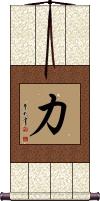
力 is the simplest form of “power” or “strength.”
In Japanese, it is pronounced “chikara” when used alone, and “ryoku” when used in a sentence (there are also a few other possible pronunciations of this Kanji in Japanese).
In some contexts, this can mean ability, force, physical strength, capability, and influence.
See Also: With All the Strength of Your Heart | Vitality | Strong / Healthy
Perseverance / Will-Power
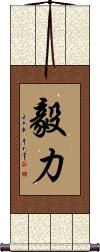
毅力 is a way to express “perseverance” with the idea of “willpower” in Chinese and old Korean Hanja. It can also mean “strong-willed.”
The first character means “strong” and “persistent,” while the second means “strength” and “power.”
Will-Power / Self-Control
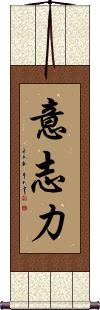
意志力 is a form of willpower or self-control and is about having the determination or tenacity to keep going.
In Japanese, this is the power of will, the strength of will, volition, intention, intent, or determination.
Determination to Achieve / Will-Power
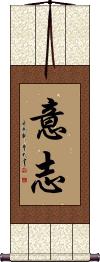
意志 is a Chinese, Korean, and Japanese word that means “determination to achieve.” It can also be translated as: will; willpower; determination; volition; intention; or intent.
In Japanese, this can also be the given name, Ishi.
Inner Strength
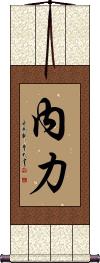
內力 is the shorter version of inner strength (can also be translated as “internal force”). The first character holds the meaning of “inner” or “internal.” The second character means “power,” “force,” or “strength.”
內力 is a Kung Fu way of talking about an inner power or strength from within. This is a way to express “inner chi.” This is something that you might hear in a real Chinese Kung Fu movie.
While understood in Chinese and Japanese, this can have a secondary meaning of “inner stress” in Japanese.
Inner Strength
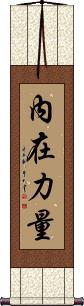
內在力量 is the slightly-verbose way to say inner strength.
The first two characters mean “intrinsic” or “inner.” The second two characters mean “power,” “force” or “strength” (especially physical strength). 內在力量 is more a short phrase rather than just a word in Chinese and Korean. This can sort of be understood in Japanese but it's not normal/proper Japanese.
Strength: Strong and Solid
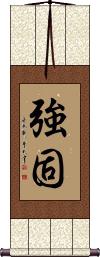
強固 means firmness, stability, security, and strength in Japanese.
It's not used commonly in China, but it means “powerful,” “firm,” “solid,” “strong,” or “better than others” in Chinese. There is a slight variation in the top of the first character between Chinese and Japanese. Because this is more of a Japanese word, we are showing the Japanese form here.
強固 is also a Korean word, but Korean Hanja uses the Chinese form of the first character (one tiny stroke is a little different), so just let me know if your audience is Korean when you place your order, and we'll have it written in the Chinese/Korean version.
With all the strength of your heart
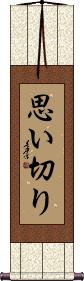
思い切り can mean “with all one's strength,” “with all one's heart,” “to the limits of your heart,” or “to the end of your heart/emotions.”
The character breakdown:
思い (omoi) thought; mind; heart; feelings; emotion; sentiment; love; affection; desire; wish; hope; expectation; imagination; experience
切り (kiri) bounds; limits.
Note: Because this selection contains some special Japanese Hiragana characters, it should be written by a Japanese calligrapher.
Inner Strength is Better than Outward Appearance
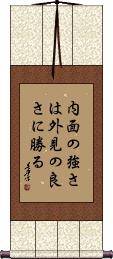
内面の強さは外見の良さに勝る is a Japanese proverb that literally translates as “inner/internal strength/power [versus] outward-appearance [the] merit/virtue/good quality [does] excel/surpass/exceed/outweigh.”
More naturally in English, this would be “Inner Strength Outweighs Outward Appearance.”
Note: Because this selection contains some special Japanese Hiragana characters, it should be written by a Japanese calligrapher.
Inner Strength / Self-Improvement
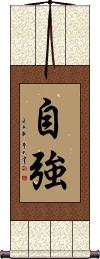
自強 is the kind of inner strength that applies to a person who has will-power and can inspire themselves to do great things.
自強 can also be the creed of a person that always pursues self-improvement.
Other translations: self-strengthening, striving for improvement, self-improvement, striving to become stronger, and self-renewal.
Inner Strength is Better than Outward Appearance
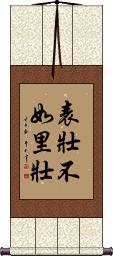
表壯不如里壯 literally translates as: [Better to be] strong inside than [to be] strong outside.
The ancient original meaning was:
[An] able [husband] outside [working to support a family is] not as good as [an] able [wife] inside [working and saving to take care of the family].
The current meaning is:
Inner strength is more important than outward appearance.
Always Striving for Inner Strength
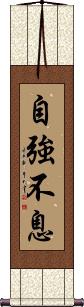
自強不息 is a proverb or idiom that suggests that the pursuit of self-improvement is eternal. It can also be a suggestion to strive unremittingly in life.
The first two characters mean inner strength with the idea of self-improvement. The last two characters mean “never rest” or “striving without giving up.”
Some will translate these four characters as “Exert and strive hard without any let-up.”
Strength / Vigor / Energy
Physical Strength
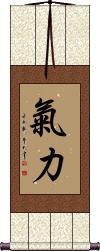
氣力 can mean any of the words in the title above, and in some contexts, can also mean effort, will-power, or talent.
This refers mostly to physical strength (as opposed to mental or spiritual).
 In modern Japan, they use a simplified first character for this word. If you want to order this title with that special Japanese version, click on the character to the right instead of the button above.
Spiritual Strength / Strength of Spirit
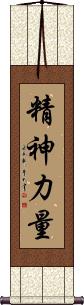
精神力量 is a title that speaks of one's soul or spirit and the capacity or strength that soul possesses.
The first two characters mean mind, heart, spirit, and/or soul.
The last two characters mean strength, capacity, or ability.
Note: Separately, these are two words in Japanese and can be pronounced, but this does not make a natural title in Japanese (best if your audience is Chinese).
Strength / Ability
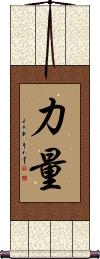
力量 is a general strength term.
It can refer to mental or physical strength (depending on context). 力量 can also be used to describe strength in terms of capability, capacity, ability, and even tact. Some may translate this as power or force.
Strength and Honor
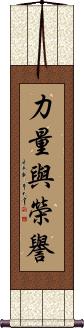
力量與榮譽 is “strength and honor” in Chinese.
The first two characters are usually understood as (physical) strength but can also mean power or force.
The middle character is a connecting particle similar to “and.”
The last two characters are a way to say honor but can also be understood as honorable reputation, honorary, or glory.
Strength and Honor
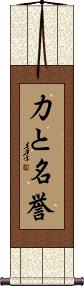
力と名譽 is “strength and honor” in Japanese Kanji (with one Hiragana).
The first Kanji is understood as strength, power, or force.
The second character is a connecting particle-like, “and” or “with.”
The last two Kanji mean honor/honour, credit, or prestige. This last word is also used in the Bushido code to mean honor.
Strength and Love
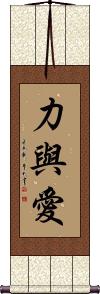
While not a common title for a wall scroll in China, 力與愛 means “strength and love” or “power and love” in Chinese characters.
Fortitude / Strength of Character
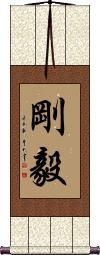
剛毅 is a Japanese and Chinese word that means resolute and firm, fortitude, firmness of character, hardihood, manliness, or macho.
See Also: Perseverance | With All the Strength of Your Heart | Tenacious / Tenacity
Flexibility Overcomes Strength
Softness Overcomes Hardness
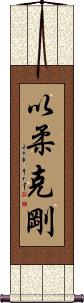
以柔克剛 can mean “Softness Overcomes Hardness,” “Flexibility Overcomes Power,” “Flexibility Overcomes Strength,” “Overcoming Powerful Strength with Flexibility,” or “Use Softness to Conquer Strength.”
Strength and Love in Unity
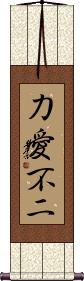
力愛不二 is a proverb that literally means:
“Strength [and] Love [are] Not Two [separate ideas/concepts/things].”
You'll find this proverb translated from Japanese to English as:
Love and strength are not separate.
Power and love are indivisible.
Strength and love in harmony.
Strength and love stand together.
Old Japanese grammar is quite different than English, and so this proverb says a lot within the brevity of just 4 characters. If you just read these characters directly as “Strength Love Not Two,” you'd probably miss the real meaning.
According to the Swedish Shorinji Kempo Federation, this is the second characteristic of Shorinji Kempo.
This post really explains the concept best in my opinion: Bushido by MS: Riki Ai Fu Ni, which states: “Riki Ai Funi” is the philosophy that power (Riki) and love (Ai) are indivisible. More concretely, a person, who is powerful but does not have love, cannot control and misuse their power; on the other hand, a person, who has loved ones but is not powerful enough, cannot protect himself/herself nor loved ones.
Strength and Courage
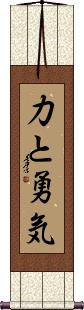
力と勇気 may not be the most common Japanese phrase, but this is how to write “strength and courage” or “power and bravery” in Japanese.
Physical Strength
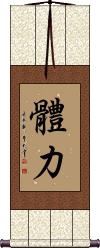
體力 means “physical strength,” “physical power,” or “physical stamina” in Chinese, ancient Japanese, and old Korean Hanja.
See Also: Perseverance / Indomitable / Invincible Fortitude | Strong / Healthy
Physical Strength
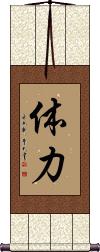
体力 means “physical strength” or “physical power.”
The first character was first simplified in Japan. Later, that simplified version became the standard in mainland China. Just in case you want this version, it is offered here. I suggest it if your audience is Japanese. Most Chinese know the older traditional version, which looks like 體力.
体力 can also be defined: stamina; endurance; physical strength; resilience; resistance to disease; clout; stability.
See Also: Perseverance / Indomitable / Invincible Fortitude | Strong / Healthy
Strong Hearted / Strong Willed
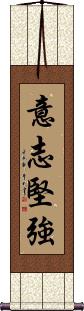
意志堅強 can mean either “strong-hearted,” “strong-willed” or “determination.”
The first two characters can mean “will,” “willpower,” “determination,” “volition,” “intention,” or “intent.” But, it should be noted that this first part possesses the element of “heart” in the lower portion of both characters (they also partially carry the meaning “with the whole heart”).
The last two characters mean “strong” or “staunch.”
Chinese word order and grammar are a bit different than English, so in this case, they are in reverse order of English but have the correct meaning in a natural form.
See Also: Strong Willed | Discipline | Will-Power / Self
Herculean Strength
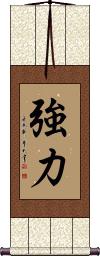
強力 means herculean strength, powerful, or strong.
I've even heard this described as “strength to carry a mountain.”
Note: This can also be the Japanese surname Gouriki (like Mr. Strong).
Strength and Courage
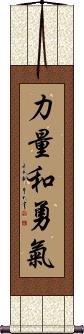
While 力量和勇氣 is not a typical Chinese phrase, this is how to write “strength and courage.”
If this is an important idea for you, we can make a great custom Chinese “strength and courage” wall scroll for you.
Love Faith Strength
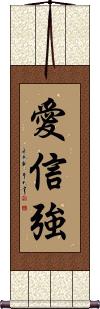
愛信強 is the shortest way to write the word list, “love faith strength.”
The first character is love, the second is faith or believe, and the third means strong or strength.
It should be noted that word lists like this are not as natural sounding in Chinese as word lists can be in English. it’s more common to have a full phrase (with subject, verb, and object) or single words on calligraphy wall scrolls in Asia.
God Give Me Strength
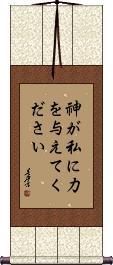
神が私に力を与えてください is “God give me strength” in Japanese.
This is the long and formal version. We also have a short version.
Note: Because this selection contains some special Japanese Hiragana characters, it should be written by a Japanese calligrapher.
God Give Me Strength
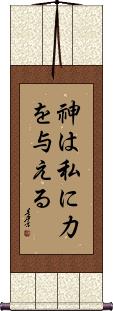
神は私に力を與える means “God give me strength,” in Japanese.
神は私に力を與える is the short version, we also have a longer more formal version.
Note: Because this selection contains some special Japanese Hiragana characters, it should be written by a Japanese calligrapher.
Love Faith Strength
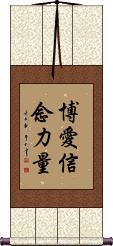
博愛信念力量 is the verbose way to write the word list, “love faith strength.”
It should be noted that word lists like this are not as natural sounding in Chinese as word lists can be in English. it’s more common to have a full phrase (with subject, verb, and object) or single words on calligraphy wall scrolls in Asia.
Strength Love Honor
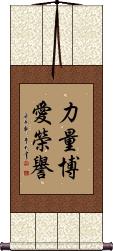
力量 博愛 榮譽 is the verbose way to write the word list, “strength love honor.”
It should be noted that word lists like this are not as natural sounding in Chinese as word lists can be in English. it’s more common to have a full phrase (with subject, verb, and object) or single words on calligraphy wall scrolls in Asia.
Courage and Strength
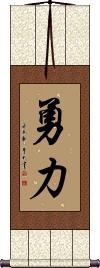
勇力 is a very short way to say “courage and strength” in Chinese and Japanese.
In Japanese, it's read more like “strong courage” or “powerful courage.” This can also be the personal name Yuri or Yuuri in Japanese.
Conquering Yourself is a Sign of Strength
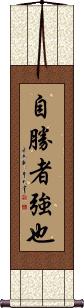
自勝者強也 means “One who conquers oneself is strong” in Chinese.
自勝 = Self-overcoming or self-conquering
者 = is
強 = Strength
也 = Also
God Give Me Strength
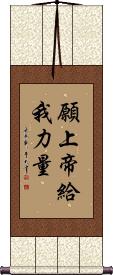
願上帝給我力量 is a wish or a prayer that you might call out at a desperate time.
Translated by us for a military serviceman in Iraq. He may need to use this phrase often, though I am not sure where he's going to find a place to hang a wall scroll.
Inner Strength / Inner Well-Being and Health
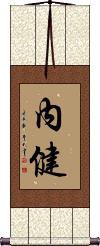
內健 is an old Chinese word meaning inner strength or inner health.
It's the idea of health and well-being starting or residing inside yourself. Also defined as fortitude within the context of good health.
Strong / Powerful / Force
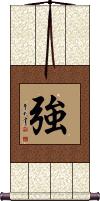
強 is a character that means strong, strength, force, powerful, better, stubborn, and stiff (yes, all of this in one character).
This “strong” has less to do with physical strength and more to do with having a winning attitude, or just having the ability to win at something.
Note that most of the time, this character is pronounced “qiang” but when used with the meaning of stubborn, unyielding, or stiff, it is pronounced “jiang” in Chinese.
Also, sometimes “qiang” is used in modern Chinese to describe people that do crazy things (For example: Bicycling from Beijing to Tibet alone). I sometimes can be found outside my Beijing apartment wearing nothing but shorts and a tee-shirt while eating ice cream during a snow storm, just to hear my neighbors call me “qiang.” Maybe they mean “strong” but perhaps they are using the new meaning of “crazy strong.”
強 can also be a Chinese surname that romanizes as Jiang in the mainland or Chiang if from Taiwan.
強 is a valid Korean Hanja character with the same meaning but is mostly used in compound Korean words.
強 is used in Japanese (though normally in compound words). In Japanese, it has the same meaning but in some contexts can mean “a little more than...” or “a little over [some amount].” Most Japanese would read this as tough, strength, stiff, hard, inflexible, obstinate, or stubborn.
The variant 彊 is sometimes seen in older literature.
Girl Power / Woman Power
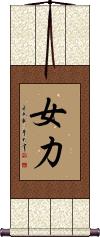
This can be read as “girl power,” “woman power,” “women empowerment” or “female strength.”
女力 is kind of a strange or unofficial title in Chinese and Japanese. At least, it's not common for a wall scroll.
This should be “onna ryoku” in Japanese but I found some who suggest it should be “me riki.”
Great Power
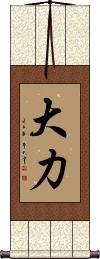
大力 can mean immense physical strength or great power.
This can also act as an adjective for expressing how energetically or vigorously something is.
This can also be a given name, Dairiki, in Japanese.
Perseverance
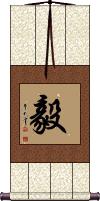
毅 is the simplest way to express perseverance in Chinese and Korean Hanja.
This single-character version leaves a bit of mystery about what kind of perseverance you might want to convey.
In Korean, this is usually associated with “strength of character.”
In Japanese, this character can be pronounced in a dozen different ways (so we have left out the Japanese pronunciation guide that normally appears above). In Japanese, this Kanji would usually be translated as “strong” (perhaps strong-willed).
See Also: Tenacious / Tenacity | Perseverance / Indomitable / Invincible Fortitude | With All the Strength of Your Heart | Carry On | Undaunted
No Pain No Gain
Literally: No Pain, No Strength
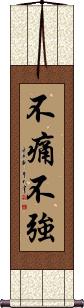
不痛不強 is a proverb that is close to our idea of “no pain, no gain” in English. It holds this meaning in the context of working out at the gym etc.
不痛不強 means “no pain, no strength,” meaning that if you don't experience a little pain, you will not gain any strength.
Undaunted After Repeated Setbacks
Persistence to overcome all challenges
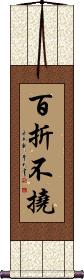
百折不撓 is a Chinese proverb that means “Be undaunted in the face of repeated setbacks.”
More directly translated, it reads, “[Overcome] a hundred setbacks, without flinching.” 百折不撓 is of Chinese origin but is commonly used in Japanese and somewhat in Korean (same characters, different pronunciation).
This proverb comes from a long, and occasionally tragic story of a man that lived sometime around 25-220 AD. His name was Qiao Xuan, and he never stooped to flattery but remained an upright person at all times. He fought to expose the corruption of higher-level government officials at great risk to himself.
Then when he was at a higher level in the Imperial Court, bandits were regularly capturing hostages and demanding ransoms. But when his own son was captured, he was so focused on his duty to the Emperor and the common good that he sent a platoon of soldiers to raid the bandits' hideout, and stop them once and for all even at the risk of his own son's life. While all of the bandits were arrested in the raid, they killed Qiao Xuan's son at first sight of the raiding soldiers.
Near the end of his career, a new Emperor came to power, and Qiao Xuan reported to him that one of his ministers was bullying the people and extorting money from them. The new Emperor refused to listen to Qiao Xuan and even promoted the corrupt Minister. Qiao Xuan was so disgusted that in protest, he resigned from his post as minister (something almost never done) and left for his home village.
His tombstone reads “Bai Zhe Bu Nao” which is now a proverb used in Chinese culture to describe a person of strong will who puts up stubborn resistance against great odds.
My Chinese-English dictionary defines these 4 characters as “keep on fighting despite all setbacks,” “be undaunted by repeated setbacks,” and “be indomitable.”
Our translator says it can mean “never give up” in modern Chinese.
Although the first two characters are translated correctly as “repeated setbacks,” the literal meaning is “100 setbacks” or “a rope that breaks 100 times.” The last two characters can mean “do not yield” or “do not give up.”
Most Chinese, Japanese, and Korean people will not take this absolutely literal meaning but will instead understand it as the title suggests above. If you want a single big word definition, it would be indefatigability, indomitableness, persistence, or unyielding.
See Also: Tenacious / Tenacity | Perseverance / Indomitable / Invincible Fortitude | With All the Strength of Your Heart | Perseverance | Persistence
Imagination
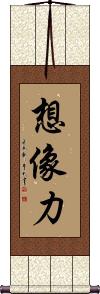
想像力 is probably the best way to express “imagination” in Chinese, Japanese Kanji, and old Korean Hanja.
It literally means “your strength to imagine.” The last character means strength or ability, while the first two mean imagine or conceptualize. My Japanese dictionary defines this as “The power of imagination.” While my Korean dictionary says, “imaginative power.”
Creativity
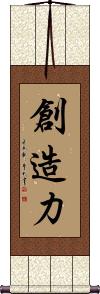
創造力 is a word that means “strength of creativity” or sort of “creativity (is your) strength.”
This can also be translated as “ingenuity.”
Creativity is the power of imagination. It is discovering your own special talents. Daring to see things in new ways and find different ways to solve problems. With your creativity, you can bring something new into the world.
The first character means “to create,” and the second means “to make or build.” Together they mean “creative.” The third character means “strength.”
This is the most common transliteration to Mandarin Chinese for the masculine western name Lee.
力 means “power” or “strength.”
Note: This can sometimes be used as a male given name in China. It is not the only given name that sounds like Lee or Li in China.
Gutsy / Daring / Bold
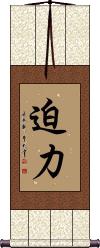
迫力 is a Chinese word that is a form of personal strength.
It is a word that describes a person who is willing to take a risk. In English, we might say, “Someone with guts.”
An example might be a person that is not rich but invests many money into something (knowing they could double their money or lose it all). Win or lose, this is a person that knows or pushes their potential.
Tearing this word apart, the first character means “to compel,” urgent, urge, force, imminent, or “spur on.” The second means power, strong, bear, or exert.
Note: 迫力 is also a word in Japanese Kanji and Korean Hanja but with a meaning more like force, intensity, appeal, strength, impact, force, or simply power.
Potential / Momentum
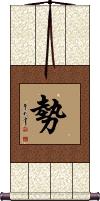
勢 is a word that means potential or momentum in Chinese, Japanese, and Korean.
Depending on the context, this can also be translated as an influence, tendency, military strength (potential), or power.
Daodejing / Tao Te Ching - Chapter 33
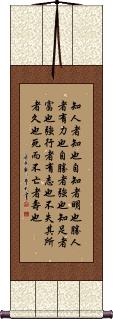
This is referred to as passage or chapter 33 of the Dao De Jing (often Romanized as “Tao Te Ching”).
These are the words of the philosopher Laozi (Lao Tzu).
To know others is wisdom;
To know oneself is acuity/intelligence.
To conquer others is power,
To conquer oneself is strength.
To know contentment is to have wealth.
To act resolutely is to have purpose.
To stay one's ground is to be enduring.
To die and yet not be forgotten is to be long-lived.
To understand others is to be knowledgeable;
To understand yourself is to be wise.
To conquer others is to have strength;
To conquer yourself is to be strong.
To know when you have enough is to be rich.
To go forward with strength is to have ambition.
To not lose your place is to be long-lasting.
To die but not be forgotten -- that's true long life.
He who is content is rich;
He who acts with persistence has will;
He who does not lose his roots will endure;
He who dies physically but preserves the Dao
will enjoy a long after-life.
Notes:
During our research, the Chinese characters shown here are probably the most accurate to the original text of Laozi. These were taken for the most part from the Mawangdui 1973 and Guodan 1993 manuscripts which pre-date other Daodejing texts by about 1000 years.
Grammar was a little different in Laozi’s time. So you should consider this to be the ancient Chinese version. Some have modernized this passage by adding, removing, or swapping articles and changing the grammar (we felt the oldest and most original version would be more desirable). You may find other versions printed in books or online - sometimes these modern texts are simply used to explain to Chinese people what the original text really means.
This language issue can be compared in English by thinking how the King James (known as the Authorized version in Great Britain) Bible from 1611 was written, and comparing it to modern English. Now imagine that the Daodejing was probably written around 403 BCE (2000 years before the King James Version of the Bible). To a Chinese person, the original Daodejing reads like text that is 3 times more detached compared to Shakespeare’s English is to our modern-day speech.
Extended notes:
While on this Biblical text comparison, it should be noted, that just like the Bible, all the original texts of the Daodejing were lost or destroyed long ago. Just as with the scripture used to create the Bible, various manuscripts exist, many with variations or copyist errors. Just as the earliest New Testament scripture (incomplete) is from 170 years after Christ, the earliest Daodejing manuscript (incomplete) is from 100-200 years after the death of Laozi.
The reason that the originals were lost probably has a lot to do with the first Qin Emperor. Upon taking power and unifying China, he ordered the burning and destruction of all books (scrolls/rolls) except those pertaining to Chinese medicine and a few other subjects. The surviving Daodejing manuscripts were either hidden on purpose or simply forgotten about. Some were not unearthed until as late as 1993.
We compared many research by various archeologists and historians before deciding on this as the most accurate and correct version. But one must allow that it may not be perfect, or the actual and original as from the hand of Laozi himself.
Cooperation
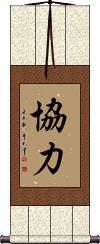
協力 is a Japanese word that means cooperation.
If you look at the second character, which means “strength” or “power,” and then you look at the first character, you will see that the first character seems to represent multiple “strengths” together. Thus, you can visually see the meaning of this word as “stronger when working together.” The combination of characters that form this word is commonly seen in Japanese Kanji and Korean Hanja but not used in China (however, a Chinese person could probably guess the meaning, and it can be pronounced in Chinese).
It is implied that you are cooperating to create some project or product.
This can also be translated as “joint effort.”
See Also: Partnership: Marriage
Dragon
Year of the Dragon / Zodiac Sign
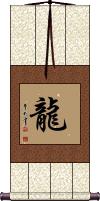
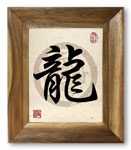
龍 is the character for dragon in Chinese, old Korean Hanja, and Japanese Kanji.
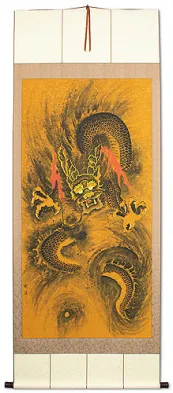
The dragon is a creature of myth and legend that dominates Chinese, Japanese, and even European folklore. In China, the dragon is the symbol of the Emperor, strength, and power, and the Chinese dragon is known as the god of water.
From the Chinese Zodiac, if you were born in the year of the Dragon, you . . .
Have a strong body and spirit.
Are full of energy.
Have vast goals.
Have a deep level of self-awareness.
Will do whatever you can to “save face.”
See also our Chinese Zodiac or Dragon Calligraphy pages.
This in-stock artwork might be what you are looking for, and ships right away...
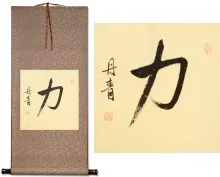

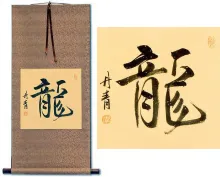


Starting at $28.88


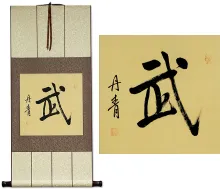
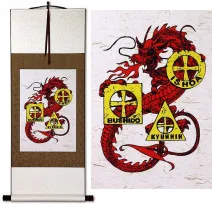
The following table may be helpful for those studying Chinese or Japanese...
| Title | Characters | Romaji (Romanized Japanese) | Various forms of Romanized Chinese | |
| Power Strength | 力 | chikara / ryoku | lì / li4 / li | |
| Perseverance Will-Power | 毅力 | yì lì / yi4 li4 / yi li / yili | i li / ili | |
| Will-Power Self-Control | 意志力 | ishi ryoku / ishiryoku | yì zhì lì yi4 zhi4 li4 yi zhi li yizhili | i chih li ichihli |
| Determination to Achieve Will-Power | 意志 | ishi | yì zhì / yi4 zhi4 / yi zhi / yizhi | i chih / ichih |
| Inner Strength | 內力 内力 | nai ryoku / nairyoku | nèi lì / nei4 li4 / nei li / neili | |
| Inner Strength | 內在力量 内在力量 | nèi zài lì liàng nei4 zai4 li4 liang4 nei zai li liang neizaililiang | nei tsai li liang neitsaililiang |
|
| Strength: Strong and Solid | 強固 强固 | kyouko / kyoko | qiáng gù / qiang2 gu4 / qiang gu / qianggu | ch`iang ku / chiangku / chiang ku |
| With all the strength of your heart | 思い切り | omoi kiri / omoikiri | ||
| Inner Strength is Better than Outward Appearance | 内面の強さは外見の良さに勝る | naimen no tsuyosa ha gaiken no yosa ni masaru | ||
| Inner Strength Self-Improvement | 自強 自强 | zì qiáng / zi4 qiang2 / zi qiang / ziqiang | tzu ch`iang / tzuchiang / tzu chiang | |
| Inner Strength is Better than Outward Appearance | 表壯不如里壯 表壮不如里壮 | biǎo zhuàng bù rú lǐ zhuàng biao3 zhuang4 bu4 ru2 li3 zhuang4 biao zhuang bu ru li zhuang biaozhuangburulizhuang | piao chuang pu ju li chuang piaochuangpujulichuang |
|
| Always Striving for Inner Strength | 自強不息 自强不息 | zì qiáng bú xī zi4 qiang2 bu2 xi1 zi qiang bu xi ziqiangbuxi | tzu ch`iang pu hsi tzuchiangpuhsi tzu chiang pu hsi |
|
| Strength Vigor Energy | 氣力 气力 / 気力 | kiryoku | qì lì / qi4 li4 / qi li / qili | ch`i li / chili / chi li |
| Spiritual Strength Strength of Spirit | 精神力量 | seishin rikiryou seishinrikiryou seishin rikiryo | jīng shén lì liàng jing1 shen2 li4 liang4 jing shen li liang jingshenliliang | ching shen li liang chingshenliliang |
| Strength Ability | 力量 | riki ryou / rikiryou / riki ryo | lì liàng / li4 liang4 / li liang / liliang | |
| Strength and Honor | 力量與榮譽 力量与荣誉 | lì liàng yǔ róng yù li4 liang4 yu3 rong2 yu4 li liang yu rong yu liliangyurongyu | li liang yü jung yü liliangyüjungyü |
|
| Strength and Honor | 力と名譽 力と名誉 | chikara to mei yo chikaratomeiyo | ||
| Strength and Love | 力與愛 力与爱 | lì yǔ ài li4 yu3 ai4 li yu ai liyuai | li yü ai liyüai |
|
| Fortitude Strength of Character | 剛毅 刚毅 | gouki / goki | gāng yì / gang1 yi4 / gang yi / gangyi | kang i / kangi |
| Flexibility Overcomes Strength | 以柔克剛 以柔克刚 | yǐ róu kè gāng yi3 rou2 ke4 gang1 yi rou ke gang yiroukegang | i jou k`o kang ijoukokang i jou ko kang |
|
| Strength and Love in Unity | 力愛不二 力爱不二 | riki ai fu ni rikiaifuni | ||
| Strength and Courage | 力と勇氣 力と勇気 | riki to yu ki rikitoyuki | ||
| Physical Strength | 體力 体力 | tai ryoku / tairyoku | tǐ lì / ti3 li4 / ti li / tili | t`i li / tili / ti li |
| Physical Strength | 體力 体力 | tairyoku | tǐ lì / ti3 li4 / ti li / tili | t`i li / tili / ti li |
| Strong Hearted Strong Willed | 意志堅強 意志坚强 | yì zhì jiān qiáng yi4 zhi4 jian1 qiang2 yi zhi jian qiang yizhijianqiang | i chih chien ch`iang ichihchienchiang i chih chien chiang |
|
| Herculean Strength | 強力 强力 | kyou ryoku / kyouryoku / kyo ryoku | qiáng lì / qiang2 li4 / qiang li / qiangli | ch`iang li / chiangli / chiang li |
| Strength and Courage | 力量和勇氣 力量和勇气 | lì liàng hé yǒng qì li4 liang4 he2 yong3 qi4 li liang he yong qi liliangheyongqi | li liang ho yung ch`i lilianghoyungchi li liang ho yung chi |
|
| Love Faith Strength | 愛信強 爱信強 | ài xìn qiáng ai4 xin4 qiang2 ai xin qiang aixinqiang | ai hsin ch`iang aihsinchiang ai hsin chiang |
|
| God Give Me Strength | 神が私に力を與えてください 神が私に力を与えてください | kami ga watashi ni chikara o atae te kudasai | ||
| God Give Me Strength | 神は私に力を與える 神は私に力を与える | kami wa watashi ni chikara o ataeru | ||
| Love Faith Strength | 博愛信念力量 博爱信念力量 | bó ài xìn niàn lì liàng bo2 ai4 xin4 nian4 li4 liang4 bo ai xin nian li liang boaixinnianliliang | po ai hsin nien li liang poaihsinnienliliang |
|
| Strength Love Honor | 力量博愛榮譽 力量博爱荣誉 | lì liàng bó ài róng yù li4 liang4 bo2 ai4 rong2 yu4 li liang bo ai rong yu liliangboairongyu | li liang po ai jung yü liliangpoaijungyü |
|
| Courage and Strength | 勇力 | yuu ri / yuuri / yu ri | yǒng lì / yong3 li4 / yong li / yongli | yung li / yungli |
| Conquering Yourself is a Sign of Strength | 自勝者強也 | zì shèng zhě qiáng yě zi4 sheng4 zhe3 qiang2 ye3 zi sheng zhe qiang ye zishengzheqiangye | tzu sheng che ch`iang yeh tzushengchechiangyeh tzu sheng che chiang yeh |
|
| God Give Me Strength | 願上帝給我力量 愿上帝给我力量 | yuàn shàng dì gěi wǒ lì liàng yuan4 shang4 di4 gei3 wo3 li4 liang4 yuan shang di gei wo li liang yuanshangdigeiwoliliang | yüan shang ti kei wo li liang yüanshangtikeiwoliliang |
|
| Inner Strength Inner Well-Being and Health | 內健 | nèi jiàn / nei4 jian4 / nei jian / neijian | nei chien / neichien | |
| Strong Powerful Force | 強 强 | kyou / kyo | qiáng / qiang2 / qiang | ch`iang / chiang |
| Girl Power Woman Power | 女力 | onna ryoku / onnaryoku | nǚ lì / nv3 li4 / nv li / nvli | nü li / nüli |
| Great Power | 大力 | dai riki / dairiki | dà lì / da4 li4 / da li / dali | ta li / tali |
| Perseverance | 毅 | see note / seenote / se note | yì / yi4 / yi | i |
| No Pain No Gain | 不痛不強 不痛不强 | bú tòng bù qiáng bu2 tong4 bu4 qiang2 bu tong bu qiang butongbuqiang | pu t`ung pu ch`iang putungpuchiang pu tung pu chiang |
|
| Undaunted After Repeated Setbacks | 百折不撓 百折不挠 | hyaku setsu su tou hyakusetsusutou hyaku setsu su to | bǎi zhé bù náo bai3 zhe2 bu4 nao2 bai zhe bu nao baizhebunao | pai che pu nao paichepunao |
| Imagination | 想像力 | souzouryoku sozoryoku | xiǎng xiàng lì xiang3 xiang4 li4 xiang xiang li xiangxiangli | hsiang hsiang li hsianghsiangli |
| Creativity | 創造力 创造力 | souzouryoku sozoryoku | chuàng zào lì chuang4 zao4 li4 chuang zao li chuangzaoli | ch`uang tsao li chuangtsaoli chuang tsao li |
| Lee | 力 | lì / li4 / li | ||
| Gutsy Daring Bold | 迫力 | hakuryoku | pò lì / po4 li4 / po li / poli | p`o li / poli / po li |
| Potential Momentum | 勢 势 | zei | shì / shi4 / shi | shih |
| Daodejing Tao Te Ching - Chapter 33 | 知人者知也自知者明也勝人者有力也自勝者強也知足者富也強行者有志也不失其所者久也死而不亡者壽也 知人者知也自知者明也胜人者有力也自胜者强也知足者富也强行者有志也不失其所者久也死而不亡者寿也 | zhī rén zhě zhī yě zì zhī zhě míng yě shèng rén zhě yǒu lì yě zì shèng zhě qiáng yě zhī zú zhě fù yě qiáng xíng zhě yǒu zhì yě bù zhī qí suǒ zhě jiǔ yě sǐ ér bù wáng zhě shòu yě zhi1 ren2 zhe3 zhi1 ye3 zi4 zhi1 zhe3 ming2 ye3 sheng4 ren2 zhe3 you3 li4 ye3 zi4 sheng4 zhe3 qiang2 ye3 zhi1 zu2 zhe3 fu4 ye3 qiang2 xing2 zhe3 you3 zhi4 ye3 bu4 zhi1 qi2 suo3 zhe3 jiu3 ye3 si3 er2 bu4 wang2 zhe3 shou4 ye3 zhi ren zhe zhi ye zi zhi zhe ming ye sheng ren zhe you li ye zi sheng zhe qiang ye zhi zu zhe fu ye qiang xing zhe you zhi ye bu zhi qi suo zhe jiu ye si er bu wang zhe shou ye | chih jen che chih yeh tzu chih che ming yeh sheng jen che yu li yeh tzu sheng che ch`iang yeh chih tsu che fu yeh ch`iang hsing che yu chih yeh pu chih ch`i so che chiu yeh ssu erh pu wang che shou yeh chih jen che chih yeh tzu chih che ming yeh sheng jen che yu li yeh tzu sheng che chiang yeh chih tsu che fu yeh chiang hsing che yu chih yeh pu chih chi so che chiu yeh ssu erh pu wang che shou yeh |
|
| Cooperation | 協力 协力 | kyouryoku / kyoryoku | xié lì / xie2 li4 / xie li / xieli | hsieh li / hsiehli |
| Dragon | 龍 龙 | ryuu / tatsu ryu / tatsu | lóng / long2 / long | lung |
| In some entries above you will see that characters have different versions above and below a line. In these cases, the characters above the line are Traditional Chinese, while the ones below are Simplified Chinese. | ||||

Successful Chinese Character and Japanese Kanji calligraphy searches within the last few hours...



