Many custom options...


And formats...



Not what you want?
Try other similar-meaning words, fewer words, or just one word.
Feel free to email me with your request. If it's easy, I'll translate it for free and add it to this database of calligraphy for you.
Nature or Land in Chinese / Japanese...
Buy a Nature or Land calligraphy wall scroll here!
Earth
(Used in Japanese version of five elements)
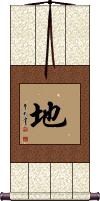
地 is the single-character element and title of the planet Earth in Chinese, old Korean Hanja, and Japanese Kanji.
Because this is a single character, the definition is a little ambiguous and can have many meanings depending on the context in which it is used. These meanings include: earth, ground, land, soil, dirt, place, territory, bottom (of a package, book, etc.), earth (one of the Japanese five elements), the region in question, the local area, skin, texture, fabric, material, weave, base, background, one's true nature, narrative (i.e. descriptive part of a story), real life, actuality, etc.
In Japanese, this Kanji can be pronounced several ways, including chi, ji, tsushi, or tsuchi.
地 is also an element of the Japanese version of the five elements (the original Chinese version uses a different version of earth).
This in-stock artwork might be what you are looking for, and ships right away...


Gallery Price: $108.00
Your Price: $59.88
Not the results for Nature or Land that you were looking for?
Below are some entries from our dictionary that may match your Nature or Land search...
| Characters If shown, 2nd row is Simp. Chinese |
Pronunciation Romanization |
Simple Dictionary Definition |
天地 see styles |
tiān dì tian1 di4 t`ien ti tien ti amachi あまち |
More info & calligraphy: Heaven and Earth(1) heaven and earth; the universe; the world; nature; (2) (てんち only) land; world; realm; sphere; (3) (てんち only) top and bottom; (4) (あめつち only) gods of heaven and earth; (surname) Amachi heaven and earth |
二土 see styles |
èr tǔ er4 tu3 erh t`u erh tu nido |
There are three groups: 性土 and 相土 : the former is the ubiquitous, unadulterated or innocent 法性之理 dharma-name, or essence of things; the latter is the form-nature, or formal existence of the dharma, pure or impure according to the mind and action of the living. The 淨土 and 穢土 are Pure-land or Paradise; and impure land, e.g. the present world. In the Pure-land there are also 報土 , the land in which a Buddha himself dwells and 化土 in which all beings are transformed. There are other definitions, e. g. the former is Buddha's Paradise, the latter the world in which he dwells and which he is transforming, e. g. this Sahā-world. |
九方便 see styles |
jiǔ fāng biàn jiu3 fang1 bian4 chiu fang pien ku hōben |
The nine suitable stages in religious service; cf. 大日經, 7; 作禮 salutation to the universal Triratna; 出罪 repentance and confession; 歸依 trust (in the Triratna); 施身 giving of self (to the Tathāgata); 發菩提心 vowing to devote the mind to bodhi; 隨喜 rejoicing (in all good); 勸請 beseeching (all Tathāgatas to rain down the saving law); 奉請法身 praying for the Buddha-nature in self and others for entry in the Pure Land; 迴向 demitting the good produced by the above eight methods, to others, universally, past, present, and future. This form of service is generally performed before engaging in esoteric observances. The verses in which these nine stages are presented are of a commendably devotional character. |
五所依土 see styles |
wǔ suǒ yī tǔ wu3 suo3 yi1 tu3 wu so i t`u wu so i tu go shoe do |
The five Buddha-kṣetra, or dependencies, the realms, or conditions of a Buddha. They are: (1) 法性土 his dharmakāya-kṣetra, or realm of his 'spiritual nature', dependent on and yet identical with the 眞如 bhutatathata; (2) 實 with its five immortal skandhas, i. e. his glorified body for his own enjoyment;. (3) 色相土 the land or condition of his self-expression as wisdom; (4) 他受用土 his saṃbhogakāya realm for the joy of others; (5) 變化土 the realm on which his nirmāṇakāya depends, that of the wisdom of perfect service of all, which results in his relation to every kind of condition. |
奉請法身方便 奉请法身方便 see styles |
fèng qǐng fǎ shēn fāng biàn feng4 qing3 fa3 shen1 fang1 bian4 feng ch`ing fa shen fang pien feng ching fa shen fang pien bujō hōshin hōben |
praying for the Buddha-nature in self and others for entry in the Pure Land |
The following table may be helpful for those studying Chinese or Japanese...
| Title | Characters | Romaji (Romanized Japanese) | Various forms of Romanized Chinese | |
| Earth | 地 | chi / ji / tsushi / tsuchi | dì / di4 / di | ti |

Successful Chinese Character and Japanese Kanji calligraphy searches within the last few hours...



