Many custom options...


And formats...



Ferry in Chinese / Japanese...
Buy a Ferry calligraphy wall scroll here!
Personalize your custom “Ferry” project by clicking the button next to your favorite “Ferry” title below...
Ferry
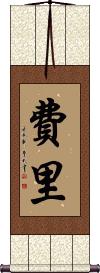
費里 is the name Ferry in Chinese (Mandarin).
Ferry
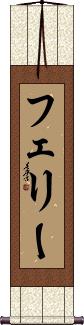
フェリー is the name Ferry in Japanese Katakana.
Note: Because this title is entirely Japanese Katakana, it should be written by a Japanese calligrapher.
Mark the boat to find the lost sword / Ignoring the changing circumstances of the world
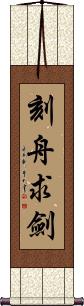
刻舟求劍 is an originally-Chinese proverb that serves as a warning to people that things are always in a state of change.
Thus, you must consider that and not depend on the old ways or a way that may have worked in the past but is no longer valid.
This idiom/proverb comes from the following story:
A man was traveling in a ferry boat across a river. With him, he carried a treasured sword. Along the way, the man became overwhelmed and intoxicated by the beautiful view and accidentally dropped his prized sword into the river. Thinking quickly, he pulled out a knife and marked on the rail of the boat where exactly he had lost his sword.
When the boat arrived on the other side of the river, the man jumped out of the boat and searched for his sword right under where he'd made the mark. Of course, the boat had moved a great distance since he made the mark, and thus, he could not find the sword.
While this man may seem foolhardy, we must take a great lesson from this parable: Circumstances change, so one should use methods to handle the change. In modern China, this is used in business to mean that one should not depend on old business models for a changing market.
This proverb dates back to the Spring and Autumn period (770–476 BC) of the territory now known as China. It has spread and is somewhat known in Japan and Korea.
These search terms might be related to Ferry:
Carry On, Undaunted
Chop Wood, Carry Water
This Too Shall Pass
Not the results for Ferry that you were looking for?
Below are some entries from our dictionary that may match your Ferry search...
| Characters If shown, 2nd row is Simp. Chinese |
Pronunciation Romanization |
Simple Dictionary Definition |
津 see styles |
jīn jin1 chin wataru わたる |
More info & calligraphy: Zin(1) Tsu (city in Mie); (suffix) (2) harbour; harbor; port; (suffix) (3) ferry; (given name) Wataru Ford, ferry, place of crossing a stream. |
フェリー see styles |
ferii / feri フェリー |
More info & calligraphy: Ferry |
度 see styles |
duó duo2 to wataru わたる |
to estimate; Taiwan pr. [duo4] (n,n-suf) (1) degree (angle, temperature, scale, etc.); (counter) (2) counter for occurrences; (n,n-suf) (3) strength (of glasses); glasses prescription; (n,n-suf) (4) alcohol content (percentage); alcohol by volume; (5) (See 度を過ごす) extent; degree; limit; (6) (See 度を失う) presence of mind; composure; (given name) Wataru pāramitā, 波羅蜜; intp. by 渡 to ferry over; to save. The mortal life of reincarnations is the sea; nirvana is the other shore; v. pāramitā, 波. Also, to leave the world as a monk or nun, such is a 度得 or 度者. |
沆 see styles |
hàng hang4 hang |
a ferry; fog; flowing |
渡 see styles |
dù du4 tu wataru わたる |
to cross; to pass through; to ferry (surname, female given name) Wataru cross over |
乘船 see styles |
chéng chuán cheng2 chuan2 ch`eng ch`uan cheng chuan |
to embark; to travel by ship; to ferry |
六度 see styles |
liù dù liu4 du4 liu tu rokudo ろくど |
(surname) Rokudo The six things that ferry one beyond the sea of mortality to nirvana, i. e. the six pāramitās 波羅蜜 (波羅蜜多): (1) 布施 dāna, charity, or giving, including the bestowing of the truth on others; (2) 持戒 śīla, keeping the command rents; (3) 忍辱 kṣānti, patience under insult; (4) 精進 vīrya, zeal and progress; (5) 闡定 dhyāna, meditation or contemplation; (6) 智慧 prajñā; wisdom, the power to discern reality or truth. It is the last that carries across the saṃsāra (sea of incarnate life) to the shores of nirvana. The opposites of these virtues are meanness, wickedness, anger, sloth, a distracted mind, and ignorance. The 唯識論 adds four other pāramitās: (7) 方便 upāya, the use of appropriate means; (8) 願 praṇidhāna, pious vows; (9) 力 bala, power of fulfillment; (10) 智 jñāna knowledge. |
多羅 多罗 see styles |
duō luó duo1 luo2 to lo tara たら |
(1) (abbreviation) (See 多羅樹) palmyra; (2) (abbreviation) (See 多羅葉) lusterleaf holly; (3) patra (silver incense dish placed in front of a Buddhist statue); (surname, female given name) Tara tārā, in the sense of starry, or scintillation; Tāla, for the fan-palm; Tara, from 'to pass over', a ferry, etc. Tārā, starry, piercing, the eye, the pupil; the last two are both Sanskrit and Chinese definitions; it is a term applied to certain female deities and has been adopted especially by Tibetan Buddhism for certain devīs of the Tantric school. The origin of the term is also ascribed to tar meaning 'to cross', i. e. she who aids to cross the sea of mortality. Getty, 19-27. The Chinese derivation is the eye; the tara devīs; either as śakti or independent, are little known outside Lamaism. Tāla is the palmyra, or fan-palm, whose leaves are used for writing and known as 具多 Pei-to, pattra. The tree is described as 70 or 80 feet high, with fruit like yellow rice-seeds; the borassus eabelliformis; a measure of 70 feet. Taras, from to cross over, also means a ferry, and a bank, or the other shore. Also 呾囉. |
接送 see styles |
jiē sòng jie1 song4 chieh sung |
to pick up and drop off; to ferry back and forth |
擺渡 摆渡 see styles |
bǎi dù bai3 du4 pai tu |
ferry |
普渡 see styles |
pǔ dù pu3 du4 p`u tu pu tu futo |
(Buddhism, Daoism) to deliver all sentient beings from suffering; (Tw) a ritual of making offerings, esp. to wandering spirits rather than gods or ancestors (abbr. for 中元普渡[zhong1 yuan2 pu3 du4]) Universally to ferry across. |
津梁 see styles |
jīn liáng jin1 liang2 chin liang tsuhari つはり |
lit. ferry bridge; fig. interim measure over some difficulty; a guide (surname) Tsuhari A bridge or ferry across a stream; i. e. religion. |
津送 see styles |
jīn sòng jin1 song4 chin sung shinsō |
To escort to the ferry, either the living to deliverance or more generally the dead; to bid goodbye (to a guest). |
渡し see styles |
watashi わたし |
(1) ferry (crossing); ferry(boat); (suffix) (2) delivery |
渡す see styles |
watasu わたす |
(transitive verb) (1) to ferry across (e.g. a river); to carry across; to traverse; (transitive verb) (2) to lay across; to build across; (transitive verb) (3) to hand over; to hand in; to pass; to give; to transfer |
渡口 see styles |
dù kǒu du4 kou3 tu k`ou tu kou watariguchi わたりぐち |
ferry crossing (surname) Watariguchi |
渡場 see styles |
watariba わたりば |
(irregular okurigana usage) ferry landing; point of departure or arrival for ferries; (place-name) Watariba |
渡船 see styles |
dù chuán du4 chuan2 tu ch`uan tu chuan watafune わたふね |
ferry ferry; ferryboat; (surname) Watafune |
渡輪 渡轮 see styles |
dù lún du4 lun2 tu lun |
ferry boat |
渡頭 渡头 see styles |
dù tóu du4 tou2 tu t`ou tu tou todou / todo とどう |
ferry crossing point (surname) Todou |
濟度 济度 see styles |
jì dù ji4 du4 chi tu saido |
To ferry the living across the sea of reincarnation to the shore of nirvāṇa. |
船便 see styles |
funabin(p); senbin ふなびん(P); せんびん |
(1) surface mail (by ship); sea mail; (2) ferry service; steamer service |
載車 载车 see styles |
zài chē zai4 che1 tsai ch`e tsai che |
onboard (equipment); to ferry cars; missile trucks |
輪渡 轮渡 see styles |
lún dù lun2 du4 lun tu |
ferry |
通船 see styles |
tsuusen / tsusen つうせん |
(n,vs,vi) ferry boat; barge |
過渡 过渡 see styles |
guò dù guo4 du4 kuo tu kato かと |
to cross over (by ferry); transition; interim; caretaker (administration) (1) crossing; ferry; (2) transient; (3) changing old to new |
乗合船 see styles |
noriaibune のりあいぶね noriaisen のりあいせん |
(1) ferryboat; ferry; passenger boat; (2) shared fishing boat |
停船場 see styles |
teisenjou / tesenjo ていせんじょう |
ferry landing |
國內線 国内线 see styles |
guó nèi xiàn guo2 nei4 xian4 kuo nei hsien |
domestic flight; internal line (air, train, ferry etc) |
川止め see styles |
kawadome かわどめ |
(noun/participle) suspension of ferry service |
Click here for more Ferry results from our dictionary
The following table may be helpful for those studying Chinese or Japanese...
| Title | Characters | Romaji (Romanized Japanese) | Various forms of Romanized Chinese | |
| Ferry | 費里 费里 | fèi lǐ / fei4 li3 / fei li / feili | ||
| Ferry | フェリー | ferii / feri | ||
| Mark the boat to find the lost sword Ignoring the changing circumstances of the world | 刻舟求劍 刻舟求剑 | kokushuukyuuken kokushukyuken | kè zhōu qiú jiàn ke4 zhou1 qiu2 jian4 ke zhou qiu jian kezhouqiujian | k`o chou ch`iu chien kochouchiuchien ko chou chiu chien |
| In some entries above you will see that characters have different versions above and below a line. In these cases, the characters above the line are Traditional Chinese, while the ones below are Simplified Chinese. | ||||

Successful Chinese Character and Japanese Kanji calligraphy searches within the last few hours...



