Many custom options...


And formats...



Eye for an Eye in Chinese / Japanese...
Buy an Eye for an Eye calligraphy wall scroll here!
Personalize your custom “Eye for an Eye” project by clicking the button next to your favorite “Eye for an Eye” title below...
Eye for an eye
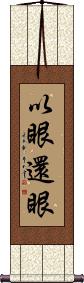
以眼還眼 is the same proverb that seems to be used in virtually every language and culture worldwide.
Whether you are Arab, Persian, Jewish, European, British, Asian, or American, this proverb is well known as the “original form of justice.”
Eye for an eye, tooth for a tooth
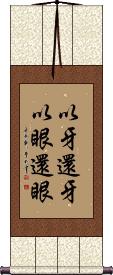
Here's the full proverb, 以牙还牙以眼还眼, with the first and second parts.
However, in Chinese, it's more natural to put the “tooth” part first, so this more accurately reads “Tooth for a tooth, eye for an eye.”
If revenge is important to you, I suppose this is the phase you want on your wall.
Tooth for a tooth
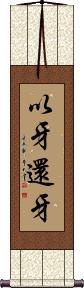
以牙還牙 is a phrase that often goes with “An eye for an eye,” even in Chinese. Revenge seems to cross all languages, cultures, and even species (animals are known to take revenge too).
If a Chinese person uses just one part of the full proverb, it will be this “tooth for a tooth” one. Although, we are more likely to say “eye for an eye” alone in English.
Chinese people may also read this with the meaning of “Bite me, and I will bite you back.” However, it literally means “tooth for a tooth” or “you take my tooth, I take yours.”
Islam
(phonetic version)
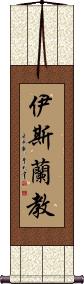
伊斯蘭教 both means and sounds like “Islam” in Mandarin Chinese.
The first three characters sound like the word “Islam,” and the last character means “religion” or “teaching.” It's the most general term for “Islam” in China. The highest concentration of Muslims in China is Xinjiang (the vast region in northwest China that was called The East Turkistan Republic until 1949 and is sometimes called Chinese Turkistan, Uyghuristan). Here you will find Uygurs, Kazakhs, Kyrgyz, and others that are descendants of Turkmen (possibly mixed with Persians and Arabs). Many of their ancestors were traders who traveled the silk road to buy and sell spices and silk and exchange other goods from the Orient and the Middle East.
I spent some time in Xinjiang and got to know this community. They are strong people who can endure much. They are friendly and love to have a good time. I was a stranger but was treated by villagers (near China's border with Afghanistan) as if I was a good friend.
However, I have heard that it's best not to cross them, as in this land, the law is the blade, and everything is “eye for an eye.” The Chinese government has little control in Xinjiang, with almost no police officers except in the capital of Urumqi (so it's a 60-hour roundtrip train ride to seek the aid of law enforcement in most cases).
While few seem devout, there are at least small mosques in every village. And you will never see a man or woman outside without a head covering.
It should be noted that these people are all citizens of China, but they are officially of the Caucasian race. A visit to Xinjiang will change your idea of what it means to be Chinese.
Not the results for Eye for an Eye that you were looking for?
Below are some entries from our dictionary that may match your Eye for an Eye search...
| Characters If shown, 2nd row is Simp. Chinese |
Pronunciation Romanization |
Simple Dictionary Definition |
明 see styles |
míng ming2 ming meishuu / meshu めいしゅう |
More info & calligraphy: Light / Bright(1) (ant: 暗) brightness; (2) discernment; insight; an eye (for); (3) (See 明を失う) eyesight; vision; (prefix) (4) (abbreviation) (See 明治) nth year in the Meiji era (1868.9.8-1912.7.30); (surname) Meishuu vidyā, knowledge. ming means bright, clear, enlightenment, intp. by 智慧 or 聰明 wisdom, wise; to understand. It represents Buddha-wisdom and its revelation; also the manifestation of a Buddha's light or effulgence; it is a term for 眞言 because the 'true word' can destroy the obscurity of illusion; the 'manifestation' of the power of the object of worship; it means also dhāraṇīs or mantras of mystic wisdom. Also, the Ming dynasty A. D. 1368-1644. |
眼 see styles |
yǎn yan3 yen mesaki めさき |
More info & calligraphy: Eyeballs / Eyes(1) eye; eyeball; (2) (archaism) pupil and (dark) iris of the eye; (3) (archaism) insight; perceptivity; power of observation; (4) (archaism) look; field of vision; (5) (archaism) core; center; centre; essence; (surname) Mesaki cakṣuh, the eye. |
ヤニ see styles |
yani ヤニ |
More info & calligraphy: Yani |
佛眼 see styles |
fó yǎn fo2 yan3 fo yen butsugen |
More info & calligraphy: The Eye of the Buddha |
心眼 see styles |
xīn yǎn xin1 yan3 hsin yen shingan しんがん |
More info & calligraphy: Mind’s Eyethe mind's eye The eye of the mind, mental vision. |
達磨 达磨 see styles |
dá mó da2 mo2 ta mo daruma だるま |
More info & calligraphy: Daruma / Damodharma; also 達摩; 達麼; 達而麻耶; 曇摩; 馱摩 tr. by 法. dharma is from dhara, holding, bearing, possessing, etc.; and means 'that which is to be held fast or kept, ordinance, statute, law, usage, practice'; 'anything right.' M.W. It may be variously intp. as (1) characteristic, attribute, predicate; (2) the bearer, the transcendent substratum of single elements of conscious life; (3) element, i.e. a part of conscious life; (4) nirvāṇa, i.e. the Dharma par excellence, the object of Buddhist teaching; (5) the absolute, the real; (6) the teaching or religion of Buddha; (7) thing, object, appearance. Also, Damo, or Bodhidharma, the twenty-eighth Indian and first Chinese patriarch, who arrived in China A.D. 520, the reputed founder of the Chan or Intuitional School in China. He is described as son of a king in southern India; originally called Bodhitara. He arrived at Guangdong, bringing it is said the sacred begging-bowl, and settled in Luoyang, where he engaged in silent meditation for nine years, whence he received the title of wall-gazing Brahman 壁觀婆羅門, though he was a kṣatriya. His doctrine and practice were those of the 'inner light', independent of the written word, but to 慧可 Huike, his successor, he commended the Laṅkāvatāra-sūtra as nearest to his views. There are many names with Dharma as initial: Dharmapāla, Dharmagupta, Dharmayaśas, Dharmaruci, Dharmarakṣa, Dharmatrāta, Dharmavardhana, etc. |
マーク see styles |
maagu / magu マーグ |
More info & calligraphy: Mark |
ヒートン see styles |
biiton / biton ビートン |
More info & calligraphy: Heaton |
不動明王 不动明王 see styles |
bù dòng míng wáng bu4 dong4 ming2 wang2 pu tung ming wang fudoumyouou / fudomyoo ふどうみょうおう |
More info & calligraphy: Fudo Myo-o / Wisdom King不動尊 Aryacalanatha 阿奢羅曩 tr. 不動尊 and 無動尊 and Acalaceta, 阿奢囉逝吒 tr. 不動使者. The mouthpiece or messenger, e. g. the Mercury, of the Buddhas; and the chief of the five Ming Wang. He is regarded as the third person in the Vairocana trinity. He has a fierce mien overawing all evil spirits. He is said to have attained to Buddhahood, but also still to retain his position with Vairocana. He has many descriptive titles, e. g. 無量力神通無動者; 不動忿怒王, etc. Five different verbal signs are given to him. He carries a sharp wisdom-sword, a noose, a thunder-bolt. The colour of his images is various—black, blue, purple. He has a youthful appearance; his hair falls over his left shoulder; he stands or sits on a rock; left eye closed; mouth shut, teeth gripping upper lip, wrinkled forehead, seven locks of hair, full-bodied, A second representation is with four faces and four arms, angry mien, protruding teeth, with fames around him. A third with necklaces. A fourth, red, seated on a rock, fames, trident, etc. There are other forms. He has fourteen distinguishing symbols, and many dharanis associated with the realm of fire, of saving those in distress, and of wisdom. He has two messengers 二童子 Kimkara 矜羯羅 and Cetaka 制吒迦, and, including these, a group of eight messengers 八大童子 each with image, symbol, word-sign, etc. Cf. 不動佛. |
以眼還眼 以眼还眼 see styles |
yǐ yǎn huán yǎn yi3 yan3 huan2 yan3 i yen huan yen |
More info & calligraphy: Eye for an eye |
情人眼裡出西施 情人眼里出西施 see styles |
qíng rén yǎn lǐ chū xī shī qing2 ren2 yan3 li3 chu1 xi1 shi1 ch`ing jen yen li ch`u hsi shih ching jen yen li chu hsi shih |
lit. in the eyes of a lover appears 西施[Xi1 shi1] (idiom); fig. beauty is in the eye of the beholder |
百聞は一見に如かず see styles |
hyakubunhaikkennishikazu ひゃくぶんはいっけんにしかず |
More info & calligraphy: Seeing is Believing |
境 see styles |
jìng jing4 ching sakae さかえ |
border; place; condition; boundary; circumstances; territory (1) border; boundary; (2) turning point; watershed; (3) area; region; spot; space; environment; (4) psychological state; mental state; (1) border; boundary; (2) area; region; spot; space; environment; (3) psychological state; mental state; (4) (Buddhist term) cognitive object; something perceptible by the sense organs or mind; (surname) Sakae viṣaya; artha; gocara. A region, territory, environment, surroundings, area, field, sphere, e.g. the sphere of mind, the sphere of form for the eye, of sound for the ear, etc.; any objective mental projection regarded as reality. |
壷 see styles |
tsubosaki つぼさき |
(out-dated or obsolete kana usage) (1) jar; pot; vase; (2) dice cup; (3) depression (i.e. the basin of a waterfall); (4) (archaism) target (when aiming an arrow); (5) (kana only) (figurative) bull's-eye; (6) (kana only) key point (of a conversation, etc.); (7) (kana only) acupuncture point; moxibustion point; (8) (kana only) nodes on a fingerboard (of a shamisen, etc.); hu (ancient Chinese vessel shaped like a vase, usually used to store alcohol); (surname) Tsubosaki |
壺 壶 see styles |
hú hu2 hu tsubosaki つぼさき |
pot; classifier for bottled liquid (out-dated or obsolete kana usage) (1) jar; pot; vase; (2) dice cup; (3) depression (i.e. the basin of a waterfall); (4) (archaism) target (when aiming an arrow); (5) (kana only) (figurative) bull's-eye; (6) (kana only) key point (of a conversation, etc.); (7) (kana only) acupuncture point; moxibustion point; (8) (kana only) nodes on a fingerboard (of a shamisen, etc.); hu (ancient Chinese vessel shaped like a vase, usually used to store alcohol); (surname) Tsubosaki |
壼 壸 see styles |
kǔn kun3 k`un kun tsubo つぼ tsuho つほ tsufu つふ |
palace corridor; fig. women's quarters; women (irregular kanji usage) (1) jar; pot; vase; (2) dice cup; (3) depression (i.e. the basin of a waterfall); (4) (archaism) target (when aiming an arrow); (5) (kana only) (figurative) bull's-eye; (6) (kana only) key point (of a conversation, etc.); (7) (kana only) acupuncture point; moxibustion point; (8) (kana only) nodes on a fingerboard (of a shamisen, etc.); (irregular kanji usage) (out-dated or obsolete kana usage) (1) jar; pot; vase; (2) dice cup; (3) depression (i.e. the basin of a waterfall); (4) (archaism) target (when aiming an arrow); (5) (kana only) (figurative) bull's-eye; (6) (kana only) key point (of a conversation, etc.); (7) (kana only) acupuncture point; moxibustion point; (8) (kana only) nodes on a fingerboard (of a shamisen, etc.) |
屎 see styles |
shǐ shi3 shih ki ばば |
feces; excrement; a stool; (bound form) secretion (of the ear, eye etc) (child. language) (kana only) pooh-pooh; poop; something dirty; (interjection) (1) (colloquialism) bullshit; shit; damn; (2) (colloquialism) feces; excrement; dung; (can act as adjective) (3) damn; damned; blasted; stupid; (4) (slang) very; extremely; (adverb) (5) (slang) a lot Excrement. |
根 see styles |
gēn gen1 ken nemawari ねまわり |
root; basis; classifier for long slender objects, e.g. cigarettes, guitar strings; CL:條|条[tiao2]; radical (chemistry) (1) root (of a plant); (2) root (of a tooth, hair, etc.); center (of a pimple, etc.); (3) root (of all evil, etc.); source; origin; cause; basis; (4) one's true nature; (5) (fishing) reef; (personal name) Nemawari mūla, a root, basis, origin; but when meaning an organ of sense, indriyam, a 'power', 'faculty of sense, sense, organ of sense'. M.W. A root, or source; that which is capable of producing or growing, as the eye is able to produce knowledge, as faith is able to bring forth good works, as human nature is able to produce good or evil karma. v. 五根 and 二十二根. |
滴 see styles |
dī di1 ti shizuku しずく |
to drip; to let drip; to apply (eye drops etc); (bound form) a drop (of liquid); classifier for drops of liquid (counter) counter for drops of liquid; (female given name) Shizuku |
牟 see styles |
móu mou2 mou mu む |
barley; to moo; to seek or obtain; old variant of 侔[mou2]; old variant of 眸[mou2] (surname) Mu To low (as an ox); overpass; barley; a grain vessel; weevil; eye-pupil; translit. mu, ma. |
的 see styles |
dì di4 ti yukuha ゆくは |
(bound form) bull's-eye; target (1) mark; target; (2) object; subject; focus; (3) point (e.g. of argument); (personal name) Yukuha main point |
目 see styles |
mù mu4 mu mokuzaki もくざき |
eye; (literary) to look; to regard; eye (of a net); mesh; mesh size; grit size (abbr. for 目數|目数[mu4 shu4]); item; section; list; catalogue; (taxonomy) order; name; title (1) {biol} order; (2) item (of a budget revision, etc.); (counter) (3) {go} counter for played stones; counter for surrounded points; (surname) Mokuzaki cakṣṣuḥ, the eye; the organ of vision; the head or chief; translit. ma, mu. |
眇 see styles |
miǎo miao3 miao byou / byo びょう |
blind in one eye; blind; tiny; humble; to stare (adj-t,adv-to) (1) (obsolete) (See 眇たる・びょうたる) small; minute; tiny; little; insignificant; (2) (obsolete) (See 眇・すがめ) squint eye; cross-eye; strabismus |
眚 see styles |
shěng sheng3 sheng |
cataract of the eye; error |
眥 眦 see styles |
zì zi4 tzu manajiri まなじり |
(anatomy) corner of the eye; canthus corner of the eye |
眦 see styles |
zì zi4 tzu manajiri まなじり |
variant of 眥|眦[zi4] corner of the eye |
眵 see styles |
chī chi1 ch`ih chih |
(bound form) sleep (dried mucus in the corner of the eye) |
眶 see styles |
kuàng kuang4 k`uang kuang |
(bound form) eye socket; Taiwan pr. [kuang1] |
眸 see styles |
móu mou2 mou mu む |
pupil (of the eye); eye (noun - becomes adjective with の) (1) pupil (of eye); (2) eye; (personal name) Mu |
睚 see styles |
yá ya2 ya |
(literary) corner of the eye; canthus |
Click here for more Eye for an Eye results from our dictionary
The following table may be helpful for those studying Chinese or Japanese...
| Title | Characters | Romaji (Romanized Japanese) | Various forms of Romanized Chinese | |
| Eye for an eye | 以眼還眼 以眼还眼 | yǐ yǎn huán yǎn yi3 yan3 huan2 yan3 yi yan huan yan yiyanhuanyan | i yen huan yen iyenhuanyen |
|
| Eye for an eye, tooth for a tooth | 以牙還牙以眼還眼 以牙还牙以眼还眼 | yǐ yá huán yá yǐ yǎn huán yǎn yi3 ya2 huan2 ya2 yi3 yan3 huan2 yan3 yi ya huan ya yi yan huan yan yiyahuanyayiyanhuanyan | i ya huan ya i yen huan yen iyahuanyaiyenhuanyen |
|
| Tooth for a tooth | 以牙還牙 以牙还牙 | yǐ yá huán yá yi3 ya2 huan2 ya2 yi ya huan ya yiyahuanya | i ya huan ya iyahuanya |
|
| Islam | 伊斯蘭教 伊斯兰教 | yī sī lán jiào yi1 si1 lan2 jiao4 yi si lan jiao yisilanjiao | i ssu lan chiao issulanchiao |
|
| In some entries above you will see that characters have different versions above and below a line. In these cases, the characters above the line are Traditional Chinese, while the ones below are Simplified Chinese. | ||||

Successful Chinese Character and Japanese Kanji calligraphy searches within the last few hours...



