Many custom options


And formats



Control of Power in Chinese / Japanese
Buy a Control of Power calligraphy wall scroll here!
Personalize your custom “Control of Power” project by clicking the button next to your favorite “Control of Power” title below.
3. Self-Discipline / Will-Power
4. Self-Control
6. Discipline
7. Discipline / Training / Tempering Character
Control of Power
Him Cho Chung
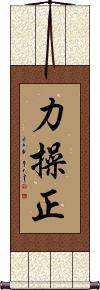
力操正 is a Korean martial arts title meaning “Power Control.”
It's most often cited as one of the 8 key concepts from Tang Soo Do.
This can be pronounced in Chinese but will only be recognized by those familiar with martial arts terms.
Will-Power / Self-Control
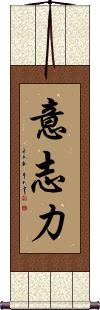
意志力 is a form of willpower or self-control and is about having the determination or tenacity to keep going.
In Japanese, this is the power of will, the strength of will, volition, intention, intent, or determination.
Self-Discipline / Will-Power
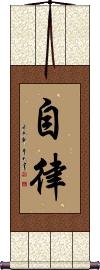
自律 means self-discipline and self-control.
It is doing what you really want to do rather than being tossed around by your feelings like a leaf in the wind. You act instead of reacting. You get things done in an orderly and efficient way. With self-discipline, you take charge of yourself.
Not sure if this one works for a Japanese audience.
See Also: Discipline | Self-Control
Self-Control
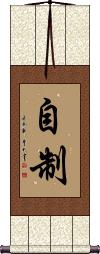
The short and sweet version of self-control.
Note: This can also mean self-restraint.
See Also: Will-Power / Self | Discipline
Self-Control
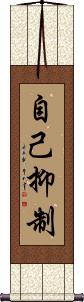
自己抑制 has a meaning like “to restrain oneself” in Chinese, Japanese, and old Korean.
The first two characters mean “regarding oneself,” and the second two mean “to refrain” or “to restrain.”
See Also: Discipline | Will-Power / Self
Well-Disciplined / Orderly
Special Military Term
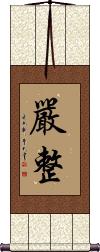
When reading an account of some battles in China, I came across the Chinese word, 嚴整. As it turns out, 嚴整 is only used in military circles to describe neat, orderly, and well-disciplined troops. Perhaps this is actually closer to the meaning I was taught while in the U.S. Marines.
The first character literally means stern, serious, strict, or severe (it can also mean airtight or watertight.
The second character means exact, in good order, whole, complete, and orderly.
Together, these two characters multiply each other into a word that expresses the highest military level of discipline.
See Also: Self-Control | Will-Power / Self
Discipline
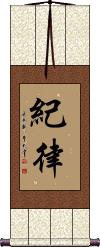
紀律 is a Chinese and Korean word that conveys the idea of extreme self-control and perhaps self-sacrifice, and obedience.
This word matches the kind of “discipline” I was in the Marine Corps. There is also an additional idea of maintaining order or being orderly in your tasks.
This idea would also fit an athlete training for the Olympics who gives up many pleasures to stay focused on their training.
See Also: Self-Control | Will-Power / Self
Discipline
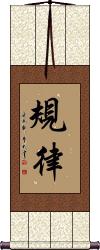
規律 is a Japanese word for discipline that relays the ideas of keeping order, and observance (of rules, laws, regulations).
This is also a word in Chinese and old Korean Hanja where it suggests that you are one who follows a certain law of behavior or has a regular and dependable pattern of behavior, personal regime, or rhythm.
See Also: Self-Control | Will-Power / Self
Discipline

鍛練 is the Japanese Kanji and Korean Hanja word used for discipline.
This has a meaning like “forging or creating something from lots of training and practice.” My Japanese dictionary translates this as “tempering, forging, hardening, disciplining, training.”
This is for Japanese and Korean only. In Chinese, these characters might be translated as (physical) “exercise.”


The modern form of the second Japanese Kanji looks like the first image to the right. There’s also an alternate modern form after that, and finally, an alternate traditional form. Because calligraphy is an art, the calligrapher could choose any of these possible forms. Let us know if you have a preference.
See Also: Self-Control | Will-Power / Self
Discipline / Training / Tempering Character
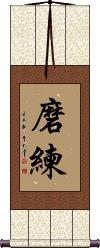
磨鍊 is a form of discipline which suggests training of the mind and character, aimed at producing self-control, obedience, etc.
One of my Chinese-English dictionaries even translates this as “tempering oneself” or turning yourself into hardened steel.
In old Korean Hanja, they use these characters in reverse order but with the same meaning. If you want the Korean version, please click this link instead of the button above: Korean version.
Determination
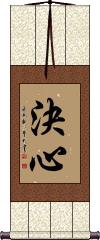
決心 is a Chinese, Japanese, and Korean word that holds the dictionary definition of determination but literally means determined heart.
The first character means to determine or determined.
The second character means heart, mind, or soul, so you can imagine that this form of determination partially means putting your heart into something. It can also be translated as resolve, resolution, or decision (as in a decision made and followed).
See Also: Sincerity and Devotion | Tenacious / Tenacity | Passions / Feelings / Emotions | Dedication | Will-Power / Self
Strong Hearted / Strong Willed
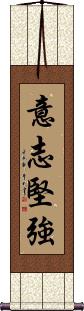
意志堅強 can mean either “strong-hearted,” “strong-willed” or “determination.”
The first two characters can mean “will,” “willpower,” “determination,” “volition,” “intention,” or “intent.” But, it should be noted that this first part possesses the element of “heart” in the lower portion of both characters (they also partially carry the meaning “with the whole heart”).
The last two characters mean “strong” or “staunch.”
Chinese word order and grammar are a bit different than English, so in this case, they are in reverse order of English but have the correct meaning in a natural form.
See Also: Strong Willed | Discipline | Will-Power / Self
Electricity / Lightning
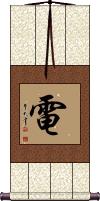
電 is the title for electricity in Chinese, Japanese Kanji, and old Korean Hanja.
While This means electric or electricity, it can also be used to mean lightning.
Note: This Kanji is not usually used alone like this in Japanese.
See Also: Thunder | Will-Power / Self | Supernatural Energy | Rain
Electricity / Lightning
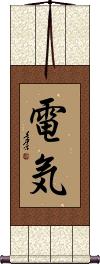
電氣 is the title for electricity in Japanese Kanji.
This can also be used to mean lightning in Japanese.
See Also: Thunder | Will-Power / Self | Supernatural Energy | Rain
Daodejing / Tao Te Ching - Chapter 27
The Mastery of Effortless Skill

Chapter 27 of the Daodejing reveals a profound truth about mastery: the highest skill leaves no trace, requires no force, and appears almost invisible.
善行無轍跡,
善言無瑕謫,
善數不用籌策,
善閉無關鍵而不可開,
善結無繩約而不可解。
是以聖人常善救人,
故無棄人;
常善救物,
故無棄物。
是謂襲明。
故善人者,不善人之師;
不善人者,善人之資。
不貴其師,不愛其資,
雖智大迷,
是謂要妙。
The sage moves through life with such natural harmony that nothing seems imposed; doors need no locks, knots require no rope, and actions leave no mark behind.
This is the essence of wúwéi (effortless action), where true ability arises from deep alignment with the Tao rather than deliberate effort.
At its heart, this chapter teaches compassion without exception. The sage “abandons no one and nothing,” recognizing value in all people and all things. Even those who seem flawed or unrefined are not rejected, but understood as part of a greater whole with each person both a student and a teacher in the unfolding of life.
Laozi reminds us that wisdom is not about perfection or control, but about subtle awareness. The truly skilled individual does not rely on tools, rules, or rigid structures; instead, they embody an intuitive understanding that makes their actions naturally complete.
In this way, excellence becomes quiet, effortless, and beyond imitation.
This teaching also reflects a deeper philosophical insight: Opposites are interdependent. The “good” person learns from the “not good,” and the “not good” provides the material for growth. To reject either is to misunderstand the balance of existence itself.
As calligraphy, Daodejing Chapter 27 serves as a reminder to cultivate inner mastery rather than outward display. It is a meditation on refinement, humility, and the quiet power of skill perfected through harmony with the natural order.
Note: The Chinese text used here is based on the early Mawangdui silk manuscript tradition (2nd century BCE). The Guodian manuscripts do NOT preserve Chapter 27 in full form.
This in-stock artwork might be what you are looking for, and ships right away...






The following table may be helpful for those studying Chinese or Japanese:
| Title | Characters | Romaji (Romanized Japanese) | Various forms of Romanized Chinese | |
| Control of Power | 力操正 | lì cào zhèng li4 cao4 zheng4 li cao zheng licaozheng | li ts`ao cheng litsaocheng li tsao cheng |
|
| Will-Power Self-Control | 意志力 | ishi ryoku / ishiryoku | yì zhì lì yi4 zhi4 li4 yi zhi li yizhili | i chih li ichihli |
| Self-Discipline Will-Power | 自律 | jiritsu | zì lǜ / zi4 lv4 / zi lv / zilv | tzu lü / tzulü |
| Self-Control | 自制 | jisei | zì zhì / zi4 zhi4 / zi zhi / zizhi | tzu chih / tzuchih |
| Self-Control | 自己抑制 | jikoyokusei | zì jǐ yì zhì zi4 ji3 yi4 zhi4 zi ji yi zhi zijiyizhi | tzu chi i chih tzuchiichih |
| Well-Disciplined Orderly | 嚴整 严整 | yán zhěng yan2 zheng3 yan zheng yanzheng | yen cheng yencheng |
|
| Discipline | 紀律 纪律 | jì lǜ / ji4 lv4 / ji lv / jilv | chi lü / chilü | |
| Discipline | 規律 规律 | kiritsu | guī / gui1 lu:4 / gui lu: / guilu: | kuei lü / kueilü |
| Discipline | 鍛練 / 鍛錬 锻练 | tan ren / tanren | duàn liàn duan4 lian4 duan lian duanlian | tuan lien tuanlien |
| Discipline Training Tempering Character | 磨練 / 磨鍊 / 磨鍊 磨练 | mó liàn / mo2 lian4 / mo lian / molian | mo lien / molien | |
| Determination | 決心 决心 | kesshin / keshin | jué xīn / jue2 xin1 / jue xin / juexin | chüeh hsin / chüehhsin |
| Strong Hearted Strong Willed | 意志堅強 意志坚强 | yì zhì jiān qiáng yi4 zhi4 jian1 qiang2 yi zhi jian qiang yizhijianqiang | i chih chien ch`iang ichihchienchiang i chih chien chiang |
|
| Electricity Lightning | 電 电 | den | diàn / dian4 / dian | tien |
| Electricity Lightning | 電氣 電気 | den ki / denki | ||
| Daodejing Tao Te Ching - Chapter 27 | 善行無轍跡善言無瑕謫善數不用籌策善閉無關鍵而不可開善結無繩約而不可解是以聖人常善救人故無棄人常善救物故無棄物是謂襲明故善人者不善人之師不善人者善人之資不貴其師不愛其資雖智大迷是謂要妙 善行无辙迹善言无瑕谪善数不用筹策善闭无关键而不可开善结无绳约而不可解是以圣人常善救人故无弃人常善救物故无弃物是谓袭明故善人者不善人之师不善人者善人之资不贵其师不爱其资虽智大迷是谓要妙 | shàn xíng wú zhé jì shàn yán wú xiá zhé shàn shù bù yòng chóu cè shàn bì wú guān jiàn ér bù kě kāi shàn jié wú shéng yuē ér bù kě jiě shì yǐ shèng rén cháng shàn jiù rén gù wú qì rén cháng shàn jiù wù gù wú qì wù shì wèi xí míng gù shàn rén zhě bù shàn rén zhī shī bù shàn rén zhě shàn rén zhī zī bù guì qí shī bù ài qí zī suī zhì dà mí shì wèi yào miào shan4 xing2 wu2 zhe2 ji4 shan4 yan2 wu2 xia2 zhe2 shan4 shu4 bu4 yong4 chou2 ce4 shan4 bi4 wu2 guan1 jian4 er2 bu4 ke3 kai1 shan4 jie2 wu2 sheng2 yue1 er2 bu4 ke3 jie3 shi4 yi3 sheng4 ren2 chang2 shan4 jiu4 ren2 gu4 wu2 qi4 ren2 chang2 shan4 jiu4 wu4 gu4 wu2 qi4 wu4 shi4 wei4 xi2 ming2 gu4 shan4 ren2 zhe3 bu4 shan4 ren2 zhi1 shi1 bu4 shan4 ren2 zhe3 shan4 ren2 zhi1 zi1 bu4 gui4 qi2 shi1 bu4 ai4 qi2 zi1 sui1 zhi4 da4 mi2 shi4 wei4 yao4 miao4 shan xing wu zhe ji shan yan wu xia zhe shan shu bu yong chou ce shan bi wu guan jian er bu ke kai shan jie wu sheng yue er bu ke jie shi yi sheng ren chang shan jiu ren gu wu qi ren chang shan jiu wu gu wu qi wu shi wei xi ming gu shan ren zhe bu shan ren zhi shi bu shan ren zhe shan ren zhi zi bu gui qi shi bu ai qi zi sui zhi da mi shi wei yao miao | shan hsing wu che chi shan yen wu hsia che shan shu pu yung ch`ou ts`e shan pi wu kuan chien erh pu k`o k`ai shan chieh wu sheng yüeh erh pu k`o chieh shih i sheng jen ch`ang shan chiu jen ku wu ch`i jen ch`ang shan chiu wu ku wu ch`i wu shih wei hsi ming ku shan jen che pu shan jen chih shih pu shan jen che shan jen chih tzu pu kuei ch`i shih pu ai ch`i tzu sui chih ta mi shih wei yao miao shan hsing wu che chi shan yen wu hsia che shan shu pu yung chou tse shan pi wu kuan chien erh pu ko kai shan chieh wu sheng yüeh erh pu ko chieh shih i sheng jen chang shan chiu jen ku wu chi jen chang shan chiu wu ku wu chi wu shih wei hsi ming ku shan jen che pu shan jen chih shih pu shan jen che shan jen chih tzu pu kuei chi shih pu ai chi tzu sui chih ta mi shih wei yao miao |
|
| In some entries above you will see that characters have different versions above and below a line. In these cases, the characters above the line are Traditional Chinese, while the ones below are Simplified Chinese. | ||||

Successful Chinese Character and Japanese Kanji calligraphy searches within the last few hours...



