Many custom options


And formats



Calmness in Chinese / Japanese
Buy a Calmness calligraphy wall scroll here!
Personalize your custom “Calmness” project by clicking the button next to your favorite “Calmness” title below.
4. Inner Peace / Silence / Serenity
7. Calm / Cool
10. Peaceful Heart / Peace of Mind / Calm Mind
11. Peaceful / Tranquil / Calm / Free From Worry
12. Peacefulness / Tranquility / Perfectly Quiet
13. Reach Peace and Calm Through Meditation
15. Stability / Calm and Orderly / Equilibrium
16. Tranquil / Tranquility / Serenity
17. Keep Calm in Face of Adversity
18. Keep Calm, Be Not Impatient
19. Life of Serenity
21. Tranquility Yields Transcendence
22. A Life of Serenity Yields Understanding
23. Serenity Prayer
Stillness / Quiet / Calm
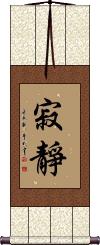
寂靜 is the Chinese and old Japanese word for calmness, stillness, and tranquility.
In the Buddhist context, this can refer to the calmness of the heart, enlightenment, or the state of being calm and quiet - free from temptation and distress. This can be thought of as being in a state of earthly nirvāṇa.
Note: The second character is written just slightly differently in modern Japanese (静 instead of 靜). Expect a slight variation if you order this from the Japanese master calligrapher. The version shown here is considered the ancient Japanese and original Chinese form.
Calm / Cool-Headed
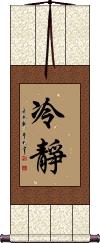
冷靜 means calm and cool-headed in Chinese, Japanese, and Korean.
Other translations: calmness, composure, coolness, serenity, tranquility.
冷靜 is a good wall scroll for someone that wants to remind themselves to stay calm and level-headed.
See Also: So Be It / Amen
Calm / Tranquility
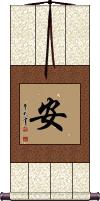
安 is used in many compound words in the CJK world.
Alone, this character has a broad span of possible meanings. These meanings include relaxed, quiet, rested, contented, calm, still, to pacify, peaceful, at peace, soothing, or soothed.
安 and even the pronunciation was borrowed from Chinese and absorbed into both Japanese Kanji and Korean Hanja. In all these languages, this character is pronounced like “an.”
Inner Peace / Silence / Serenity
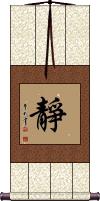
靜 is the simplest way to convey the meaning of inner peace and serenity.
靜 is often translated as “serenity.” It can also be used to express the ideas of still, calm, serene, quiet, silent, stillness, not moving, or tranquility.
In the old days, Chinese, Japanese, or Korean people might hang a wall scroll with this character in their reading room to bring about a sense of peace in the room.
 While they once used the same character form in Japan, they now use a slightly-simplified version in modern Japan (after WWII). This version is shown to the right, and can be selected for your wall scroll by clicking on that Kanji instead of the button above.
See Also: Worldwide Peace
Silent / Solitary
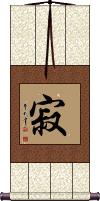
寂 means silent, solitary, quiet, calm, still, rest, or tranquil.
This also has a strong association with Buddhism where it can mean “entering into Nirvana.” In that context, this is sometimes used to refer to the passing of a Buddhist monk (he is silent, as he has entered Nirvana). For the living, this is about tranquility (especially of mind).
Some will also use this to mean “elegant simplicity.”
From Sanskrit, this can represent praśama, vivikta, śānti, or nibbāna (nirvāṇa).
Calm and Collected
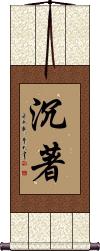
Calm / Cool
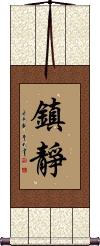
鎮靜 represents the idea of being calm, cool, or relaxed in Chinese, Japanese Kanji, and old Korean Hanja.
My Korean dictionary further defines this as quiet, calm, tranquility, and pacification.
From my Japanese dictionary: calm, quiet, tranquility, appeasement, pacification.
Note: This term is also used in Korean Hanja but there is a slight deviation in the way they write the second character in Korean. Still, a Korean person who can read Hanja, will be able to read this word. We can write it in the Korean form if you wish (just let us know when you place your order). In Korean, this is the word you might use to tell someone to “calm down” or “take it easy.”
Calm and Open Mind
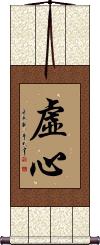
虛心 is a Buddhist term that speaks of being open-minded and/or having a calm and humble mind or heart.
Peace and Tranquility
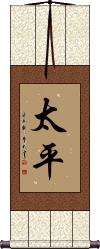
太平 means “peace and tranquility” or “peace and security” in Chinese, Japanese Kanji, and old Korean Hanja.
The literal translation would be “very balanced” or “very peaceful.”
The first character means very, much, too much, or extremely.
The second character means balanced, peaceful, calm, equal, even, level, or smooth.
Peace and Tranquility
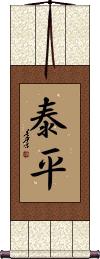
泰平 means peace and/or tranquility in Japanese and Korean (also understood but not as common in Chinese).
Peaceful Heart / Peace of Mind / Calm Mind
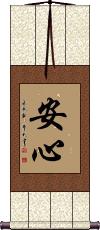
安心 can mean relief, peace of mind, feeling at ease, to be relieved, to set one's mind at rest, and easiness.
安心 is a nice word that encompasses great meanings within just two characters. Some of the other meanings include pacifying, settling the mind, and peace of mind. It's also the idea of feeling a sense of security, safety, and confidence in your state of well-being.
This can be used by everyone, but some consider it to be a Buddhist concept (You'll find it in your Zen dictionary).
Note: Can be romanized as Anshin or Anjin in Japanese.
Peaceful / Tranquil / Calm / Free From Worry
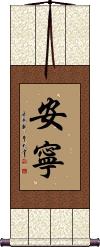
This is a nice word that means peaceful, tranquil, calm, composed, “free from worry,” “public peace,” tranquility, good health, well-being, or welfare in Chinese and Korean.
Note: The definition in Japanese is not so broad but still means peaceful or “public peace.”
Peacefulness / Tranquility / Perfectly Quiet
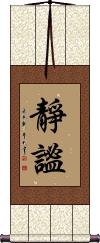
靜 and 謐 both mean quiet. Together, 靜謐 reinforces the meanings, almost creating a word that means “double quiet” or “perfect quiet.”
A good wall scroll for a library, reading room, or another quiet place.
See Also: Worldwide Peace | Peace / Harmony
Reach Peace and Calm Through Meditation
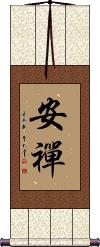
安禪 creates a title that means to reach peace and calm through meditation.
安禪 is an excellent wall scroll for your relaxation or meditation room.
This is also a Buddhist-related term that encompasses the idea of entering into dhyana meditation.
This is also used in Japanese, but in modern times, the second character has changed, so it's 安禅 now. If you want the modern Japanese version, just choose a Japanese calligrapher, and let me know when you place your order.
Serenity / Tranquility
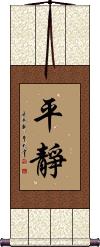
平靜 is one of several ways to express “serenity” or “tranquility” in Chinese, Japanese Kanji, and old Korean Hanja.
It can also be translated as calm, serenity, tranquil, undisturbed, or serene.
See Also: Worldwide Peace
Serenity / Tranquility
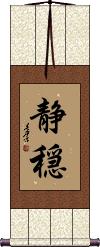
靜穏 is a Japanese-specific way to express “serenity” or “tranquility.”
Notes: The second Kanji is not a Chinese character - it was morphed or developed in Japan after Chinese characters were absorbed into the Japanese language during the 5th century.
The first character is slightly-simplified from the original Chinese form but still recognizable.
See Also: Worldwide Peace
Stability / Calm and Orderly / Equilibrium
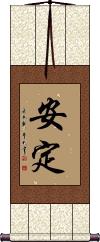
安定 is a word that means: quiet; settled; maintain; calm and orderly; stability; equilibrium.
Tranquil / Tranquility / Serenity
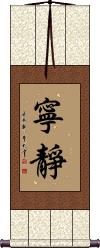
寧靜 expresses the idea of tranquility and serenity in Chinese.
See Also: Worldwide Peace | Inner Peace | Peace / Harmony | Stillness / Quiet / Calm
Keep Calm in Face of Adversity
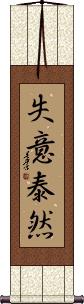
失意泰然 is a very old Japanese proverb that suggests “keeping calm and collected at times of disappointment,” or “maintaining a serene state of mind when faced with adversity.”
It's hard to relate individual character meanings to the overall meaning unless you also understand Japanese grammar. The word order is very different than English. That being said, here's the character meaning breakdown:
失 To miss, lose or fail.
意 Feelings, thoughts, meaning.
泰 Safe, peaceful.
然 Like that, in that way, however, although.
Using these definitions in English, we might say, “Although you may fail or lose, have a feeling of peace and calm.”
Keep Calm, Be Not Impatient
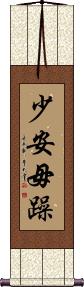
少安毋躁 is a short Chinese phrase that means keep calm, don't get excited, and don't be impatient or hot-tempered.
Life of Serenity
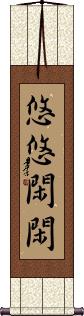
悠悠閑閑 means “life of serenity” in Japanese.
However, it can also have these meanings depending on how it's read: “composed and unhurried,” “easygoing and leisurely,” “in indolence,” or “life of idleness.”
Open and Calm Mind
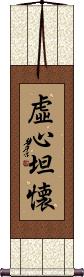
虛心坦懐 is a Japanese proverb that means “with an open and calm mind,” “with no preconceived notions,” or “without reservations.”
In some contexts, it can mean frank or candid.
If you want to remind yourself to approach each situation with no preconceptions, this is a good title for you. This can also refer to the ideas of being candid, frank, and straightforward.
Tranquility Yields Transcendence
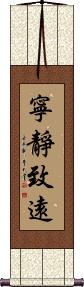
寧靜致遠 is an ancient Chinese idiom that means “tranquility yields transcendence.”
This suggests pursuing a quiet life of profound study.
The first two characters mean tranquility. The last two characters mean “go far,” which suggests achieving much in your life or expanding beyond normal limits. The direct translation would read something like, “[With] tranquility [in your life, you'll] go far.”
Compare this to the English idiom: Still waters run deep.
A Life of Serenity Yields Understanding
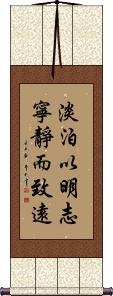
淡泊以明志寧靜而致遠 is a kind of complex ten-character proverb composed by Zhuge Liang about 1800 years ago.
淡泊以明志寧靜而致遠 is a Chinese proverb that means “Leading a simple life will yield a clear mind, and having inner peace will help you see far (into the world).”
What I have translated as “simple life” means NOT being materialistic and NOT competing in the rat race.
The last word means “far” but the deeper meaning is that you will surpass what you can currently see or understand. Perhaps even the idea of opening up vast knowledge and understanding of complex ideas.
The whole phrase has a theme that suggests that if you are NOT an aggressive, cut-throat person who fights their way to the top, no matter how many people they crush along the way, and instead seek inner peace, you will have a happier existence and be more likely to understand the meaning of life.
See Also: Tranquil / Tranquility / Serenity
Serenity Prayer
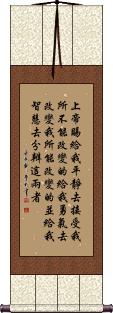
This is the serenity prayer, as used by many 12-step programs and support groups.
In Chinese, this says:
God grant me the serenity to accept the things I cannot change, the courage to change the things I can, and the wisdom to know the difference.
Serenity Prayer
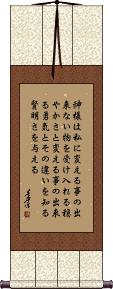
This is a Japanese version of the serenity prayer, as used by many 12-step programs and support groups.
In Japanese, this says:
God grant me the serenity to accept the things I cannot change, the courage to change the things I can, and the wisdom to know the difference.
Note: Because this selection contains some special Japanese Hiragana characters, it should be written by a Japanese calligrapher.
These search terms might be related to Calmness:
A Life of Serenity Yields Understanding
Achieve Inner Peace; Find Deep Understanding
Balance / Peace
Calm / Cool
Calm / Cool-Headed
Calm / Tranquility
Calm and Collected
Calm and Open Mind
Eternal Peace
Eternal Peace and Happiness
Faith Love Peace
Great Peace
House of Peace
Inner Bliss and Peace From Meditation
Inner Peace
Inner Peace / Silence / Serenity
Keep Calm in Face of Adversity
Keep Calm, Be Not Impatient
Life of Serenity
Live in Peace and Contentment
Open and Calm Mind
Patience Brings Peace of Mind
Patience Yields Peace of Mind
Peace / Harmony
Peace / Peaceful
Peace and Good Health
Peace and Love
Peace and Tranquility
Peace of Mind
Peace, Love, Happiness
Peaceful / Tranquil / Calm / Free From Worry
Peaceful Heart / Peace of Mind / Calm Mind
Reach Peace and Calm Through Meditation
Serenity / Tranquility
Serenity Prayer
Spiritual Peace / Enlightened Peace
Stability / Calm and Orderly / Equilibrium
Stable - Mind at Peace
Stillness / Quiet / Calm
The Whole World at Peace
Tranquil / Tranquility / Serenity
Warrior for Peace
World Peace
Worldwide Peace
Worldwide Wish for Peace and Prosperity
The following table may be helpful for those studying Chinese or Japanese:
| Title | Characters | Romaji (Romanized Japanese) | Various forms of Romanized Chinese | |
| Stillness Quiet Calm | 寂靜 寂静 | sekisei / jakujou sekisei / jakujo | jì jìng / ji4 jing4 / ji jing / jijing | chi ching / chiching |
| Calm Cool-Headed | 冷靜 冷静 | rei sei / reisei | lěng jìng leng3 jing4 leng jing lengjing | leng ching lengching |
| Calm Tranquility | 安 | an | ān / an1 / an | |
| Inner Peace Silence Serenity | 靜 静 | shizu / sei | jìng / jing4 / jing | ching |
| Silent Solitary | 寂 | jaku | jì / ji4 / ji | chi |
| Calm and Collected | 沉著 沉着 | chén zhuó chen2 zhuo2 chen zhuo chenzhuo | ch`en cho chencho chen cho |
|
| Calm Cool | 鎮靜 镇静 | chin sei / chinsei | zhèn jìng zhen4 jing4 zhen jing zhenjing | chen ching chenching |
| Calm and Open Mind | 虛心 虚心 | ko shin / koshin | xū xīn / xu1 xin1 / xu xin / xuxin | hsü hsin / hsühsin |
| Peace and Tranquility | 太平 | tai hei / taihei | tài píng / tai4 ping2 / tai ping / taiping | t`ai p`ing / taiping / tai ping |
| Peace and Tranquility | 泰平 | taihei | ||
| Peaceful Heart Peace of Mind Calm Mind | 安心 | an shin / anshin | ān xīn / an1 xin1 / an xin / anxin | an hsin / anhsin |
| Peaceful Tranquil Calm Free From Worry | 安寧 安宁 | an nei / annei | ān níng / an1 ning2 / an ning / anning | |
| Peacefulness Tranquility Perfectly Quiet | 靜謐 静谧 | seihitsu | jìng mì / jing4 mi4 / jing mi / jingmi | ching mi / chingmi |
| Reach Peace and Calm Through Meditation | 安禪 安禅 | an zen / anzen | ān chán / an1 chan2 / an chan / anchan | an ch`an / anchan / an chan |
| Serenity Tranquility | 平靜 平静 | heisei | píng jìng ping2 jing4 ping jing pingjing | p`ing ching pingching ping ching |
| Serenity Tranquility | 靜穏 静穏 | seion | ||
| Stability Calm and Orderly Equilibrium | 安定 | an tei / antei | ān dìng / an1 ding4 / an ding / anding | an ting / anting |
| Tranquil Tranquility Serenity | 寧靜 宁静 | níng jìng ning2 jing4 ning jing ningjing | ning ching ningching |
|
| Keep Calm in Face of Adversity | 失意泰然 | shitsuitaizen | ||
| Keep Calm, Be Not Impatient | 少安毋躁 | shǎo ān wú zào shao3 an1 wu2 zao4 shao an wu zao shaoanwuzao | shao an wu tsao shaoanwutsao |
|
| Life of Serenity | 悠悠閑閑 | yuu yuu kan kan yuuyuukankan yu yu kan kan | ||
| Open and Calm Mind | 虛心坦懐 虚心坦懐 | kyo shin tan kai kyoshintankai | ||
| Tranquility Yields Transcendence | 寧靜致遠 宁静致远 | níng jìng zhì yuǎn ning2 jing4 zhi4 yuan3 ning jing zhi yuan ningjingzhiyuan | ning ching chih yüan ningchingchihyüan |
|
| A Life of Serenity Yields Understanding | 淡泊以明志寧靜而致遠 淡泊以明志宁静而致远 | dàn bó yǐ míng zhì, níng jìng ér zhì yuǎn dan4 bo2 yi3 ming2 zhi4, ning2 jing4 er2 zhi4 yuan3 dan bo yi ming zhi, ning jing er zhi yuan | tan po i ming chih, ning ching erh chih yüan | |
| Serenity Prayer | 上帝賜給我平靜去接受我所不能改變的給我勇氣去改變我所能改變的並給我智慧去分辨這兩者 上帝赐给我平静去接受我所不能改变的给我勇气去改变我所能改变的并给我智慧去分辨这两者 | shàng dì cì wǒ píng jìng qù jiē shòu wǒ suǒ bù néng gǎi biàn de wǒ yǒng qì qù gǎi biàn wǒ suǒ néng gǎi biàn de bìng wǒ zhì huì qù fēn biàn zhè liǎng zhě shang4 di4 ci4 gei3 wo3 ping2 jing4 qu4 jie1 shou4 wo3 suo3 bu4 neng2 gai3 bian4 de gei3 wo3 yong3 qi4 qu4 gai3 bian4 wo3 suo3 neng2 gai3 bian4 de bing4 gei3 wo3 zhi4 hui4 qu4 fen1 bian4 zhe4 liang3 zhe3 shang di ci gei wo ping jing qu jie shou wo suo bu neng gai bian de gei wo yong qi qu gai bian wo suo neng gai bian de bing gei wo zhi hui qu fen bian zhe liang zhe | shang ti tz`u kei wo p`ing ching ch`ü chieh shou wo so pu neng kai pien te kei wo yung ch`i ch`ü kai pien wo so neng kai pien te ping kei wo chih hui ch`ü fen pien che liang che shang ti tzu kei wo ping ching chü chieh shou wo so pu neng kai pien te kei wo yung chi chü kai pien wo so neng kai pien te ping kei wo chih hui chü fen pien che liang che |
|
| Serenity Prayer | 神様は私に変える事の出来ない物を受け入れる穏やかさと変える事の出来る勇気とその違いを知る賢明さを与える | kamisama ha watashi ni kaeru koto no deki nai mono o ukeireru odayaka sa to kaeru koto no dekiru yuuki to sono chigai o shiru kenmei sa o ataeru kamisama ha watashi ni kaeru koto no deki nai mono o ukeireru odayaka sa to kaeru koto no dekiru yuki to sono chigai o shiru kenmei sa o ataeru | ||
| In some entries above you will see that characters have different versions above and below a line. In these cases, the characters above the line are Traditional Chinese, while the ones below are Simplified Chinese. | ||||

Successful Chinese Character and Japanese Kanji calligraphy searches within the last few hours...



