Many custom options...


And formats...



Battles in Chinese / Japanese...
Buy a Battles calligraphy wall scroll here!
Personalize your custom “Battles” project by clicking the button next to your favorite “Battles” title below...
1. Battles
2. Know Your Enemy, Know Yourself, and You Cannot Lose
3. Know Your Enemy, Know Yourself, and Win 100 Battles
4. Know Thy Enemy, Know Thyself
5. Schooled by Experience and Hard Knocks
6. Sanchin
Battles

バトルズ is the name Battles in Japanese Katakana.
Note: Because this title is entirely Japanese Katakana, it should be written by a Japanese calligrapher.
Battles

巴特爾斯 is the name Battles in Chinese (Mandarin).
Know Your Enemy, Know Yourself, and You Cannot Lose
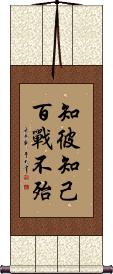
知彼知己百戰不殆 is from Sun Tzu's (Sunzi's) Art of War. It means that if you know and understand the enemy, you also know yourself, and thus with this complete understanding, you cannot lose.
This proverb is often somewhat directly translated as “Know the enemy and know yourself, and you can fight a hundred battles without defeat.”
It can also be translated as “If you know both yourself and your enemy, you can come out of hundreds of battles without danger,” or “Know your enemy, know yourself, and your victory will not be threatened.”
Know Your Enemy, Know Yourself, and Win 100 Battles
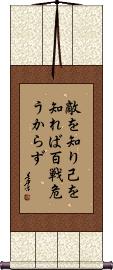
敵を知り己を知れば百戦危うからず is the longer/full Japanese version of this proverb. This means “Know your enemy, know yourself, and you will not fear a hundred battles.”
Others will translate this as “Know thy enemy, know thyself, yields victory in one hundred battles.”
Note: Because this selection contains some special Japanese Hiragana characters, it should be written by a Japanese calligrapher.
Know Thy Enemy, Know Thyself
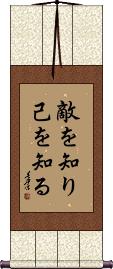
敵を知り己を知る is the Japanese version of “know your enemy, know yourself.”
There is a longer version of this proverb that adds, “...and you can win 100 battles.”
Note: Because this selection contains some special Japanese Hiragana characters, it should be written by a Japanese calligrapher.
Schooled by Experience and Hard Knocks
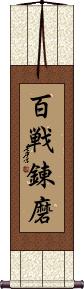
百戦錬磨 is a Japanese proverb or title that means veteran, or rather, someone schooled by adversity in many battles or someone rich in life experience.
If you are who you are because of the adversity you experienced in life, this could be your title.
Sanchin
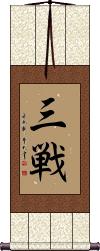
三戦 is a title that literally means “three battles/conflicts/wars.”
三戦 is often figuratively used to relay the idea of a battle to unify the mind, body, and spirit.
Original usage likely comes from Fujian province in Southern China (just across from Taiwan).
This title is used in various schools such as Okinawan Karate, Uechi-Ryū, Gōjū-Ryū, Fujian White Crane, and Five Ancestors among others.
Well-Disciplined / Orderly
Special Military Term
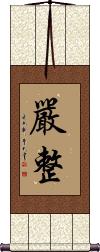
When reading an account of some battles in China, I came across the Chinese word, 嚴整. As it turns out, 嚴整 is only used in military circles to describe neat, orderly, and well-disciplined troops. Perhaps this is actually closer to the meaning I was taught while in the U.S. Marines.
The first character literally means stern, serious, strict, or severe (it can also mean airtight or watertight.
The second character means exact, in good order, whole, complete, and orderly.
Together, these two characters multiply each other into a word that expresses the highest military level of discipline.
See Also: Self-Control | Will-Power
Old, But More Vigorous in Spirit
Age is just a number
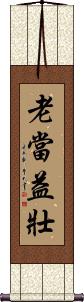
老當益壯 is a Chinese proverb that means “old but vigorous” or “hale and hearty despite the years.”
Said of someone who is more spirited when he/she grows older.
The story behind this Chinese proverb:
In the Eastern Han Dynasty, there was a man named Ma Yuan. He had been planning to herd animals on the frontier since he was young. When he grew up, Ma became a minor official of a county.
Once, he was sending some prisoners to another location. He felt pity for them, so he set them free, and then he fled to another county in the north. He herded animals there, and thus his dream came true. He always said: “If you want to be a great man, the poorer you are, the firmer in spirit you have to be; the older you are, the more spirited you should be.”
Later, when he was even older, Ma Yuan became a famous general of the Eastern Han Dynasty and contributed to many battles.
Kenjutsu / Kenjitsu
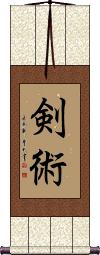
In Japanese, the modern definition, using simple terms, 剣術 is “A martial art involving swords” or “The art of the sword.”
However, in Chinese, this is the word for fencing (as in the Olympic sport).
I will suppose that you want this for the Japanese definition, which comes from skills and techniques developed in the 15th century. At that time, Kenjutsu (or swordsmanship) was a strictly military art taught to Samurai and Bushi (soldiers). The fact that swords are rarely used in military battles anymore, and with the pacification of Japan after WWII, Kenjutsu is strictly a ceremonial practice often studied as a form of martial art (more for the discipline aspect rather than practical purpose).
Language note: The Korean definition is close to the Japanese version described above. However, it should be noted that this can mean “fencing” depending on the context in Japanese, Chinese, and Korean.

 Character variation notes: There are slight variations possible with the second character. Either way is correct and understood by both Japanese and Chinese folks.
Since there are about 5 common ways to write the sword character, if you are particular about which version you want, please note that in the “special instructions” when you place your order.
Romanization note: This term is often Romanized as Kenjitsu; however, following the rules of Japanese Romaji, it should be Kenjutsu.
The following table may be helpful for those studying Chinese or Japanese...
| Title | Characters | Romaji (Romanized Japanese) | Various forms of Romanized Chinese | |
| Battles | バトルズ | batoruzu | ||
| Battles | 巴特爾斯 巴特尔斯 | bā tè ěr sī ba1 te4 er3 si1 ba te er si bateersi | pa t`e erh ssu pateerhssu pa te erh ssu |
|
| Know Your Enemy, Know Yourself, and You Cannot Lose | 知彼知己百戰不殆 知彼知己百战不殆 | zhí bǐ zhí jī bǎi zhàn bú dài zhi2 bi3 zhi2 ji1 bai3 zhan4 bu2 dai4 zhi bi zhi ji bai zhan bu dai zhibizhijibaizhanbudai | chih pi chih chi pai chan pu tai | |
| Know Your Enemy, Know Yourself, and Win 100 Battles | 敵を知り己を知れば百戦危うからず | teki o shi ri o no o shi re ba hya ku sen aya u ka ra zu | ||
| Know Thy Enemy, Know Thyself | 敵を知り己を知る | te ki o shi ri o no re o shi ru tekioshirionoreoshiru | ||
| Schooled by Experience and Hard Knocks | 百戦錬磨 | hyakusenrenma | ||
| Sanchin | 三戦 | san sen / sansen | sān zhàn / san1 zhan4 / san zhan / sanzhan | san chan / sanchan |
| Well-Disciplined Orderly | 嚴整 严整 | yán zhěng yan2 zheng3 yan zheng yanzheng | yen cheng yencheng |
|
| Old, But More Vigorous in Spirit | 老當益壯 老当益壮 | lǎo dāng yì zhuàng lao3 dang1 yi4 zhuang4 lao dang yi zhuang laodangyizhuang | lao tang i chuang laotangichuang |
|
| Kenjutsu Kenjitsu | 剣術 剑术 | kenjutsu | jiàn shù / jian4 shu4 / jian shu / jianshu | chien shu / chienshu |
| In some entries above you will see that characters have different versions above and below a line. In these cases, the characters above the line are Traditional Chinese, while the ones below are Simplified Chinese. | ||||

Successful Chinese Character and Japanese Kanji calligraphy searches within the last few hours...



