Many custom options...


And formats...



Shi in Chinese / Japanese...
Buy a Shi calligraphy wall scroll here!
Personalize your custom “Shi” project by clicking the button next to your favorite “Shi” title below...
2. Stone / Rock
3. You are always a beauty in your lover’s eyes
5. Best
6. Honesty
7. Persimmon
9. Samurai
10. Esprit de Corps / Determination
11. The Four Seasons
12. One Heart / One Mind / Heart and Soul
16. Sumo Wrestler
17. Sushi
18. Ten
19. Time
20. Warrior
22. Bushido / The Way of the Samurai
23. Bushi Kai
24. Enlightenment
25. Shidokan
27. Guardian Angel
29. Krishna
31. The Nature of Martial Arts
32. Shikantaza
33. Sisters at Heart
Xishi / Xi Shi
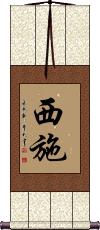
西施 is the Chinese title for Xishi, who lived around 450 BC. She was a famous Chinese beauty, perhaps the foremost of the Four Beauties (四大美女). She was given by King Gou Jian of the Yue Kingdom as a concubine to the King of Wu. This was part of an elaborate plan to destroy the Wu Kingdom - and it worked.
Note: In Japanese, this can be an unrelated given name, Seishi. Though the Xishi story is somewhat known in Japan.
Stone / Rock
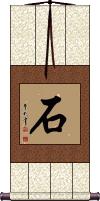
石 is the character that means rock or stone in both Chinese and Japanese.
Alone, this will be read as “stone” in Japanese but in some context, it is a unit of measure for the volume of about five bushels.
This can also refer to a gem or jewel.
This can also be the Japanese surnames that romanize as Ishi, Tsuruishi, Soku, Seki, Shi, Kazu, Iso, Ishizaki, Ishisaki, or Koku.
You are always a beauty in your lover’s eyes
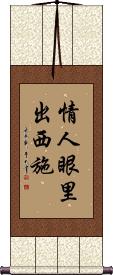
Any woman with affection for Asian art will love a gift of this Chinese proverb calligraphy on a wall scroll.
She will melt in your arms as you tell her the meaning of these characters.
Contained in this phrase is a reference to the most beautiful woman in Chinese history. Her name was Xi Shi, and she was known to have good looks that need not have fine robes or makeup. Her charms were so powerful that she brought down an entire kingdom (in a successful effort to bring honor and pride back to her people).
情人眼里出西施 is a great way to express that the woman in your life is your one love.
Shiken Haramitsu Daikomyo
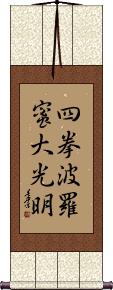
四拳波羅蜜大光明 is “shiken haramitsu daikōmyō,” a famous Japanese Buddhist mantra.
四拳 = shi-ken = four fists (many translate this as “four hearts”).
波羅蜜 = ha-ra-mitsu = A loanword representing pāramitā, or entrance into Nirvana. Awkwardly, it also means jackfruit.
大光明 = dai-kou-myo = big/great light bright (great bright light).
Shiken represents four hearts:
1. The Merciful Heart - Love and caring for all living things.
2. The Sincere Heart - Pursues righteousness, or the right path - sincerely trying to do what is right.
3. The Attuned Heart - Knows that nature and fate have their ways, and thus stay in tune with the universe.
4. The Dedicated Heart - Steadfast on the chosen path to the end.
Best
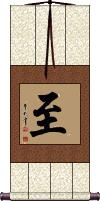
至 is a little strange as calligraphy, but 至 would be the character that means “best” or “extreme” in Chinese and Korean.
The problem is, this is seldom used alone. It's mostly used in combination with other characters to make words like “best friend,” “best food,” and “best love.”
I do not recommend this character for a wall scroll. It's better if you find a more specific term that fits your circumstances.
Note: This can be pronounced in Japanese and has a similar meaning but it is rarely if ever used in modern Japanese.
Honesty
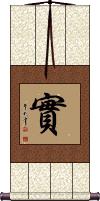
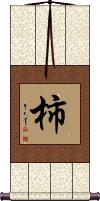
Persimmon
Potential / Momentum
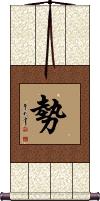
勢 is a word that means potential or momentum in Chinese, Japanese, and Korean.
Depending on the context, this can also be translated as an influence, tendency, military strength (potential), or power.
Samurai
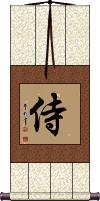
In Japanese, 侍 represents the warriors that attempted to hold peace when there was no Emperor in Japan.
Be cautious though, as it is an old way to express “servant” or “waiter” in Chinese and Korean. Of course, if you are a samurai, you are a servant to your Shogun-ate, Lord, or the people (which is the root meaning).
See Also: Warrior
Esprit de Corps / Determination
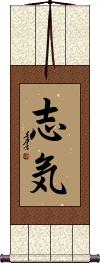
志気 is a Japanese word that can mean “esprit de corps” or “determination to achieve.”
When this is pronounced “Shige,” it can refer to a place in Japan. It can also be a Japanese surname, Shiki.
The Four Seasons
Short version
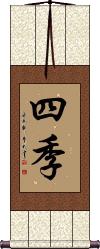
四季 is the 2-character way to say “Four Seasons.”
四季 literally means “4” and “seasons.”
One Heart / One Mind / Heart and Soul
Isshin
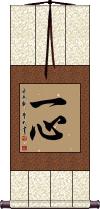
一心 can be translated as “one mind,” “single-minded focus,” or “wholehearted devotion,” from Chinese, Japanese Kanji, and old Korean Hanja.
Colloquially or figuratively, it means: wholeheartedly; heart and soul; of one mind; single-mindedness, wholeheartedness; one's whole heart; with the whole mind or heart; one mind in heart.
I'm not kidding, all of those came right from the dictionary for this one title.
In martial arts usage, this term emphasizes total commitment, where intent, attention, and action are unified without distraction.
In Japanese budō, it often conveys wholehearted dedication to practice or principle, whereas in Chinese usage it tends toward inner mental cultivation.
In Buddhism, this can refer to the bhūtatathatā, or the whole of things; the universe as one mind, or a spiritual unity.
In Japanese, this can be the female given name, Hitomi.
Shidai / Sida / Mahabhuta
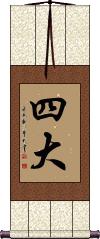
In Mahayana Buddhism, 四大 represents mahābhūta, the four elements of which all things are made: earth, water, fire, and wind.
This can also represent the four freedoms: speaking out freely, airing views fully, holding great debates, and writing big-character posters.
In some contexts, this can be a university or college offering four-year programs.
To others, this can represent the Tao, Heaven, Earth, and King.
Going back to the Buddhist context, these four elements “earth, water, fire, and wind,” represent 堅, 濕, 煖, 動, which are: solid, liquid, heat, and motion.
Light of the World
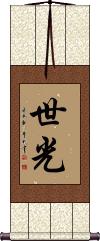
世光 means “light of the world” in a Buddhist context in Chinese and Japanese.
This can also be the personal name Toshimitsu in Japanese.
Shili / Shiri / Sri
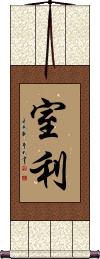
室利 is a Buddhist term or title that comes from the Sanskrit śrī.
The meaning is fortunate, lucky, prosperous, wealth, or beauty. This can be a sort of suffix for certain deities or respected people in Buddhism.
Sumo Wrestler
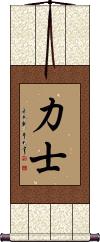
力士 literally means “strong man” but is more commonly used as a title for sumo wrestlers.
In Japanese, this is a Rikishi.
力士 is also used in Chinese and old Korean with the same meaning. Occasionally, this will also be used to refer to a strong or mighty man, hero, demigod, etc. But anyone in the CJK world will first think of a sumo wrestler before the more literary usage as a strong man or demigod.
Sushi
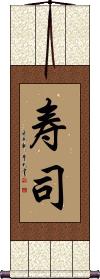
Got a 寿司/sushi restaurant and need an appropriate wall scroll? Or maybe you love sushi enough to have it on your wall. This sushi calligraphy scroll is for you.
Note that the written characters for sushi are the same in Chinese and Japanese. However, the first character is actually a modern Japanese / Simplified Chinese, so in some cases, it will be written differently in Taiwan, Hong Kong, and some older Japanese sushi restaurants where you might see 壽司 instead of 寿司.
Ten
The number ten
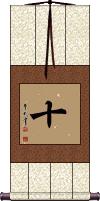
十 is the number ten in Chinese, Japanese Kanji, and old Korean Hanja.
This is a strange selection for a wall scroll, so it's here mostly for reference. I guess it's OK if the number ten is important to you.
 Because this character is rather simple (just two strokes), there is an anti-fraud way to write ten on bank documents. This variant is shown to the right.
Time
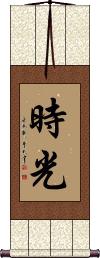
時光 is a Chinese and Japanese word that means time, era, period of time, etc.
時光 is used as part of other words like “time machine” (時光機) or “happy time” (歡樂時光) (happy hour) in bars.
This can also be a surname or given name, Tokimitsu, in Japan.
Warrior
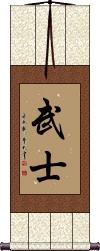
The first character, 武, is the spirit or essence of a warrior. The second character, 士, means soldier, officer, or official. 武士 is also used appropriately enough to describe a piece of a chess game. 武士 can also be translated as a soldier, cavalier, palace guard, or samurai, and sometimes as a knight. I've occasionally seen this translated as strong man or tough man (gender not necessarily implied).
By far, 武士 is the most common way to write warrior in Chinese characters, Japanese Kanji, and old Korean Hanja.
Note: In Japanese, this is Bushi, as in Bushido.
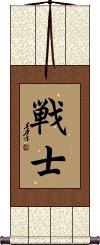
Warrior / Fighter
Senshi
Bushido / The Way of the Samurai
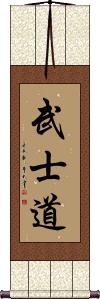
武士道 is the title for “The Code of the Samurai.”
Sometimes called “The Seven Virtues of the Samurai,” “The Bushido Code,” or “The Samurai Code of Chivalry.”
This would be read in Chinese characters, Japanese Kanji, and old Korean Hanja as “The Way of the Warrior,” “The Warrior's Way,” or “The Warrior's Code.”
It's a set of virtues that the Samurai of Japan and ancient warriors of China and Korea had to live and die by. However, while known throughout Asia, this title is mostly used in Japan and thought of as being of Japanese origin.
The seven commonly-accepted tenets or virtues of Bushido are Rectitude 義, Courage 勇, Benevolence 仁, Respect 礼(禮), Honour 名誉, Honesty 誠, and Loyalty 忠実. These tenets were part of oral history for generations, thus, you will see variations in the list of Bushido tenets depending on who you talk to.
See our page with just Code of the Samurai / Bushido here
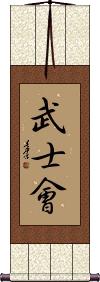
Bushi Kai
Enlightenment
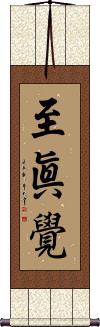
至眞覺 represents the enlightenment of one who has attained the ultimate truth.
This would be the state of an enlightened or liberated person in the context of Buddhism. A goal that all should want to attain and aspire for.
Shidokan
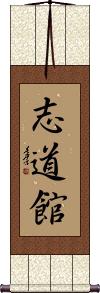
志道館 is the Japanese title Shidōkan (sometimes pronounced Kokorozashi-do-kan).
志道館 is often associated with Shorin-ryu Shidokan (小林流志道館). Do not confuse this title with the newer 士道館 which is also romanized as Shidōkan.
Shiite sect of Islam
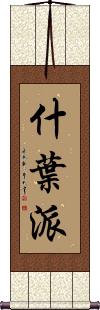
什葉派 is the Chinese title for the Shiite sect of Islam.
Guardian Angel
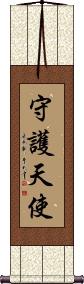
守護天使 is the title used for guardian angel in Chinese and Japanese Kanji.
It's used in the same way we use this title in the west - such as a guardian angel watching out for you and allowing you to survive a disaster or accident.
The first two characters mean to guard and protect. The second two mean “angel” (literally “Heaven's messenger”).
I Love You / Aishiteru
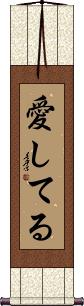
It's very uncommon (some will say taboo) to say “I love you” in Japanese culture. It's especially awkward for a man to tell a woman this in Japanese. Everyone is more likely to say “Watashi wa anata ga suki desu” or “I like you” (literally, “I regarding you, have like.”
If you have to say “I love you” in Japanese, 愛してる is a selection of Kanji and Hiragana that provide a way.
Note: Because this selection contains some special Japanese Hiragana characters, it should be written by a Japanese calligrapher.
Krishna
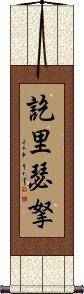
訖里瑟拏 is the name Krishna in Chinese (Mandarin) as well as a version of this name used in Japanese.
Marici / Marishiten
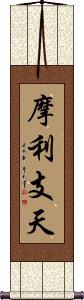
This is the Chinese and Japanese title for Marici, the Buddhist god of war.
Pronounced as Marishiten in Japan or Molizhitian in China.
The original name Mārīcī comes from the Sanskrit मारीची which literally means “Ray of Light.”
The Nature of Martial Arts
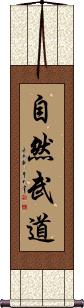
自然武道 is a means the Nature of Martial Arts.
The first two characters create a word that means nature, natural, or spontaneous.
The last two characters are often translated as martial arts.
Shikantaza
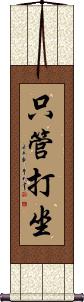
只管打坐 is the Japanese Buddhist term shikantaza which represents zazen meditation in which one focuses on sitting without actively seeking enlightenment.
Sometimes this is translated as “meditation of just sitting” or “meditation practice where one stays intensely focused without focusing on any particular object.”
Sometimes written, 祗管打坐 with the same pronunciation and perceived meaning.
Sisters at Heart
The love between sisters
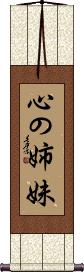
心の姉妹 is “heart of sisters,” “soul sisters,” or “sisters of the heart.”
This can be used for actual sisters to celebrate the heartfelt love they feel.
It can even be used by two women who feel a connection as if they are sisters.
Shorin-Ryu Shidokan
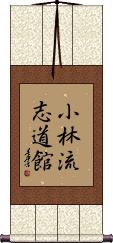
小林流志道館 is the Japanese title Shorin-ryu Shidōkan.
Not the results for shi that you were looking for?
Below are some entries from our dictionary that may match your shi search...
| Characters If shown, 2nd row is Simp. Chinese |
Pronunciation Romanization |
Simple Dictionary Definition |
侍 see styles |
shì shi4 shih hito ひと |
More info & calligraphy: Samurai(1) (archaism) man in attendance (on a person of high standing); retainer; (2) (abbreviation) (hist) (See 侍所・2) samurai guard house (Heian and Kamakura periods); (given name) Hito Attend; wait on; attendant. |
勢 势 see styles |
shì shi4 shih seiji / seji せいじ |
More info & calligraphy: Potential / Momentum(suffix noun) group (of people, players, companies, etc.); camp; team; (personal name) Seiji bala, sthāman. Power, influence, authority; aspect, circumstances. |
實 实 see styles |
shí shi2 shih minoru みのる |
More info & calligraphy: Honesty(s,m) Minoru Real, true, honest, sincere; solid; fixed; full; to fill; fruit, kernel, effects; verily, in fact; it is used for 眞, as in 一實 the supreme fact, or ultimate reality; also for bhūta. |
柿 see styles |
shì shi4 shih kokera こけら |
More info & calligraphy: Persimmon(irregular kanji usage) (1) chopped wood; wood chips; (2) (abbreviation) thin shingles; kaki; Japanese persimmon (Diospyros kaki); (surname) Kokera persimmon |
石 see styles |
shí shi2 shih tsuruishi つるいし |
More info & calligraphy: Stone / Rock(counter) (1) counter for jewels in a watch; (counter) (2) counter for transistors, diodes, etc. in an electronic product; (surname) Tsuruishi Stone, rock. |
世光 see styles |
shì guāng shi4 guang1 shih kuang toshimitsu としみつ |
More info & calligraphy: Light of the Worldlight of the world |
世界 see styles |
shì jiè shi4 jie4 shih chieh sekai せかい |
More info & calligraphy: The World(1) the world; society; the universe; (2) sphere; circle; world; (can be adjective with の) (3) world-renowned; world-famous; (4) {Buddh} (original meaning) realm governed by one Buddha; space; (surname, female given name) Sekai Loka 世間; the finite world, the world, a world, which is of two kinds: (1) 衆生世界 that of the living, who are receiving their 正報 correct recompense or karma; (2) 器世界 that of the material, or that on which karma depends for expression. By the living is meant 有情 the sentient. |
乘勢 乘势 see styles |
chéng shì cheng2 shi4 ch`eng shih cheng shih |
More info & calligraphy: Strike While the Iron is Hot |
乾屍 干尸 see styles |
gān shī gan1 shi1 kan shih |
More info & calligraphy: Mummy / Dried Corpse |
亨氏 see styles |
hēng shì heng1 shi4 heng shih |
More info & calligraphy: Heinz |
什葉 什叶 see styles |
shí yè shi2 ye4 shih yeh |
More info & calligraphy: Shii |
伊始 see styles |
yī shǐ yi1 shi3 i shih |
More info & calligraphy: New Beginning |
來世 来世 see styles |
lái shì lai2 shi4 lai shih raise |
More info & calligraphy: Eternal Life / Future LifeFuture world, or rebirth. |
信實 信实 see styles |
xìn shí xin4 shi2 hsin shih nobuzane のぶざね |
More info & calligraphy: Faithfulness(personal name) Nobuzane |
力士 see styles |
lì shì li4 shi4 li shih rikishi りきし |
More info & calligraphy: Sumo Wrestler(1) {sumo} sumo wrestler; rikishi; (2) strong man; (3) (abbreviation) {Buddh} (See 金剛力士) Deva king; (surname) Rikishi 力者 vīra. A strong or mighty man, hero, demigod. Used for the Licchavi, also 離車; 梨車 (or 黎車); 栗呫媻. The terms 力士城 and 力士生地 are defined as Kuśinagara. |
勇士 see styles |
yǒng shì yong3 shi4 yung shih yuuji / yuji ゆうじ |
More info & calligraphy: Brave Warriorbrave warrior; hero; brave man; (given name) Yūji |
十七 see styles |
shí qī shi2 qi1 shih ch`i shih chi tona とな |
More info & calligraphy: 17 Seventeen17; seventeen; (surname) Tona |
十八 see styles |
shí bā shi2 ba1 shih pa toya とや |
More info & calligraphy: Eighteen / 1818; eighteen; (personal name) Toya aṣṭādaśa, eighteen. |
十戒 see styles |
shí jiè shi2 jie4 shih chieh jukkai じゅっかい |
More info & calligraphy: Ten Commandments(1) (Buddhist term) the 10 precepts; (2) Ten Commandments; Decalogue; Decalog; (surname) Jukkai Śikṣāpada. The ten prohibitions (in Pāli form) consist of five commandments for the layman: (1) not to destroy life 不殺生 pāṇātipātāveramaṇi; (2) not to steal 不倫盜 adinnādānāver; (3) not to commit adultery 不婬慾 abrahmacaryaver.; (4) not to lie 不妄語musāvādāver.; (5) not to take intoxicating liquor 不飮酒 suramereyya-majjapamādaṭṭhānāver. Eight special commandments for laymen consist of the preceding five plus: (6) not to eat food out of regulated hours 不非時食 vikāla-bhojanāver.; (7) not to use garlands or perfumes 不著華鬘好香塗身 mālā- gandha-vilepana-dhāraṇa-maṇḍana-vibhūṣanaṭṭhānā; (8) not to sleep on high or broad beds (chastity) 不坐高廣大牀 uccāsayanā-mahāsayanā. The ten commandments for the monk are the preceding eight plus: (9) not to take part in singing, dancing, musical or theatrical performances, not to see or listen to such 不歌舞倡伎不往觀聽 nacca-gīta-vādita-visūkadassanāver.; (10) to refrain from acquiring uncoined or coined gold, or silver, or jewels 不得捉錢金銀寶物 jātarūpa-rajata-paṭīggahaṇāver. Under the Māhayāna these ten commands for the monk were changed, to accord with the new environment of the monk, to the following: not to kill, not to steal, to avoid all unchastity, not to lie, not to slander, not to insult, not to chatter, not to covet, not to give way to anger, to harbour no scepticism. |
十月 see styles |
shí yuè shi2 yue4 shih yüeh totsuki とつき |
More info & calligraphy: October(adverbial noun) October; (female given name) Totsuki |
十法 see styles |
shí fǎ shi2 fa3 shih fa jippō |
More info & calligraphy: Ten perfect Mahayana rules |
博世 see styles |
bó shì bo2 shi4 po shih hiroyo ひろよ |
More info & calligraphy: Bosch(female given name) Hiroyo |
合十 see styles |
hé shí he2 shi2 ho shih gōjū |
More info & calligraphy: Namaste - Greeting合爪; 合掌 To bring the ten fingers or two palms together; a monk's salutation. |
啟示 启示 see styles |
qǐ shì qi3 shi4 ch`i shih chi shih |
More info & calligraphy: Inspire |
嘗試 尝试 see styles |
cháng shì chang2 shi4 ch`ang shih chang shih |
More info & calligraphy: Let Us Try |
士兵 see styles |
shì bīng shi4 bing1 shih ping |
More info & calligraphy: Soldier / Private |
大師 大师 see styles |
dà shī da4 shi1 ta shih daishi だいし |
More info & calligraphy: Grand Master / Great Teacher(honorific or respectful language) {Buddh} great teacher (i.e. a buddha, bodhisattva or high monk, esp. Kobo Daishi); (place-name) Daishi Great teacher, or leader, one of the ten titles of a Buddha. |
天使 see styles |
tiān shǐ tian1 shi3 t`ien shih tien shih yukari ゆかり |
More info & calligraphy: Angel / Messenger of Heaven(noun - becomes adjective with の) angel; (female given name) Yukari Divine messengers, especially those of Yama; also his 三天使 three messengers, or lictors— old age, sickness, death; and his 五天使 or 五大使, i. e. the last three together with rebirth and prisons or punishments on earth. |
失戀 失恋 see styles |
shī liàn shi1 lian4 shih lien |
More info & calligraphy: Broken HeartedSee: 失恋 |
室利 see styles |
shì lì shi4 li4 shih li shiri |
More info & calligraphy: Shili / Shiri / Sri |
Click here for more shi results from our dictionary
The following table may be helpful for those studying Chinese or Japanese...
| Title | Characters | Romaji (Romanized Japanese) | Various forms of Romanized Chinese | |
| Xishi Xi Shi | 西施 | sei shi / seishi | xī shī / xi1 shi1 / xi shi / xishi | hsi shih / hsishih |
| Stone Rock | 石 | ishi | shí / shi2 / shi | shih |
| You are always a beauty in your lover’s eyes | 情人眼里出西施 | qíng rén yǎn lǐ chū xī shī qing2 ren2 yan3 li3 chu1 xi1 shi1 qing ren yan li chu xi shi qingrenyanlichuxishi | ch`ing jen yen li ch`u hsi shih chingjenyenlichuhsishih ching jen yen li chu hsi shih |
|
| Shiken Haramitsu Daikomyo | 四拳波羅蜜大光明 | shi ken ha ra mitsu dai kou myou shi ken ha ra mitsu dai ko myo | ||
| Best | 至 | shi | zhì / zhi4 / zhi | chih |
| Honesty | 實 实 | shí / shi2 / shi | shih | |
| Persimmon | 柿 | kaki | shì / shi4 / shi | shih |
| Potential Momentum | 勢 势 | zei | shì / shi4 / shi | shih |
| Samurai | 侍 | samurai | shì / shi4 / shi | shih |
| Esprit de Corps Determination | 志気 | shi ki / shi ge shiki / shige | ||
| The Four Seasons | 四季 | shi ki / shiki | sì jì / si4 ji4 / si ji / siji | ssu chi / ssuchi |
| One Heart One Mind Heart and Soul | 一心 | isshin / ishin | yī shì dài yi1 shi4 dai4 yi shi dai yishidai | i shih tai ishihtai |
| Shidai Sida Mahabhuta | 四大 | shi dai / shidai | sì dà / si4 da4 / si da / sida | ssu ta / ssuta |
| Light of the World | 世光 | toshimitsu | shì guāng shi4 guang1 shi guang shiguang | shih kuang shihkuang |
| Shili Shiri Sri | 室利 | shiri | shì lì / shi4 li4 / shi li / shili | shih li / shihli |
| Sumo Wrestler | 力士 | ri kishi / rikishi | lì shì / li4 shi4 / li shi / lishi | li shih / lishih |
| Sushi | 壽司 寿司 | su shi / sushi | shòu sī / shou4 si1 / shou si / shousi | shou ssu / shoussu |
| Ten | 十 / 拾 十 | juu / ju | shí / shi2 / shi | shih |
| Time | 時光 时光 | tokimitsu | shí guāng shi2 guang1 shi guang shiguang | shih kuang shihkuang |
| Warrior | 武士 | bu shi / bushi | wǔ shì / wu3 shi4 / wu shi / wushi | wu shih / wushih |
| Warrior Fighter | 戦士 | sen shi / senshi | ||
| Bushido The Way of the Samurai | 武士道 | bu shi do / bushido | wǔ shì dào wu3 shi4 dao4 wu shi dao wushidao | wu shih tao wushihtao |
| Bushi Kai | 武士會 武士会 | bu shi kai / bushikai | ||
| Enlightenment | 至眞覺 至眞觉 | shi shin kaku shishinkaku | zhì zhēn jué zhi4 zhen1 jue2 zhi zhen jue zhizhenjue | chih chen chüeh chihchenchüeh |
| Shidokan | 志道館 | shi dou kan shidoukan shi do kan | ||
| Shiite sect of Islam | 什葉派 什叶派 | shí yè pài shi2 ye4 pai4 shi ye pai shiyepai | shih yeh p`ai shihyehpai shih yeh pai |
|
| Guardian Angel | 守護天使 守护天使 | shu go ten shi shugotenshi | shǒu hù tiān shǐ shou3 hu4 tian1 shi3 shou hu tian shi shouhutianshi | shou hu t`ien shih shouhutienshih shou hu tien shih |
| I Love You Aishiteru | 愛してる | ai shi te ru aishiteru | ||
| Krishna | 訖里瑟拏 讫里瑟拏 | ki ri shi na kirishina | qì lǐ sè ná qi4 li3 se4 na2 qi li se na qilisena | ch`i li se na chilisena chi li se na |
| Marici Marishiten | 摩利支天 | ma ri shi ten marishiten | mó lì zhī tiān mo2 li4 zhi1 tian1 mo li zhi tian molizhitian | mo li chih t`ien molichihtien mo li chih tien |
| The Nature of Martial Arts | 自然武道 | shi zen bu do shizenbudo | zì rán wǔ dào zi4 ran2 wu3 dao4 zi ran wu dao ziranwudao | tzu jan wu tao tzujanwutao |
| Shikantaza | 只管打坐 | shi kan ta za shikantaza | zhǐ guǎn dǎ zuò zhi3 guan3 da3 zuo4 zhi guan da zuo zhiguandazuo | chih kuan ta tso chihkuantatso |
| Sisters at Heart | 心の姉妹 | kokoro no shi mai kokoronoshimai | ||
| Shorin-Ryu Shidokan | 小林流志道館 | sho rin ryu shi dou kan shorinryushidoukan sho rin ryu shi do kan | ||
| In some entries above you will see that characters have different versions above and below a line. In these cases, the characters above the line are Traditional Chinese, while the ones below are Simplified Chinese. | ||||

Successful Chinese Character and Japanese Kanji calligraphy searches within the last few hours...



