Many custom options...


And formats...



Live in Chinese / Japanese...
Buy a Live calligraphy wall scroll here!
Personalize your custom “Live” project by clicking the button next to your favorite “Live” title below...
2. Live In The Moment / Live In The Now
6. Live For The Day / Seize The Day
11. Live in Peace and Contentment
13. Live and Let Die
15. Live Free or Die
17. Live Well
18. Live Together and Help Each Other
19. Live Love Die
Live Without Regret
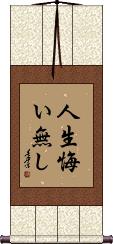
人生悔い無し is how to say “live without regrets” in Japanese.
Note: Because this selection contains some special Japanese Hiragana characters, it should be written by a Japanese calligrapher.
Live Without Regret
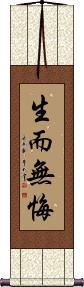
生而無悔 is how to say “live without regrets” in Mandarin Chinese.
Note: There is some debate about whether this makes sense in Japanese. It would be read, "nama ji mu ke," and be understood in Japanese. But, a Japanese person will probably think it’s Chinese (not Japanese).
Live In The Moment / Live In The Now
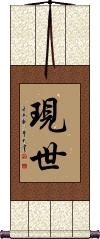
現世 is a very short way to write “live in the moment” or “live in the now” in Japanese.
This short word is open to interpretation. It's used in Japanese Buddhism to mean “the current epoch” or “the current age” (the current age is but a brief moment in the greater scope of existence). In that context, this is pronounced “utsushiyo” or “ustusiyo” in Japanese. Otherwise, it's pronounced “gensei” in Japanese.
Other translation possibilities include:
Earthly world
This world
This life
Present life
Present generation
Present incarnation
This existence
This (momentary) reality
Note: This is also a word in Chinese and old Korean Hanja. While the meaning is more or less the same, this is not recommended for a wall scroll if your audience is Chinese or Korean. This selection is best if your audience is Japanese.
Living / Live Life
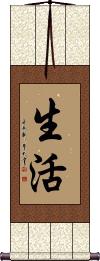
生活 means life, living, to live, or the state of being alive. It can also refer to your daily existence or livelihood. It can also be a suggestion to just “Live life.”
生活 is also the term used in other titles such as “healthy living” or Lance Armstrong's “Livestrong” campaign (Chinese title for Livestrong only).
If you need a reminder that you are alive and to take a breath, this might be the perfect wall scroll for you.
Live For The Day
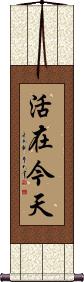
活在今天 is not an eastern concept, so it does not translate into a phrase that seems natural on a wall scroll.
However, if this is your philosophy, the characters shown here do capture your idea of living for today or living in the moment. 活在今天 says “Live in today,” and they are grammatically correct in Chinese.
Note: This kind of makes sense in Korean Hanja but the grammar is Chinese, so it’s not that natural in Korean.
Live Laugh Love
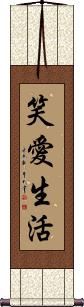
In English, the word order shown in the title is the most natural or popular. In Chinese, the natural order is a little different:
The first character means laugh (sometimes means smile).
The second character means love.
The last two characters mean “live” as in “to be alive” or “pursue life.”
Please note: 笑愛生活 is not a normal phrase in that it does not have a subject, verb, or object. It is a word list. Word lists are not common in Asian languages/grammar (at least not as normal as in English). We only added this entry because so many people requested it.
We put the characters in the order shown above, as it almost makes a single word with the meaning “A life of laughter and love.” It's a made-up word, but it sounds good in Chinese.
We removed the Japanese pronunciation guide from this entry, as the professional Japanese translator deemed it "near nonsense" from a Japanese perspective. Choose this only if your audience is Chinese and you want the fewest-possible characters to express this idea.
In Korean, this would be 소애생활 or "so ae saeng hwar" but I have not confirmed that this makes sense in Korean.
Live For The Day / Seize The Day
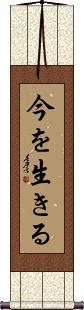
今を生きる is a Japanese phrase that can be translated as “live for the day,” “live for the moment,” “seize the day,” or “make the most of the present.”
You can think of this as the Japanese version of “Carpe Diem.”
Note: Because this selection contains some special Japanese Hiragana characters, it should be written by a Japanese calligrapher.
Live in Prosperity
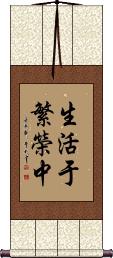
生活于繁榮中 means “live in prosperity.” It's kind of a suggestion to be prosperity the center of your world.
This is the way some people want to live (and you should always live for what you love). However, this phrase does not suggest a peaceful life - rather one that is always busy. It's not for everyone, but it might be for you.
See Also: Prosperity
Ikiru / To Live
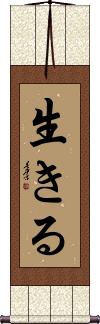
生きる is a Japanese title that means to live, to exist, to make a living, to subsist, to come to life, or to be enlivened.
生きる is also the title of a 1952 Japanese movie that uses the translated English title of “To Live.”
This term, when used in the context of baseball, and some Japanese games such as “go,” can mean “safe.”
Note: Because this selection contains some special Japanese Hiragana characters, it should be written by a Japanese calligrapher.
Live Laugh Love
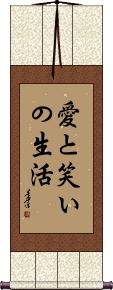
Because a word list of “Live Laugh Love” is not natural in Japanese, this takes the concept and incorporates it into a proper phrase.
愛と笑いの生活 can be translated as “A life of love and laughter” or “Live life with love and laughter.”
Note: Because this selection contains some special Japanese Hiragana characters, it should be written by a Japanese calligrapher.
You Only Live Once
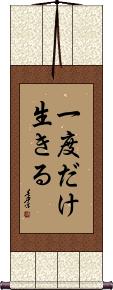
一度だけ生きる is the simplest Japanese phrase that means “[you] only live once” or “only one [life] to live.”
The first four characters create a word that means “only once.”
The last three characters create a word that means “to live” or “to exist.”
Note: Because this selection contains some special Japanese Hiragana characters, it should be written by a Japanese calligrapher.
Live in Peace and Contentment
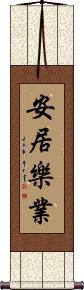
安居樂業 is the Chinese, Japanese Kanji, and old Korean Hanja proverb for “living in peace and working happily,” or “to live in peace and be content with one's occupation.”
Live Long and Prosper
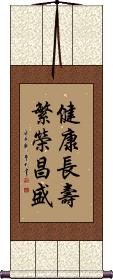
This means “Live Long And Prosper” in Chinese.
A phrase and greeting made famous by Leonard Nimoy in the role of Spock on the original Star Trek TV series.
Live and Let Die
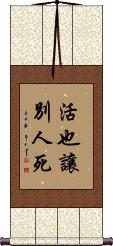
活也讓別人死 means “live and let die” in Chinese.
This is the Chinese translation of the song lyric by Guns 'n Roses for the James Bond 007 movie of the same name.
Live and Let Die
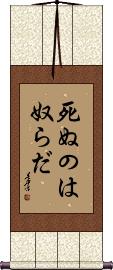
死ぬのは奴らだ means “live and let die,” in Japanese.
死ぬのは奴らだ is the Japanese title of the James Bond 007 movie of the same name.
Note: Because this selection contains some special Japanese Hiragana characters, it should be written by a Japanese calligrapher.
Live for What You Love
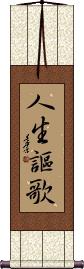
人生謳歌 means “live for what you love” in Japanese.
The first two characters mean “human life” or simply “living.” The last two characters mean “merit,” “prosperity,” or “what you enjoy.” This phrase can suggest working or staying busy for your own goals (in your career).
See Also: Prosperity
Live Free or Die
Give me liberty or give me death
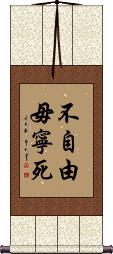
不自由毋寧死 means “Give me liberty or give me death” in Chinese.
This is also the best way to say, “Live free or die.”
The characters break down this way:
不 = Not; none; without.
自由 = Freedom; liberty; freewill; self-determination.
毋寧 = Rather; would rather; rather be.
死 = Dead; death.
This will go nicely next to your “Don't tread on me” flag. This phrase is known well enough in China that it's listed in a few dictionaries. Though I doubt you will find too many Chinese citizens willing to yell this on the steps of the capital in Beijing.
See Also: Death Before Dishonor
You Only Live Once
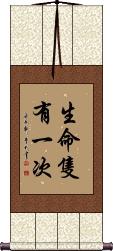
生命隻有一次 is the translation to Chinese of the popular English phrase, “You only live once.”
This is a more modern idea for Chinese people. The reason is, most Chinese people were taught quite the opposite idea from Buddhism.
Live Well
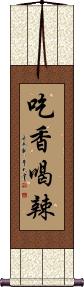
This Chinese proverb means “to eat delicious food and drink liquor.”
It is taken or understood to suggest living well.
Live Together and Help Each Other
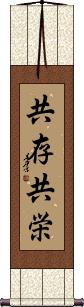
共存共栄 is a Japanese proverb that means “live together and help each other,” “existing together, thriving together,” or “co-existence and co-prosperity.”
Live Love Die
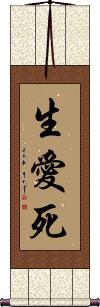
This came from a customer's request, but it's not too bad.
These three simple characters suggest that you are born, you learn to love, and then exit the world.
Live By The Sword Die By The Sword
Matthew 26:52
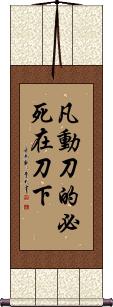
凡动刀的,必死在刀下 is the second part of Matthew 26:52 from the Chinese Union Bible where Jesus suggests that one who uses a sword will also die by it.
This in-stock artwork might be what you are looking for, and ships right away...

Gallery Price: $61.00
Your Price: $33.88

Gallery Price: $31.00
Your Price: $16.88

Gallery Price: $200.00
Your Price: $122.88
These search terms might be related to Live:
5. Right Living / Right Livelihood / Perfect Livelihood
Breathe
Embrace Life / Embrace Living
Endure and Survive
Healthy Living
Living / Live Life
Mono No Aware
Return to Dwell in Gardens and Fields Poem
Settle
Stay Strong / Indestructible / Unbreakable
Stay Strong / Iron Will
Survive
The Buddha is in Each Sentient Being
The Key to Immortality is First Living a Life Worth Remembering
The following table may be helpful for those studying Chinese or Japanese...
| Title | Characters | Romaji (Romanized Japanese) | Various forms of Romanized Chinese | |
| Live Without Regret | 人生悔い無し | jinsei kui nashi jinseikuinashi | ||
| Live Without Regret | 生而無悔 生而无悔 | shēng ér wú huǐ sheng1 er2 wu2 hui3 sheng er wu hui shengerwuhui | sheng erh wu hui shengerhwuhui |
|
| Live In The Moment Live In The Now | 現世 现世 | gen sei / gensei | xiàn shì / xian4 shi4 / xian shi / xianshi | hsien shih / hsienshih |
| Living Live Life | 生活 | sei katsu / seikatsu | shēng huó sheng1 huo2 sheng huo shenghuo | |
| Live For The Day | 活在今天 | huó zài jīn tiān huo2 zai4 jin1 tian1 huo zai jin tian huozaijintian | huo tsai chin t`ien huotsaichintien huo tsai chin tien |
|
| Live Laugh Love | 笑愛生活 笑爱生活 | xiào ài shēng huó xiao4 ai4 sheng1 huo2 xiao ai sheng huo xiaoaishenghuo | hsiao ai sheng huo hsiaoaishenghuo |
|
| Live For The Day Seize The Day | 今を生きる | ima wo i ki ru imawoikiru | ||
| Live in Prosperity | 生活于繁榮中 生活于繁荣中 | shēng huó yú fán róng zhōng sheng1 huo2 yu2 fan2 rong2 zhong1 sheng huo yu fan rong zhong shenghuoyufanrongzhong | sheng huo yü fan jung chung shenghuoyüfanjungchung |
|
| Ikiru To Live | 生きる | ikiru | ||
| Live Laugh Love | 愛と笑いの生活 | ai to warai no seikatsu aitowarainoseikatsu | ||
| You Only Live Once | 一度だけ生きる | ichi do da ke i ki ru ichidodakeikiru | ||
| Live in Peace and Contentment | 安居樂業 安居乐业 | an kyo raku gyou ankyorakugyou an kyo raku gyo | ān jū lè yè an1 ju1 le4 ye4 an ju le ye anjuleye | an chü le yeh anchüleyeh |
| Live Long and Prosper | 健康長壽繁榮昌盛 健康长寿繁荣昌盛 | Jiàn kāng cháng shòu fán róng chāng shèng Jian4 kang1 chang2 shou4 fan2 rong2 chang1 sheng4 Jian kang chang shou fan rong chang sheng | Chien k`ang ch`ang shou fan jung ch`ang sheng Chien kang chang shou fan jung chang sheng |
|
| Live and Let Die | 活也讓別人死 活也让别人死 | huó yě ràng bié rén sǐ huo2 ye3 rang4 bie2 ren2 si3 huo ye rang bie ren si huoyerangbierensi | huo yeh jang pieh jen ssu huoyehjangpiehjenssu |
|
| Live and Let Die | 死ぬのは奴らだ | shinu no wa yatsuradesu shinunowayatsuradesu | ||
| Live for What You Love | 人生謳歌 | jin sei ou ka jinseiouka jin sei o ka | ||
| Live Free or Die | 不自由毋寧死 不自由毋宁死 | bú zì yóu wú nìng sǐ bu2 zi4 you2 wu2 ning4 si3 bu zi you wu ning si buziyouwuningsi | pu tzu yu wu ning ssu putzuyuwuningssu |
|
| You Only Live Once | 生命隻有一次 生命只有一次 | shēng mìng zhǐ yǒu yí cì sheng1 ming4 zhi3 you3 yi2 ci4 sheng ming zhi you yi ci shengmingzhiyouyici | sheng ming chih yu i tz`u shengmingchihyuitzu sheng ming chih yu i tzu |
|
| Live Well | 吃香喝辣 | chī xiāng hē là chi1 xiang1 he1 la4 chi xiang he la chixianghela | ch`ih hsiang ho la chihhsianghola chih hsiang ho la |
|
| Live Together and Help Each Other | 共存共栄 | kyou son kyou ei kyousonkyouei kyo son kyo ei | ||
| Live Love Die | 生愛死 生爱死 | sei ai shi / seiaishi | shēng ài sǐ sheng1 ai4 si3 sheng ai si shengaisi | sheng ai ssu shengaissu |
| Live By The Sword Die By The Sword | 凡動刀的必死在刀下 凡动刀的必死在刀下 | fán dòng dāo de bì sǐ zài dāo xià fan2 dong4 dao1 de bi4 si3 zai4 dao1 xia4 fan dong dao de bi si zai dao xia | fan tung tao te pi ssu tsai tao hsia | |
| In some entries above you will see that characters have different versions above and below a line. In these cases, the characters above the line are Traditional Chinese, while the ones below are Simplified Chinese. | ||||

Successful Chinese Character and Japanese Kanji calligraphy searches within the last few hours...



