Didn't find what you want?
Try these methods:
1. Use other similar-meaning words.
2. Use fewer words or just one word.
3. Post your request on my forum so we can translate it for you.
All custom calligraphy items are made-to-order in our little Beijing artwork-mounting workshop.
Buy a Cheng calligraphy wall scroll here!
Start your custom "Cheng" project by clicking the button next to your favorite "Cheng" title below...
Quick links to words on this page...


These four characters together relay the meaning that can be expressed in English as, "When three people say there's a tiger running in the street, you believe it".
Of course, there is an ancient story behind this idiom...
This is actually a proverb that resulted from a conversation that occurred around 300 B.C.
The conversation was between the king of the Wei kingdom and one of the king's ministers named Pang Cong.
It was near the end of one of many wars, this time with the Zhao kingdom. Pang Cong was to be sent by the king to the Zhao kingdom with the king's son who was to be held hostage. It was common at the time for a king to make his son a hostage to secure stable peace between warring kingdoms.
Before minister Pang Cong departed, he asked his king, "If one person told you there was a tiger running in the street, would you believe it?".
"No", the king said.
The minister continued, "What if two people told you?"
The king replied, "Well, I would have my doubts, but I might believe it".
The minister continued, "So, what if three people told you that there is a tiger running in the streets?"
The king replied, "Yes, I would believe it, it must be true if three people say it".
The minister then reminded the king, "Your son and I are now traveling far away to live in the distant Zhao kingdom - much farther from your palace than the street. Rumors may fly about me in my absence, so I hope your majesty will weight such rumors appropriately".
The king replied, "I have every trust in you, do not worry"
While the minister was gone, the king's enemies gossiped about minister Pang Cong on many occasions. At first, the king thought nothing of these comments and rumors. But slowly as the rumors mounted, the king began to suspect ill of his minister.
Some time later when peace was well-established, the minister and prince were freed and returned to the kingdom of Wei. The king received his son, BUT DID NOT EVEN SUMMON MINISTER PANG CONG TO THE PALACE!
Hopefully this story will help you see how dangerous words can be when used to promote rumors, or create ill will. And perhaps will inspire you to not believe everything you hear.
There is also a secondary suggestion in this idiom that gossip is as ferocious as a tiger. Some Chinese people who don't know the ancient story above may believe that this scroll means that rumors are as vicious as three tigers.
Note: This proverb appears in my Korean dictionary, but is not well-known in Korea.


This literally translates as: [One who] cannot steer the boat blames the bends in the river.
Figuratively, this means: One who is incompetent always tries to shift the blame elsewhere.
This is similar to the English idiom, "a poor workman/craftsman blames his tools".


This Chinese proverb represents having great ambitions. British might say "to plough through". Another way to understand it is, "surmount all difficulties and forge ahead courageously".
This can also be translated as, "braving the wind and waves" or "to brave the wind and the billows".
Literally it reads: "ride [the] wind [and] break/cleave/cut [the] waves", or "ride [the] wind [and] slash [through the] waves".
This is a great proverb to encourage yourself or someone else not to be afraid of problems or troubles, and when you have a dream just go for it.


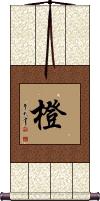
This is the single-character version of orange. This can refer to the color orange, or the fruit (Just like in English). Sometimes it can refer to a whole orange tree. In botany, it can refer to bitter orange (Citrus aurantium).
In Japanese, this is sometimes pronounced as Chen, and used as a female given name. When pronounced as Daidai or Kabuchi, it can be a surname in Japanese.


This proverb means exactly what you think.
Every failure that you experience is a chance to learn from it and find success.
Knowing what does not work is just as important as finding out what does work.
See Also... Experience Is The Mother Of Wisdom


This is often seen at weddings and other celebrations in China. It suggests that he dragon and phoenix will bring you auspicious tidings.
The first character is dragon.
The second is phoenix.
The third is presents or brings.
And the last means auspicious, propitious, or luck.


This is a custom word list scroll created at the special request of a customer.
This is a word list (not a normal Chinese or Japanese phrase).
Please contact me before deciding to purchase this phrase.


Commitment is caring deeply about something or someone. It is deciding carefully what you want to do, and then giving it 100%, holding nothing back. You give your all to a friendship, a task, or something you believe in. You finish what you start. You keep your promises.
In Chinese, this word directly means to undertake something or to make a promise to do something.
Within the idea of commitment, this word also means to make a big effort, or undertaking a great task. Outside of the commitment idea, this particular word can also mean approval, acceptance, consent, assent, acquiescence, or agreement depending on context (especially in Japanese and Korean). Therefore this word is probably best if your audience is Chinese.
See Also... Partnership | Hard Work | Dedication


This is the word most often used in Chinese, Korean and Japanese to mean accomplishment or achievement. This word can also be used to mean success, attain a result, fulfillment, realization, or completion.


This Chinese proverb could also be translated in English as "No success can compensate for failure in the home".
Also, the word for "home" can be exchanged with "family".


This Chinese proverb literally translates as: [If the] helmsman is not nervous, the passengers [will feel] secure.
Figuratively, this means: If the leader appears confident, his/her followers will gain confidence also.
This is a great suggestion that a confident leader inspires confidence in his/her troops or followers. Of course, a nervous leader will create fear in troops or followers.


This word is universal in Chinese, Japanese Kanji and old Korean Hanja.
It can mean earnestness, enthusiasm, ardor, zeal, devotion, spirit, or fervor.


This is the occupational title of an engineer in Chinese. In China, an engineer might have a sign on his desk or a name badge that has his/her name on it, and this title. It's not too common to see this on a wall scroll in China, but you are allowed to take such liberties in the west.
Note that in China, a wall scroll like this is sometimes given to a teacher who builds (engineers) the spirits of their students. It's a way to honor a teacher, and in this case, the meaning departs from an occupational title.


This is the Chinese name for the Great Wall. Built at the northern border of China to protect from Mongul attack.
Notes:
In Japanese, this is a surname Nagaki. Japanese use a longer title for the Great Wall of China.
In Korean, this refers to Changsŏng (a city in Changsŏng-kun county, Chŏllanam-to province).


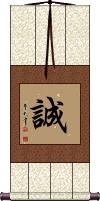
This character means truth, faith, fidelity, sincerity, trust and/or confidence.
As a single-character wall scroll, this suggests that you believe "honesty is the best policy", as your personal philosophy.
This is also a virtue of the Samurai Warrior
See our page with just Code of the Samurai / Bushido here


This is the English proverb,"The destination is nothing without the journey", translated into Chinese.


This means, "A life of happiness and prosperity" or "A life of happiness and success". It's a great and very positive and inspirational wall scroll selection.
See Also... Prosperity


This proverb means "Life is a Journey".
If this matches your philosophy, this might be the perfect Chinese calligraphy for you.


Loyalty is staying true to someone. It is standing up for something you believe in without wavering. It is being faithful to your family, country, school, friends or ideals, when the going gets tough as well as when things are good. With loyalty, you build relationships that last forever.
Notes:
1. This written form of loyalty is universal in Chinese, Japanese Kanji, and old Korean Hanja.
2. There is also a Japanese version that is part of the Bushido Code which may be more desirable depending on whether your intended audience is Japanese or Chinese.
3. This version of loyalty is sometimes translated as devotion, sincerity, fidelity, or allegiance.


This Chinese proverb means, "to grind an iron bar down to a fine needle", or "Even a bar of iron can be ground down to ta needle [with perseverance]".
Figuratively, this means to persevere in a difficult task or to study diligently.


These are the pillars of marriage (at least they are for some - if you have a different set of pillars and want them on a wall scroll, just post a custom phrase request on our forum).
This is actually a "word list", consisting of "Respect/Loyalty/Honesty". Word lists are not as common in Chinese as they are in English, but leaving that concern behind, this has a good meaning.
If you want to customize it more, add an inscription with your wedding date or names (just a small extra fee for translation).
Note: Because these are three separate words, the calligrapher may be inclined to leave a small space between each two-character word. Let us know if you have any preference when you place your order.


This is the clearest and most natural way to translate "Semper Fidelis" or "Always Faithful" into Mandarin Chinese. This is specifically meant for U.S. Marines who often use the shortened term "Semper Fi".
The first two characters are a word that means always, forever, and/or eternally.
The last two characters are a word that means fidelity, loyal, and/or devoted.
I spent 10 years in the Marines, so it was a no-brainer to add this to our calligraphy database.


This is the true essence of sincerity. It takes strength of personality to be truly sincere without over-doing it. Speaking of strength, this is probably the strongest way to convey the idea of sincerity in the Chinese language without over-doing it.
The first character literally means true, real, and genuine. While the second character means sincere and honest.


This is the idea that you enter into something with the utmost sincerity and fidelity. Ideas such as devotion, honesty, and "one's true heart" are also contained in this word.
This is a universal word as the Chinese, Japanese Kanji, and Korean Hanja are all identical.


This Chinese and Japanese word for "success" is often used to refer to "career success", but is also used for other successes in life.
It matches the western dictionary definition of "The achievement of something desired, planned, or attempted". And it's also used it this old Chinese proverb:
which means Failure is the Mother of Success.
Sometimes this word is translated as prosperity, but success, succeed, or successfully are more correct definitions.
See Also... Prosperity


This literally translates as: Only after much tempering is steel produced.
Figuratively, this means: True character must be tested in hardship.
This is a mild form of saying, "Whatever doesn't kill me, makes me stronger".


This is the Tom Clan Generational Poem. If you are interested in this poem, you probably already know the meaning, so for now we'll forgo including a translation.
Where there is a will, there is a way


This old Chinese proverb has been translated many different ways into English. As you read the translations below, keep in mind that in Chinese, heart=mind.
Nothing is impossible to a willing heart.
Nothing is impossible to a willing mind.
Nothing is difficult to a willing heart.
Where there is a will, there is a way.
Nothing in the world is impossible if you set your mind to do it.
A wilful man will have his way.
If you wish it,you will do it.
A determined heart can accomplish anything.
All things are possible to a strong mind.


This is the Chinese and Japanese way to write Libra (scales) of western astrology.
See Also... Chinese Zodiac


This is an ancient Chinese proverb used in modern times to wish someone a long and successful career.
It's really about the 10,000 Flight of the Peng (Peng, also known as Roc is a mythical fish that can turn into a bird and take flight).
Breaking down each character:
1. Peng or Roc (a kind of bird).
2. Journey (in this case, a flight).
3. 10,000 (Ten Thousand).
4. Li is a unit of distance often referred to as a "Chinese Mile", though the real distance is about half a kilometer.
Direct Translation: "Peng's Journey [of] 10,000 Li".
Literal meaning: "The 10,000-Li Flying Range Of The Roc".
Perceived meaning: "To have a bright future" or "To go far".

庄子 - Zhuangzi
This proverb/idiom comes from the book of Zhuangzi. It tells the tale of a huge fish which could turn into a gigantic bird. This bird was called "peng" and was many miles long. This legendary size allowed the Peng to fly from the Northern Sea to the Southern Sea in a single bound.
Wishing someone "a Peng's Journey of 10,000 Li", will imply that they will be able to travel far without stopping, and will have great success, a long career, and a prosperous future.
Skills cannot be perfected without perseverance in practice


This literally translates as: Do not worry about not being able to master [a skill]; What [one should] be concerned about is lack of perseverance.
Figuratively, this means: One's skills cannot be perfected without perseverance in practice.
For me, I've learned that you can only get so much from school or studying. You've really got to do "on-the-job training" to perfect your ability and skill.
For martial arts students: You can read about a kick in a book, or someone can tell you about a certain kick, but until you practice the kick, there's no way you'll master it.


This Chinese proverb means, "persevere and you will succeed".
It's very much like the English idiom, "where there's a will, there's a way".


These are the five codes of Tang Soo Do. I suggest you have this arranged in five columns when you get to the options page for your custom calligraphy wall scroll.
Here's my translations of each of the five codes:
國家忠誠 Be loyal to your country.
父母孝道 In regards to parents, behave in a filial way.
朋友有信 Be faithful in friendship.
殺生有擇 When fighting for life and death, make noble choices.
臨戰無退 No retreat in battle.
Note: "Tang Soo Do" is actually 唐手道. It's 당수도 in Korean Hangul. It can also be romanized as "Tangsudo" or "Dangsudo".
The scroll that I am holding in this picture is a "medium size"
4-character wall scroll.
As you can see, it is a great size to hang on your wall.
(We also offer custom wall scrolls in larger sizes)
Professional calligraphers are getting to be hard to find these days.
Instead of drawing characters by hand, the new generation in China merely type roman letters into their computer keyboards and pick the character that they want from a list that pops up.
There is some fear that true Chinese calligraphy may become a lost art in the coming years. Many art institutes in China are now promoting calligraphy programs in hopes of keeping this unique form
of art alive.
Even with the teachings of a top-ranked calligrapher in China, my calligraphy will never be good enough to sell. I will leave that to the experts.
The same calligrapher who gave me those lessons also attracted a crowd of thousands and a TV crew as he created characters over 6-feet high. He happens to be ranked as one of the top 100 calligraphers in all of China. He is also one of very few that would actually attempt such a feat.
If your search is not successful, just post your request on our forum, and we'll be happy to do research or translation for any reasonable request.
Successful Chinese Character and Japanese Kanji calligraphy searches within the last few hours...

With so many searches, we had to upgrade to our own Linux server.
Of course, only one in 500 searches results in a purchase - Hey buy a wall scroll!!!
The following table is only helpful for those studying Chinese (or Japanese), and perhaps helps search engines to find this page when someone enters Romanized Chinese or Japanese
| Title | Characters Simplified Traditional | Japanese Romaji (Romanized Japanese) | Various forms of Romanized Chinese | |
| Tiger Rumor | 三人成虎 三人成虎 | n/a | sān rén chéng hǔ san ren cheng hu san jen ch`eng hu | san1 ren2 cheng2 hu3 sanrenchenghu sanjenchenghu san jen cheng hu |
| The incompetent boat pilot blames the river for his shortcomings | 不会撑船赖河湾 不會撐船賴河灣 | n/a | bù huì chēng chuán lài hé wān bu hui cheng chuan lai he wan pu hui ch`eng ch`uan lai ho wan | bu4 hui4 cheng1 chuan2 lai4 he2 wan1 buhuichengchuanlaihewan puhuichengchuanlaihowan pu hui cheng chuan lai ho wan |
| Great Ambitions | 乘风破浪 乘風破浪 | n/a | chéng fēng pò làng cheng feng po lang ch`eng feng p`o lang | cheng2 feng1 po4 lang4 chengfengpolang chengfengpolang cheng feng po lang |
| Orange | 橙 橙 | daidai | chéng cheng ch`eng | cheng2 cheng cheng |
| Failure is the Mother of Success | 失败是成功之母 失敗是成功之母 | n/a | shī bài shì chéng gōng zhī mǔ shi bai shi cheng gong zhi mu shih pai shih ch`eng kung chih mu | shi1 bai4 shi4 cheng2 gong1 zhi1 mu3 shibaishichenggongzhimu shih pai shih cheng kung chih mu |
| Dragon and Phoenix Brings Luck | 龙凤呈祥 龍鳳呈祥 | n/a | lóng fèng chéng xiáng long feng cheng xiang lung feng ch`eng hsiang | long2 feng4 cheng2 xiang2 longfengchengxiang lungfengchenghsiang lung feng cheng hsiang |
| Respect and Loyalty | 尊敬忠诚 尊敬忠誠 | son kei chu sei sonkeichusei | zūn jìng zhōng chéng zun jing zhong cheng tsun ching chung ch`eng | zun1 jing4 zhong1 cheng2 zunjingzhongcheng tsunchingchungcheng tsun ching chung cheng |
| Commitment | 承诺 承諾 | shoudaku shodaku | chéng nuò cheng nuo ch`eng no | cheng2 nuo4 chengnuo chengno cheng no |
| Achievement / Accomplishment | 成就 成就 | jouju joju | chéng jiù cheng jiu ch`eng chiu | cheng2 jiu4 chengjiu chengchiu cheng chiu |
| Any success can not compensate for failure in the home | 所有的成功都无法补偿家庭的失败 所有的成功都無法補償家庭的失敗 | n/a | suǒ yǒu de chéng gōng dōu wú fǎ bǔ cháng jiā tíng de shī bài suo you de cheng gong dou wu fa bu chang jia ting de shi bai so yu te ch`eng kung tou wu fa pu ch`ang chia t`ing te shih pai | suo3 you3 de cheng2 gong1 dou1 wu2 fa3 bu3 chang2 jia1 ting2 de shi1 bai4 so yu te cheng kung tou wu fa pu chang chia ting te shih pai |
| The Confident Helmsman Inspires Confidence in the Passengers | 把舵的不慌乘船的稳当 把舵的不慌乘船的穩當 | n/a | bǎ tuò de bù huāng chéng chuán de wěn dang ba tuo de bu huang cheng chuan de wen dang pa t`o te pu huang ch`eng ch`uan te wen tang | ba3 tuo4 de bu4 huang1 cheng2 chuan2 de wen3 dang pa to te pu huang cheng chuan te wen tang |
| Devotion / Enthusiasm | 热诚 熱誠 | nessei nesei | rè chéng re cheng je ch`eng | re4 cheng2 recheng jecheng je cheng |
| Engineer | 工程师 工程師 | n/a | gōng chéng shī gong cheng shi kung ch`eng shih | gong1 cheng2 shi1 gongchengshi kungchengshih kung cheng shih |
| The Great Wall of China | 长城 長城 | nagaki | cháng chéng chang cheng ch`ang ch`eng | chang2 cheng2 changcheng changcheng chang cheng |
| Honesty | 诚 誠 | makoto | chéng cheng ch`eng | cheng2 cheng cheng |
| The Destination is Nothing Without the Journey | 不经旅途不成目的 不經旅途不成目的 | n/a | bù jīng lǚ tú bù chéng mù dì bu jing lu: tu bu cheng mu di pu ching lü t`u pu ch`eng mu ti | bu4 jing1 lu:3 tu2 bu4 cheng2 mu4 di4 bujinglu:tubuchengmudi puchinglütupuchengmuti pu ching lü tu pu cheng mu ti |
| A Life of Happiness and Prosperity | 幸福而成功的一生 倖福而成功的一生 | n/a | xìng fú ér chéng gōng de yì shēng xing fu er cheng gong de yi sheng hsing fu erh ch`eng kung te i sheng | xing4 fu2 er2 cheng2 gong1 de yi4 sheng1 hsing fu erh cheng kung te i sheng |
| Life is a Journey | 人生是一段旅程 人生是一段旅程 | n/a | rén shēng shì yí duàn lǚ chéng ren sheng shi yi duan lv cheng jen sheng shih i tuan lü ch`eng | ren2 sheng1 shi4 yi2 duan4 lv3 cheng2 renshengshiyiduanlvcheng jen sheng shih i tuan lü cheng |
| Loyalty | 忠诚 忠誠 | chuu sei chuusei chu sei | zhōng chéng zhong cheng chung ch`eng | zhong1 cheng2 zhongcheng chungcheng chung cheng |
| Even an iron bar can be ground to a needle | 磨杵成针 磨杵成針 | n/a | mó chǔ chéng zhēn mo chu cheng zhen mo ch`u ch`eng chen | mo2 chu3 cheng2 zhen1 mochuchengzhen mochuchengchen mo chu cheng chen |
| Pillars of Marriage | 尊重忠诚诚实 尊重忠誠誠實 | n/a | zūn zhòng zhōng chéng chéng shí zun zhong zhong cheng cheng shi tsun chung chung ch`eng ch`eng shih | zun1 zhong4 zhong1 cheng2 cheng2 shi2 tsun chung chung cheng cheng shih |
| Semper Fidelis / Always Faithful | 永远忠诚 永遠忠誠 | n/a | yǒng yuǎn zhōng chéng yong yuan zhong cheng yung yüan chung ch`eng | yong3 yuan3 zhong1 cheng2 yongyuanzhongcheng yungyüanchungcheng yung yüan chung cheng |
| Sincere / True Sincerity | 真诚 真誠 | n/a | zhēn chéng zhen cheng chen ch`eng | zhen1 cheng2 zhencheng chencheng chen cheng |
| Sincerity and Devotion | 至诚 至誠 | shisei | zhì chéng zhi cheng chih ch`eng | zhi4 cheng2 zhicheng chihcheng chih cheng |
| Success | 成功 成功 | seikou seiko | chéng gōng cheng gong ch`eng kung | cheng2 gong1 chenggong chengkung cheng kung |
| Tempering Makes Strong Steel | 百炼才成钢 百煉才成鋼 / 百煉纔成鋼 | n/a | bǎi liàn cái chéng gāng bai lian cai cheng gang pai lien ts`ai ch`eng kang | bai3 lian4 cai2 cheng2 gang1 bailiancaichenggang pailientsaichengkang pai lien tsai cheng kang |
| Tom Clan Generational Poem | 尔昌友延嗣捷开文裔光宗传世泽远晋本立道隆积善家国重学业广成芳 爾昌友延嗣捷開文裔光宗傳世澤遠晉本立道隆積善家國重學業廣成芳 | n/a | ěr chāng yǒu yán sì jié kāi wén yì guāng zōng chuán shì zé yuǎn jìn běn lì dào lóng jī shàn jiā guó zhòng xué yè guǎng chéng fāng er chang you yan si jie kai wen yi guang zong chuan shi ze yuan jin ben li dao long ji shan jia guo zhong xue ye guang cheng fang erh ch`ang yu yen ssu chieh k`ai wen i kuang tsung ch`uan shih tse yüan chin pen li tao lung chi shan chia kuo chung hsüeh yeh kuang ch`eng fang | er3 chang1 you3 yan2 si4 jie2 kai1 wen2 yi4 guang1 zong1 chuan2 shi4 ze2 yuan3 jin4 ben3 li4 dao4 long2 ji1 shan4 jia1 guo2 zhong4 xue2 ye4 guang3 cheng2 fang1 erh chang yu yen ssu chieh kai wen i kuang tsung chuan shih tse yüan chin pen li tao lung chi shan chia kuo chung hsüeh yeh kuang cheng fang |
| Vatican City | 梵蒂冈城 梵蒂岡城 | n/a | fàn dì gāng chéng fan di gang cheng fan ti kang ch`eng | fan4 di4 gang1 cheng2 fandigangcheng fantikangcheng fan ti kang cheng |
| To a Willing Heart, All Things Are Possible | 有志者事竟成 有志者事竟成 / 有誌者事竟成 | n/a | yǒu zhì zhě shì jìng chéng you zhi zhe shi jing cheng yu chih che shih ching ch`eng | you3 zhi4 zhe3 shi4 jing4 cheng2 youzhizheshijingcheng yuchihcheshihchingcheng yu chih che shih ching cheng |
| Libra Zodiac Symbol / Sign | 天秤座 天秤座 | tenbin-za | tiān chèng zuò tian cheng zuo t`ien ch`eng tso | tian1 cheng4 zuo4 tianchengzuo tienchengtso tien cheng tso |
| A Bright Future | 鹏程万里 鵬程萬里 / 鵬程萬裡 | n/a | péng chéng wàn lǐ peng cheng wan li p`eng ch`eng wan li | peng2 cheng2 wan4 li3 pengchengwanli pengchengwanli peng cheng wan li |
| Perseverance is the Key | 不怕练不成就怕心不恒 不怕練不成就怕心不恆 | n/a | bù pà liàn bù chéng jiù pà xīn bù héng bu pa lian bu cheng jiu pa xin bu heng pu p`a lien pu ch`eng chiu p`a hsin pu heng | bu4 pa4 lian4 bu4 cheng2 jiu4 pa4 xin1 bu4 heng2 pu pa lien pu cheng chiu pa hsin pu heng |
| Where there's a will there's a way | 有志竟成 有志竟成 | n/a | yǒu zhì jìng chéng you zhi jing cheng yu chih ching ch`eng | you3 zhi4 jing4 cheng2 youzhijingcheng yuchihchingcheng yu chih ching cheng |
| Five Codes of Tang Soo Do | 国家忠诚父母孝道朋友有信杀生有择临战无退 國家忠誠父母孝道朋友有信殺生有擇臨戰無退 | n/a | guó jiā zhōng chéng fù mǔ xiào dào péng yǒu yǒu xìn shā shēng yǒu zé lín zhàn wú tuì guo jia zhong cheng fu mu xiao dao peng you you xin sha sheng you ze lin zhan wu tui kuo chia chung ch`eng fu mu hsiao tao p`eng yu yu hsin sha sheng yu tse lin chan wu t`ui | guo2 jia1 zhong1 cheng2 fu4 mu3 xiao4 dao4 peng2 you3 you3 xin4 sha1 sheng1 you3 ze2 lin2 zhan4 wu2 tui4 kuo chia chung cheng fu mu hsiao tao peng yu yu hsin sha sheng yu tse lin chan wu tui |
If you have not set up your computer to display Chinese, the characters in this table probably look like empty boxes or random text garbage.
This is why I spent hundreds of hours making images so that you could view the characters in the "cheng" listings above.
If you want your Windows computer to be able to display Chinese characters you can either head to your Regional and Language options in your Win XP control panel, select the [Languages] tab and click on [Install files for East Asian Languages]. This task will ask for your Win XP CD to complete in most cases. If you don't have your Windows XP CD, or are running Windows 98, you can also download/run the simplified Chinese font package installer from Microsoft which works independently with Win 98, ME, 2000, and XP. It's a 2.5MB download, so if you are on dial up, start the download and go make a sandwich.
Some people may refer to this entry as Cheng Kanji, Cheng Characters, Cheng in Mandarin Chinese, Cheng Characters, Cheng in Chinese Writing, Cheng in Japanese Writing, Cheng in Asian Writing, Cheng Ideograms, Chinese Cheng symbols, Cheng Hieroglyphics, Cheng Glyphs, Cheng in Chinese Letters, Cheng Hanzi, Cheng in Japanese Kanji, Cheng Pictograms, Cheng in the Chinese Written-Language, or Cheng in the Japanese Written-Language.
Copyright Oriental Outpost 2002-2013 - All Rights Reserved
Image Use Policy Privacy Policy
This page of cheng Chinese calligraphy dictionary search results was generated in 0.0822 seconds.