Many custom options


And formats



Not what you want?
Try other similar-meaning words, fewer words, or just one word.
True Essence in Chinese / Japanese
Buy a True Essence calligraphy wall scroll here!
Personalize your custom “True Essence” project by clicking the button next to your favorite “True Essence” title below.
True Essence
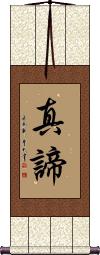
真諦 is a Buddhist term that can mean the real meaning, the true essence, or the ultimate truth.
Sincere / True Sincerity
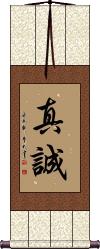
真誠 is the true essence of sincerity.
It takes strength of personality to be truly sincere without overdoing it. Speaking of strength, this is probably the strongest way to convey the idea of sincerity in the Chinese language.
The first character literally means true, real, and genuine. While the second character means sincere and honest.
Shoshin-Ryu
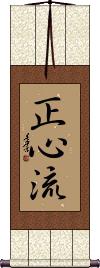
正心流 is a Japanese title that means “right heart style,” “true mind method,” or “truthful heart school.”
The first character means right, correct, greater, or true.
The second character means heart, mind, soul, or essence.
The third character means style, method, or some will translate it as a school.
Please note, there is more than one martial arts school that romanizes as Shoshin-Ryu.
Lingering Mind
Zanshin
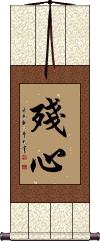
First off, 殘心 should only be used in the context of Japanese martial arts. In Chinese, it's a rather sad title (like a broken heart). In Chinese, the first character alone means destroyed, spoiled, ruined, injured, cruel, oppressive, savage, incomplete, or disabled. However, in Japanese, it's remainder, leftover, balance, or lingering.
The second character means heart, mind, soul, or essence in both languages.
殘心 is one of the five spirits of the warrior (budo) and is often used as a Japanese martial arts tenet. Under that context, places such as the Budo Dojo define it this way: The spirit of zanshin is the state of the remaining or lingering spirit. It is often described as a sustained and heightened state of awareness and mental follow-through. However, true zanshin is a state of focus or concentration before, during, and after the execution of a technique, where a link or connection between uke and nage is preserved. Zanshin is the state of mind that allows us to stay spiritually connected, not only to a single attacker but to multiple attackers and even an entire context; a space, a time, an event.
 In modern Japan (and Simplified Chinese), they use a different version of the first character, as seen to the right. Click on this character to the right instead of the button above if you want this modern Japanese version of lingering mind / zanshin.
Daodejing / Tao Te Ching - Chapter 27
The Mastery of Effortless Skill

Chapter 27 of the Daodejing reveals a profound truth about mastery: the highest skill leaves no trace, requires no force, and appears almost invisible.
善行無轍跡,
善言無瑕謫,
善數不用籌策,
善閉無關鍵而不可開,
善結無繩約而不可解。
是以聖人常善救人,
故無棄人;
常善救物,
故無棄物。
是謂襲明。
故善人者,不善人之師;
不善人者,善人之資。
不貴其師,不愛其資,
雖智大迷,
是謂要妙。
The sage moves through life with such natural harmony that nothing seems imposed; doors need no locks, knots require no rope, and actions leave no mark behind.
This is the essence of wúwéi (effortless action), where true ability arises from deep alignment with the Tao rather than deliberate effort.
At its heart, this chapter teaches compassion without exception. The sage “abandons no one and nothing,” recognizing value in all people and all things. Even those who seem flawed or unrefined are not rejected, but understood as part of a greater whole with each person both a student and a teacher in the unfolding of life.
Laozi reminds us that wisdom is not about perfection or control, but about subtle awareness. The truly skilled individual does not rely on tools, rules, or rigid structures; instead, they embody an intuitive understanding that makes their actions naturally complete.
In this way, excellence becomes quiet, effortless, and beyond imitation.
This teaching also reflects a deeper philosophical insight: Opposites are interdependent. The “good” person learns from the “not good,” and the “not good” provides the material for growth. To reject either is to misunderstand the balance of existence itself.
As calligraphy, Daodejing Chapter 27 serves as a reminder to cultivate inner mastery rather than outward display. It is a meditation on refinement, humility, and the quiet power of skill perfected through harmony with the natural order.
Note: The Chinese text used here is based on the early Mawangdui silk manuscript tradition (2nd century BCE). The Guodian manuscripts do NOT preserve Chapter 27 in full form.
This in-stock artwork might be what you are looking for, and ships right away...

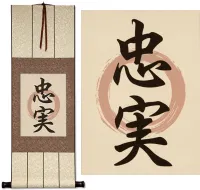
Not the results for true essence that you were looking for?
Below are some entries from our dictionary that may match your true essence search:
| Characters If shown, 2nd row is Simp. Chinese |
Pronunciation Romanization |
Simple Dictionary Definition |
真諦 真谛 see styles |
zhēn dì zhen1 di4 chen ti shindai しんだい |
More info & calligraphy: True Essence(1) {Buddh} (esp. しんたい) (See 俗諦) ultimate truth; (2) (esp. しんてい) essence; (person) Paramartha (499-569 CE) |
一如 see styles |
yī rú yi1 ru2 i ju kazuyuki かずゆき |
to be just like oneness; (personal name) Kazuyuki The one ru, i.e. the bhūtatathatā, or absolute, as the norm and essence of life. The 眞如 true suchness, or true character, or reality; the 法性 nature of things or beings. The whole of things as they are, or seem; a cosmos; a species; things of the same order. Name of a celebrated monk, Yiru. V. 一眞; 一實. |
三身 see styles |
sān shēn san1 shen1 san shen sanmi さんみ |
{Buddh} trikaya (three bodies of the Buddha); (surname) Sanmi trikāya. 三寶身 The threefold body or nature of a Buddha, i.e. the 法, 報, and 化身, or dharmakāya, sambhogakāya, and nirmāṇakāya. The three are defined as 自性, 受用, and 變化, the Buddha-body per se, or in its essential nature; his body of bliss, which he "receives" for his own "use" and enjoyment; and his body of transformation, by which he can appear in any form; i.e. spiritual, or essential; glorified; revealed. While the doctrine of the trikāya is a Mahāyāna concept, it partly results from the Hīnayāna idealization of the earthly Buddha with his thirty-two signs, eighty physical marks, clairvoyance, clairaudience, holiness, purity, wisdom, pity, etc. Mahāyāna, however, proceeded to conceive of Buddha as the Universal, the All, with infinity of forms, yet above all our concepts of unity or diversity. To every Buddha Mahāyāna attributed a three-fold body: that of essential Buddha; that of joy or enjoyment of the fruits of his past saving labours; that of power to transform himself at will to any shape for omnipresent salvation of those who need him. The trinity finds different methods of expression, e.g. Vairocana is entitled 法身, the embodiment of the Law, shining everywhere, enlightening all; Locana is 報身; c.f. 三賓, the embodiment of purity and bliss; Śākyamuni is 化身 or Buddha revealed. In the esoteric sect they are 法 Vairocana, 報 Amitābha, and 化 Śākyamuni. The 三賓 are also 法 dharma, 報 saṅgha, 化 buddha. Nevertheless, the three are considered as a trinity, the three being essentially one, each in the other. (1) 法身 Dharmakāya in its earliest conception was that of the body of the dharma, or truth, as preached by Śākyamuni; later it became his mind or soul in contrast with his material body. In Mādhyamika, the dharmakāya was the only reality, i.e. the void, or the immateria1, the ground of all phenomena; in other words, the 眞如 the tathāgatagarbha, the bhūtatathatā. According to the Huayan (Kegon) School it is the 理or noumenon, while the other two are氣or phenomenal aspects. "For the Vijñānavāda... the body of the law as highest reality is the void intelligence, whose infection (saṃkleҫa) results in the process of birth and death, whilst its purification brings about Nirvāṇa, or its restoration to its primitive transparence" (Keith). The "body of the law is the true reality of everything". Nevertheless, in Mahāyāna every Buddha has his own 法身; e.g. in the dharmakāya aspect we have the designation Amitābha, who in his saṃbhogakāya aspect is styled Amitāyus. (2) 報身Sambhogakāya, a Buddha's reward body, or body of enjoyment of the merits he attained as a bodhisattva; in other words, a Buddha in glory in his heaven. This is the form of Buddha as an object of worship. It is defined in two aspects, (a) 自受用身 for his own bliss, and (b) 他受用身 for the sake of others, revealing himself in his glory to bodhisattvas, enlightening and inspiring them. By wisdom a Buddha's dharmakāya is attained, by bodhisattva-merits his saṃbhogakāya. Not only has every Buddha all the three bodies or aspects, but as all men are of the same essence, or nature, as Buddhas, they are therefore potential Buddhas and are in and of the trikāya. Moreover, trikāya is not divided, for a Buddha in his 化身 is still one with his 法身 and 報身, all three bodies being co-existent. (3) 化身; 應身; 應化身 nirmāṇakāya, a Buddha's transformation, or miraculous body, in which he appears at will and in any form outside his heaven, e.g. as Śākyamuni among men. |
圓覺 圆觉 see styles |
yuán jué yuan2 jue2 yüan chüeh engaku |
Complete enlightenment potentially present in each being, for all have 本覺 primal awareness, or 眞心 the true heart (e. g. conscience), which has always remained pure and shining; considered as essence it is the 一心 one mind, considered causally it is the Tathāgata-garbha, considered it is|| perfect enlightenment, cf. 圓覺經. |
地体 see styles |
jitai じたい |
(1) (archaism) essence; true nature; substance; reality; (adverb) (2) (archaism) originally; naturally; by nature; from the start |
如實 如实 see styles |
rú shí ru2 shi2 ju shih nyo jitsu |
as things really are; realistic Real, reality, according to reality ( yathābhūtam); true; the 眞如 zhenru, or bhūtatathatā, for which it is also used; the universal undifferentiated, i. e. 平等不二, or the primary essence out of which the phenomenal arises; 如實空 is this essence in its purity; 如實不空 is this essence in its differentiation. |
實性 实性 see styles |
shí xìng shi2 xing4 shih hsing jisshō |
Real nature, or essence, i.e. the 眞如 bhūtatathatā. |
實相 实相 see styles |
shí xiàng shi2 xiang4 shih hsiang jissō |
actual situation; the ultimate essence of things (Buddhism) Reality, in contrast with 虛妄; absolute fundamental reality, the ultimate, the absolute; the 法身, i.e. dharmakāya, or 眞如 bhūtatathatā. Other terms are 一實; 一如; 一相; 無相; 法證; 法位; 涅槃; 無爲; 眞諦; 眞性; 眞空; 實性; 實諦; 實際, q.v. |
本質 本质 see styles |
běn zhì ben3 zhi4 pen chih honshitsu ほんしつ |
essence; nature; innate character; intrinsic quality (noun - becomes adjective with の) essence; true nature; substance; reality Original substance, the substance itself; any real object of the senses. |
法身 see styles |
fǎ shēn fa3 shen1 fa shen hotsushin ほつしん |
{Buddh} (See 三身) dharmakaya (dharma body, Buddhism's highest form of existence); (surname) Hotsushin dharmakāya, embodiment of Truth and Law, the "spiritual" or true body; essential Buddhahood; the essence of being; the absolute, the norm of the universe; the first of the trikāya, v.三身. The dharmakāya is divided into 總 unity and 別 diversity; as in the noumenal absolute and phenomenal activities, or potential and dynamic; but there are differences of interpretation, e.g. as between the 法相 and 法性 schools. Cf. 法身體性. There are many categories of the dharmakāya. In the 2 group 二法身 are five kinds: (1) 理 "substance" and 智 wisdom or expression; (2) 法性法身 essential nature and 應化法身 manifestation; the other three couples are similar. In the 3 group 三法身 are (1) the manifested Buddha, i.e. Śākyamuni; (2) the power of his teaching, etc.; (3) the absolute or ultimate reality. There are other categories. |
眞空 see styles |
zhēn kōng zhen1 kong1 chen k`ung chen kung mahiro まひろ |
(female given name) Mahiro (1) The absolute void, complete vacuity, said to be the nirvana of the Hīnayāna. (2) The essence of the bhūtatathatā, as the 空眞如 of the 起信論, 唯識, and 華嚴. (3) The void or immaterial as reality, as essential or substantial, the 非 空 之 空 not-void void, the ultimate reality, the highest Mahāyāna concept of true voidness, or of ultimate reality. |
理法界 see styles |
lǐ fǎ jiè li3 fa3 jie4 li fa chieh ri hokkai |
One of the 四界, that of the common essence or dharmakāya of all beings. |
The following table may be helpful for those studying Chinese or Japanese:
| Title | Characters | Romaji (Romanized Japanese) | Various forms of Romanized Chinese | |
| True Essence | 真諦 真谛 | shintai / shintei | zhēn dì / zhen1 di4 / zhen di / zhendi | chen ti / chenti |
| Sincere True Sincerity | 真誠 真诚 | zhēn chéng zhen1 cheng2 zhen cheng zhencheng | chen ch`eng chencheng chen cheng |
|
| Shoshin-Ryu | 正心流 | shou shin ryuu shoushinryuu sho shin ryu | ||
| Lingering Mind | 殘心 残心 | zan shin / zanshin | cán xīn / can2 xin1 / can xin / canxin | ts`an hsin / tsanhsin / tsan hsin |
| Daodejing Tao Te Ching - Chapter 27 | 善行無轍跡善言無瑕謫善數不用籌策善閉無關鍵而不可開善結無繩約而不可解是以聖人常善救人故無棄人常善救物故無棄物是謂襲明故善人者不善人之師不善人者善人之資不貴其師不愛其資雖智大迷是謂要妙 善行无辙迹善言无瑕谪善数不用筹策善闭无关键而不可开善结无绳约而不可解是以圣人常善救人故无弃人常善救物故无弃物是谓袭明故善人者不善人之师不善人者善人之资不贵其师不爱其资虽智大迷是谓要妙 | shàn xíng wú zhé jì shàn yán wú xiá zhé shàn shù bù yòng chóu cè shàn bì wú guān jiàn ér bù kě kāi shàn jié wú shéng yuē ér bù kě jiě shì yǐ shèng rén cháng shàn jiù rén gù wú qì rén cháng shàn jiù wù gù wú qì wù shì wèi xí míng gù shàn rén zhě bù shàn rén zhī shī bù shàn rén zhě shàn rén zhī zī bù guì qí shī bù ài qí zī suī zhì dà mí shì wèi yào miào shan4 xing2 wu2 zhe2 ji4 shan4 yan2 wu2 xia2 zhe2 shan4 shu4 bu4 yong4 chou2 ce4 shan4 bi4 wu2 guan1 jian4 er2 bu4 ke3 kai1 shan4 jie2 wu2 sheng2 yue1 er2 bu4 ke3 jie3 shi4 yi3 sheng4 ren2 chang2 shan4 jiu4 ren2 gu4 wu2 qi4 ren2 chang2 shan4 jiu4 wu4 gu4 wu2 qi4 wu4 shi4 wei4 xi2 ming2 gu4 shan4 ren2 zhe3 bu4 shan4 ren2 zhi1 shi1 bu4 shan4 ren2 zhe3 shan4 ren2 zhi1 zi1 bu4 gui4 qi2 shi1 bu4 ai4 qi2 zi1 sui1 zhi4 da4 mi2 shi4 wei4 yao4 miao4 shan xing wu zhe ji shan yan wu xia zhe shan shu bu yong chou ce shan bi wu guan jian er bu ke kai shan jie wu sheng yue er bu ke jie shi yi sheng ren chang shan jiu ren gu wu qi ren chang shan jiu wu gu wu qi wu shi wei xi ming gu shan ren zhe bu shan ren zhi shi bu shan ren zhe shan ren zhi zi bu gui qi shi bu ai qi zi sui zhi da mi shi wei yao miao | shan hsing wu che chi shan yen wu hsia che shan shu pu yung ch`ou ts`e shan pi wu kuan chien erh pu k`o k`ai shan chieh wu sheng yüeh erh pu k`o chieh shih i sheng jen ch`ang shan chiu jen ku wu ch`i jen ch`ang shan chiu wu ku wu ch`i wu shih wei hsi ming ku shan jen che pu shan jen chih shih pu shan jen che shan jen chih tzu pu kuei ch`i shih pu ai ch`i tzu sui chih ta mi shih wei yao miao shan hsing wu che chi shan yen wu hsia che shan shu pu yung chou tse shan pi wu kuan chien erh pu ko kai shan chieh wu sheng yüeh erh pu ko chieh shih i sheng jen chang shan chiu jen ku wu chi jen chang shan chiu wu ku wu chi wu shih wei hsi ming ku shan jen che pu shan jen chih shih pu shan jen che shan jen chih tzu pu kuei chi shih pu ai chi tzu sui chih ta mi shih wei yao miao |
|
| In some entries above you will see that characters have different versions above and below a line. In these cases, the characters above the line are Traditional Chinese, while the ones below are Simplified Chinese. | ||||

Successful Chinese Character and Japanese Kanji calligraphy searches within the last few hours...



