Many custom options...


And formats...



Tradition in Chinese / Japanese...
Buy a Tradition calligraphy wall scroll here!
Personalize your custom “Tradition” project by clicking the button next to your favorite “Tradition” title below...
1. Smriti
2. Shuhari
3. Battojutsu
4. Isshin-Jutsu
5. Isshin-Do
6. Isshin Kenpo
8. Isshin Association / Isshin Association
9. Zen Buddhism
11. Easter
Smriti
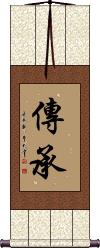
傳承 is a Chinese and Japanese word that means to pass on (to future generations).
This can also mean passed on (from former times), a continued tradition, handing down (information), legend, tradition, folklore, transmission, or an inheritance.
傳承 is the Chinese equivalent of Smriti (from Sanskrit: स्मृति / Smṛti). The term can be used for Hindu (and sometimes Buddhist) texts that have authority because the author is known.
Shuhari
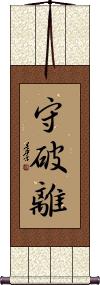
Shuhari represents the three stages of mastery: Learning the fundamentals, breaking with tradition, and creating one's own techniques.
Battojutsu
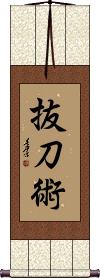
Battōjutsu or 抜刀術 is the art of sword drawing associated closely with the tradition of Kenjutsu.
Battōjutsu typically is done with a real and sharp-bladed katana and is often practiced as a form of kata.
Isshin-Jutsu

一心術 can be translated as “Isshin-Jutsu,” or “Single-Minded Technique.”
As a style or lineage name, this term identifies a specific tradition and its teachings. In calligraphy, it works well for dojo signage or lineage-focused pieces.
Cross-language note: while the core meaning is broadly shared across Chinese and Japanese usage, nuance and frequency can differ by tradition.
Isshin-Do

一心道 can be translated as “Isshin-Do,” or “Single-Minded Way.”
As a style or lineage name, this term is used to identify a specific tradition and its teachings. In calligraphy, it works well for dojo signage or lineage-focused pieces.
Single-mindedness; wholehearted. Way;
Isshin Kenpo

一心拳法 can be translated as “Isshin Kenpo” or “Single-Mindedness Kempo.”
As a style or lineage name, this term is used to identify a specific tradition and its teachings. In calligraphy, it works well for dojo signage or lineage-focused pieces.
Cross-language note: while the core meaning is broadly shared across Chinese and Japanese usage, nuance and frequency can differ by tradition.
Om Mani Padme Hum
Oṃ maṇi padme hūṃ
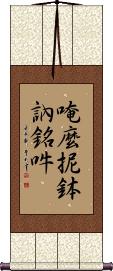
唵麼抳鉢訥銘吽 is one of the earliest and best-known mantras in the Buddhist tradition.
It can be heard in temples from Tokyo to Tibet.
This mantra is an expression of the basic attitude of compassion. It translates literally as “oṃ the jewel in the lotus hūṃ.”
There are several titles and transliterations for this mantra, including, 六字大明呪 (Great 6-syllable mantra), 六字真言 (6-syllable Sanskrit mantra of Avalokiteshvara bodhisattva), 唵嘛呢叭咪吽, 唵嘛呢叭咪哞, and 唵嘛咪叭呢哞.
Contact me if you need any of these alternates on your wall scroll.
Isshin Association / Isshin Association

一心協会 can be translated as “Isshin Association.”
This term is commonly used for organizations or affiliations within martial arts communities. In calligraphy, it often conveys legitimacy, unity, single-mindedness, and shared standards. Cross-language note: while the core meaning is broadly shared across Chinese and Japanese usage, nuance and frequency can differ by tradition.
Note: Written as 一心協會 in Traditional Chinese.
Zen Buddhism
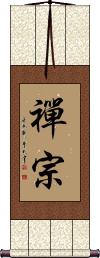
禪宗 is one way to title “Zen Buddhism.” Because the original pronunciation of Zen in Chinese is Chan, you'll also see this expressed as Chan Buddhism.
From the Buddhist Dictionary:
The Chan, meditative or intuitional, sect is usually said to have been established in China by Bodhidharma, the twenty-eighth patriarch, who brought the tradition of the Buddha-mind from India. This sect, believing in direct enlightenment, disregarded ritual and sūtras and depended upon the inner light and personal influence for the propagation of its tenets, founding itself on the esoteric tradition supposed to have been imparted to Kāśyapa by the Buddha, who indicated his meaning by plucking a flower without further explanation. Kāśyapa smiled in apprehension and is supposed to have passed on this mystic method to the patriarchs. The successor of Bodhidharma was 慧可 Huike, and he was succeeded by 僧璨 Sengcan, 道信 Daoxin, 弘忍 Hongren, 慧能 Huineng, and 神秀 Shenxiu, the sect dividing under the two latter into the southern and northern schools: the southern school became prominent, producing 南嶽 Nanyue and 靑原 Qingyuan, the former succeeded by 馬祖 Mazu, the latter by 石頭 Shitou. From Mazu's school arose the five later schools.
Divine Transmission

神伝 can mean teachings conveyed by the gods, or teachings handed down from the divine.
神伝 calligraphy is seen in classical martial arts (koryū) or esoteric lineages.
This title emphasizes legitimacy, tradition, and sacred transmission. It suggests a strong provenance of your martial arts doctrinal origins.
Easter
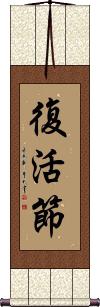
復活節 is the Chinese and old Korean way to write Easter.
Easter is not a well-known holiday in China, but Chinese Christians tend to follow the American tradition of the Easter egg ritual, etc. Non-Christians may think it's a celebration of rabbits that can lay eggs.
South Korea has a higher percentage of Christians than any other Asian country, so they celebrate Easter with plenty of enthusiasm.
Good Luck / Good Fortune
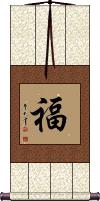
福 is pronounced “fu” in Chinese.
The character “fu” is posted by virtually all Chinese people on the doors of their homes during the Spring Festival (closely associated with the Chinese New Year).
One tradition from the Zhou Dynasty (beginning in 256 B.C.) holds that putting a fu symbol on your front door will keep the goddess of poverty away.
福 literally means good fortune, prosperity, blessed, blessedness, happiness, and fulfillment.
You'll also see this character in Vietnam (where Chinese characters were the written form until a romanization reform) where it is pronounced Phúc - a word commonly used in Vietnamese names because of its good meaning.
See Also: Lucky
This in-stock artwork might be what you are looking for, and ships right away...


Gallery Price: $108.00
Your Price: $59.88

Gallery Price: $101.00
Your Price: $55.88

Gallery Price: $101.00
Your Price: $55.88

Gallery Price: $60.00
Your Price: $36.88

Gallery Price: $60.00
Your Price: $36.88

Gallery Price: $60.00
Your Price: $36.88

Gallery Price: $286.00
Your Price: $158.88
Gallery Price: $72.00
Your Price: $39.88

Gallery Price: $500.00
Your Price: $195.88

The following table may be helpful for those studying Chinese or Japanese...
| Title | Characters | Romaji (Romanized Japanese) | Various forms of Romanized Chinese | |
| Smriti | 傳承 传承 | denshou / densho | chuán chéng chuan2 cheng2 chuan cheng chuancheng | ch`uan ch`eng chuancheng chuan cheng |
| Shuhari | 守破離 | shu ha ri / shuhari | ||
| Battojutsu | 抜刀術 | battou jutsu battoujutsu batto jutsu | ||
| Isshin-Jutsu | 一心術 | isshin-jutsu ishin-jutsu | yī xīn shù yi1 xin1 shu4 yi xin shu yixinshu | i hsin shu ihsinshu |
| Isshin-Do | 一心道 | isshin-dō / ishin-dō | yī xīn dào yi1 xin1 dao4 yi xin dao yixindao | i hsin tao ihsintao |
| Isshin Kenpo | 一心拳法 | isshin-kenpō ishin-kenpō | yī xīn quán fǎ yi1 xin1 quan2 fa3 yi xin quan fa yixinquanfa | i hsin ch`üan fa ihsinchüanfa i hsin chüan fa |
| Om Mani Padme Hum | 唵麼抳鉢訥銘吽 唵么抳钵讷铭吽 | on mani padomei un onmanipadomeiun | ǎn mó nǐ bō míng hǒu an3 mo2 ni3 bo1 ne4 ming2 hou3 an mo ni bo ne ming hou anmoniboneminghou | an mo ni po ne ming hou anmoniponeminghou |
| Isshin Association Isshin Association | 一心協会 | isshin-kyōkai ishin-kyōkai | yī xīn xié huì yi1 xin1 xie2 hui4 yi xin xie hui yixinxiehui | i hsin hsieh hui ihsinhsiehhui |
| Zen Buddhism | 禪宗 禅宗 | zen shuu / zenshuu / zen shu | chán zōng chan2 zong1 chan zong chanzong | ch`an tsung chantsung chan tsung |
| Divine Transmission | 神伝 | shinden | ||
| Easter | 復活節 复活节 | fù huó jié fu4 huo2 jie2 fu huo jie fuhuojie | fu huo chieh fuhuochieh |
|
| Good Luck Good Fortune | 福 | fuku | fú / fu2 / fu | |
| In some entries above you will see that characters have different versions above and below a line. In these cases, the characters above the line are Traditional Chinese, while the ones below are Simplified Chinese. | ||||

Successful Chinese Character and Japanese Kanji calligraphy searches within the last few hours...



