Many custom options...


And formats...



Thousand in Chinese / Japanese...
Buy a Thousand calligraphy wall scroll here!
Personalize your custom “Thousand” project by clicking the button next to your favorite “Thousand” title below...
1. A wise person reflecting a thousand times can still make a mistake
2. Senju Kannon
3. Better to Travel 10,000 Miles than Read 10,000 Books
4. Diversity
5. 1000 good moves ruined by 1 bad
6. A Moment of Time is as Precious as Gold
7. One Day Seems Like 1000 Years
8. Qian
9. A Journey of 1000 Miles Begins with a Single Step
10. An Open Book Benefits Your Mind
13. Brought Together from 1000 Miles Away by Fate
14. A Journey of 1000 Miles Feels Like One
15. A Journey of 1000 Miles Begins with a Single Step
16. Five Elements
17. Even a fool may sometimes come up with a good idea
18. The Whole Room Rocks With Laughter
19. A Bright Future
A wise person reflecting a thousand times can still make a mistake

智者千慮,必有一失 is a Chinese proverb that literally means, “A wise person reflecting a thousand times can still make a mistake.”
Figuratively, this means that nobody is infallible.
Senju Kannon
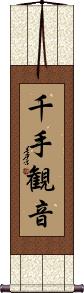
千手観音 is Senju Kannon, a Japanese title for the thousand-armed Avalokiteshvara or thousand-armed Kannon (Buddhist deity/goddess of compassion).
Better to Travel 10,000 Miles than Read 10,000 Books
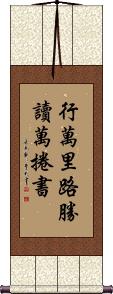
行万里路胜读万卷书 translates a few ways:
To travel ten thousand miles beats reading ten-thousand books.
Better to travel ten thousand li than to read ten thousand books. (a “li” is an ancient Chinese mile)
Traveling thousands of miles is better than reading thousands of books.
No matter how you slice it, this Chinese proverb is claiming that experience is more profound and meaningful than what you can get from a book. Go do it! Don't just read about it.
Diversity
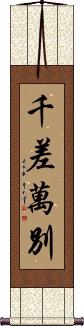
千差萬別 is used to describe “manifold diversity.”
It literally means “A thousand differences and ten thousand distinctions.”
Other translations include an infinite variety of; multifarious; being extremely varied and wide-ranging.
The third character is written differently in Japanese, so if you order this from the Japanese master calligrapher it will look like 千差万別 instead of 千差萬別.
1000 good moves ruined by 1 bad
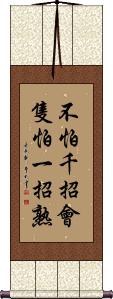
不怕千招会只怕一招熟 is a Chinese proverb that literally translates as: Do not worry about making a thousand clever moves; what [one has to] fear is one bad move.
Figuratively, this means: Even if you have made many clever moves before, one wrong move will ruin the whole game.
I compare this to the English saying, “It takes only one Aw-shit to wipe out a thousand Attaboys.”
A Moment of Time is as Precious as Gold
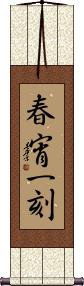
春宵一刻 is a Japanese proverb that means “A moment of time in a spring evening (is worth a thousand pieces of gold).”
One Day Seems Like 1000 Years
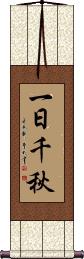
一日千秋 is a Japanese and Chinese proverb about missing someone.
一日千秋 is often used to express how hard it is to wait for someone's return or to be away from someone.
Some will translate this as “one day feels like a very long time” or “waiting for someone (something) is hard.”
You might see this romanized as a single word, Ichijitsusenshuu, or as “Ichijitsu Senshuu” from Japanese.
If you break down the characters one-by-one, we get:
一 = one/a
日 = day/sun (can also represent time or date)
千 = 1000/thousand
秋 = autumn/fall
Together, 千秋 can mean “autumn comes thousand times” (or 1000 years). It can also be read as 1000 periods of time.
However, it relays the idea of heartache as you wait for someone you miss.
Qian
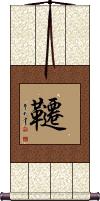
韆 can be a Chinese surname, Qian.
The meaning of this character can be thousand, a large quantity, or a swing.
A Journey of 1000 Miles Begins with a Single Step
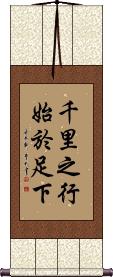
千里之行始於足下 is a Chinese proverb that means “a thousand-mile journey begins with the first step.”
This proverb figuratively means “big accomplishments come from an accumulation of little achievements made one by one.”
An Open Book Benefits Your Mind
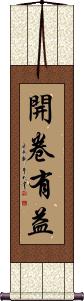
There are several ways to translate this ancient proverb. Translated literally and directly, it says, “Open roll has/yields benefit.”
To understand that, you must know a few things...
First, Chinese characters and language have deeper meanings that often are not spoken but are understood - especially with ancient texts like this. Example: It's understood that the “benefit” referred to in this proverb is to the reader's mind. Just the last character expresses that whole idea.
Second, Chinese proverbs are supposed to make you think and leave a bit of mystery to figure out.
Third, for this proverb, it should be noted that roll = book. When this proverb came about (about two thousand years ago), books were rolls of bamboo slips strung together. The first bound books like the ones we use today did not come about until about a thousand years after this proverb when they invented paper in China.
開卷有益 is a great gift for a bookworm who loves to read and increase their knowledge. Or for any friend that is or wants to be well-read.
Some other translations of this phrase:
Opening a book is profitable
The benefits of education.
No Place Like Home
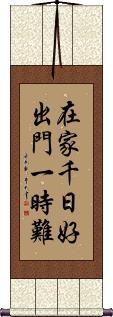
在家千日好出门一时难 is a Chinese proverb that literally means “At home, one can spend a thousand days in comfort but spending a day away from home can be challenging.”
Figuratively, this means “There's no place like home,” or roughly a Chinese version of “Home sweet home.”
Seeing is Believing
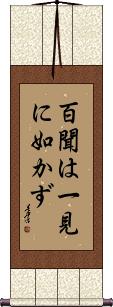
百聞は一見に如かず is the Japanese version of an ancient Chinese proverb that means “Seeing once is better than hearing one hundred times.”
It is the rough equivalent of “seeing is believing,” “one eye-witness is better than many hearsays,” or “a picture is worth a thousand words.”
Sometimes it's simply more prudent to verify with your own eyes.
Note: Because this selection contains some special Japanese Hiragana characters, it should be written by a Japanese calligrapher.
See Also: Hearing a Hundred Times is Not as Good as Seeing Once
Seeing is Believing
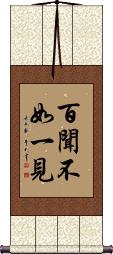
百聞不如一見 is a proverb that means “Better to see something once rather than hear about it one hundred times” or “Telling me about something 100 times is not as good as seeing it once.”
In English, we have the similar proverb of “Seeing is believing” but this has a bit of the “A picture paints a thousand words” meaning too.
Sometimes it's simply more prudent to verify with your own eyes.
Brought Together from 1000 Miles Away by Fate
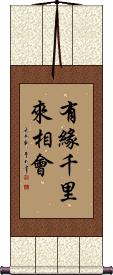
有緣千里來相會 means that fate or destiny has caused us to meet from a thousand miles away.
The 有緣 part suggests something that is connected as if by a thread due to fate, destiny, or karma.
This romantic phrase is seen in Chinese greeting cards. It relays the idea that your love was meant to be and that you were destined to meet (regardless of what distance or obstacles might have made such a meeting unlikely).
See Also: Red Thread
A Journey of 1000 Miles Feels Like One
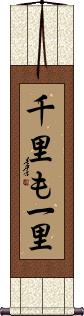
千里も一里 is a Japanese proverb that states “A journey of a thousand miles feels like only one mile.” It is understood that in the proverb, this applies when going to see the one you love.
Note that the “mile” or 里 used in this proverb is an old Chinese “li” (pronounced “ri” in Japanese). It's not actually a mile, as the measurement is really closer to 500 meters (it would take 3 of these to get close to a western mile). Still, 1000里 (333 miles) is a long way.
A Journey of 1000 Miles Begins with a Single Step
senri no michi mo ippo kara
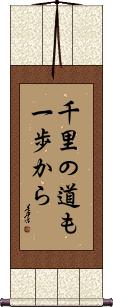
千里の道も一歩から is the Japanese version of an ancient Chinese proverb that means “a journey of a thousand miles begins with a single step.”
Some will also translate this as a 1000-mile road starts with one brick (a small amount).
In this case, the real measurement is an ancient Chinese “li” or 里, which is romanized as “ri” in Japanese. It's about half a kilometer, so three 里 would be a western mile. A journey of 333 miles begins with a single step, just doesn't sound as natural.
Note: Because this selection contains some special Japanese Hiragana characters, it should be written by a Japanese calligrapher.
Five Elements
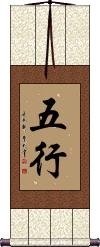
五行 is the title of the five elements: wood, fire, water, earth, and metal.
The first character means five, and the second character is simply element(s).
According to ancient Chinese science, all matter in the world is comprised of these elements. One idea presented with the five elements is that when energy is added, the matter is believed to expand. When energy is removed, matter contracts. Oddly, this concept is not far from Einstein's theories and modern science. Just a few thousand years before Einstein.
More info: Wikipedia - Five Elements (Wu Xing).
See Also: Wood | Fire | Water | Earth | Metal | Five Elements
Even a fool may sometimes come up with a good idea
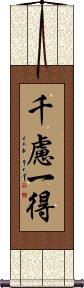
千慮一得 means “1000 tries, one success,” or “[a] thousand tries [leads to] one success.”
This proverb is a humble way to express your success, ideas, or accomplishments. As if you are a fool who just got lucky in inventing or creating something.
Translations for this proverb include:
Even without any notable ability on my part, I may still get it right sometimes by good luck.
Even a fool may sometimes come up with a good idea.
Compare this to the English idiom, “Even a broken clock is right twice a day.”
The Whole Room Rocks With Laughter
The perfect scroll if you love humor or as a gift for the comedian in your life
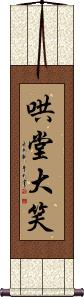
In China, 哄堂大笑 is a proverb that is used in response to a good joke or witty comment.
The story goes that Mr. Feng and Mr. He were both senior officials in the Song Dynasty (about a thousand years ago). One day, Mr. Feng walked into their shared office wearing a new pair of boots. The boots caught the eye of Mr. He who said, “New boots! - how much were they?.” Mr. Feng lifted one of the boots off the ground as if to show it off and responded, “900 coins.”
Astonished, Mr. Feng explained, “900? How can that be? - I paid 1800 coins for my boots!.” Mr. Feng then lifted his other foot off the ground and said, “This boot was also 900 coins.”
It is said that the whole room was shaking from the laughter of all that heard Mr. Feng's joke on Mr. He.
A Bright Future
Incredible 10,000-Mile Flight of the Peng
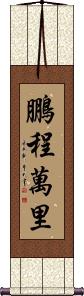
鵬程萬里 is an ancient Chinese proverb used in modern times to wish someone a long and successful career.
It's really about the 10,000 Flight of the Peng (Peng, also known as Roc is a mythical fish that can turn into a bird and take flight).
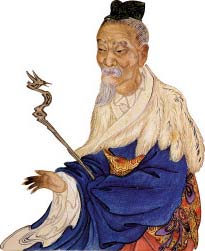
莊子
Zhuangzi or Chuang Tzu
Breaking down each character:
1. Peng or Roc (a kind of bird).
2. Journey (in this case, a flight).
3. 10,000 (Ten Thousand).
4. Li is a unit of distance often referred to as a “Chinese Mile,” though the real distance is about half a kilometer.
Direct Translation: “Peng's Journey [of] 10,000 Li.”
Literal meaning: “The 10,000-Li Flying Range Of The Roc.”
Perceived meaning: “To have a bright future” or “To go far.”
This proverb/idiom comes from the book of Zhuangzi or Chuang Tzu. It tells the tale of a huge fish that could turn into a gigantic bird. This bird was called a “peng” and was many miles long. This legendary size allowed the Peng to fly from the Northern Sea to the Southern Sea in a single bound.
Wishing someone “a Peng's Journey of 10,000 Li” will imply that they can travel far without stopping and will have great success, a long career, and a prosperous future.
This in-stock artwork might be what you are looking for, and ships right away...

Gallery Price: $108.00
Your Price: $59.88

Gallery Price: $200.00
Your Price: $95.88
The following table may be helpful for those studying Chinese or Japanese...
| Title | Characters | Romaji (Romanized Japanese) | Various forms of Romanized Chinese | |
| A wise person reflecting a thousand times can still make a mistake | 智者千慮必有一失 智者千虑必有一失 | zhì zhě qiān lǜ bì yǒu yī shī zhi4 zhe3 qian1 lu:4 bi4 you3 yi1 shi1 zhi zhe qian lu: bi you yi shi zhizheqianlu:biyouyishi | chih che ch`ien lü pi yu i shih chihchechienlüpiyuishih chih che chien lü pi yu i shih |
|
| Senju Kannon | 千手観音 | senju kannon senjukannon | ||
| Better to Travel 10,000 Miles than Read 10,000 Books | 行萬里路勝讀萬捲書 行万里路胜读万卷书 | xíng wàn lǐ lù shèng dú wàn juǎn shū xing2 wan4 li3 lu4 sheng4 du2 wan4 juan3 shu1 xing wan li lu sheng du wan juan shu | hsing wan li lu sheng tu wan chüan shu | |
| Diversity | 千差萬別 千差万别 / 千差万別 | sen sa man betsu sensamanbetsu | qiān chā wàn bié qian1 cha1 wan4 bie2 qian cha wan bie qianchawanbie | ch`ien ch`a wan pieh chienchawanpieh chien cha wan pieh |
| 1000 good moves ruined by 1 bad | 不怕千招會隻怕一招熟 不怕千招会只怕一招熟 | bú pà qiān zhāo huì zhǐ pà yī zhāo shú bu2 pa4 qian1 zhao1 hui4 zhi3 pa4 yi1 zhao1 shu2 bu pa qian zhao hui zhi pa yi zhao shu | pu p`a ch`ien chao hui chih p`a i chao shu pu pa chien chao hui chih pa i chao shu |
|
| A Moment of Time is as Precious as Gold | 春宵一刻 | shunshouikkoku shunshoikoku | ||
| One Day Seems Like 1000 Years | 一日千秋 | ichi jitsu sen shuu ichijitsusenshuu ichi jitsu sen shu | yí rì qiān qiū yi2 ri4 qian1 qiu1 yi ri qian qiu yiriqianqiu | i jih ch`ien ch`iu ijihchienchiu i jih chien chiu |
| Qian | 韆 千 | qiān / qian1 / qian | ch`ien / chien | |
| A Journey of 1000 Miles Begins with a Single Step | 千里之行始於足下 千里之行始于足下 | qiān lǐ zhī xíng shǐ yú zú xià qian1 li3 zhi1 xing2 shi3 yu2 zu2 xia4 qian li zhi xing shi yu zu xia qianlizhixingshiyuzuxia | ch`ien li chih hsing shih yü tsu hsia chien li chih hsing shih yü tsu hsia |
|
| An Open Book Benefits Your Mind | 開卷有益 开卷有益 | kāi juàn yǒu yì kai1 juan4 you3 yi4 kai juan you yi kaijuanyouyi | k`ai chüan yu i kaichüanyui kai chüan yu i |
|
| No Place Like Home | 在家千日好出門一時難 在家千日好出门一时难 | zài jiā qiān rì hǎo chū mén yì shí nán zai4 jia1 qian1 ri4 hao3 chu1 men2 yi4 shi2 nan2 zai jia qian ri hao chu men yi shi nan | tsai chia ch`ien jih hao ch`u men i shih nan tsai chia chien jih hao chu men i shih nan |
|
| Seeing is Believing | 百聞は一見に如かず | hyakubun wa ikken ni shikazu hyakubunwaikkennishikazu hyakubun wa iken ni shikazu | ||
| Seeing is Believing | 百聞不如一見 百闻不如一见 | bǎi wén bù rú yí jiàn bai3 wen2 bu4 ru2 yi2 jian4 bai wen bu ru yi jian baiwenburuyijian | pai wen pu ju i chien paiwenpujuichien |
|
| Brought Together from 1000 Miles Away by Fate | 有緣千里來相會 有缘千里来相会 | yǒu yuán qiān lǐ lái xiāng huì you3 yuan2 qian1 li3 lai2 xiang1 hui4 you yuan qian li lai xiang hui youyuanqianlilaixianghui | yu yüan ch`ien li lai hsiang hui yu yüan chien li lai hsiang hui |
|
| A Journey of 1000 Miles Feels Like One | 千里も一里 | sen ri mo ichi ri senrimoichiri | ||
| A Journey of 1000 Miles Begins with a Single Step | 千里の道も一歩から | sen ri no michi mo i-ppo ka ra senrinomichimoi-ppokara sen ri no michi mo i-po ka ra | ||
| Five Elements | 五行 | gogyou / gogyo | wǔ xíng / wu3 xing2 / wu xing / wuxing | wu hsing / wuhsing |
| Even a fool may sometimes come up with a good idea | 千慮一得 千虑一得 | senryonoittoku | qiān lǜ yī dé qian1 lv4 yi1 de2 qian lv yi de qianlvyide | ch`ien lü i te chienlüite chien lü i te |
| The Whole Room Rocks With Laughter | 哄堂大笑 | hōng tāng dà xiào hong1 tang1 da4 xiao4 hong tang da xiao hongtangdaxiao | hung t`ang ta hsiao hungtangtahsiao hung tang ta hsiao |
|
| A Bright Future | 鵬程萬里 鹏程万里 | péng chéng wàn lǐ peng2 cheng2 wan4 li3 peng cheng wan li pengchengwanli | p`eng ch`eng wan li pengchengwanli peng cheng wan li |
|
| In some entries above you will see that characters have different versions above and below a line. In these cases, the characters above the line are Traditional Chinese, while the ones below are Simplified Chinese. | ||||

Successful Chinese Character and Japanese Kanji calligraphy searches within the last few hours...



