Many custom options...


And formats...



The Way the Truth in Chinese / Japanese...
Buy a The Way the Truth calligraphy wall scroll here!
Personalize your custom “The Way the Truth” project by clicking the button next to your favorite “The Way the Truth” title below...
2. True Religion / Buddha Truth
5. Appreciation of Truth by Meditation
6. Comparison Leads to Truth and Enlightenment
8. Paramartha
10. Diamond
13. Avatar
Thirst for Truth
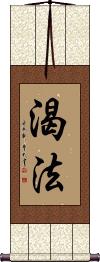
渴法 means to thirst for the truth or the Buddha-way.
渴法 is the internal need to seek the way of the truth in Buddhism.
True Religion / Buddha Truth
The way of the truth
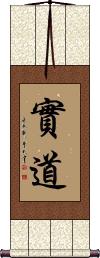
實道 is a Buddhist title that means “The true way,” “The true religion,” “The way of the truth,” or “The absolute Buddha-truth.”
Walk in the Way
The Way of Buddha Truth
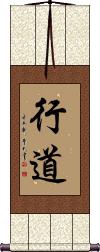
In Taoist and Buddhist contexts, 行道 means to “Walk in the Way.” In Buddhism, that further means to follow the Buddha truth. In some Buddhist sects, this can mean making a procession around a statue of the Buddha (always with the right shoulder towards the Buddha).
Outside of that context, this can mean route (when going somewhere), the way to get somewhere, etc.
In Japanese, this can be the surname or given name Yukimichi.
In Wine there is Truth
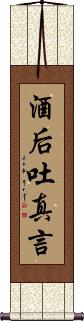
酒后吐真言 / 酒後吐真言 is a nice Asian proverb if you know a vintner or wine seller - or wine lover - although the actual meaning might not be exactly what you think or hope.
The literal meaning is that someone drinking wine is more likely to let the truth slip out. It can also be translated as “People speak their true feelings after drinking alcohol.”
It's long believed in many parts of Asia that one can not consciously hold up a facade of lies when getting drunk, and therefore the truth will come out with a few drinks.
I've had the experience where a Korean man would not trust me until I got drunk with him (I was trying to gain access to the black market in North Korea which is tough to do as an untrusted outsider) - so I think this idea is still well-practiced in many Asian countries.
 VS
VS 
Please note that there are two common ways to write the second character of this phrase. The way it's written will be left up to the mood of the calligrapher, unless you let us know that you have a certain preference.
Appreciation of Truth by Meditation
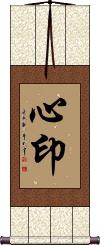
心印 is a Buddhist concept that simply stated is “appreciation of truth by meditation.”
It's a deep subject, but my understanding is that you can find truth through meditation, and once you've found the truth, you can learn to appreciate it more through further meditation. This title is not commonly used outside of the Buddhist community (your Asian friends may or may not understand it). The literal translation would be something like “the mind seal,” I've seen this term translated this way from Japanese Buddhist poetry. But apparently, the seal that is stamped deep in your mind is the truth. You just have to meditate to find it.
Soothill defines it this way: Mental impression, intuitive certainty; the mind is the Buddha-mind in all, which can seal or assure the truth; the term indicates the intuitive method of the Chan (Zen) school, which was independent of the spoken or written word.
Reference: Soothill-Hodous Dictionary of Chinese Buddhism
See Also: Zen
Comparison Leads to Truth and Enlightenment
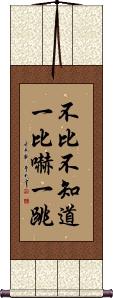
不比不知道一比吓一跳 is a Chinese proverb that literally means: [If one not does] not make comparisons, [one will] not know [the truth] when [one] compares, [one will be] greatly surprised.
This goes to the idea that if you do not know bad times, you cannot know what good times are.
...And...
You can not know light without experiencing darkness.
Another way to translate this would be: If you wish to be enlightened, you need to make comparisons and analyze every aspect (of a situation, issue, or problem).
Daoism / Taoism
Literally: The Way or Road
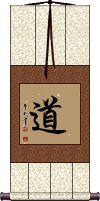
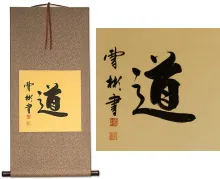
道 is the character “dao” which is sometimes written as “tao” but pronounced like “dow” in Mandarin.
道 is the base of what is known as “Taoism.” If you translate this literally, it can mean “the way” or “the path.”
Dao is believed to be that which flows through all things and keeps them in balance. It incorporates the ideas of yin and yang (e.g. there would be no love without hate, no light without dark, no male without female.)
The beginning of Taoism can be traced to a mystical man named
Lao Zi (604-531 BC), who followed, and added to the teachings of Confucius.
More about Taoism / Daoism here.
Note that this is pronounced “dou” and sometimes “michi” when written alone in Japanese but pronounced “do” in word compounds such as Karate-do and Bushido. It's also “do” in Korean.
Alternate translations and meanings: road, way, path; truth, principle province.
Important Japanese note: In Japanese, this will generally be read with the road, way, or path meaning. Taoism is not as popular or well-known in Japan so Daoist/Taoist philosophy is not the first thing a Japanese person will think of when they read this character.
See our Taoism Page
Paramartha
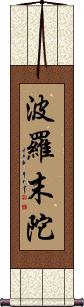
波羅末陀 is the Chinese and Japanese way to write the ancient Sanskrit word Paramārtha or परमार्थ which now means the highest truth, ultimate truth, ultimate reality, or fundamental meaning.
Paramārtha is the name of a famous Buddhist monk born in 499 CE. Paramārtha traveled the world (including Cambodia and territories that are now part of China) to spread the teachings of Buddhism by translating scriptures into the local languages so the truth could be understood by the masses.
So, we should all want to be a Paramārtha who brings the ultimate truth, knowledge, and enlightenment to others.
Buddha Seeking
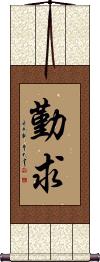
勤求 is a complex word that means inquiring in the Buddha way.
To put it another way, it is seeking something in the right way, at the right time, and diligently seeking only truth or the good.
Diamond
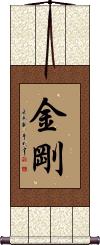
金剛 is a common way to call diamonds in Chinese and Japanese.
Traditionally, there were not that many diamonds that made their way to Asia, so this word does not have the deep cultural significance that it does in the west (thanks mostly to De Beers' marketing). Therefore, this word was kind of borrowed from other uses.
This title can also refer to vajra (a Sanskrit word meaning both thunderbolt and diamond that originally refers to an indestructible substance); hard metal; pupa of certain insects; Vajrapani, Buddha's warrior attendant; King Kong; adamantine; Buddhist symbol of the indestructible truth.
True / Real / Genuine
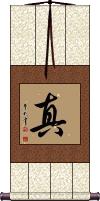
真 is a simple way to express the idea that something is real, true, truth, or genuine.
Occasionally, this character refers to a Buddhist sect that originated in the 13th century.
真 is commonly used as a compound with other characters to create ideas like “true love.” It's also used similarly to the English words “really” or “truly” to say “really good” or “He is really knowledgeable.” Those phrases start with “他真的是... (note the second character is 真).
There are two ways to write this character, shown here is the most common way in China; however, a slight stroke variation is used in Korean Hanja. If you want that version, just let us know when you place your order.
See Also: Honesty
Believe / Faith / Trust
śraddhā
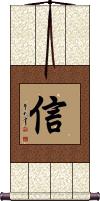
信 can mean to believe, truth, faith, fidelity, sincerity, trust, and confidence in Chinese, old Korean Hanja, and Japanese Kanji.
This single character is often part of other words with similar meanings.
It is one of the five basic tenets of Confucius.
In Chinese, it sometimes has the secondary meaning of a letter (as in the mail) depending on context but it will not be read that way when seen on a wall scroll.
In the Buddhist context, this is śraddhā (faith through hearing or being taught).
Avatar
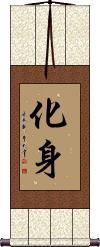
化身 is a way to say avatar in Chinese characters, Korean Hanja, and Japanese Kanji.
This is the original Buddhist idea of an avatar (not the movie). This can also mean: incarnation; reincarnation; embodiment; personification; impersonation.
化身 is the Chinese word used for the original Sanskrit, nirmāṇakāya. Alternates for nirmāṇakāya include 應身, 應化身, or 變化身. In the context of Buddhism, this is a Buddha's metamorphosic body, which has the power to assume any shape to propagate the Truth. This title, 化身, is used for the appearance of a Buddha's many forms.
Science / Universal Law
The rules of life, the universe, and everything.
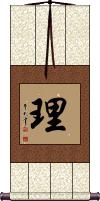
At its essence, 理 means science.
理 is a very ambiguous and open term; it speaks to the reason that all things exist, and how things work from the microscopic to the cosmic level.
In the Buddhist context, this character represents the “Universal Law.”
There are many translations for this word, including inner essence, intrinsic order, reason, logic, truth, natural science (esp. physics), principle, the underlying principles of the cosmos, the way of things, ruling principle, fundamental law, intrinsicality, universal basis, or essential element(s).
If you are a scientist, or just searching for “the answer to life, the universe, and everything,” this could be the character for you.
Daodejing / Tao Te Ching - Chapter 27
The Mastery of Effortless Skill

Chapter 27 of the Daodejing reveals a profound truth about mastery: the highest skill leaves no trace, requires no force, and appears almost invisible.
善行無轍跡,
善言無瑕謫,
善數不用籌策,
善閉無關鍵而不可開,
善結無繩約而不可解。
是以聖人常善救人,
故無棄人;
常善救物,
故無棄物。
是謂襲明。
故善人者,不善人之師;
不善人者,善人之資。
不貴其師,不愛其資,
雖智大迷,
是謂要妙。
The sage moves through life with such natural harmony that nothing seems imposed; doors need no locks, knots require no rope, and actions leave no mark behind.
This is the essence of wúwéi (effortless action), where true ability arises from deep alignment with the Tao rather than deliberate effort.
At its heart, this chapter teaches compassion without exception. The sage “abandons no one and nothing,” recognizing value in all people and all things. Even those who seem flawed or unrefined are not rejected, but understood as part of a greater whole with each person both a student and a teacher in the unfolding of life.
Laozi reminds us that wisdom is not about perfection or control, but about subtle awareness. The truly skilled individual does not rely on tools, rules, or rigid structures; instead, they embody an intuitive understanding that makes their actions naturally complete.
In this way, excellence becomes quiet, effortless, and beyond imitation.
This teaching also reflects a deeper philosophical insight: Opposites are interdependent. The “good” person learns from the “not good,” and the “not good” provides the material for growth. To reject either is to misunderstand the balance of existence itself.
As calligraphy, Daodejing Chapter 27 serves as a reminder to cultivate inner mastery rather than outward display. It is a meditation on refinement, humility, and the quiet power of skill perfected through harmony with the natural order.
Note: The Chinese text used here is based on the early Mawangdui silk manuscript tradition (2nd century BCE). The Guodian manuscripts do NOT preserve Chapter 27 in full form.
Crisis equals Danger plus Opportunity?
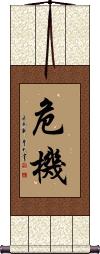
危機 means crisis in Chinese and Japanese.
Separately, the first character here does mean “danger” or “to endanger,” and the second character can mean “opportunity.”
However, I want to debunk a myth that was propagated by some westerners who did not have a clear understanding of Asian languages...
While often, Chinese/Japanese/Korean compound words (words of two or more characters) are the sum of their parts, this is not always the case. The compound is often understood with a completely different meaning than the two characters individually.
Many have said that the Chinese/Japanese/Korean word for Crisis is made up of the characters for “danger” and “opportunity.” 危機 is true when phrased this way.
However, it's not absolutely correct to say that “danger + opportunity = crisis” in Asian cultures.
English example:
If I tell you that...
Bovine creature + Guy behind the plate in baseball = Locomotive train protection

...you would think I was mad. But consider that “cow + catcher = cowcatcher,” which is the device that used to be found on steam engines to protect them if they hit an animal on the tracks. When we hear the word “cowcatcher,” we don't separate the words into their individual meanings (necessarily).
The same is true with the word for crisis in Chinese/Japanese/Korean. While you can separate the characters, few Asian people would automatically do so in their minds.
The final answer:
It is a half-truth to say, “danger plus opportunity equals crisis” in Chinese/Japanese/Korean. Use this statement and concept with caution.
Also, the second character can mean “secret” or “machine,” depending on context so I guess you have to say “a dangerous machine = crisis” or “danger + a secret = crisis.” Both of these are only slightly more ridiculous than the first premise.
PS: 危機 is probably not a great word for a scroll unless you have a special use for it.
This in-stock artwork might be what you are looking for, and ships right away...

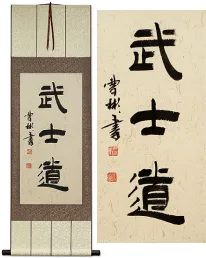
Gallery Price: $200.00
Your Price: $98.88

Gallery Price: $200.00
Your Price: $118.88
Gallery Price: $268.00
Your Price: $148.77
Gallery Price: $87.00
Your Price: $47.88

Gallery Price: $200.00
Your Price: $118.88

Gallery Price: $200.00
Your Price: $118.88
The following table may be helpful for those studying Chinese or Japanese...
| Title | Characters | Romaji (Romanized Japanese) | Various forms of Romanized Chinese | |
| Thirst for Truth | 渴法 | katsuhō | kě fǎ / ke3 fa3 / ke fa / kefa | k`o fa / kofa / ko fa |
| True Religion Buddha Truth | 實道 实道 | jitsu dou / jitsudou / jitsu do | shí dào / shi2 dao4 / shi dao / shidao | shih tao / shihtao |
| Walk in the Way | 行道 | yukimichi | xíng dào / xing2 dao4 / xing dao / xingdao | hsing tao / hsingtao |
| In Wine there is Truth | 酒后吐真言 / 酒後吐真言 酒后吐真言 | jiǔ hòu tǔ zhēn yán jiu3 hou4 tu3 zhen1 yan2 jiu hou tu zhen yan jiuhoutuzhenyan | chiu hou t`u chen yen chiuhoutuchenyen chiu hou tu chen yen |
|
| Appreciation of Truth by Meditation | 心印 | shin nin / shinnin | xīn yìn / xin1 yin4 / xin yin / xinyin | hsin yin / hsinyin |
| Comparison Leads to Truth and Enlightenment | 不比不知道一比嚇一跳 不比不知道一比吓一跳 | bù bǐ bù zhī dào yī bǐ xià yì tiào bu4 bi3 bu4 zhi1 dao4 yi1 bi3 xia4 yi4 tiao4 bu bi bu zhi dao yi bi xia yi tiao | pu pi pu chih tao i pi hsia i t`iao pu pi pu chih tao i pi hsia i tiao |
|
| Daoism Taoism | 道 | michi / -do | dào / dao4 / dao | tao |
| Paramartha | 波羅末陀 波罗末陀 | ha ra ma da haramada | bō luó mò tuó bo1 luo2 mo4 tuo2 bo luo mo tuo boluomotuo | po lo mo t`o polomoto po lo mo to |
| Buddha Seeking | 勤求 | gongu | qín qiú / qin2 qiu2 / qin qiu / qinqiu | ch`in ch`iu / chinchiu / chin chiu |
| Diamond | 金剛 金刚 | kon gou / kongou / kon go | jīn gāng / jin1 gang1 / jin gang / jingang | chin kang / chinkang |
| True Real Genuine | 真 or 眞 真 | shin / makoto | zhēn / zhen1 / zhen | chen |
| Believe Faith Trust | 信 | shin | xìn / xin4 / xin | hsin |
| Avatar | 化身 | keshin | huà shēn / hua4 shen1 / hua shen / huashen | |
| Science Universal Law | 理 | kotowari | lǐ / li3 / li | |
| Daodejing Tao Te Ching - Chapter 27 | 善行無轍跡善言無瑕謫善數不用籌策善閉無關鍵而不可開善結無繩約而不可解是以聖人常善救人故無棄人常善救物故無棄物是謂襲明故善人者不善人之師不善人者善人之資不貴其師不愛其資雖智大迷是謂要妙 善行无辙迹善言无瑕谪善数不用筹策善闭无关键而不可开善结无绳约而不可解是以圣人常善救人故无弃人常善救物故无弃物是谓袭明故善人者不善人之师不善人者善人之资不贵其师不爱其资虽智大迷是谓要妙 | shàn xíng wú zhé jì shàn yán wú xiá zhé shàn shù bù yòng chóu cè shàn bì wú guān jiàn ér bù kě kāi shàn jié wú shéng yuē ér bù kě jiě shì yǐ shèng rén cháng shàn jiù rén gù wú qì rén cháng shàn jiù wù gù wú qì wù shì wèi xí míng gù shàn rén zhě bù shàn rén zhī shī bù shàn rén zhě shàn rén zhī zī bù guì qí shī bù ài qí zī suī zhì dà mí shì wèi yào miào shan4 xing2 wu2 zhe2 ji4 shan4 yan2 wu2 xia2 zhe2 shan4 shu4 bu4 yong4 chou2 ce4 shan4 bi4 wu2 guan1 jian4 er2 bu4 ke3 kai1 shan4 jie2 wu2 sheng2 yue1 er2 bu4 ke3 jie3 shi4 yi3 sheng4 ren2 chang2 shan4 jiu4 ren2 gu4 wu2 qi4 ren2 chang2 shan4 jiu4 wu4 gu4 wu2 qi4 wu4 shi4 wei4 xi2 ming2 gu4 shan4 ren2 zhe3 bu4 shan4 ren2 zhi1 shi1 bu4 shan4 ren2 zhe3 shan4 ren2 zhi1 zi1 bu4 gui4 qi2 shi1 bu4 ai4 qi2 zi1 sui1 zhi4 da4 mi2 shi4 wei4 yao4 miao4 shan xing wu zhe ji shan yan wu xia zhe shan shu bu yong chou ce shan bi wu guan jian er bu ke kai shan jie wu sheng yue er bu ke jie shi yi sheng ren chang shan jiu ren gu wu qi ren chang shan jiu wu gu wu qi wu shi wei xi ming gu shan ren zhe bu shan ren zhi shi bu shan ren zhe shan ren zhi zi bu gui qi shi bu ai qi zi sui zhi da mi shi wei yao miao | shan hsing wu che chi shan yen wu hsia che shan shu pu yung ch`ou ts`e shan pi wu kuan chien erh pu k`o k`ai shan chieh wu sheng yüeh erh pu k`o chieh shih i sheng jen ch`ang shan chiu jen ku wu ch`i jen ch`ang shan chiu wu ku wu ch`i wu shih wei hsi ming ku shan jen che pu shan jen chih shih pu shan jen che shan jen chih tzu pu kuei ch`i shih pu ai ch`i tzu sui chih ta mi shih wei yao miao shan hsing wu che chi shan yen wu hsia che shan shu pu yung chou tse shan pi wu kuan chien erh pu ko kai shan chieh wu sheng yüeh erh pu ko chieh shih i sheng jen chang shan chiu jen ku wu chi jen chang shan chiu wu ku wu chi wu shih wei hsi ming ku shan jen che pu shan jen chih shih pu shan jen che shan jen chih tzu pu kuei chi shih pu ai chi tzu sui chih ta mi shih wei yao miao |
|
| Crisis equals Danger plus Opportunity? | 危機 危机 | kiki | wēi jī / wei1 ji1 / wei ji / weiji | wei chi / weichi |
| In some entries above you will see that characters have different versions above and below a line. In these cases, the characters above the line are Traditional Chinese, while the ones below are Simplified Chinese. | ||||

Successful Chinese Character and Japanese Kanji calligraphy searches within the last few hours...



