Many custom options...


And formats...



Stem in Chinese / Japanese...
Buy a Stem calligraphy wall scroll here!
Personalize your custom “Stem” project by clicking the button next to your favorite “Stem” title below...
Bellflower / Herb of Bellflower
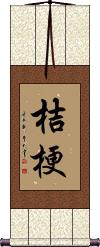
桔梗 means “Chinese bellflower” in Japanese.
In Chinese, it refers to the “Platycodon grandiflorus” (Platycodon grandiflorum), “balloon flower,” or “bellflower.”
Please note that in Chinese, this particular 2-character title suggests that you are talking about the medicinal herb derived from the stem of this flower/plant.
Taido
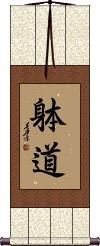
Taidō (The Way of the Body) is a style of Karate practiced in Japan and popular worldwide.
Taidō or 躰道 traces a lineage from Genseiryū (玄制流), which came from Shuri-te (首里手), one of the original martial arts schools of ancient Okinawa.
The first character 躰 is a variant of the original Chinese character 體. In modern Japan, they tend to use 体, a more simple character form. 体 is also the modern Simplified Chinese form of 體.
The 躰 character is correct for this 躰道 martial arts title. But it can be confusing with so many variants out there, not to mention other homophonic Japanese words that also romanize as Taidō or Taidou.
To have a bit more fun with this 躰 character, it has a 身 radical on the left, which sets it apart. The meaning doubles up on the “body” as 身 (shin) is a character that also means body in Japanese and Chinese. On the right is 本, which often means root, stem, origin, source, or fundamental (but can also mean “book” in some contexts). This has deviated from the original 體 which was 骨 (bone) + 豊 (vessel). Hence, the body was your “bone vessel” in ancient Asia.
The meaning of 躰, as well as 體 and 体, is usually translated as the body. When related to the physical body, it can also refer to the torso, trunk, build, physique, or the constitution of a person. As an extension of this, it can also refer to someone's health (good body = good health).
However, depending on the context, it can encompass other meanings such as form, style, system, experience, aspect, corpus, corporeal, substance, or essentials.
The second character, 道, is recognized and well-known as the “Way” and is the same “do” as in Karate-do or Aikido.
Not the results for stem that you were looking for?
Below are some entries from our dictionary that may match your stem search...
| Characters If shown, 2nd row is Simp. Chinese |
Pronunciation Romanization |
Simple Dictionary Definition |
干 see styles |
gān gan1 kan motomu もとむ |
(bound form) to have to do with; to concern oneself with; one of the ten heavenly stems 天干[tian1 gan1]; (archaic) shield (irregular okurigana usage) (n,n-pref) drying; dried; (male given name) Motomu A shield; a stem, or pole; to offend; to concern; to seek. |
本 see styles |
běn ben3 pen yanakamoto やなかもと |
More info & calligraphy: Ben(1) book; volume; script; (prefix) (2) this; present; current; ... in question; ... at issue; (prefix) (3) main; head; principal; (prefix) (4) real; genuine; regular; proper; (counter) (5) counter for long, cylindrical things; counter for films, TV shows, etc.; counter for goals, home runs, etc.; counter for telephone calls; (surname) Yanakamoto Radical, fundamental, original, principal, one's own; the Buddha himself, contrasted with 蹟 chi, traces left by him among men to educate them; also a volume of a book. |
蒂 see styles |
dì di4 ti |
More info & calligraphy: Tee |
ざる see styles |
zaru ザル |
(auxiliary) (form) (after a -nai stem; attributive form of 〜ざり) (See ざり) not; un-; (personal name) Zal |
しな see styles |
jina ジナ |
(suffix) (after the -masu stem of a verb) having just started ...; (personal name) Gina; Zina |
とも see styles |
tomo トモ |
(particle) (1) (after the -ba stem of a verb) but; however; (particle) (2) (See ても・1) even though; even if; (female given name) Tomo |
あんす see styles |
ansu アンス |
(expression) (1) (archaism) (semi-polite) to come; to go; (auxiliary verb) (2) (polite language) (archaism) (after -masu stem of verb) (See ます・1) expresses politeness towards the listener (or reader); (surname) Hains |
まっせ see styles |
masse マッセ |
(expression) (ksb:) (on -masu stem of verb; roughly equiv. to -ますよ) let's do it; I (we) are going to do it; (personal name) Massais |
す see styles |
zu ず |
(auxiliary verb) (1) (after the -nai stem of a verb and for サ変 as せ~ず (all senses); continuative form of ぬ) (See ぬ,ずに) (does) not ..., and; (does) not ..., so; not (doing); without (doing); (auxiliary verb) (2) (archaism) (See ない) not |
な see styles |
na な |
(particle) (1) (prohibitive; used with dictionary form verb) don't; (particle) (2) (imperative (from なさい); used with -masu stem of verb) do; (interjection) (3) (See なあ) hey; listen; you; (particle) (4) (when seeking confirmation, for emphasis, etc.; used at sentence end) now, ...; well, ...; I tell you!; you know; (particle) (5) (used to express admiration, emotionality, etc.; used at sentence end) wow; ooh |
ぬ see styles |
nu ぬ |
(aux-v,vn) (archaism) (following ~ます stem of a verb) indicates completion |
出 see styles |
chū chu1 ch`u chu de で |
to go out; to come out; to arise; to occur; to produce; to yield; to go beyond; to exceed; (used after a verb to indicate an outward direction or a positive result); classifier for dramas, plays, operas etc (n,n-suf) (1) coming out; going out; outflow; efflux; rising (of the Sun or the Moon); (n,n-suf) (2) attending (work); appearing (on stage); one's turn to go on; (n,n-suf) (3) start; beginning; (n,n-suf) (4) origins; background; person (or item) originating from ...; graduate of ...; native of ...; member of ... (lineage); (n,n-suf) (5) architectural member that projects outward; (n,n-suf) (6) highest point of the stern of a ship; (n,n-suf) (7) (kana only) (usu. after the -masu stem of a verb as 〜出がある or 〜出がない, etc.) amount (comprising something); amount of time or effort required to do something; (surname) De To go out, come forth, put forth; exit; beyond. |
前 see styles |
qián qian2 ch`ien chien misaki みさき |
front; forward; ahead; first; top (followed by a number); future; ago; before; BC (e.g. 前293年); former; formerly (1) in front (of); before (e.g. a building); (n,adj-no,adv) (2) before; earlier; previously; prior; ago; (minutes) to (the hour); (noun - becomes adjective with の) (3) (the) front; frontal part; fore; head (e.g. of a line); (4) forward; ahead; (5) (in the) presence (of); in front (of someone); (can be adjective with の) (6) previous (e.g. page); prior (e.g. engagement); first (e.g. half); former (e.g. example); (suffix) (7) (after a noun or the -masu stem of a verb) (See 一人前・1) portion; helping; (8) front (of one's body or clothing); breast (of a coat, kimono, etc.); (9) privates; private parts; (10) (colloquialism) criminal record; previous conviction; (a) prior; (personal name) Misaki pūrva. Before; former, previous; in front. |
嗜 see styles |
shì shi4 shih shi |
addicted to; fond of; stem corresponding to -phil or -phile Fond of, given up to, doting; translit. sh, j sounds. |
時 时 see styles |
shí shi2 shih tozaki とざき |
o'clock; time; when; hour; season; period (suffix noun) (1) (after noun or -masu stem of verb) (See 食事時) time for ...; time to ...; (suffix noun) (2) (See 売り時) good time to ...; opportunity to ...; (suffix noun) (3) (See 花見時) season; (surname) Tozaki Time, hour, period; constantly; as kāla, time in general, e.g. year, month, season, period; as samaya, it means kṣaṇa, momentary, passing; translit. ji. |
柄 see styles |
bǐng bing3 ping fukumasu ふくます |
handle or shaft (of an axe etc); (of a flower, leaf or fruit) stem; something that affords an advantage to an opponent; classifier for knives or blades hilt (of a sword); haft (of a dagger); handle; handgrip; (personal name) Fukumasu A handle; authority, power. |
柯 see styles |
kē ke1 k`o ko ko こ |
(literary) branch; stem; stalk; (literary) ax handle (obscure) handle of an axe; handle of a hatchet; (surname) Ko Axe-handle; agent; translit. k, v. 呵, 迦, 哥, etc. |
梗 see styles |
gěng geng3 keng kyō |
branch; stem; stalk; CL:根[gen1]; to block; to hinder; (neologism that evolved from 哏[gen2], initially in Taiwan, during the first decade of the 21st century) memorable creative idea (joke, catchphrase, meme, neologism, witty remark etc); prominent feature of a creative work (punchline of a joke, trope in a drama, special ingredient in a dish, riff in a pop song etc) illness |
様 see styles |
yàng yang4 yang you / yo よう |
Japanese variant of 樣|样 (n-suf,n) (1) (kana only) (usu. after the -masu stem of a verb) (See 様だ・1) appearing ...; looking ...; (n-suf,n) (2) (usu. after the -masu stem of a verb) way to ...; method of ...ing; (n-suf,n) (3) (usu. after a noun) form; style; design; (n-suf,n) (4) (usu. after a noun) (See 様だ・2) like; similar to; (5) thing (thought or spoken); (female given name) Yō |
秧 see styles |
yāng yang1 yang nae なえ |
sapling; seedling; sprout; (esp.) rice seedling; stem; stalk; vine; baby livestock; fry; (dialect) to raise; to cultivate (plants or animals) (out-dated kanji) rice seedlings; (female given name) Nae |
稈 秆 see styles |
gǎn gan3 kan kan かん |
stalks of grain culm (hollow stem of a grass) |
等 see styles |
děng deng3 teng hitoshi ひとし |
to wait for; to await; by the time; when; till; and so on; etc.; et al.; (bound form) class; rank; grade; (bound form) equal to; same as; (used to end an enumeration); (literary) (plural suffix attached to a personal pronoun or noun) (suffix) (1) (kana only) pluralizing suffix; (suffix) (2) (kana only) (See あちら・1,いくら・1) or so; rough indicator of direction, location, amount, etc.; (suffix) (3) (kana only) (after the stem of an adjective) (See 清ら) nominalizing suffix; (s,m,f) Hitoshi To pair; parallel, equal, of like order; a class, grade, rank; common; to wait; sign of plural. In Buddhist writings it is also used for 'equal everywhere', 'equally everywhere', 'universal'. |
茎 see styles |
kei / ke けい |
stalk; stem; (female given name) Kei |
莖 茎 see styles |
jīng jing1 ching |
stalk; stem; CL:條|条[tiao2] See: 茎 |
菰 see styles |
gū gu1 ku komo こも |
Manchurian wild rice (Zizania latifolia), now rare in the wild, formerly harvested for its grain, now mainly cultivated for its edible stem known as 茭白筍|茭白笋[jiao1 bai2 sun3], which is swollen by a smut fungus; variant of 菇[gu1] (1) (abbreviation) woven straw mat (orig. made of wild rice leaves); (2) beggar; (3) (archaism) Manchurian wild rice (Zizania latifolia) |
蔸 see styles |
dōu dou1 tou |
root and lower stem of certain plants; classifier for pieces and clumps |
蕻 see styles |
hòng hong4 hung |
(literary) luxuriant; flourishing; (literary) bud; (dialect) long stem of certain vegetables |
蘊 蕴 see styles |
yùn yun4 yün osamu おさむ |
to accumulate; to hold in store; to contain; to gather together; to collect; depth; inner strength; profundity (given name) Osamu skandha, v. 塞; older tr. 陰, intp. as that which covers or conceals, implying that physical and mental forms obstruct realization of the truth; while the tr. 蘊, implying an accumulation or heap, is a nearer connotation to skandha, which, originally meaning the shoulder, becomes stem, branch, combination, the objects of sense, the elements of being or mundane consciousness. The term is intp. as the five physical and mental constituents, which combine to form the intelligent 性 or nature; rūpa, the first of the five, is considered as physical, the remaining four as mental; v. 五蘊. The skandhas refer only to the phenomenal, not to the 無爲 non-phenomenal. |
軸 轴 see styles |
zhòu zhou4 chou jiku じく |
see 壓軸戲|压轴戏[ya1 zhou4 xi4]; Taiwan pr. [zhou2] (n,n-suf) (1) axis; shaft; axle; (2) center; centre; focal point; key point; (3) stalk; stem; (4) (See 掛け物・かけもの・1) hanging scroll a roller for a scroll |
黀 see styles |
zōu zou1 tsou |
hemp stem |
Click here for more stem results from our dictionary
The following table may be helpful for those studying Chinese or Japanese...
| Title | Characters | Romaji (Romanized Japanese) | Various forms of Romanized Chinese | |
| Bellflower Herb of Bellflower | 桔梗 | ki kyou / kikyou / ki kyo | jié gěng / jie2 geng3 / jie geng / jiegeng | chieh keng / chiehkeng |
| Taido | 躰道 | tai dou / taidou / tai do | ||

Successful Chinese Character and Japanese Kanji calligraphy searches within the last few hours...



