Many custom options...


And formats...



Sickness in Chinese / Japanese...
Buy a Sickness calligraphy wall scroll here!
Personalize your custom “Sickness” project by clicking the button next to your favorite “Sickness” title below...
Birth Old-Age Sickness Death
Born to Suffer
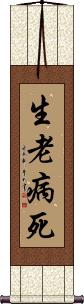
生老病死 means “to be born, to grow old, to get sick and to die” or “birth, aging, sickness, and death.”
This is an old somewhat-morbid Chinese proverb that is also used in Korean and Japanese. It figuratively means the fate of humankind (i.e. mortality) or suggests that we are all born to suffer.
In the Buddhist context, there are the “four inevitables in human life” or “four afflictions that are the lot of every human” known as “四苦” (literally “four afflictions”). Sometimes this proverb is written with that affliction character, 苦, at the end like 生老病死苦.
Preparation Yields No Fear or Worries
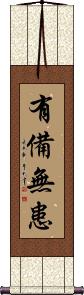
有備無患 means “When you are well-prepared, you have nothing to fear.”
Noting that the third character means “no” or “without” and modifies the last... The last character can mean misfortune, troubles, worries, or fears. It could even be stretched to mean sickness. Therefore you can translate this proverb in a few ways. I've also seen it translated as “Preparedness forestalls calamities.”
有備無患 is comparable to the English idiom, “Better safe than sorry,” but does not directly/literally mean this.
Misery Loves Company
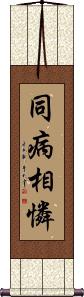
同病相憐 is a Chinese proverb that means “fellow sufferers empathize with each other” or to match it with a western idiom, “misery loves company.” This is also somewhat known in Korean Hanja.
This could be two people who were just dumped by a girlfriend/boyfriend or just divorced. They're drawn together either by their misery or because of the need to share their miserable experience with someone else.
同病相憐 is probably the saddest proverb in our collection.
Literally, the characters mean:
同 together with
病 illness, sickness, disease (in this case, just the mental anguish after some kind of event or life issue)
相 mutual, reciprocal, each other
憐 pity, sympathize
In Japanese, this is written with two extra Hiragana on the end like this: 同病相憐れむ
If you want the Japanese version,
don’t
use the button above but click here instead: Misery Loves Company in Japanese
These search terms might be related to Sickness:
Not the results for sickness that you were looking for?
Below are some entries from our dictionary that may match your sickness search...
| Characters If shown, 2nd row is Simp. Chinese |
Pronunciation Romanization |
Simple Dictionary Definition |
五行 see styles |
wǔ xíng wu3 xing2 wu hsing gogyou / gogyo ごぎょう |
More info & calligraphy: Five Elements(1) (See 五大・ごだい・1) the five elements (in Chinese philosophy: wood, fire, earth, metal and water); the five phases; wu xing; (2) {Buddh} five practices of the Bodhisattvas; (3) (See 六信五行) the five pillars of Islam; (surname, given name) Gogyou The five lines of conduct. I. According to the 起信論 Awakening of Faith they are almsgiving; keeping the commandments; patience under insult; zeal or progress; meditation. II. According to the 涅槃經 Nirvana Sutra they are saintly or bodhisattva deeds; arhat, or noble deeds; deva deeds; children's deeds (i. e. normal good deeds of men, devas, and Hinayanists); sickness conditions, e. g. illness, delusion, etc.; — into all these lines of conduct and conditions a Bodhisattva enters. III. The five elements, or tanmātra— wood, fire, earth, metal, and water; or earth, water, ire, air, and ether (or space) as taught by the later Mahāyāna philosophy; idem 五大. |
天使 see styles |
tiān shǐ tian1 shi3 t`ien shih tien shih yukari ゆかり |
More info & calligraphy: Angel / Messenger of Heaven(noun - becomes adjective with の) angel; (female given name) Yukari Divine messengers, especially those of Yama; also his 三天使 three messengers, or lictors— old age, sickness, death; and his 五天使 or 五大使, i. e. the last three together with rebirth and prisons or punishments on earth. |
生老病死 see styles |
shēng lǎo bìng sǐ sheng1 lao3 bing4 si3 sheng lao ping ssu shouroubyoushi / shorobyoshi しょうろうびょうし |
More info & calligraphy: Birth Old-Age Sickness Death(yoji) {Buddh} the four inevitables in human life (birth, aging, sickness, and death) Birth, age, sickness, death, the 四苦 four afflictions that are the lot of every man. The five are the above four and 苦 misery, or suffering. |
恙 see styles |
yàng yang4 yang |
sickness |
殗 see styles |
yè ye4 yeh |
sickness; repeated |
疒 see styles |
ne ne4 ne |
sick; sickness; Kang Xi radical 104; also pr. [chuang2] |
疾 see styles |
jí ji2 chi tsuguo つぐお |
(bound form) disease; ailment; (bound form) swift; (literary) to hate; to abhor (personal name) Tsuguo Sickness, an attack of illness: haste, speedy: angry. |
痾 疴 see styles |
kē ke1 k`o ko a |
(literary) disease; also pr. [e1] Sickness, pain; diarrhoea. |
瘼 see styles |
mò mo4 mo |
distress; sickness |
鬧 闹 see styles |
nào nao4 nao tō |
noisy; cacophonous; to make noise; to disturb; to vent (feelings); to fall ill; to have an attack (of sickness); to go in (for some activity); to joke busy |
三使 see styles |
sān shǐ san1 shi3 san shih sanshi |
The three (divine) messengers—birth, sickness, death; v. 使. Also 三天使 . |
不例 see styles |
furei / fure ふれい |
indisposition; sickness |
二苦 see styles |
èr kǔ er4 ku3 erh k`u erh ku ni ku |
Two kinds of suffering: within, e.g. sickness, sorrow; from without, e.g. calamities. |
五官 see styles |
wǔ guān wu3 guan1 wu kuan gokan ごかん |
five sense organs of TCM (nose, eyes, lips, tongue, ears 鼻目口舌耳); facial features the five sense organs; (place-name) Gokan The five controlling powers, v. 五大使, birth, old age, sickness, death, and the (imperial) magistrate. |
五苦 see styles |
wǔ kǔ wu3 ku3 wu k`u wu ku goku |
The five forms of suffering: I. (1) Birth, age, sickness, death; (2) parting with those loved; (3) meeting with the hated or disliked; (4) inability to obtain the desired; (5) the five skandha sufferings, mental and physical. II. Birth, age, sickness, death, and the shackles (for criminals). III. The sufferings of the hells, and as hungry ghosts, animals, asuras, and human beings. |
任病 see styles |
rèn bìng ren4 bing4 jen ping ninbyō |
naturalism sickness |
作病 see styles |
zuò bìng zuo4 bing4 tso ping sakubyou / sakubyo さくびょう |
feigned illness contrivance sickness |
傷病 see styles |
shoubyou / shobyo しょうびょう |
injuries and sickness; wounds and illness |
八師 八师 see styles |
bā shī ba1 shi1 pa shih hasshi |
The eight teachers―murder, robbery, adultery, lying, drinking, age, sickness, and death; v. 八師經. |
八苦 see styles |
bā kǔ ba1 ku3 pa k`u pa ku hakku はっく |
the eight distresses - birth, age, sickness, death, parting with what we love, meeting with what we hate, unattained aims, and all the ills of the five skandhas (Buddhism) {Buddh} the eight kinds of suffering (birth, old age, disease, death, parting from loved ones, meeting disliked ones, not getting what one seeks, pains of the five skandha) The eight distresses―birth, age, sickness, death, parting with what we love, meeting with what we hate, unattained aims, and all the ills of the five skandhas. |
八覺 八觉 see styles |
bā jué ba1 jue2 pa chüeh hachikaku |
The eight (wrong) perceptions or thoughts, i.e. desire; hate; vexation (with others); 親里 home-sickness; patriotism (or thoughts of the country's welfare); dislike of death; ambition for one's clan or family; slighting or being rude to others. 華嚴經 13. |
労り see styles |
itawari いたわり |
(noun - becomes adjective with の) (1) (kana only) sympathy; consideration; carefulness; attention; (2) (archaism) service; labor; labour; trouble; meritorious deed; (3) (archaism) illness; disease; sickness |
十境 see styles |
shí jìng shi2 jing4 shih ching jikkyō |
Ten objects of or stages in meditation觀 in the Tiantai school, i.e. 陰境 the five skandhas; 煩惱境 life's distresses and delusion; 病患境 sickness, or duḥkha, its cause and cure; 業相境 age-long karmaic influences; 魔事境 Māra affairs, how to overthrow their rule; 禪定境 the conditions of dhyāna and samādhi; 諸見境 various views and doubts that arise; 慢境 pride in progress and the delusion that one has attained nirvāṇa; 二乘境 temptation to be content with the lower nirvāṇa, instead of going on to the greater reward; 菩薩境 bodhisattvahood; see the 止觀 5. |
同病 see styles |
doubyou / dobyo どうびょう |
the same sickness |
吐気 see styles |
hakike はきけ |
nausea; sickness in the stomach |
四山 see styles |
sì shān si4 shan1 ssu shan yotsuyama よつやま |
(place-name) Yotsuyama Like four closing-in mountains are birth, age, sickness, and death; another group is age, sickness, death, and decay (衰, i. e. of wealth, honours, etc., or 無常 impermanence). |
女病 see styles |
nǚ bìng nv3 bing4 nü ping nyobyō |
Woman as a disease; feminine disease. |
如病 see styles |
rú bìng ru2 bing4 ju ping nyobyō |
like sickness |
孕吐 see styles |
yùn tù yun4 tu4 yün t`u yün tu |
morning sickness (during pregnancy) |
害喜 see styles |
hài xǐ hai4 xi3 hai hsi |
to react to pregnancy by experiencing morning sickness or a strong appetite for certain foods |
Click here for more sickness results from our dictionary
The following table may be helpful for those studying Chinese or Japanese...
| Title | Characters | Romaji (Romanized Japanese) | Various forms of Romanized Chinese | |
| Birth Old-Age Sickness Death | 生老病死 | shou rou byou shi shouroubyoushi sho ro byo shi | shēng lǎo bìng sǐ sheng1 lao3 bing4 si3 sheng lao bing si shenglaobingsi | sheng lao ping ssu shenglaopingssu |
| Preparation Yields No Fear or Worries | 有備無患 有备无患 | yǒu bèi wú huàn you3 bei4 wu2 huan4 you bei wu huan youbeiwuhuan | yu pei wu huan yupeiwuhuan |
|
| Misery Loves Company | 同病相憐 同病相怜 | doubyou shou awaremu doubyoushouawaremu dobyo sho awaremu | tóng bìng xiāng lián tong2 bing4 xiang1 lian2 tong bing xiang lian tongbingxianglian | t`ung ping hsiang lien tungpinghsianglien tung ping hsiang lien |
| In some entries above you will see that characters have different versions above and below a line. In these cases, the characters above the line are Traditional Chinese, while the ones below are Simplified Chinese. | ||||

Successful Chinese Character and Japanese Kanji calligraphy searches within the last few hours...



