Not what you want?
Try other similar-meaning words, fewer words, or just one word.
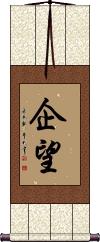
Buy a Looking Forward Hoping calligraphy wall scroll here!
Personalize your custom “Looking Forward Hoping” project by clicking the button next to your favorite “Looking Forward Hoping” title below...
2. From This Moment Forward / From This Day Forward
4. Enjoy Life
5. Guard
7. Ambitious / To Improve Oneself
9. This is Life
11. Jobin
13. Mirror
14. Waru
15. Falcon
16. Shark
17. Iron Heart
18. Fire Horse
19. Mushindo
20. Tan
21. Ririsa
24. Butterfly
25. Alert / On Guard / Lingering Mind
26. Shin Buddhism
28. Rose Flower
29. Motivation
30. Fundamental Principles of Tai Chi Chuan
31. Aikido
33. Khánh
35. Dogen
36. Karma
38. Katana
39. Ocean / Sea
40. Read
41. Emperor
42. Sasuke
43. No one knows a son better than the father
44. Shadow Warrior
45. Gaman
47. Learn From Your Predecessors
48. Do not shed a tear until you see the coffin
51. Clarity
52. Safety and Well-Being of the Family
53. Inspiration
54. Daodejing / Tao Te Ching - Chapter 33
55. The Middle Way
57. Sword
59. Kansei Engineering / Sense Engineering
60. Glory and Honor
61. Past experience is the teacher for the future
62. Hapkido
企望 is a Chinese and Japanese word that can be translated as:
to hope; to look forward; looking forward to; hoping for.
The first character means to plan. The second can mean to hope; to expect; to gaze (into the distance); to look towards. Sometimes it can mean a full moon.
Together, these characters create this word about hoping, wishing, looking forward, and dreaming about the future.
In simple terms, 從此以后 means “from now on,” but you can also interpret it as “Now is the beginning of the future” or “From this day forward.
The first two characters roughly mean “henceforth.” The last two characters mean later, afterward, following, or “in the future.”
人生を楽しみにしている is one way to write “enjoy life” in Japanese.
The character breakdown:
人生 (jinsei) life (i.e. conception to death) human lifetime, living.
を (o) connecting particle.
楽しみ (tanoshimi) enjoyment; pleasure; anticipation; looking forward to.
に (ni) connecting particle.
し (shi) to do; to cause; to become; to make (into).
て (te) connecting particle.
いる (iru) indicates continuing action or resulting state.
Note: Because this selection contains some special Japanese Hiragana characters, it should be written by a Japanese calligrapher.
前衛 is the Chinese, Japanese Kanji, and old Korean Hanja for an advanced guard, vanguard, or avant-garde.
This can also refer to a forward (in soccer / futbol).
Advance and Progress
上進 is a Chinese and Japanese Kanji word that means to advance, to make progress, to do better, to be ambitious, to improve oneself, or to move forward.
This can refer to a single person, general things (such as a work project), or a whole country.
In Japanese, this is sometimes used as the given name Joushin.
外向 is the Chinese, Japanese Kanji, and old Korean Hanja for outward-looking, extrovert, or extroverted.
This literally means “to face the outside” (as opposed to hiding one's face).
榮譽勇氣責任 is a word list that reads, “榮譽 勇氣 責任” or “honor courage commitment.”
If you are looking for this, it is likely that you are in the military (probably Navy or Marines).
We worked on this for a long time to find the right combination of words in Chinese. However, it should still be noted that word lists are not very natural in Chinese. Most of the time, there would be a subject, verb, and object for a phrase with this many words.
鏡 is a Chinese character, Japanese Kanji and Korean Hanja that means mirror.
It can also mean lens or looking-glass depending on context.
In Buddhism, this is the equivalent of ādarśa from Sanskrit meaning a mirror.
割る is a transitive verb in Japanese that means: to divide; to cut; to break; to halve; to separate; to split; to rip; to crack; to smash; to dilute.
There are not many words that romanize as waru, but many people seem to be looking for this, so I added it.
Note: This Japanese word has nothing to do with Star Wars!
鶻 is a Chinese character that means falcon.
This can also refer to a migratory bird of prey.
If you are looking for the Dutch surname Valk, or the German surname Falco by meaning, this would be a good character for you.
This single Chinese character means shark.
However, in Japanese, it can refer to the family of goby fish.
鯊 is good if you're looking for the word shark in Chinese and Japanese folks might misunderstand it.
鐵心 can be translated as “iron heart,” “steel core,” or “iron mind” in Chinese and Japanese Kanji.
This is not a common term, but I added it here since so many were looking for “iron heart.” This is almost like saying you are without emotions or feelings - a very stoic person. This is not a Buddhist trait.
Surname
譚 is the surname Tan in Chinese.
The original form is 譚 but generations ago some changed the character to 覃 and some write it 檀 or 談. All of these romanize as tán in Mandarin Chinese and Tam in Cantonese. 覃, 檀, and 談 are rarely used for surnames now, you probably want 譚.
If you are looking for the origin of the Vietnamese name Tan, that came from 秦.
If you need one of these other characters, just copy and paste it into the search bar above, and an "Order Scroll" button will appear for you.
リリサ is the name Ririsa in Japanese Katakana.
This would be the western name Ririsa in Japanese. If you are looking for the original Japanese name, it will be different (search our dictionary for that - as there are at least 10 variations that romanize as a Japanese female given name Ririsa).
Note: Because this title is entirely Japanese Katakana, it should be written by a Japanese calligrapher.
望 holds the ideas of ambition, hope, desire, aspiring to, expectations, looking towards, to gaze (into the distance), and in some contexts, full moon rising.
望 is one of those single characters that is vague but in that vagueness, it also means many things.
望 is a whole word in Chinese and old Korean but is seldom seen alone in Japanese. Still, it holds the meanings noted above in all three languages.
This directly translates as, “First, love myself.”
While you might be looking for “Love yourself first,” there's the problem with yourself versus myself. If this is on your wall or tattooed on your arm, should it not say “myself” since it's directed at you, and not others?
See Also: Love Yourself First
蝶 is the simplest way to write “butterfly” in Chinese, Japanese and Korean.
If you are looking at the Chinese pronunciation and Romanization, please note this is not pronounced like the English “die.”
It actually sounds like “dee-ah.” (Chinese Romanization does not exactly follow English or Latin pronunciation of Roman letters).
Zanshin
残心 is a Japanese Kanji word meaning: continued alertness; unrelaxed alertness; remaining on one's guard; lingering mind, and being prepared for a counterstrike. This context is used in martial arts, which is probably why you are looking up this word.
In archery and golf, it can be the follow-through.
In the context of love and relationships, it can be lingering affection, attachment, regret, regrets, or reluctance.
True Pure Land Buddhism
浄土真宗 is known in the west as “Shin Buddhism.”
This is a school of Japanese “Pure Land Buddhism.” This form is also known as “True Pure Land Buddhism” or “Jodoshinshu” (jōdoshinshū).
If you are looking for this title, you probably already know the rest of the story.
See Also: Pure Land Buddhism
鷹 is the way to write eagle, falcon, or hawk in Chinese.
It means hawk or falcon in Japanese Kanji, and simply “eagle” in old Korean Hanja. Though we have different words for them in English, eagles, falcons, and hawks are all seen as the same general type of bird in Asian languages.
If you are looking for the Dutch surname Valk, or the German surname Falco by meaning, this would be a good character for you.
There are other multi-character words (most of them contain this character) which express different specific species of birds of prey (bald eagle, osprey, golden eagle, etc). If you need a more specific title, just contact me.
(The flower of love)
薔薇 is the universal way to write rose (as in the flower) because it is understood in both Chinese and Japanese (same characters in either language). 薔薇 is also a common way to write about roses in Asian poetry. This can be translated as “wild rose” if you are looking for that title.
薔薇 is also how to write “rose” in old Korean Hanja (though they now use Hangul, and most Koreans of this generation will not be able to read this without a dictionary).
動力 can be used for motivation - it can also mean power/motion/propulsion/force. It can be anything internal or external that keeps you going.
動力 is the safest way to express motivation in Chinese. If your audience is Japanese, please see the other entry for motivation. 動力 is a word in Japanese and Korean, but it means “motive power” or “kinetic energy” (without the motivation meaning that you are probably looking for).
See Also: Enthusiasm | Passion
Peng, Lu, Ji, An, Cai, Lie, Zhou, and Kao are the eight fundamentals or forces of Tai Chi Chuan or Taiqiquan.
棚 (Peng) refers to the outward (or upward) expansion of energy.
履 (Lu) is often referred to as “rollback.” Lu is the ability to absorb, yield/deflect incoming force.
擠 (Ji) is often thought of as a “forward press.” However, it is also best described as a “squeezing out of space.”
按 (An) is a downward movement of energy, best translated as “(relaxed) sinking.”
採 (Cai or Tsai) translated as “downward pluck.” Cai is a combination of Lu and An.
列 (Lie or Lieh) is “Split” and is a combination of Peng and Ji.
肘 (Zhou) Elbowing.
靠 (Kao) Shouldering (for when the arms are bound/distance is too close to punch).
Source: https://combativecorner.wordpress.com/2015/12/03/the-8-energies-and-5-movements-of-taijiquan/
合気道 is the modern Japanese way to write Aikido.
Aikido is often referred to as the defensive martial art.
While Aikido was born in Japan, it has become a somewhat famous form of defensive tactics taught to soldiers and Marines, as well as some law enforcement officers in the West.
Looking at the characters, the first means “union” or “harmony.”
The second character means “universal energy” or “spirit.”
The third means “way” or “method.”
Please note that while the original 合氣道 characters can be pronounced in Chinese, this word is not well-known in China and is not considered part of the Chinese lexicon.
Note: It is somewhat accepted that this is the origin of Hapkido in Korea. And other than a modern simplification to the middle Kanji of this 3-Kanji word, it is written the same in Korean Hanja.
See Also: Martial Arts | Hapkido
磬 means “chime stones,” but I'm including it here for those looking for the original Chinese character for the Vietnamese name Khánh.
Other definitions include ancient percussion instrument made of stone or jade pieces hung in a row and struck as a xylophone, sounding stone, ancient Chinese chime shaped like a chevron.
There is also a possibility that your original character is 慶 which means to celebrate or felicity. Contact me if you need that character.
一心流空手道 is the full title for Isshin-Ryu Karate-Do.
The literal meaning is “one heart method empty hand way.”
There are other ways to translate this, but if you are looking for this title, you already know that.
This would make a great wall scroll for your dojo or private studio if you study this form of Japanese (technically from Okinawa) Karate.
Because this is a specifically-Japanese title, I strongly recommend that you select our Japanese Master Calligrapher to create this artwork.
Usually, when people are looking for 道元 or “Dogen,” they are referring to the Japanese Zen monk by this name.
He lived from 1200-1253. This Dogen name or title literally means “The Way Origin” or “Beginning of the Path.” It is understood to mean “beginning of right doctrine or faith” in the context of his name and work to establish the Sōtō school of Zen in Japan.
To accomplish that task, this humble monk traveled from Japan and across China to find the more original or pure forms of Buddhism.
Transliterated personal name
卡瑪 is the most common transliteration to Mandarin Chinese for the name Karma.
Note: This sounds like Karma but does not have the meaning of Karma in Chinese. See our other entry if you are looking for the Buddhist idea of Karma.
In fact, if your name is Karma, I strongly suggest that you use a word that means Karma, rather than this one that sounds like Karma (meaning is more important and universal in Chinese/Japanese/Korean).
The first character means “wood glue” or can be understood as “sticky” or “sticking.”
The second character means “hand” (or “hands”).
This term can be romanized as “Chi Sau,” “Chi Sao,” or from Mandarin, “Chi Shou.”
黐手 is a concept that comes from the Wing Chun (AKA: Ving Tsun, Wing Tsun, or Yong Chun) style of martial arts. If you are looking for this term, chances are, you already know the meaning within the context of Wing Chun.
Japanese Samurai Sword
刀 is the Japanese Kanji for “sword.” This refers to the style of sword carried by warriors, samurai, and shogun of ancient Japan.
With the pacification of Japan, such swords are now only used for ceremony and decoration. The true art of sword-smithing is all but lost in Japan with new sword production dedicated to making inexpensive replicas for the tourist and foreign market.
For those of you that want to ask whether I can get you a real antique sword. Let me tell you that most real Asian swords were melted down after WWII in Japan, and during the Great Leap Forward in China. Any remaining swords are family heirlooms that nobody will part with.
Please carefully note that the Japanese kanji character shown above is only for a Japanese audience. In China, this character means “knife.” See our other entry for “sword” in Chinese.
Note: 刀 can mean knife, sword, or blade in Korean, depending on context.
See Also: Sword
海 is the character often used for sea or ocean in Chinese, Japanese Kanji, and old Korean Hanja. In some context, this can refer to the beach, or an area near the sea, such as “Shanghai” (same hai is the second character of Shanghai).
If you are looking for a universal word for ocean or sea - or can't decide which character for ocean or sea that you want, pick this one!
海 is also a common female given name in Japan - also a good name for a restaurant as “Umi Sushi” would mean “Ocean Sushi Restaurant.”
Please note that our Japanese master calligrapher will tend to write this character in the form shown to the right (a line instead of two dots). Both versions are correct, and can be read in either language. Let us know if you have a preference when you order.
閱 is a Chinese character that means to read. It can also refer to observing (the world, and learning from it), or gaining life experiences. 閱 is a good character to relay the idea of being “well-read,” which can include reading books, studying, and learning through experience.
The dictionary definition also includes: to inspect; to review; to peruse; to go through; to experience.
Technically, this is also a Japanese Kanji but only some Japanese Buddhists use it (most of the population will not recognize it).
In Chinese and Japanese Buddhism, this means examining, inspecting, and/or looking over.
皇帝 means emperor in Chinese, Japanese, and old Korean.
From times of old, the emperors of Asia ruled under the authority of God himself. One definition of an emperor is a ruler put in power by God. This definition separates emperors from the various kings in Chinese history (although defining who is a king versus an emperor gets vague sometimes).
Occasionally, the emperor's wife was widowed, and she took the role of an empress until her death (see our entry for empress if that is what you are looking for).
サスケ is the Japanese title of the TV show, Sasuke Rising.
サスケ is the original Japanese TV show that inspired the American Ninja Warrior, Ninja Warrior UK, and other variations.
It should be noted that in Japan, the show's title is usually displayed in capital Roman letters as “SASUKE,” rather than the Japanese text, サスケ. Although, both titles are known in Japan (you'd probably need to search for サスケ if looking to buy a Sasuke DVD in Japan).
Notes: Sasuke can also be a given name (written the same way). There are also other names that romanize as Sasuke in Japanese.
Note: Because this title is entirely Japanese Katakana, it should be written by a Japanese calligrapher.
知子莫若父 can be translated as “No one knows a son better than his father.”
This idiom is based on the idea that after spending many years together, family members know everything about each other. Better than anyone else, a father knows the qualities and shortcomings of his son.
If you are looking for something about “father and son,” this is probably the best selection.
While this is the original proverb (very old), others have been composed about various combinations of mothers, sons, daughters, and fathers. Let me know if you need a custom version.
影武者 is the title for Shadow Warrior in Chinese and Japanese.
This may refer to a few video games that share this English title, or a Japanese movie called Kagemusha.
If you are looking for the Japanese TV show, that was originally 影の軍団 (Kage no Gundan), which more literally means “Army of Shadows,” but was re-titled Shadow Warrior when released outside Japan in English.
In Japan, this title can also refer to a body double or decoy of an army general or leader used to avoid assassination. It can also be somebody who does all the work (or fighting) behind the scenes (not getting much, if any, credit).
![]()
Gaman is a Zen Buddhist term from Japan that means “enduring the seemingly unbearable with patience and dignity.”
This title can also be translated as patience, perseverance, tolerance, or self-denial.
我慢 is also a Chinese Buddhist term with a different pronunciation. It comes from Sanskrit abhimāna or ātma-mada. Chinese Buddhism defines this very differently as “Egoism exalting self and depreciating others,” “self-intoxication,” or “pride.” Alone, the first character means “Me, I, or Self,” and the second character in a Buddhist context comes from Sanskrit māna and means pride, arrogance, self-conceit, looking down on others, superciliousness, etc.
I’m currently working with Japanese and Chinese translators to try and reconcile the true meaning or any commonality of this word between languages. For now, please only consider this if your audience is Japanese.
推手 is the martial arts title “Pushing Hands.”
推手 is the title for two-person training routines practiced in internal Chinese martial arts such as Baguazhang, Xingyiquan, Tai Chi Chuan (Taijiquan), Liuhebafa, Chuan Fa, and Yiquan.
The first character means “pushing.”
The second character means “hand” (or “hands”).
This term can be romanized as “Tui Sau,” “Tui Sao,” or from Mandarin, “Tui Shou.”
If you are looking for this term, chances are, you already know the meaning within the context of Tai Chi and other martial arts.
When the cart in front overturns, be cautious with your own
前車之覆后車之鑒 is a Chinese proverb that suggests looking at the circumstances and toils of those you proceeded before you and learning from their experience.
This more literally means “the cart in front overturns, a warning to the following cart.”
This is figuratively translated as “draw a lesson from the failure of one's predecessor,” “learn from past mistakes,” or compared to the English idiom, “once bitten twice shy.”
Other more-direct translations:
Make the overturning of the chariot in front a warning for the chariot behind.
Learn caution through an unpleasant experience.
The wrecked coach in front should be a warning.
The overturned cart in front serves as a warning to the carts behind.
不見棺材不落淚 is a cautionary tale that suggests you are unknowingly (though it should be obvious)on a bad course.
It further suggests that you will not realize your folly until the worst has happened.
This can also be a warning of inaction until it's too late to take action. Again, not realizing your error until it's too late.
In an alternate interpretation, some will suggest this means doing something bad and not looking back - Then the worst happens.
It should be noted that this is one of the oddest selections for a wall scroll in our whole Asian calligraphy database. All of our translators are convinced that no Chinese person would ever hang this on their wall.
南派螳螂 can be translated literally as “Southern School Praying Mantis” or “Southern Style Praying Mantis.”
Despite its name, the Southern Praying Mantis style of Chinese martial arts is unrelated to the Northern Praying Mantis style. Southern Praying Mantis is instead related most closely to fellow Hakka styles such as Dragon and more distantly to the Fujian family of styles that includes Fujian White Crane, Five Ancestors, and Wing Chun.
This style of martial arts focuses more on fighting skills rather than aesthetics.
Of course, you already knew that if you were looking for this term.
Note: This title can be pronounced and does have meaning in Korean but only to Koreans familiar with Chinese martial arts.
Daoist / Taoist Tenet
無為 or “Wu Wei” is a Daoist (Taoist) tenet that speaks to the idea of letting nature take its course.
Some will say it's about knowing when to take action and when not to. In reality, it's more about not going against the flow. What will happen is controlled by the Dao (Tao), for which one who follows the Dao will not resist or struggle against.
You can think of 無為 as the Chinese way to express “laissez-faire.”
There is a lot more to this concept, but if you are looking for this entry, you already know the expanded concept.
Warning: Outside of the Daoist context, this means idleness or inactivity (especially in Japanese, where not everyone knows this as a Daoist concept, though it does pair well with the Japanese concept of Wabi-Sabi).
清 is a word that means clarity or clear in Chinese, Japanese Kanji, and old Korean Hanja.
Looking at the parts of this character, you have three splashes of water on the left, “life” on the top right, and the moon on the lower right.
Because of something Confucius said about 2500 years ago, you can imagine that this character means “live life with clarity like bright moonlight piercing pure water.” The Confucian idea is something like “Keep clear what is pure in yourself, and let your pure nature show through.” Kind of like saying, “Don't pollute your mind or body, so that they remain clear.”
This might be stretching the definition of this single Chinese character but the elements are there, and “clarity” is a powerful idea.
Korean note: Korean pronunciation is given above but this character is written with a slight difference in the "moon radical" in Korean. However, anyone who can read Korean Hanja, will understand this character with no problem (this is considered an alternate form in Korean). If you want the more standard Korean Hanja form (which is an alternate form in Chinese), just let me know.
Japanese note: When reading in Japanese, this Kanji has additional meanings of pure, purify, or cleanse (sometimes to remove demons or "exorcise"). Used more in compound words in Japanese than as a stand-alone Kanji.
Kanai Anzen
家內安全 is the Japanese way of saying “Family First.”
It's a Japanese proverb about the safety and well-being of your family and/or peace and prosperity in the household.
Some Japanese will hang an amulet in their home with these Kanji. The purpose is to keep your family safe from harm.
According to Shinto followers, hanging this in your home is seen as an invocation to God to always keep family members free from harm.
We were looking for a way to say “family first” in Japanese when this proverb came up in the conversation and research. While it doesn't say “family first,” it shows that the safety and well-being of your family is your first or most important priority. So, this proverb is the most natural way to express the idea that you put your family first.
See Also: Peace and Prosperity
靈感 is the Chinese word closest to hitting the mark for the English word inspiration.
In a more extended context, I have even seen this translated as “brain wave.”
The first character means alert, departed soul, efficacious, quick, effective, or intelligent.
The second character means to feel, to move, to touch, or to affect.
The combined meaning of these two characters changes a bit, but I think it's nice to know the individual meanings to give you a better understanding of where a word comes from.
You could describe this word as “the thought that pops into your head just before you patent the greatest widget ever invented that everyone in the world will want.”
At least, that's the idea.
This term can also mean “intelligent thought” if you translate it directly from each character. If you are looking for inspiration or need to be inspired, this is the word for you.
When the first character was absorbed into Japanese from Chinese, an alternate form became the standard in Japan. The Kanji shown to the right is the form currently used in Japan. This is still considered an alternate form in China to this day.
it’s
readable by both Chinese and Japanese people but if your audience is Japanese, I recommend the Kanji shown to the right - just click on that Kanji to order that version.
This is referred to as passage or chapter 33 of the Dao De Jing (often Romanized as “Tao Te Ching”).
These are the words of the philosopher Laozi (Lao Tzu).
Notes:
During our research, the Chinese characters shown here are probably the most accurate to the original text of Laozi. These were taken for the most part from the Mawangdui 1973 and Guodan 1993 manuscripts which pre-date other Daodejing texts by about 1000 years.
Grammar was a little different in Laozi’s time. So you should consider this to be the ancient Chinese version. Some have modernized this passage by adding, removing, or swapping articles and changing the grammar (we felt the oldest and most original version would be more desirable). You may find other versions printed in books or online - sometimes these modern texts are simply used to explain to Chinese people what the original text really means.
This language issue can be compared in English by thinking how the King James (known as the Authorized version in Great Britain) Bible from 1611 was written, and comparing it to modern English. Now imagine that the Daodejing was probably written around 403 BCE (2000 years before the King James Version of the Bible). To a Chinese person, the original Daodejing reads like text that is 3 times more detached compared to Shakespeare’s English is to our modern-day speech.
Extended notes:
While on this Biblical text comparison, it should be noted, that just like the Bible, all the original texts of the Daodejing were lost or destroyed long ago. Just as with the scripture used to create the Bible, various manuscripts exist, many with variations or copyist errors. Just as the earliest New Testament scripture (incomplete) is from 170 years after Christ, the earliest Daodejing manuscript (incomplete) is from 100-200 years after the death of Laozi.
The reason that the originals were lost probably has a lot to do with the first Qin Emperor. Upon taking power and unifying China, he ordered the burning and destruction of all books (scrolls/rolls) except those pertaining to Chinese medicine and a few other subjects. The surviving Daodejing manuscripts were either hidden on purpose or simply forgotten about. Some were not unearthed until as late as 1993.
We compared a lot of research by various archeologists and historians before deciding on this as the most accurate and correct version. But one must allow that it may not be perfect, or the actual and original as from the hand of Laozi himself.
In the most basic translation, 中道 means road through the middle or middle road.
The expanded meaning can be moderation or the golden mean.
But if you are looking for this title, you are probably seeking the Buddhist definition, which is more complex.
中道 is the middle way or middle path of Buddhism. This has various interpretations. In general, it denotes the mean between two extremes and has special reference to the mean between realism and nihilism, or eternal substantial existence and annihilation.
The Buddha teaches that one should not take things to extremes. Don't be extremely evil and engage in debauchery and murder. But do not spend every waking out trying to be a perfect saint. Instead, take the middle path, try to help others, show loving kindness wherever you can, and try not to do harm. If you inadvertently harm another being, make amends if you can, and move on. Realize you are not perfect, but in time, a path of moderation lead toward proper living and enlightenment.
少林寺拳法 is a specific type of martial art in Japan that claims origins in the Kung Fu practiced in the original Shaolin Monastery of China.
The first three characters mean “Shaolin Monastery,” and you might notice the Japanese is pronounced in a very similar way. The reason is, many words were “borrowed” from the original Chinese when Japan did not have a written language and simply absorbed Chinese characters into their language around the 5th century. When a Japanese word did not exist, the Chinese pronunciation was often absorbed as well as the written form.
The last two characters mean “fist law” or “method of the fist.” It has long been argued as to whether the Japanese for these characters should be Romanized as “kempo” or “kenpo.” The official method should be “kenpou” but it's common to drop the “u” that comes after the “o.”
I imagine if you are looking for this title, you already know what it means, so the above is simply extra information that a student of Shorinji Kempo might want to know.
劍 is pronounced “jian” in Chinese. When you say it, imagine that you are making the sound of a sword as it clashes with a metal shield. This might get you closer to the correct pronunciation in Chinese.
I actually wonder if this word came from the metallic ringing sounds of a sword in battle - but such knowledge is lost in history.
The sword is a symbol of a warrior. The one thing that a soldier in ancient China lived and died by. A warrior with his skills and sword proves himself of great value. A warrior who losses his sword instantly becomes worthless.
劍 is an excellent scroll for someone in the military (especially officers of all services - as well as enlisted NCO Marines since they still carry swords even if mainly for ceremonial purposes). Or perhaps someone who practices variations of kung fu or tai chi that involve weapons.
Please note that while this character is understood with the sword meaning in Japanese, you might be looking for the word “katana” which also means sword in Japanese but means “knife” in Chinese.
There are other ways to write sword, and here are a few...

If you are particular about the version you receive, please let me know when you place your order (Note: Special styles are only available from one of our master calligraphers).
武芸者 is the Japanese Kanji title for “Martial Arts Master.” It suggests that you have reached at least the level of black belt and are probably to the level where you are ready to become an instructor.
Please consider carefully where you stand before ordering this phrase on a wall scroll. If you are not a master, this will make you look a bit foolish.
If you want to get this as a gift for your master at the dojo. Try to discreetly make sure this term is used in your school. Different schools and styles of Japanese martial arts use different terms. You may notice in the Romaji that the last two characters romanize as “geisha” which means “person skilled in arts” (what a geisha girl really is). The title here has the character for “martial,” “warrior,” and/or “military” in front of it. Therefore the literal translation is “martial art person.”
These Kanji are valid Chinese characters and Korean Hanja, but this title does not really make sense in Chinese and is not often used in Korean, though a Chinese or Korean would be able to guess the meaning by looking at the first and last characters.
In short, 感性工學 or Kansei engineering involves collecting data on human experiences with a product and then designing or engineering improvements based on those experiences or “senses.”
Some may define Kansei as “engineering around the human experience.”
There is a lot more to know about Kansei, but if you are looking for this word, you probably already know the big picture.
Note: This term is very new in China and is only used by businesses, factories, and engineers that are implementing TQM principles. While the characters have the same base meaning in both languages, this is a Japanese title that flows back into the Chinese language (in history, most things flowed from China to Japan). To a Chinese person unfamiliar with this concept, they may interpret this as “sense vocational studies,” which doesn't make much sense. You may have to explain the intended meaning to some Chinese viewers. But that can make it a great conversation piece.
Kansei is also a newer term in Korean and is only used in certain parts of the industry, with the definition of “Sensory Engineering.” Not yet in widespread use in Korea.
Above is the modern Japanese version of this title. The last character has a Traditional Chinese version, making this 感性工學 instead of 感性工学. If you want the Traditional Chinese version, please include special instructions or email me so that I make sure the calligrapher writes the version you want.
See Also: Kaizen
榮 relates to giving someone a tribute or praise.
It's a little odd as a gift, so this may not be the best selection for a wall scroll.
I've made this entry because this character is often misused as “honorable” or “keeping your honor.” It's not quite the same meaning, as this usually refers to a tribute or giving an honor to someone.
榮 is often found in tattoo books incorrectly listed as the western idea of personal honor or being honorable. Check with us before you get a tattoo that does not match the meaning you are really looking for. As a tattoo, this suggests that you either have a lot of pride in yourself or that you have a wish for prosperity for yourself and/or your family.
In modern Japanese Kanji, glory and honor look like the image to the right.
There is a lot of confusion about this character, so here are some alternate translations for this character: prosperous, flourishing, blooming (like a flower), glorious beauty, proud, praise, rich, or it can be the family name “Rong.” The context in which the character is used can change the meaning between these various ideas.
In the old days, this could be an honor paid to someone by the Emperor (basically a designation by the Emperor that a person has high standing).
To sum it up: 榮 has a positive meaning; however, it's a different flavor than the idea of being honorable and having integrity.
Past events not forgotten serve as teachers for later events.
The most literal translation to English of this ancient 前事不忘后事之师 Chinese proverb is:
“Past events not forgotten serve as teachers for later events.”
However, it's been translated several ways:
Don't forget past events, they can guide you in the future.
Benefit from past experience.
Past experience, if not forgotten, is a guide for the future.
Past calamity is my teacher.
A good memory for the past is a teacher for the future.
The remembrance of the past is the teacher of the future.
If one remembers the lessons of the past; They will serve as a guide to avoid mistakes in the future.
The origin:
This proverb comes from the 5th century B.C., just before the Warring States Period in the territory now known as China.
The head of the State of Jin, Zhi Bo, seized power in a coup. He did this with help from the armies of the State of Han and Wei. Instead of being grateful for the help from Han and Wei, he treacherously took the land of Han and Wei. Never satisfied, Zhi Bo employed the armies of Han and Wei to attack and seize the State of Zhao.
The king of Zhao took advice from his minister Zhang Mengtan and secretly contacted the Han and Wei armies to reverse their plans and attack the army of Zhi Bo instead. The plan was successful, and the State of Zhao was not only saved but was set to become a powerful kingdom in the region.
Zhang Mengtan immediately submitted his resignation to a confused king of Zhao. When asked why, Zhang Mengtan said, “I've done my duty to save my kingdom, but looking back at past experience, I know sovereign kings are never satisfied with the power or land at hand. They will join others and fight for more power and more land. I must learn from past experiences, as those experiences are the teachers of future events.”
The king could not dispute the logic in that statement and accepted Zhang Mengtan's resignation.
For generations, the State of Zhao continued to fight for power and land until finally defeated and decimated by the State of Qin (which led to the birth of the Qin Dynasty in 221 B.C.).
Korean Martial Art of re-directing force
Hapkido or 合氣道 is a mostly-defensive martial art in Korea.
Hapkido has some connection to the Aikido of Japan. They are written with the same characters in both languages. However, it should be noted that the Korean Hanja characters shown here are the traditional Chinese form - but in modern Japan, the middle character was slightly simplified.
Note: You can consider this to be the older Japanese written form of Aikido. Titles on older books and signs about Aikido use this form.
The connection between Japanese Aikido and Korean Hapkido is muddled in history. The issue is probably due to the difficult relationship between the two countries around WWII. Many Koreans became virtual slaves to the Japanese during that period. After WWII, many things in Korea were disassociated from having any Japanese origin. The relationship has greatly mellowed out now.
Looking at the characters, the first means “union” or “harmony.”
The second character means “universal energy” or “spirit.”
The third means “way” or “method.”
One way to translate this into English is the “Harmonizing Energy Method.” This makes sense, as Hapkido has more to do with redirecting energy than fighting strength against strength.
More Hapkido info
More notes:
1. Sometimes Hapkido is Romanized as “hap ki do,” “hapki-do” “hab gi do” or “hapgido.”
2. Korean Hanja characters are actually Chinese characters that usually hold the same meaning in both languages. There was a time when these characters were the standard and only written form of Korean. The development of modern Korean Hangul characters is a somewhat recent event in the greater scope of history. There was a time when Chinese characters were the written form of many languages in places known in modern times as North Korea, South Korea, Japan, Vietnam, Singapore, Hong Kong, Taiwan, Mainland China, and a significant portion of Malaysia. Even today, more people in the world can read Chinese characters than English.
3. While these Korean Hanja characters can be pronounced in Chinese, this word is not well-known in China and is not considered part of the Chinese lexicon.
It's Never Too Late Too Mend
Long ago in what is now China, there were many kingdoms throughout the land. This time period is known as “The Warring States Period” by historians because these kingdoms often did not get along with each other.
Sometime around 279 B.C. the Kingdom of Chu was a large but not particularly powerful kingdom. Part of the reason it lacked power was the fact that the King was surrounded by “yes men” who told him only what he wanted to hear. Many of the King's court officials were corrupt and incompetent which did not help the situation.
The King was not blameless himself, as he started spending much of his time being entertained by his many concubines.
One of the King's ministers, Zhuang Xin, saw problems on the horizon for the Kingdom, and warned the King, “Your Majesty, you are surrounded by people who tell you what you want to hear. They tell you things to make you happy and cause you to ignore important state affairs. If this is allowed to continue, the Kingdom of Chu will surely perish, and fall into ruins.”
This enraged the King who scolded Zhuang Xin for insulting the country and accused him of trying to create resentment among the people. Zhuang Xin explained, “I dare not curse the Kingdom of Chu but I feel that we face great danger in the future because of the current situation.” The King was simply not impressed with Zhuang Xin's words.
Seeing the King's displeasure with him and the King's fondness for his court of corrupt officials, Zhuang Xin asked permission from the King that he may take leave of the Kingdom of Chu, and travel to the State of Zhao to live. The King agreed, and Zhuang Xin left the Kingdom of Chu, perhaps forever.
Five months later, troops from the neighboring Kingdom of Qin invaded Chu, taking a huge tract of land. The King of Chu went into exile, and it appeared that soon, the Kingdom of Chu would no longer exist.
The King of Chu remembered the words of Zhuang Xin and sent some of his men to find him. Immediately, Zhuang Xin returned to meet the King. The first question asked by the King was “What can I do now?”
Zhuang Xin told the King this story:
A shepherd woke one morning to find a sheep missing. Looking at the pen saw a hole in the fence where a wolf had come through to steal one of his sheep. His friends told him that he had best fix the hole at once. But the Shepherd thought since the sheep is already gone, there is no use fixing the hole.
The next morning, another sheep was missing. And the Shepherd realized that he must mend the fence at once. Zhuang Xin then went on to make suggestions about what could be done to reclaim the land lost to the Kingdom of Qin, and reclaim the former glory and integrity of the Kingdom of Chu.
The Chinese idiom shown above came from this reply from Zhuang Xin to the King of Chu almost 2,300 years ago.
It translates roughly into English as...
“Even if you have lost some sheep, it's never too late to mend the fence.”
This proverb, 亡羊补牢犹未为晚, is often used in modern China when suggesting in a hopeful way that someone change their ways, or fix something in their life. It might be used to suggest fixing a marriage, quitting smoking, or getting back on track after taking an unfortunate path in life among other things one might fix in their life.
I suppose in the same way that we might say, “Today is the first day of the rest of your life” in our western cultures to suggest that you can always start anew.
Note: This does have Korean pronunciation but is not a well-known proverb in Korean (only Koreans familiar with ancient Chinese history would know it). Best if your audience is Chinese.
This in-stock artwork might be what you are looking for, and ships right away...
Gallery Price: $124.00
Your Price: $68.77
The following table may be helpful for those studying Chinese or Japanese...
| Title | Characters | Romaji (Romanized Japanese) | Various forms of Romanized Chinese | |
| Looking Forward Hoping | 企望 | kibou / kibo | qǐ wàng / qi3 wang4 / qi wang / qiwang | ch`i wang / chiwang / chi wang |
| From This Moment Forward From This Day Forward | 從此以后 从此以后 | cóng cǐ yǐ hòu cong2 ci3 yi3 hou4 cong ci yi hou congciyihou | ts`ung tz`u i hou tsungtzuihou tsung tzu i hou |
|
| From this Moment Forward | 今から | imakara | ||
| Enjoy Life | 人生を楽しみにしている | jin sei o tano shi mi ni shi te i ru | ||
| Guard | 前衛 前卫 | zenei | qián wèi / qian2 wei4 / qian wei / qianwei | ch`ien wei / chienwei / chien wei |
| Progress Ambition | 上進 上进 | joushin / joshin | shàng jìn shang4 jin4 shang jin shangjin | shang chin shangchin |
| Ambitious To Improve Oneself | 上進 上进 | jou shin / joushin / jo shin | shàng jìn shang4 jin4 shang jin shangjin | shang chin shangchin |
| Please Forgive Me | 請原諒 请原谅 | qíng yuán liàng qing2 yuan2 liang4 qing yuan liang qingyuanliang | ch`ing yüan liang chingyüanliang ching yüan liang |
|
| This is Life | 這就是生活 这就是生活 | zhè jiù shì shēng huó zhe4 jiu4 shi4 sheng1 huo2 zhe jiu shi sheng huo zhejiushishenghuo | che chiu shih sheng huo chechiushihshenghuo |
|
| Outgoing Extroverted | 外向 | gaikou / gaiko gaiko / gaiko | wài xiàng wai4 xiang4 wai xiang waixiang | wai hsiang waihsiang |
| Jobin | 周斌 | zhōu bīn / zhou1 bin1 / zhou bin / zhoubin | chou pin / choupin | |
| Honor Courage Commitment | 榮譽勇氣責任 荣誉勇气责任 | róng yù yǒng qì zé rèn rong2 yu4 yong3 qi4 ze2 ren4 rong yu yong qi ze ren rongyuyongqizeren | jung yü yung ch`i tse jen jungyüyungchitsejen jung yü yung chi tse jen |
|
| Mirror | 鏡 镜 | kagami | jìng / jing4 / jing | ching |
| Waru | 割る | waru | ||
| Falcon | 鶻 鹘 | hú / hu2 / hu | ||
| Shark | 鯊 鲨 | haze | shā / sha1 / sha | |
| Iron Heart | 鐵心 铁心 | tetsu kokoro / tesshin tetsukokoro / tesshin tetsu kokoro / teshin | tiě xīn / tie3 xin1 / tie xin / tiexin | t`ieh hsin / tiehhsin / tieh hsin |
| Fire Horse | 火馬 火马 | oma hi / omahi | huǒ mǎ / huo3 ma3 / huo ma / huoma | |
| Mushindo | 無心道 无心道 | mu shin dou mushindou mu shin do | ||
| Tan | 譚 谭 | tán / tan2 / tan | t`an / tan | |
| Ririsa | リリサ | ririsa | ||
| Great Expectations | 望 | bou / nozomi bo / nozomi | wàng / wang4 / wang | |
| Love Myself First | 先愛我自己 先爱我自己 | xiān ài wǒ zì jǐ xian1 ai4 wo3 zi4 ji3 xian ai wo zi ji xianaiwoziji | hsien ai wo tzu chi hsienaiwotzuchi |
|
| Butterfly | 蝶 | chou / cho | dié / die2 / die | tieh |
| Alert On Guard Lingering Mind | 残心 | zan shin / zanshin | ||
| Shin Buddhism | 浄土真宗 | jou do shin shuu joudoshinshuu jo do shin shu | ||
| Eagle Falcon Hawk | 鷹 鹰 | taka | yīng / ying1 / ying | |
| Rose Flower | 薔薇 蔷薇 | bara / shoubi bara / shobi | qiáng wēi qiang2 wei1 qiang wei qiangwei | ch`iang wei chiangwei chiang wei |
| Motivation | 動力 动力 | douryoku / doryoku | dòng lì / dong4 li4 / dong li / dongli | tung li / tungli |
| Fundamental Principles of Tai Chi Chuan | 棚履擠按採列肘靠 棚履挤按采列肘靠 | péng lǚ jǐ àn cǎi liè zhǒu kào peng2 lv3 ji3 an4 cai3 lie4 zhou3 kao4 peng lv ji an cai lie zhou kao penglvjiancailiezhoukao | p`eng lü chi an ts`ai lieh chou k`ao peng lü chi an tsai lieh chou kao |
|
| Aikido | 合氣道 合気道 | ai ki dou / aikidou / ai ki do | hé qì dào he2 qi4 dao4 he qi dao heqidao | ho ch`i tao hochitao ho chi tao |
| Tai Chi Wing Chun Kung Fu | 太極詠春功夫 太极咏春功夫 | tài jí yǒng chūn gōng fu tai4 ji2 yong3 chun1 gong1 fu tai ji yong chun gong fu taijiyongchungongfu | t`ai chi yung ch`un kung fu taichiyungchunkungfu tai chi yung chun kung fu |
|
| Khánh | 磬 | kei / ke | qìng / qing4 / qing | ch`ing / ching |
| Isshin Ryu Karate Do | 一心流空手道 | i sshin ryuu kara te dou isshinryuukaratedou i shin ryu kara te do | ||
| Dogen | 道元 | dou gen / dougen / do gen | dào yuán / dao4 yuan2 / dao yuan / daoyuan | tao yüan / taoyüan |
| Karma | 卡瑪 卡玛 | kǎ mǎ / ka3 ma3 / ka ma / kama | k`a ma / kama / ka ma | |
| Sticky Hands Chi Sau | 黐手 | chī shǒu / chi1 shou3 / chi shou / chishou | ch`ih shou / chihshou / chih shou | |
| Katana | 刀 | katana | dāo / dao1 / dao | tao |
| Ocean Sea | 海 | umi | hǎi / hai3 / hai | |
| Read | 閱 阅 | yuè / yue4 / yue | yüeh | |
| Emperor | 皇帝 | koutei / kotei | huáng dì / huang2 di4 / huang di / huangdi | huang ti / huangti |
| Sasuke | サスケ | sasuke | ||
| No one knows a son better than the father | 知子莫若父 | zhī zǐ mò ruò fù zhi1 zi3 mo4 ruo4 fu4 zhi zi mo ruo fu zhizimoruofu | chih tzu mo jo fu chihtzumojofu |
|
| Shadow Warrior | 影武者 | kagemusha | yīng wǔ zhǔ ying1 wu3 zhu3 ying wu zhu yingwuzhu | ying wu chu yingwuchu |
| Gaman | 我慢 | ga man / gaman | wǒ màn / wo3 man4 / wo man / woman | |
| Pushing Hands Tui Sau | 推手 | tuī shǒu / tui1 shou3 / tui shou / tuishou | t`ui shou / tuishou / tui shou | |
| Learn From Your Predecessors | 前車之覆后車之鑒 前车之覆后车之鉴 | qián chē zhī fù hòu chē zhī jiàn qian2 che1 zhi1 fu4 hou4 che1 zhi1 jian4 qian che zhi fu hou che zhi jian | ch`ien ch`e chih fu hou ch`e chih chien chien che chih fu hou che chih chien |
|
| Do not shed a tear until you see the coffin | 不見棺材不落淚 不见棺材不落泪 | bú jiàn guān cái bú luò lèi bu2 jian4 guan1 cai2 bu2 luo4 lei4 bu jian guan cai bu luo lei bujianguancaibuluolei | pu chien kuan ts`ai pu lo lei puchienkuantsaipulolei pu chien kuan tsai pu lo lei |
|
| Southern Praying Mantis | 南派螳螂 | nán pài táng láng nan2 pai4 tang2 lang2 nan pai tang lang nanpaitanglang | nan p`ai t`ang lang nanpaitanglang nan pai tang lang |
|
| Wu Wei Without Action | 無為 无为 | mui | wú wéi / wu2 wei2 / wu wei / wuwei | |
| Clarity | 清 | sei | qīng / qing1 / qing | ch`ing / ching |
| Safety and Well-Being of the Family | 家內安全 家内安全 | ka nai an zen kanaianzen | ||
| Inspiration | 靈感 灵感 | reikan | líng gǎn / ling2 gan3 / ling gan / linggan | ling kan / lingkan |
| Daodejing Tao Te Ching - Chapter 33 | 知人者知也自知者明也勝人者有力也自勝者強也知足者富也強行者有志也不失其所者久也死而不亡者壽也 知人者知也自知者明也胜人者有力也自胜者强也知足者富也强行者有志也不失其所者久也死而不亡者寿也 | zhī rén zhě zhī yě zì zhī zhě míng yě shèng rén zhě yǒu lì yě zì shèng zhě qiáng yě zhī zú zhě fù yě qiáng xíng zhě yǒu zhì yě bù zhī qí suǒ zhě jiǔ yě sǐ ér bù wáng zhě shòu yě zhi1 ren2 zhe3 zhi1 ye3 zi4 zhi1 zhe3 ming2 ye3 sheng4 ren2 zhe3 you3 li4 ye3 zi4 sheng4 zhe3 qiang2 ye3 zhi1 zu2 zhe3 fu4 ye3 qiang2 xing2 zhe3 you3 zhi4 ye3 bu4 zhi1 qi2 suo3 zhe3 jiu3 ye3 si3 er2 bu4 wang2 zhe3 shou4 ye3 zhi ren zhe zhi ye zi zhi zhe ming ye sheng ren zhe you li ye zi sheng zhe qiang ye zhi zu zhe fu ye qiang xing zhe you zhi ye bu zhi qi suo zhe jiu ye si er bu wang zhe shou ye | chih jen che chih yeh tzu chih che ming yeh sheng jen che yu li yeh tzu sheng che ch`iang yeh chih tsu che fu yeh ch`iang hsing che yu chih yeh pu chih ch`i so che chiu yeh ssu erh pu wang che shou yeh chih jen che chih yeh tzu chih che ming yeh sheng jen che yu li yeh tzu sheng che chiang yeh chih tsu che fu yeh chiang hsing che yu chih yeh pu chih chi so che chiu yeh ssu erh pu wang che shou yeh |
|
| The Middle Way | 中道 | chuu dou / chuudou / chu do | zhōng dào zhong1 dao4 zhong dao zhongdao | chung tao chungtao |
| Shorinji Kempo Kenpo | 少林寺拳法 | shourinji kenpou shourinjikenpou shorinji kenpo | shào lín sì quán fǎ shao4 lin2 si4 quan2 fa3 shao lin si quan fa shaolinsiquanfa | shao lin ssu ch`üan fa shaolinssuchüanfa shao lin ssu chüan fa |
| Sword | 劍 剑 | ken / tsurugi | jiàn / jian4 / jian | chien |
| Martial Arts Master | 武芸者 | bugeisha | wǔ yún zhě wu3 yun2 zhe3 wu yun zhe wuyunzhe | wu yün che wuyünche |
| Kansei Engineering Sense Engineering | 感性工學 感性工学 | kansei kougaku kanseikougaku kansei kogaku | gǎn xìng gōng xué gan3 xing4 gong1 xue2 gan xing gong xue ganxinggongxue | kan hsing kung hsüeh kanhsingkunghsüeh |
| Glory and Honor | 榮 荣 / 栄 | ei | róng / rong2 / rong | jung |
| Past experience is the teacher for the future | 前事不忘后事之師 前事不忘后事之师 | qián shì bú wàng hòu shí zhī shī qian2 shi4 bu2 wang4 hou4 shi2 zhi1 shi1 qian shi bu wang hou shi zhi shi | ch`ien shih pu wang hou shih chih shih chien shih pu wang hou shih chih shih |
|
| Hapkido | 合氣道 合气道 | ai ki do / aikido | hé qì dào he2 qi4 dao4 he qi dao heqidao | ho ch`i tao hochitao ho chi tao |
| Better Late Than Never | 亡羊補牢猶未為晚 亡羊补牢犹未为晚 | wáng yáng bǔ láo yóu wèi wéi wǎn wang2 yang2 bu3 lao2 you2 wei4 wei2 wan3 wang yang bu lao you wei wei wan | wang yang pu lao yu wei wei wan wangyangpulaoyuweiweiwan |
|
| In some entries above you will see that characters have different versions above and below a line. In these cases, the characters above the line are Traditional Chinese, while the ones below are Simplified Chinese. | ||||
Successful Chinese Character and Japanese Kanji calligraphy searches within the last few hours...
All of our calligraphy wall scrolls are handmade.
When the calligrapher finishes creating your artwork, it is taken to my art mounting workshop in Beijing where a wall scroll is made by hand from a combination of silk, rice paper, and wood.
After we create your wall scroll, it takes at least two weeks for air mail delivery from Beijing to you.
Allow a few weeks for delivery. Rush service speeds it up by a week or two for $10!
When you select your calligraphy, you'll be taken to another page where you can choose various custom options.
The wall scroll that Sandy is holding in this picture is a "large size"
single-character wall scroll.
We also offer custom wall scrolls in small, medium, and an even-larger jumbo size.
Professional calligraphers are getting to be hard to find these days.
Instead of drawing characters by hand, the new generation in China merely type roman letters into their computer keyboards and pick the character that they want from a list that pops up.
There is some fear that true Chinese calligraphy may become a lost art in the coming years. Many art institutes in China are now promoting calligraphy programs in hopes of keeping this unique form
of art alive.
Even with the teachings of a top-ranked calligrapher in China, my calligraphy will never be good enough to sell. I will leave that to the experts.
The same calligrapher who gave me those lessons also attracted a crowd of thousands and a TV crew as he created characters over 6-feet high. He happens to be ranked as one of the top 100 calligraphers in all of China. He is also one of very few that would actually attempt such a feat.
Check out my lists of Japanese Kanji Calligraphy Wall Scrolls and Old Korean Hanja Calligraphy Wall Scrolls.
Some people may refer to this entry as Looking Forward Hoping Kanji, Looking Forward Hoping Characters, Looking Forward Hoping in Mandarin Chinese, Looking Forward Hoping Characters, Looking Forward Hoping in Chinese Writing, Looking Forward Hoping in Japanese Writing, Looking Forward Hoping in Asian Writing, Looking Forward Hoping Ideograms, Chinese Looking Forward Hoping symbols, Looking Forward Hoping Hieroglyphics, Looking Forward Hoping Glyphs, Looking Forward Hoping in Chinese Letters, Looking Forward Hoping Hanzi, Looking Forward Hoping in Japanese Kanji, Looking Forward Hoping Pictograms, Looking Forward Hoping in the Chinese Written-Language, or Looking Forward Hoping in the Japanese Written-Language.