I am shipping orders on Thursday this week. News and More Info
Buy a Five Tenets calligraphy wall scroll here!
Personalize your custom “Five Tenets” project by clicking the button next to your favorite “Five Tenets” title below...
2. All Tenets of the Noble Eightfold Path
3. Taekwondo Tenets / Spirit of Taekwon-do
4. The Five Tenets of Confucius
5. Justice / Rectitude / Right Decision
6. Bushido / The Way of the Samurai
8. The Foundation of Good Conduct
10. Wisdom
11. Temperance
13. Benevolence
14. Reiki Precepts by Usui Mikao
15. Filial Piety
16. Respect
17. Nichiren
19. Zen Buddhism
廉耻精進忍耐遵守克己謙遜百折不屈 are the tenets of Tang Soo Do.
| English | Old Hanja | Modern Hangul | Pronunciation |
| 1. Integrity | 廉耻 | 렴치 or 염치 | yeom ci |
| 2. Concentration | 精進 | 정진 | jeong jin |
| 3. Perseverance | 忍耐 | 인내 | in nae |
| 4. Respect & Obedience | 遵守 | 준수 | jun su |
| 5. Self-Control | 克己 | 극기 | geug gi |
| 6. Humility | 謙遜 | 겸손 | gyeom son |
| 7. Indomitable Spirit | 百折不屈 | 백절불굴 | baeg jeor bur gur |
After some research, it appears this list was compiled in English based on Taekwondo tenets. We filled in a few of the words that did not have a corresponding Hanja or Hangul. If someone else has a better list with characters included, please contact me.
These are the eight tenets of the Buddhist Noble Eightfold Path written altogether.
Here's this list of tenets in English:
1. Right View / Right Understanding / Right Perspective / Perfect View
2. Right Resolve / Right Thought / Right Intention / Perfect Resolve
3. Right Speech / Right Talk / Perfect Speech
4. Right Action / Perfect Conduct
5. Right Living / Right Livelihood / Perfect Livelihood
6. Right Effort / Right Endeavor / Perfect Effort
7. Right Mindfulness / Right Memory / Perfect Mindfulness
8. Right Concentration / Perfect Concentration
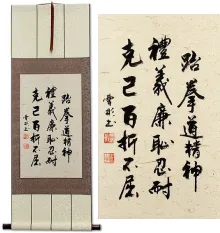
跆拳道精神禮義廉耻忍耐克己百折不屈 is General Choi's writing that is often called “The Tenets of Taekwon-do.”
The actual title would be translated as “Taekwondo Spirit” or “The Spirit of Taekwondo.” It was originally written in Korean Hanja (Chinese characters used in Korea for about 1600 years).
General Choi's original calligraphy is shown to the right. Your custom calligraphy will be unique, and not an exact match, as each calligrapher has their own style.| Traditional Korean Hanja | Modern Korean Hangul | Pronunciation | English |
| 跆拳道精神 | 태권도정신 | tae gweon do jeong sin | Taekwondo Spirit |
| 禮儀 | 예의 | ye yi | Courtesy / Etiquette / Propriety / Decorum / Formality |
| 廉耻 | 염치 | yeom ci | Integrity / Sense of Honor |
| 忍耐 | 인내 | in nae | Patience / Perseverance / Endurance |
| 克己 | 극기 | geug gi | Self-Control / Self-Denial / Self-Abnegation |
| 百折不屈 | 백절불굴 | baeg jeor bur gur | Indomitable Spirit (Undaunted even after repeated attacks from the opponent) |
| Note that the pronunciation is the official version now used in South Korea. However, it is different than what you may be used to. For instance, “Taekwon-do” is “tae gweon do.” This new romanization is supposed to be closer to actual Korean pronunciation. | |||
The Five Cardinal Rules / Virtues of Confucius
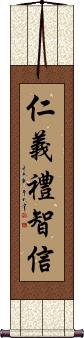
仁義禮智信 are the core of Confucius's philosophy.
Simply stated:
仁 = Benevolence / Charity
義 = Justice / Rectitude
禮 = Courtesy / Politeness / Tact
智 = Wisdom / Knowledge
信 = Fidelity / Trust / Sincerity
Many of these concepts can be found in various religious teachings. It should be clearly understood that Confucianism is not a religion but should instead be considered a moral code for a proper and civilized society.
This title is also labeled “5 Confucian virtues.”
If you order this from the Japanese calligrapher, expect the middle Kanji to be written in a more simple form (as seen to the right). This can also be romanized as "jin gi rei satoshi shin" in Japanese. Not all Japanese will recognize this as Confucian tenets but they will know all the meanings of the characters.
See Also: Confucius Teachings | Ethics
Also means: honor loyalty morality righteousness
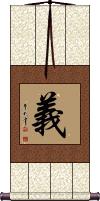
義 is about doing the right thing or making the right decision, not because it's easy but because it's ethically and morally correct.
No matter the outcome or result, one does not lose face if tempering proper justice.
義 can also be defined as righteousness, justice, morality, honor, or “right conduct.” In a more expanded definition, it can mean loyalty to friends, loyalty to the public good, or patriotism. This idea of loyalty and friendship comes from the fact that you will treat those you are loyal to with morality and justice.
義 is also one of the five tenets of Confucius's doctrine.
There's also an alternate version of this character sometimes seen in Bushido or Korean Taekwondo tenets. It's just the addition of a radical on the left side of the character. If you want this version, click on the image to the right instead of the button above.
This is also a virtue of the Samurai Warrior
See our page with just Code of the Samurai / Bushido here
See Also: Judgment | Impartial | Confucius Tenets
武士道 is the title for “The Code of the Samurai.”
Sometimes called “The Seven Virtues of the Samurai,” “The Bushido Code,” or “The Samurai Code of Chivalry.”
This would be read in Chinese characters, Japanese Kanji, and old Korean Hanja as “The Way of the Warrior,” “The Warrior's Way,” or “The Warrior's Code.”
It's a set of virtues that the Samurai of Japan and ancient warriors of China and Korea had to live and die by. However, while known throughout Asia, this title is mostly used in Japan and thought of as being of Japanese origin.
The seven commonly-accepted tenets or virtues of Bushido are Rectitude 義, Courage 勇, Benevolence 仁, Respect 礼(禮), Honour 名誉, Honesty 誠, and Loyalty 忠実. These tenets were part of oral history for generations, thus, you will see variations in the list of Bushido tenets depending on who you talk to.
See our page with just Code of the Samurai / Bushido here
跆拳道精神 means “Taekwondo Spirit” or “The Spirit of Taekwondo.”
跆拳道精神 is the title of General Choi's calligraphy often referred to as “The Tenets of Taekwon-do.”
Quote from Confucius
This proverb, 志于道据于德依于仁游于艺, from the Analects of Confucius translates as:
Resolve yourself in the Dao/Tao/Way.
Rely on Virtue.
Reside in benevolence.
Revel in the arts.
According to Confucius, these are the tenets of good and proper conduct.
This was written over 2500 years ago. The composition is in ancient Chinese grammar and phrasing. A modern Chinese person would need a background in Chinese literature to understand this without the aid of a reference.
苦諦集諦滅諦道諦 is the list of tenets of the Four Noble Truths as taught in virtually all sects of Buddhism.
They are suffering (dukkha), desire/attachment (samudaya), release from desire/attachment (nirodha), and the path leading away from suffering (magga).
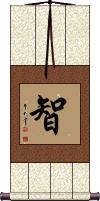
智 is the simplest way to write wisdom in Chinese, Korean Hanja, and Japanese Kanji.
Being a single character, the wisdom meaning is open to interpretation, and can also mean intellect, knowledge or reason, resourcefulness, or wit.
智 is also one of the five tenets of Confucius.
智 is sometimes included in the Bushido code but is usually not considered part of the seven key concepts of the code.
See our Wisdom in Chinese, Japanese and Korean page for more wisdom-related calligraphy.
See Also: Learn From Wisdom | Confucius
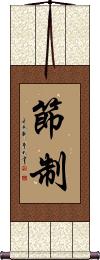
In short, 節制 or temperance is knowing when to say “when.”
Temperance is the practice of moderation and restraint (in fact, this Asian word is often translated as moderation or restraint).
It was one of the five tenets held to be vital to society in Hellenic culture. It is also one of the Four Cardinal Virtues considered central to Christian behavior by the Catholic Church.
Note: Also considered to be one of the Seven Heavenly Virtues.
śraddhā
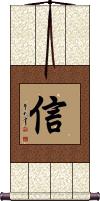
信 can mean to believe, truth, faith, fidelity, sincerity, trust, and confidence in Chinese, old Korean Hanja, and Japanese Kanji.
This single character is often part of other words with similar meanings.
It is one of the five basic tenets of Confucius.
In Chinese, it sometimes has the secondary meaning of a letter (as in the mail) depending on context but it will not be read that way when seen on a wall scroll.
In the Buddhist context, this is śraddhā (faith through hearing or being taught).
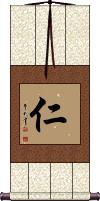
Beyond benevolence, 仁 can also be defined as “charity” or “mercy” depending on context.
The deeper meaning suggests that one should pay alms to the poor, care for those in trouble, and take care of his fellow man (or woman).
仁 is one of the five tenets of Confucius. In fact, it is a subject that Confucius spent a great deal of time explaining to his disciples.
I have also seen this benevolent-related word translated as perfect virtue, selflessness, love for humanity, humaneness, goodness, goodwill, or simply “love” in the non-romantic form.
This is also a virtue of the Samurai Warrior
See our page with just Code of the Samurai / Bushido here
Alternate Version
靈氣療法肇祖臼井甕男先生遺訓招福の秘法萬病の霊薬今日丈けは心配すな感謝して業を励げめ人に親切に is an alternate version of the precepts or tenets of Reiki by Usui Mikao.
It is impossible to be sure which version or versions were actually written by Usui Mikao. This is the less common of the three versions that you might see in the wild.
Here is a breakdown of the characters and a rough translation:
靈氣 療法 肇祖 臼井甕男。
Reiki therapy founder Mikao Usui
先生 遺訓。
Teacher's testament
招福の秘法, 萬病の霊薬。
Invite blessings of [the] secret method, 10,000 illnesses of spiritual medicine.
今日丈けは: 怒るな, 心配すな, 感謝して, 業をはげめ, 人に親切に。
At least for today: Do not be angry, do not worry, be grateful, work with diligence, [and] be kind to people.
Note: Because this selection contains some special Japanese Hiragana characters, it should be written by a Japanese calligrapher.
孝 represents filial piety.
Some will define this in more common English as “respect for your parents and ancestors.”
孝 is a subject deeply emphasized by the ancient philosophy and teachings of Confucius.
Some have included this in the list for the Bushido, although generally not considered part of the 7 core virtues of the warrior.
Note: 孝 is not the best of meanings when seen as a single character. Some will read the single-character form to mean “missing my dead ancestors.” However, when written as part of Confucian tenets, or in the two-character word that means filial piety, the meaning is better or read differently (context is important for this character).
We suggest one of our other two-character filial piety entries instead of this one.
Politeness, Gratitude and Propriety
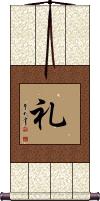
礼 is one of the five tenets of Confucius.
Beyond respect, 礼 can also be translated as propriety, good manners, politeness, rite, worship, or an expression of gratitude.
We show respect by speaking and acting with courtesy. We treat others with dignity and honor the rules of our family, school, and nation. Respect yourself, and others will respect you.
Please note that Japanese use this simplified 礼 version of the original 禮 character for respect. 礼 also happens to be the same simplification used in mainland China. While 禮 is the traditional and original version, 礼 has been used as a shorthand version for many centuries. Click on the big 禮 character to the right if you want the Traditional Chinese and older Japanese versions.
This is also a virtue of the Samurai Warrior
See our page with just Code of the Samurai / Bushido here
See Also: Confucius
日蓮 is the title Nichiren.
This title refers to a Buddhist priest who lived from 1222 to 1282. He is the founder of the Nichiren sect of Buddhism.
According to historical documents, the Nichiren sect was established in 1252. Adding the character 宗 for sect, this would be 日蓮宗 (Nichiren sect), which is also known as the 法華宗 or Lotus sect.
According to Soothill-Hodous...
Nichiren's chief tenets are the three great mysteries 三大祕法, representing the trikāya:
1. 本尊 or chief object of worship, being the great maṇḍala of the worlds of the ten directions, or universe, i.e., the body or nirmāṇakāya of Buddha.
2. 題目 the title of the Lotus Sutra 妙法蓮華經 Myo-ho-ren-ge-kyo, preceded by Namo, or “Adoration to the scripture of the lotus of the wonderful law,” for it is Buddha's spiritual body.
3. 戒壇 the altar of the law, which is also the title of the Lotus as above; the believer, wherever he is, dwells in the Pure-land of calm light 寂光淨土, the saṃbhogakāya.
谦逊正直温柔忍耐克己不屈 are the virtues used by Choi Kwang Do Martial Arts.
| English | Hanja | Hangul | Pronunciation |
| 1. Humility (Humble / Modesty) | 謙遜 | 겸손 | gyeom son |
| 2. Honesty (Integrity) | 正直 | 정직 | jeong jig |
| 3. Gentleness | 溫柔 | 온유 | on yu |
| 4. Perseverance (To Endure) | 忍耐 | 인내 | in nae |
| 5. Self-Control (Self-Restraint) | 克己 | 극기 | geug gi |
| 6. Unbreakable Spirit (Unyielding / Unbending) | 不屈 | 불굴 | bur gur |
The characters shown here are in the ancient Korean Hanja form of writing. If you wish for a Korean Hangul form of these tenets, we can arrange that with our Master Calligrapher Xing An-Ping (click on the Hangul next to the South Korean flag above to order this in Hangul).
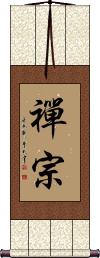
禪宗 is one way to title “Zen Buddhism.” Because the original pronunciation of Zen in Chinese is Chan, you'll also see this expressed as Chan Buddhism.
From the Buddhist Dictionary:
The Chan, meditative or intuitional, sect is usually said to have been established in China by Bodhidharma, the twenty-eighth patriarch, who brought the tradition of the Buddha-mind from India. This sect, believing in direct enlightenment, disregarded ritual and sūtras and depended upon the inner light and personal influence for the propagation of its tenets, founding itself on the esoteric tradition supposed to have been imparted to Kāśyapa by the Buddha, who indicated his meaning by plucking a flower without further explanation. Kāśyapa smiled in apprehension and is supposed to have passed on this mystic method to the patriarchs. The successor of Bodhidharma was 慧可 Huike, and he was succeeded by 僧璨 Sengcan, 道信 Daoxin, 弘忍 Hongren, 慧能 Huineng, and 神秀 Shenxiu, the sect dividing under the two latter into the southern and northern schools: the southern school became prominent, producing 南嶽 Nanyue and 靑原 Qingyuan, the former succeeded by 馬祖 Mazu, the latter by 石頭 Shitou. From Mazu's school arose the five later schools.
The following table may be helpful for those studying Chinese or Japanese...
| Title | Characters | Romaji (Romanized Japanese) | Various forms of Romanized Chinese | |
| Tang Soo Do Tenets | 廉耻精進忍耐遵守克己謙遜百折不屈 / 廉恥精進忍耐遵守克己謙遜百折不屈 廉耻精进忍耐遵守克己谦逊百折不屈 | lián chǐ jīng jìn rěn nài zūn shǒu kè jǐ qiān xùn bǎi zhé bù qū lian2 chi3 jing1 jin4 ren3 nai4 zun1 shou3 ke4 ji3 qian1 xun4 bai3 zhe2 bu4 qu1 lian chi jing jin ren nai zun shou ke ji qian xun bai zhe bu qu | lien ch`ih ching chin jen nai tsun shou k`o chi ch`ien hsün pai che pu ch`ü lien chih ching chin jen nai tsun shou ko chi chien hsün pai che pu chü |
|
| All Tenets of the Noble Eightfold Path | 正見正思唯正語正業正命正精進正念正定 正见正思唯正语正业正命正精进正念正定 | shouken shoushiyui shougo shougo shoumyou shoushoujin shounen shoujou shoken shoshiyui shogo shogo shomyo shoshojin shonen shojo | zhèng jiàn zhèng sī wéi zhèng yǔ zhèng yè zhèng mìng zhèng jīng jìn zhèng niàn zhèng dìng zheng4 jian4 zheng4 si1 wei2 zheng4 yu3 zheng4 ye4 zheng4 ming4 zheng4 jing1 jin4 zheng4 nian4 zheng4 ding4 zheng jian zheng si wei zheng yu zheng ye zheng ming zheng jing jin zheng nian zheng ding | cheng chien cheng ssu wei cheng yü cheng yeh cheng ming cheng ching chin cheng nien cheng ting |
| Taekwondo Tenets Spirit of Taekwon-do | 跆拳道精神禮義廉耻忍耐克己百折不屈 跆拳道精神礼义廉耻忍耐克己百折不屈 | tái quán dào jīng shén lǐ yì lián chǐ rěn nài kè jǐ bǎi zhé bù qū tai2 quan2 dao4 jing1 shen2 li3 yi4 lian2 chi3 ren3 nai4 ke4 ji3 bai3 zhe2 bu4 qu1 tai quan dao jing shen li yi lian chi ren nai ke ji bai zhe bu qu | t`ai ch`üan tao ching shen li i lien ch`ih jen nai k`o chi pai che pu ch`ü tai chüan tao ching shen li i lien chih jen nai ko chi pai che pu chü |
|
| The Five Tenets of Confucius | 仁義禮智信 仁义礼智信 | jin gi rei tomo nobu jingireitomonobu | rén yì lǐ zhì xìn ren2 yi4 li3 zhi4 xin4 ren yi li zhi xin renyilizhixin | jen i li chih hsin jenilichihhsin |
| Justice Rectitude Right Decision | 義 义 | gi | yì / yi4 / yi | i |
| Bushido The Way of the Samurai | 武士道 | bu shi do / bushido | wǔ shì dào wu3 shi4 dao4 wu shi dao wushidao | wu shih tao wushihtao |
| Spirit of Taekwondo | 跆拳道精神 | te kon do sei shin tekondoseishin | tái quán dào jīng shen tai2 quan2 dao4 jing1 shen2 tai quan dao jing shen taiquandaojingshen | t`ai ch`üan tao ching shen taichüantaochingshen tai chüan tao ching shen |
| The Foundation of Good Conduct | 誌于道據于德依于仁遊于藝 志于道据于德依于仁游于艺 | zhì yú dào jù yú dé yī yú rén yóu yú yì zhi4 yu2 dao4 ju4 yu2 de2 yi1 yu2 ren2 you2 yu2 yi4 zhi yu dao ju yu de yi yu ren you yu yi | chih yü tao chü yü te i yü jen yu yü i | |
| Four Noble Truths (Full List) | 苦諦集諦滅諦道諦 苦谛集谛灭谛道谛 | kutai jittai mettai doutai kutaijittaimettaidoutai kutai jittai mettai dotai | kǔ dì jí dì miè dì dào dì ku3 di4 ji2 di4 mie4 di4 dao4 di4 ku di ji di mie di dao di kudijidimiedidaodi | k`u ti chi ti mieh ti tao ti kutichitimiehtitaoti ku ti chi ti mieh ti tao ti |
| Wisdom | 智 | chi / tomo | zhì / zhi4 / zhi | chih |
| Temperance | 節制 节制 | sessei / sesei | jié zhì / jie2 zhi4 / jie zhi / jiezhi | chieh chih / chiehchih |
| Believe Faith Trust | 信 | shin | xìn / xin4 / xin | hsin |
| Benevolence | 仁 | jin | rén / ren2 / ren | jen |
| Reiki Precepts by Usui Mikao (Alternate) | 靈氣療法肇祖臼井甕男先生遺訓招福の秘法萬病の霊薬今日丈けは怒るな心配すな感謝して業を励げめ人に親切に | reiki ryouhou chouso usui mikao sensei ikun shoufuku no hihou yorozu byou no reiyaku kyou take ke wa oko ru na shinpai suna kansha shite gou o hagemu ge me hito ni shinsetsu ni reiki ryoho choso usui mikao sensei ikun shofuku no hiho yorozu byo no reiyaku kyo take ke wa oko ru na shinpai suna kansha shite go o hagemu ge me hito ni shinsetsu ni | ||
| Filial Piety | 孝 | kou / ko | xiào / xiao4 / xiao | hsiao |
| Respect | 禮 礼 | rei | lǐ / li3 / li | |
| Nichiren | 日蓮 日莲 | nichi ren / nichiren | rì lián / ri4 lian2 / ri lian / rilian | jih lien / jihlien |
| Korean CKD Virtues | 謙遜正直溫柔忍耐克己不屈 谦逊正直温柔忍耐克己不屈 | qiān xùn zhèng zhí wēn róu rěn nài kè jǐ bù qū qian1 xun4 zheng4 zhi2 wen1 rou2 ren3 nai4 ke4 ji3 bu4 qu1 qian xun zheng zhi wen rou ren nai ke ji bu qu | ch`ien hsün cheng chih wen jou jen nai k`o chi pu ch`ü chien hsün cheng chih wen jou jen nai ko chi pu chü |
|
| Zen Buddhism | 禪宗 禅宗 | zen shuu / zenshuu / zen shu | chán zōng chan2 zong1 chan zong chanzong | ch`an tsung chantsung chan tsung |
| In some entries above you will see that characters have different versions above and below a line. In these cases, the characters above the line are Traditional Chinese, while the ones below are Simplified Chinese. | ||||
Successful Chinese Character and Japanese Kanji calligraphy searches within the last few hours...

All of our calligraphy wall scrolls are handmade.
When the calligrapher finishes creating your artwork, it is taken to my art mounting workshop in Beijing where a wall scroll is made by hand from a combination of silk, rice paper, and wood.
After we create your wall scroll, it takes at least two weeks for air mail delivery from Beijing to you.
Allow a few weeks for delivery. Rush service speeds it up by a week or two for $10!
When you select your calligraphy, you'll be taken to another page where you can choose various custom options.
The wall scroll that Sandy is holding in this picture is a "large size"
single-character wall scroll.
We also offer custom wall scrolls in small, medium, and an even-larger jumbo size.
Professional calligraphers are getting to be hard to find these days.
Instead of drawing characters by hand, the new generation in China merely type roman letters into their computer keyboards and pick the character that they want from a list that pops up.
There is some fear that true Chinese calligraphy may become a lost art in the coming years. Many art institutes in China are now promoting calligraphy programs in hopes of keeping this unique form
of art alive.
Even with the teachings of a top-ranked calligrapher in China, my calligraphy will never be good enough to sell. I will leave that to the experts.
The same calligrapher who gave me those lessons also attracted a crowd of thousands and a TV crew as he created characters over 6-feet high. He happens to be ranked as one of the top 100 calligraphers in all of China. He is also one of very few that would actually attempt such a feat.
Check out my lists of Japanese Kanji Calligraphy Wall Scrolls and Old Korean Hanja Calligraphy Wall Scrolls.
Some people may refer to this entry as Five Tenets Kanji, Five Tenets Characters, Five Tenets in Mandarin Chinese, Five Tenets Characters, Five Tenets in Chinese Writing, Five Tenets in Japanese Writing, Five Tenets in Asian Writing, Five Tenets Ideograms, Chinese Five Tenets symbols, Five Tenets Hieroglyphics, Five Tenets Glyphs, Five Tenets in Chinese Letters, Five Tenets Hanzi, Five Tenets in Japanese Kanji, Five Tenets Pictograms, Five Tenets in the Chinese Written-Language, or Five Tenets in the Japanese Written-Language.
16 people have searched for Five Tenets in Chinese or Japanese in the past year.
Five Tenets was last searched for by someone else on Oct 18th, 2025