Many custom options...


And formats...



Earth and Sky in Chinese / Japanese...
Buy an Earth and Sky calligraphy wall scroll here!
Personalize your custom “Earth and Sky” project by clicking the button next to your favorite “Earth and Sky” title below...
Five Elements
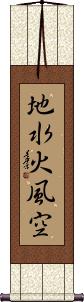
地水火風空 is the specifically-Japanese version of the five elements.
This is a little different than the ancient or original Chinese version.
The elements are written in this order:
1. Earth / Terra / Ground
2. Water
3. Fire
4. Wind / Air
5. Sky / Emptiness / Void / Ether
Note: This set of Kanji can also be romanized as “ji sui ka fuu kuu,” “jisuikafuukuu,” or “jisuikafuku.”
These can also be written in the order 地火風水空 (chi ka sui fuu kuu). Let me know when you place your order if you want the Kanji to be in this character order.
Water Dragon / Coiled Dragon
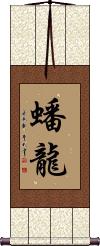
蟠龍 is sometimes seen as a lower-level of dragon or a dragon that has not-yet-reached its potential.
蟠龍 is often defined as a “lake dragon” that has not ascended to heaven.
Another way to put that is a dragon coiled on the earth, which has not yet ascended to the sky.
Art of War: 5 Points of Analysis
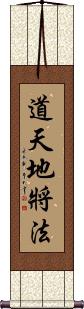
道天地將法 is a list of five key points to analyzing your situation from the first chapter of Sun Tzu's Art of War.
This reads like a 5-part military proverb. Sun Tzu says that to sharpen your skills, you must plan. To plan well, you must know your situation. Therefore, you must consider and discuss the following:
1. Philosophy and Politics: Make sure your way or your policy is agreeable among all of your troops (and the citizens of your kingdom as well). For when your soldiers believe in you and your way, they will follow you to their deaths without hesitation and will not question your orders.
2. Heaven/Sky: Consider climate / weather. This can also mean considering whether God is smiling upon you. In the modern military, this could be waiting for clear skies so that you can have air support for an amphibious landing.
3. Ground/Earth: Consider the terrain in which the battle will take place. This includes analyzing defensible positions, and exit routes, while using varying elevations to your advantage. When you plan an ambush, you must know your terrain and the best location from which to stage that ambush. This knowledge will also help you avoid being ambushed, as you will know where the likely places in which to expect an ambush from your enemy.
4. Leadership: This applies to you as the general and your lieutenants. A leader should be smart and be able to develop good strategies. Leaders should keep their word, and if they break a promise, they should punish themselves as harshly as they would punish subordinates. Leaders should be benevolent to their troops, with almost a fatherly love for them. Leaders must have the ability to make brave and fast decisions. Leaders must have steadfast principles.
5. [Military] Methods: This can also mean laws, rules, principles, models, or systems. You must have an efficient organization in place to manage both your troops and supplies. In the modern military, this would be a combination of how your unit is organized and your SOP (Standard Operating Procedure).
Notes: This is a simplistic translation and explanation. Much more is suggested in the actual text of the Art of War (Bing Fa). It would take a lot of study to master all of these aspects. In fact, these five characters can be compared to the modern military acronyms such as BAMCIS or SMEAC.
CJK notes: I have included the Japanese and Korean pronunciations but in Chinese, Korean and Japanese, this does not make a typical phrase (with subject, verb, and object) it is a list that only someone familiar with Sun Tzu’s writings would understand.
This in-stock artwork might be what you are looking for, and ships right away...
Gallery Price: $322.00
Your Price: $178.88

Gallery Price: $72.00
Your Price: $39.88
Gallery Price: $60.00
Your Price: $39.88

Gallery Price: $63.00
Your Price: $34.88
Not the results for earth and sky that you were looking for?
Below are some entries from our dictionary that may match your earth and sky search...
| Characters If shown, 2nd row is Simp. Chinese |
Pronunciation Romanization |
Simple Dictionary Definition |
蟠龍 蟠龙 see styles |
pán lóng pan2 long2 p`an lung pan lung hanryou / hanryo はんりょう |
More info & calligraphy: Water Dragon / Coiled Dragoncoiled dragon; dragon coiled on the earth, which has not yet ascended to the sky |
七曜 see styles |
qī yào qi1 yao4 ch`i yao chi yao shichiyou / shichiyo しちよう |
the seven planets of premodern astronomy (the Sun, the Moon, Mercury, Venus, Mars, Jupiter, and Saturn) (1) {astron} the seven luminaries (sun, moon, Mercury, Venus, Mars, Jupiter and Saturn); (2) the seven days of the week The seven brilliant ones — the sun and moon, together with the five planets which are connected with fire, water, wood, metal, and earth. Their essence shines in the sky, but their spirits are over men as judges of their good and evil, and as rulers over good and evil fortune. The following list shows their names in Chinese and Sanskrit: Sun 日, 太陽; aditya 阿彌底耶 Moon月, 太陰; soma 蘇摩 Mars火星, 勢惑勞; aṅgāraka 盎哦囉迦 Mercury水星, 辰星; budha 部陀 Jupiter木星, 歳星; bṛhaspati 勿哩訶娑跛底 Venus金星, 太白; śukra 戌羯羅 Saturn土星, 鎭星; śanaiścara 賖乃以室折羅. |
五夢 五梦 see styles |
wǔ mèng wu3 meng4 wu meng itsumu いつむ |
(female given name) Itsumu The five bad dreams of King Ajātaśatru on the night that Buddha entered nirvana— as the moon sank the sun arose from the earth. the stars fell like rain, seven comets appeared, and a great conflagration filling the sky fell on the earth. |
神通 see styles |
shén tōng shen2 tong1 shen t`ung shen tung jinzuu / jinzu じんづう |
remarkable ability; magical power (place-name) Jinzuu (神通力) Ubiquitous supernatural power, especially of a Buddha, his ten powers including power to shake the earth, to issue light from his pores, extend his tongue to the Brahma-heavens effulgent with light, cause divine flowers, etc., to rain from the sky, be omnipresent, and other powers. Supernatural powers of eye, ear, body, mind, etc. |
空界 see styles |
kōng jiè kong1 jie4 k`ung chieh kung chieh kuukai / kukai くうかい |
(personal name) Kuukai The realm of space, one of the six realms, earth, water, fire, wind, space, knowledge. The空界色 is the visible realm of space, the sky, beyond which is real space. |
空際 空际 see styles |
kōng jì kong1 ji4 k`ung chi kung chi kuusai / kusai くうさい |
horizon; point where the sky meets the earth The region of immateriality, or nirvana. Also called 實際, the region of reality. |
蟠竜 see styles |
hanryou / hanryo はんりょう |
coiled dragon; dragon coiled on the earth, which has not yet ascended to the sky |
那伽 see styles |
nà qié na4 qie2 na ch`ieh na chieh naka なか |
(female given name) Naka nāga. Snake, dragon, elephant. It is tr. by 龍 dragon and by 象 elephant. (1) As dragon it represents the chief of the scaly reptiles; it can disappear or be manifest, increase or decrease, lengthen or shrink; in spring it mounts in the sky and in winter enters the earth. The dragon is of many kinds. Dragons are regarded as beneficent, bringing the rains and guarding the heavens (again Draco); they control rivers and lakes, and hibernate in the deep. nāga and mahānāga are titles of a Buddha, (also of those freed from reincarnation) because of his powers, or because like the dragon he soars above earthly desires and ties. One of his former reincarnations was a powerful poisonous dragon which, out of pity, permitted itself to be skinned alive and its flesh eaten by worms. (2) A race of serpent-worshippers. |
針孔 针孔 see styles |
zhēn kǒng zhen1 kong3 chen k`ung chen kung shinku みぞ |
pinhole (out-dated or obsolete kana usage) (1) eye of a needle; (2) hole A needle's eye: it is as difficult to be reborn as a man as it is to thread a needle on earth by throwing the thread at it from the sky. |
針芥 针芥 see styles |
zhēn jiè zhen1 jie4 chen chieh shinke |
Needle and mustard seed; the appearance of Buddha is as rare as hitting the point of a needle on earth by a mustard seed thrown from the sky. |
五大色 see styles |
wǔ dà sè wu3 da4 se4 wu ta se go daishiki |
The five chief colours— yellow for earth, white for water, red for fire, black for wind, azure for space (or the sky). Some say white for wind and black for water. |
五類天 五类天 see styles |
wǔ lèi tiān wu3 lei4 tian1 wu lei t`ien wu lei tien gorui ten |
The five kinds of devas: (1) 上界天 in the upper realms of form and non-form; (2) 虛空天 in the sky, i. e. four of the six devas of the desire-realm; (3) 地居天 on the earth, i. e. the other two of the six devas, on Sumeru; (4) 遊虛天空 wandering devas of the sky, e. g. sun, moon, starvas, (5) 地下天 under-world devas, e. g. nāgas, asuras, māras, etc. Of. 五大明王. |
天旋地轉 天旋地转 see styles |
tiān xuán dì zhuàn tian1 xuan2 di4 zhuan4 t`ien hsüan ti chuan tien hsüan ti chuan |
the sky spins, the earth goes round (idiom); giddy with one's head spinning; fig. huge changes in the world |
天翻地覆 see styles |
tiān fān dì fù tian1 fan1 di4 fu4 t`ien fan ti fu tien fan ti fu |
sky and the earth turning upside down (idiom); fig. complete confusion; everything turned on its head |
昏天黑地 see styles |
hūn tiān hēi dì hun1 tian1 hei1 di4 hun t`ien hei ti hun tien hei ti |
lit. dark sky and black earth (idiom); fig. pitch dark; to black out; disorderly; troubled times |
翻天覆地 see styles |
fān tiān fù dì fan1 tian1 fu4 di4 fan t`ien fu ti fan tien fu ti |
sky and the earth turning upside down (idiom); fig. complete confusion; everything turned on its head |
遮天蔽日 see styles |
zhē tiān bì rì zhe1 tian1 bi4 ri4 che t`ien pi jih che tien pi jih |
lit. hiding the sky and covering the earth (idiom); fig. earth-shattering; omnipresent; of universal importance |
鋪天蓋地 铺天盖地 see styles |
pū tiān gài dì pu1 tian1 gai4 di4 p`u t`ien kai ti pu tien kai ti |
lit. eclipsing the sky and blanketing the earth (idiom); fig. arriving in overwhelming quantities; engulfing; all-pervasive |
開天避地 开天避地 see styles |
kāi tiān bì dì kai1 tian1 bi4 di4 k`ai t`ien pi ti kai tien pi ti |
to open the sky and divide the earth; ref. to Pangu 盤古|盘古 in the Chinese creation myth |
Variations: |
hanryou / hanryo はんりょう |
coiled dragon; dragon coiled on the earth, which has not yet ascended to the sky |
青天白日満地紅旗 see styles |
seitenhakujitsumanchikouki / setenhakujitsumanchikoki せいてんはくじつまんちこうき |
Blue Sky, White Sun, and a Wholly Red Earth (flag of the Republic of China) |
上天無路,入地無門 上天无路,入地无门 |
shàng tiān wú lù , rù dì wú mén shang4 tian1 wu2 lu4 , ru4 di4 wu2 men2 shang t`ien wu lu , ju ti wu men shang tien wu lu , ju ti wu men |
lit. there is no road to the sky, nor door into the earth (idiom); fig. to be at the end of one's rope; to be trapped in a hopeless situation |
在天願做比翼鳥,在地願做連理枝 在天愿做比翼鸟,在地愿做连理枝 |
zài tiān yuàn zuò bǐ yì niǎo , zài dì yuàn zuò lián lǐ zhī zai4 tian1 yuan4 zuo4 bi3 yi4 niao3 , zai4 di4 yuan4 zuo4 lian2 li3 zhi1 tsai t`ien yüan tso pi i niao , tsai ti yüan tso lien li chih tsai tien yüan tso pi i niao , tsai ti yüan tso lien li chih |
In the sky to be two birds flying wing to wing, on earth to be two trees with branches intertwined; wishing for conjugal bliss |
The following table may be helpful for those studying Chinese or Japanese...
| Title | Characters | Romaji (Romanized Japanese) | Various forms of Romanized Chinese | |
| Five Elements | 地水火風空 地水火风空 | chi sui ka fuu kuu chisuikafuukuu chi sui ka fu ku | ||
| Water Dragon Coiled Dragon | 蟠龍 蟠龙 | han ryuu / hanryuu / han ryu | pān lóng / pan1 long2 / pan long / panlong | p`an lung / panlung / pan lung |
| Art of War: 5 Points of Analysis | 道天地將法 道天地将法 | dou ten chi shou hou doutenchishouhou do ten chi sho ho | dào tiān dì jiàng fǎ dao4 tian1 di4 jiang4 fa3 dao tian di jiang fa daotiandijiangfa | tao t`ien ti chiang fa taotientichiangfa tao tien ti chiang fa |
| In some entries above you will see that characters have different versions above and below a line. In these cases, the characters above the line are Traditional Chinese, while the ones below are Simplified Chinese. | ||||

Successful Chinese Character and Japanese Kanji calligraphy searches within the last few hours...



