Many custom options...


And formats...



Define in Chinese / Japanese...
Buy a Define calligraphy wall scroll here!
Personalize your custom “Define” project by clicking the button next to your favorite “Define” title below...
1. Daughter
2. Integrity: Sincere Honest and Faithful
4. Samadhi
7. Awareness
8. Spiritual Peace / Enlightened Peace
9. Optimism / Happy With Your Fate
11. Respectful Heart
13. Three Treasures of Chinese Medicine
14. Sincere Heart
15. Filial Piety
16. Diligence
17. One frost doesn't make winter
19. Lingering Mind
20. No Mind / Mushin
21. Immovable Mind
22. Kansei Engineering / Sense Engineering
23. Tea Fate
24. Taekwondo
Daughter
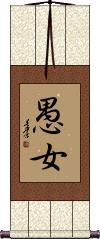
愚女 is a humble title for “daughter” in Japanese.
If you literally define each character, you get “silly girl” or “foolish woman.”
Integrity: Sincere Honest and Faithful
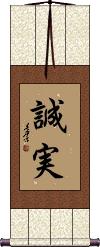
誠実 is the Japanese version of integrity which can also be defined as a combination of “sincere, honest, and faithful.”
Some may also define this as “loyal” or “loyalty.” In some contexts, it can mean “genuine.” Yes, all of this meaning in just one Japanese word!
Enlightened Truth
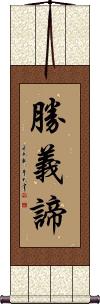
This Buddhist term means the superior truth or enlightened truth.
勝義諦 is a realm of understanding that is far beyond worldly truth.
Some will also define this as the ultimate truth.
Samadhi
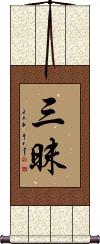
三昧 is the Chinese, Japanese Kanji, and old Korean Hanja way to write Samādhi.
Samadhi is the state of intense concentration achieved through meditation.
Some will define Samādhi as putting together, composing the mind, intent contemplation, perfect absorption, or union of the meditator with the object of meditation.
Honor and Integrity
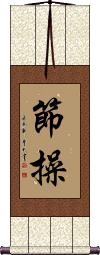
節操 means honorable, integrity of principle, constancy, honor, and in a certain context, chastity.
Please note that there are a few ways to relay the idea of integrity in Asian languages and more than one way to define honor in English. 節操 is far from the only way to express “honor and integrity.”
Sit in Meditation
Zazen
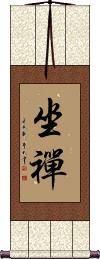
坐禪 describes the act of sitting in a state of deep meditation.
You'll notice that the second character is Chan/Zen (often used to title the meditative form of Buddhism).
In Korean Hanja, this means “religious meditation” (roughly the same as the Chinese definition).
Buddhists may define this as sitting in dhyāna, abstract meditation, fixed abstraction, or contemplation.
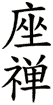 Japanese note: This will make sense in Japanese but the Kanji shown to the left are partially in ancient/traditional Japanese form. Japanese Buddhists may use 坐禪, 坐禅, 座禪, or 座禅. The most standard/modern Japanese form of this word is shown to the right. Click on the Kanji to the right (instead of the button above) if you want this specifically Japanese version.
Awareness
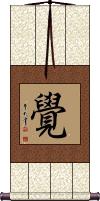
覺 can mean to feel; to figure out; thinking; awake; aware; bodhi; knowing; understanding; enlightenment; illumination; apprehend; perceive; realize.
覺 is a character that is impossible to define in a single word.
This term is often associated with Buddhism where it's understood to be: Illumination, enlightenment, or awakening in regard to the real in contrast to the seeming. However, it can also refer to enlightenment in regard to morality and evil.
Notes:
In Japanese, this can be the personal name Satoru.
In certain context, and only when pronounced as "jiao" in Chinese, it can refer to a nap, sleep or the state of sleeping. However, as a single character on a wall scroll, everyone will read this with the awareness or enlightenment context.
By no means is this the only way to write enlightenment. In fact, you should only choose this character if you are looking more for a word meaning awareness.
See Also: Enlightenment | Wisdom | Knowledge
Spiritual Peace / Enlightened Peace
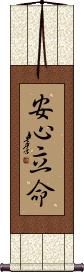
These Japanese Kanji, 安心立命, can be translated as “religious enlightenment” or “spiritual peace gained through faith.”
Other dictionaries define as “spiritual peace and enlightenment” or “keeping an unperturbed mind through faith.”
My Buddhist dictionary defines it as “spiritual peace and realization of enlightenment.”
In the Zen school, this is about settling one's body and life; attaining complete peace, and establishing one's course of life in accord with the ultimate reality.
Optimism / Happy With Your Fate
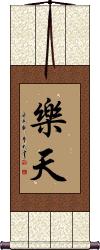
樂天 is about being optimistic and also making the best of whatever life throws at you.
This is hard to define. One dictionary defines this as “acceptance of fate and happy about it.” There is one English word equivalent, which is sanguinity or sanguinary.
You can also say that this means “Be happy with whatever Heaven provides,” or “Find happiness in whatever fate Heaven bestows upon you.” 樂天 suggests being an optimist in life.
Note: This is sometimes a given name in China.
 Please note that Japanese tend to write the first character in a slightly-different form (as seen to the right). Let us know if you have a preference when you place your order.
Fate / Chance Meeting
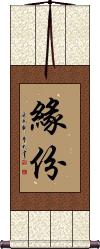
緣份 specifically represents the fate or destiny that brings two people together.
This is like the chance meeting of two people that leads sometime later to marriage.
This could also be the chance meeting of two business people who become partners and build a huge and successful company.
This idea is often associated with a fateful meeting leading to good fortune.
Some will define this word as “Destiny brings you two together” or “Meant to be.”
 Note: The second character can also be written without the left radical, as shown to the right. If you have a preference, please let use know in the special instructions for your project. There is no difference in meaning or pronunciation, just two (alternate) ways to write the same character.
See Also: Soulmates | Good Fortune
Respectful Heart
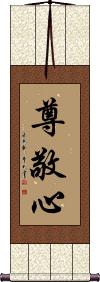
尊敬心 means respectful heart in Japanese, Chinese and Korean.
The root is 尊敬 which means respect, honor, reverence, esteem, and/or nobility. Therefore, you can also define this as an honorable heart, reverent heart, noble heart, etc.
In ancient times, it was thought your brain was the heart in your chest. Therefore, 心 or heart can also mean “mind.” Hence, 尊敬心 can also be translated as respectful mind, honorable mind, etc.
You'll see 尊敬心 romanized as Sonkeishin or Sonkeshin from Japanese.
Isshin-Ryu / Isshin Style

一心流 is the title for Isshin-Ryu.
The literal meaning is “one heart method.” You could also translate it as “Unified Hearts Method,” “One-Mind School” or “One-Heart Style.”
It implies people doing things as if with one heart and mind.
As a style or lineage name, this phrase suggests a school founded on simplicity, unity of intent, and clarity of principle rather than excessive technical complexity.
The second Kanji can be defined as the heart, mind, or essence of your being. Clearly, there's a multitude of ways you can define this title in English.
See Also: Isshin-Kai
Three Treasures of Chinese Medicine
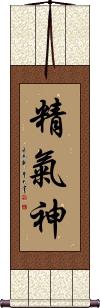
精, 氣, 神 are the characters jing, qi, and shen.
As a set, these three characters are known in English as the treasures of traditional Chinese medicine, the treasures of Qi Gong, or the three treasures of Taoism / Daoism.
Sometimes this set is titled 三寶 (sānbǎo) or “three treasures,” but here, we're writing each treasure out.
Here's how these characters are perceived in this context...
Jing: nutritive essence; refined; perfected; pure
Qi: vitality; energy; force; breath; vigor
Shen: spirit; soul; mind; being
To keep it simple, you can use “essence, vitality, and spirit” to define these.
Sincere Heart
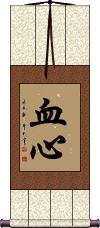
When you take 血心 apart, you find the sum is slightly different than the parts. The first character means blood, and the second means heart. It is important to note that for thousands of years, it was believed that your heart was both your soul and your mind in Asian culture. When you add blood to the heart, it is your whole being - the pure and clean dedication of your whole soul.
Most Chinese dictionaries define this as the sincerity of heart or a MEDICAL TERM!!!
Please think carefully before ordering this selection - it was only added as others have used this for coffee cups and other novelties (though perhaps naively).
Filial Piety
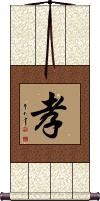
孝 represents filial piety.
Some will define this in more common English as “respect for your parents and ancestors.”
孝 is a subject deeply emphasized by the ancient philosophy and teachings of Confucius.
Some have included this in the list for the Bushido, although generally not considered part of the 7 core virtues of the warrior.
Note: 孝 is not the best of meanings when seen as a single character. Some will read the single-character form to mean “missing my dead ancestors.” However, when written as part of Confucian tenets, or in the two-character word that means filial piety, the meaning is better or read differently (context is important for this character).
We suggest one of our other two-character filial piety entries instead of this one.
Diligence
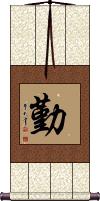
勤 is a single character that means diligence or “sense of duty” in Chinese and Korean (also understood in Japanese but not commonly seen as a stand-alone Kanji).
As a single character on a wall scroll, this will only be seen with this meaning. However, it can also mean industrious, hardworking, frequent, regular, constant, energy, zeal, fortitude, or virility.
In Buddhism, this can represent vīrya (viriya), the idea of energy, diligence, enthusiasm, or effort. It can be defined as an attitude of gladly engaging in wholesome activities, and it functions to cause one to accomplish wholesome or virtuous actions. Some Buddhists may even define this as “manliness” (a definition from a hundred years ago, before equality).
If you or someone you know is a hard worker (or needs a reminder to be diligent), then this is the wall scroll to have in your/their office.
One frost doesn't make winter

一次霜凍不代表整個冬天 is a proverb that means “One frost doesn't make winter.”
The deeper meaning is that a single early sign of cold weather doesn't signify the full onset or severity of winter; it's about the gradual transition of seasons, patience, and not jumping to conclusions.
It's a reminder to stay resilient, wait for the real season to arrive, and not let one small event define the whole experience, similar to how one kind word can warm you for months.
While the origin of this proverb is murky (not originally Chinese, likely a modern adaptation of “One swallow does not a summer make”), this idea aligns with the Chinese solar terms (二十四節氣), which mark subtle shifts, like the transition from "cold dew" (寒露) to "frost falls" (霜降).
Mind of the Beginner
Shoshin
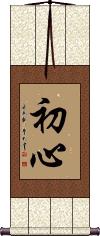
初心 is often translated in Japanese as “beginner's mind” or “beginner's spirit.”
In Chinese, the dictionary definition is “one's original intention.”
The first character means first, initial, primary, junior, beginning, or basic.
The second character means heart, mind, soul, or essence.
初心 is one of the five spirits of the warrior (budo) and is often used as a Japanese martial arts tenet. Under that context, places such as the Budo Dojo define it this way: The state of shoshin is that of a beginners mind. It is a state of awareness that always remains fully conscious, aware, and prepared to see things for the first time. The attitude of shoshin is essential to continued learning.
Lingering Mind
Zanshin
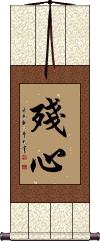
First off, 殘心 should only be used in the context of Japanese martial arts. In Chinese, it's a rather sad title (like a broken heart). In Chinese, the first character alone means destroyed, spoiled, ruined, injured, cruel, oppressive, savage, incomplete, or disabled. However, in Japanese, it's remainder, leftover, balance, or lingering.
The second character means heart, mind, soul, or essence in both languages.
殘心 is one of the five spirits of the warrior (budo) and is often used as a Japanese martial arts tenet. Under that context, places such as the Budo Dojo define it this way: The spirit of zanshin is the state of the remaining or lingering spirit. It is often described as a sustained and heightened state of awareness and mental follow-through. However, true zanshin is a state of focus or concentration before, during, and after the execution of a technique, where a link or connection between uke and nage is preserved. Zanshin is the state of mind that allows us to stay spiritually connected, not only to a single attacker but to multiple attackers and even an entire context; a space, a time, an event.
 In modern Japan (and Simplified Chinese), they use a different version of the first character, as seen to the right. Click on this character to the right instead of the button above if you want this modern Japanese version of lingering mind / zanshin.
No Mind / Mushin
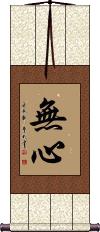
In Japanese, 無心 means innocent or without knowledge of good and evil. It literally means “without mind.”
無心 is one of the five spirits of the warrior (budo) and is often used as a Japanese martial arts tenet. Under that context, places such as the Budo Dojo define it this way: “No mind, a mind without ego. A mind like a mirror which reflects and dos not judge.” The original term was “mushin no shin,” meaning “mind of no mind.” It is a state of mind without fear, anger, or anxiety. Mushin is often described by the phrase “Mizu no Kokoro,” which means “mind like water.” The phrase is a metaphor describing the pond that clearly reflects its surroundings when calm but whose images are obscured once a pebble is dropped into its waters.
This has a good meaning in conjunction with Chan / Zen Buddhism in Japan. However, out of that context, it means mindlessness or absent-mindedness. To non-Buddhists in China, this is associated with doing something without thinking.
In Korean, this usually means indifference.
Use caution and know your audience before ordering this selection.
More info: Wikipedia: Mushin
Immovable Mind
fudoshin
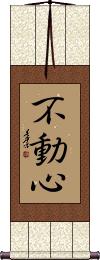
不動心 is one of the five spirits of the warrior (budo) and is often used as a Japanese martial arts tenet.
Under that context, places such as the Budo Dojo define it this way: An unshakable mind and an immovable spirit is the state of fudoshin. It is courage and stability displayed both mentally and physically. Rather than indicating rigidity and inflexibility, fudoshin describes a condition that is not easily upset by internal thoughts or external forces. It is capable of receiving a strong attack while retaining composure and balance. It receives and yields lightly, grounds to the earth, and reflects aggression back to the source.
Other translations of this title include unwavering mind, immovable mind, unwavering composure, imperturbability, steadfastness, keeping a cool head in an emergency, or keeping one's calm (during a fight).
The first two Kanji alone mean immobility, firmness, fixed, steadfastness, motionless, and idle.
The last Kanji means heart, mind, soul, or essence.
Together, these three Kanji create a title defined as “immovable mind” within the context of Japanese martial arts. However, in Chinese, it would mean “motionless heart,” and in Korean Hanja, “wafting heart” or “floating heart.”
Kansei Engineering / Sense Engineering
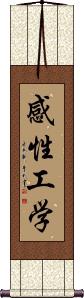
In short, 感性工學 or Kansei engineering involves collecting data on human experiences with a product and then designing or engineering improvements based on those experiences or “senses.”
Some may define Kansei as “engineering around the human experience.”
There is a lot more to know about Kansei, but if you are looking for this word, you probably already know the big picture.
Note: This term is very new in China and is only used by businesses, factories, and engineers that are implementing TQM principles. While the characters have the same base meaning in both languages, this is a Japanese title that flows back into the Chinese language (in history, most things flowed from China to Japan). To a Chinese person unfamiliar with this concept, they may interpret this as “sense vocational studies,” which doesn't make much sense. You may have to explain the intended meaning to some Chinese viewers. But that can make it a great conversation piece.
Kansei is also a newer term in Korean and is only used in certain parts of the industry, with the definition of “Sensory Engineering.” Not yet in widespread use in Korea.
Above is the modern Japanese version of this title. The last character has a Traditional Chinese version, making this 感性工學 instead of 感性工学. If you want the Traditional Chinese version, please include special instructions or email me so that I make sure the calligrapher writes the version you want.
See Also: Kaizen
Tea Fate
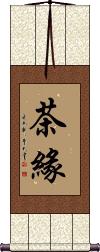
茶緣 is a special title for the tea lover. This kind of means “tea fate,” but it's more spiritual and hard to define. Perhaps the tea brought you in to drink it. Perhaps the tea will bring you and another tea-lover together. Perhaps you were already there, and the tea came to you. Perhaps it's the ah-ha moment you will have when drinking the tea.
I've been told not to explain this further, as it will either dilute or confuse the purposefully-ambiguous idea embedded in this enigma.
I happen to be the owner of a piece of calligraphy written by either the son or nephew of the last emperor of China, which is the title he wrote. It was given to me at a Beijing tea house in 2001. 茶緣 is where I learned to love tea after literally spending weeks tasting and studying everything I could about Chinese tea. I did not understand the significance of the authorship or the meaning of the title at all. Some 10 years later, I realized the gift was so profound and had such providence. Only now do I realize the value of a gift that it is too late to give proper thanks for. It was also years later that I ended up in this business and could have the artwork properly mounted as a wall scroll. It has been borrowed for many exhibitions and shows and always amazes native Chinese and Taiwanese who read the signature. This piece of calligraphy I once thought was just a bit of ink on a thin and wrinkled piece of paper, is now one of my most valued possessions. And fate has taught me to be more thankful for seemingly simple gifts.
Taekwondo
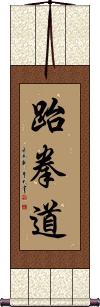
跆拳道 is one of the most widespread types of martial arts in the world as well as being an Olympic sport. Taekwondo was born in Korea with influences of Chinese and Japanese styles combined with traditional Korean combat skills. Some will define it as the “Korean art of empty-handed self-defense.”
In the simplest translation, the first character means “kick,” the second character can mean either “fist” or “punching,” and the third means “way” or “method.” Altogether, you could say this is the “Kick Punch Method.” When heard or read in various Asian languages, all will automatically think of this famous Korean martial art. It is written the same in Japanese Kanji, Chinese, and Korean Hanja characters - so the appearance of the characters is universal. However, you should note that there is another way to write this in modern Korean Hangul characters, which looks like the image to the right. 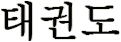
We suggest the original Korean Hanja (Chinese characters) for a wall scroll, but if you need the Hangul version, you must use master calligrapher Cao Bin: Order Taekwondo in Korean Hangul
Note: Taekwondo is sometimes Romanized as Tae-Kwondo, Tae Kwon Do, Taekwon-do, Taegwondo, Tae Gweon Do, Tai Kwon Do, Taikwondo, Taekwando, Tae Kwan Do and in Chinese Taiquandao, Tai Quan Dao, Taichuando, or Tai Chuan Tao.
These search terms might be related to Define:
Daimyo / Great Name
Proud of One’s Name
The following table may be helpful for those studying Chinese or Japanese...
| Title | Characters | Romaji (Romanized Japanese) | Various forms of Romanized Chinese | |
| Daughter | 愚女 | gu jo / gujo | ||
| Integrity: Sincere Honest and Faithful | 誠實 誠実 | sei jitsu / seijitsu | ||
| Enlightened Truth | 勝義諦 胜义谛 | shou gi tai shougitai sho gi tai | shèng yì dì sheng4 yi4 di4 sheng yi di shengyidi | sheng i ti shengiti |
| Samadhi | 三昧 | san mai / sanmai | sān mèi / san1 mei4 / san mei / sanmei | |
| Honor and Integrity | 節操 节操 | sessou / seso | jié cāo / jie2 cao1 / jie cao / jiecao | chieh ts`ao / chiehtsao / chieh tsao |
| Sit in Meditation | 坐禪 坐禅 | za zen / zazen | zuò chán / zuo4 chan2 / zuo chan / zuochan | tso ch`an / tsochan / tso chan |
| Awareness | 覺 觉 | gaku / satoru | jué / jiào jue2 / jiao4 jue / jiao jue/jiao | chüeh chiao chüehchiao |
| Spiritual Peace Enlightened Peace | 安心立命 | an jin ritsu myou anjinritsumyou an jin ritsu myo | ||
| Optimism Happy With Your Fate | 樂天 / 楽天 乐天 | raku ten / rakuten | lè tiān / le4 tian1 / le tian / letian | le t`ien / letien / le tien |
| Fate Chance Meeting | 緣份 / 緣分 缘份 / 缘分 | yuán fèn / yuan2 fen4 / yuan fen / yuanfen | yüan fen / yüanfen | |
| Respectful Heart | 尊敬心 | son kei shin sonkeishin | zūn jìng xīn zun1 jing4 xin1 zun jing xin zunjingxin | tsun ching hsin tsunchinghsin |
| Isshin-Ryu Isshin Style | 一心流 | isshin ryuu isshinryuu ishin ryu | yī xīn liú yi1 xin1 liu2 yi xin liu yixinliu | i hsin liu ihsinliu |
| Three Treasures of Chinese Medicine | 精氣神 精气神 | jīng qì shén jing1 qi4 shen2 jing qi shen jingqishen | ching ch`i shen chingchishen ching chi shen |
|
| Sincere Heart | 血心 | xuě xīn / xue3 xin1 / xue xin / xuexin | hsüeh hsin / hsüehhsin | |
| Filial Piety | 孝 | kou / ko | xiào / xiao4 / xiao | hsiao |
| Diligence | 勤 | kin | qín / qin2 / qin | ch`in / chin |
| One frost doesn't make winter | 一次霜凍不代表整個冬天 一次霜冻不代表整个冬天 | yī cì shuāng dòng bù dài biǎo zhěng gè dōng tiān yi1 ci4 shuang1 dong4 bu4 dai4 biao3 zheng3 ge4 dong1 tian1 yi ci shuang dong bu dai biao zheng ge dong tian | i tz`u shuang tung pu tai piao cheng ko tung t`ien i tzu shuang tung pu tai piao cheng ko tung tien |
|
| Mind of the Beginner | 初心 | sho shin / shoshin | chū xīn / chu1 xin1 / chu xin / chuxin | ch`u hsin / chuhsin / chu hsin |
| Lingering Mind | 殘心 残心 | zan shin / zanshin | cán xīn / can2 xin1 / can xin / canxin | ts`an hsin / tsanhsin / tsan hsin |
| No Mind Mushin | 無心 无心 | mu shin / mushin | wú xīn / wu2 xin1 / wu xin / wuxin | wu hsin / wuhsin |
| Immovable Mind | 不動心 | fu dou shin fudoushin fu do shin | ||
| Kansei Engineering Sense Engineering | 感性工學 感性工学 | kansei kougaku kanseikougaku kansei kogaku | gǎn xìng gōng xué gan3 xing4 gong1 xue2 gan xing gong xue ganxinggongxue | kan hsing kung hsüeh kanhsingkunghsüeh |
| Tea Fate | 茶緣 茶缘 | chá yuán / cha2 yuan2 / cha yuan / chayuan | ch`a yüan / chayüan / cha yüan | |
| Taekwondo | 跆拳道 | te kon do / tekondo | tái quán dào tai2 quan2 dao4 tai quan dao taiquandao | t`ai ch`üan tao taichüantao tai chüan tao |
| In some entries above you will see that characters have different versions above and below a line. In these cases, the characters above the line are Traditional Chinese, while the ones below are Simplified Chinese. | ||||

Successful Chinese Character and Japanese Kanji calligraphy searches within the last few hours...



