Many custom options...


And formats...



Speaks in Chinese / Japanese...
Buy a Speaks calligraphy wall scroll here!
Personalize your custom “Speaks” project by clicking the button next to your favorite “Speaks” title below...
1. Speaks
2. Character
4. Green Fire
5. Inner Beauty / Beauty of Spirit
7. Inner Beauty / Beauty of Spirit
10. Love the House and Its Crow
15. Immortal
16. The Spirit of Dragon and Tiger
17. The Karma/Fate/Destiny that Brings Lovers Together
18. Flowers Bloom and Flowers Fall
19. Flowers Bloom and Flowers Wither
20. Spiritual Strength / Strength of Spirit
25. Walking 100 Miles: Stopping at 90 miles, is the same as stopping half-way
26. Appreciation and Love for Your Parents
Speaks

斯皮克斯 is the name Speaks in Chinese (Mandarin).
Speaks

スピークス is the name Speaks in Japanese Katakana.
Note: Because this title is entirely Japanese Katakana, it should be written by a Japanese calligrapher.
Character
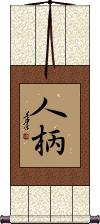
This Japanese word speaks of the quality of your personality, character, personal appearance, or gentility.
Calm and Open Mind
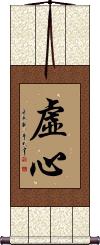
虛心 is a Buddhist term that speaks of being open-minded and/or having a calm and humble mind or heart.
Green Fire
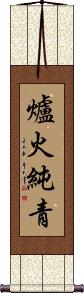
爐火純青 means “[The] furnace fire [has become] pure green.
This is an allusion to Daoist alchemy. figuratively, this speaks of an art or technique brought to the point of perfection.
Inner Beauty / Beauty of Spirit
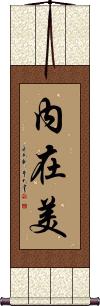
內在美 is a title that speaks of beauty on the inside.
It's not about outward or physical beauty but rather the inner beauty possessed by someone. This can also be translated as “beauty of spirit.”
Family Bond / Family Ties
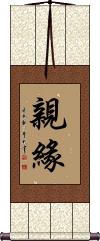
親緣 is a Chinese word that means affinity, family relationship, or consanguinity.
This speaks of the family bonds we have with others that share the same blood or ancestors.
Inner Beauty / Beauty of Spirit
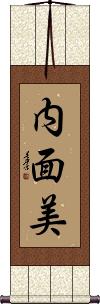
内面美 is a three-character title that speaks of beauty on the inside.
It's not about outward or physical beauty but rather the inner beauty possessed by someone. This can also be translated as “beauty of spirit.”
Acceptance / Tolerate
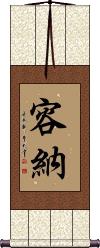
容納 speaks of being tolerant of other opinions or being accepting of other people's ideas or ways of doing things.
Other definitions of this word include having the capacity for, to accommodate, or to tolerate.
Immortal / Immortality
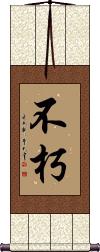
不朽 means immortal or immortality in Chinese, Japanese Kanji, and old Korean Hanja.
The literal translation is “without decay” or “never rotting.” This title speaks of something or someone who never dies and thus never rots or decays.
This can also be translated as everlasting, eternal, or imperishable.
Love the House and Its Crow
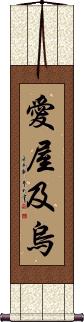
愛屋及烏 is the Chinese idiom, “Love the house and its crow.”
It speaks to the fact that if you are involved in a relationship with somebody, you are also in a relationship with everyone connected to that person. In English, we say, “Love me, love my dog.”
Hardships and Joys
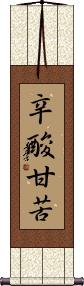
辛酸甘苦 is a Japanese proverb that speaks of the “hardships and joys” of life.
Some other translations include:
Tasting the sweets and bitters of life.
Being well-versed in the ways of the world (having seen much of life).
This is the Japanese “for better or worse” when speaking of life.
Having High Principles
Do not bow down for the sake of five pecks of rice
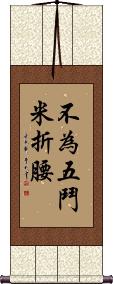
不为五斗米折腰 is a Chinese idiom/proverb that speaks of being above bribes and not losing face or honor for short-term gain.
Some may also translate the perceived meaning as “high-hearted” or “integrity beyond reproach.”
The more literal meaning is “Do not bow down for the sake of five pecks of rice.”
Martial Arts Skills
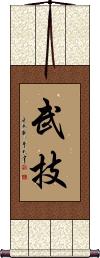
武技 can mean “martial arts skills,” “warrior skills,” or “military skills,” depending on usage.
In both Japanese and Chinese, rather than meaning martial arts, this speaks more to the skills that you possess in regard to martial arts. This phrase also has a light suggestion of “having the itch to show off these skills.”
Zen Understanding
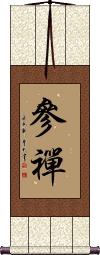
參禪 is a title that speaks of reaching an understanding (of Zen or the world). It also means “to practice meditation.” The two concepts lead you to the idea that meditation leads to understanding. 參禪 is pretty deep, so you can do your research or decide what this means for you.
This can also be defined in a more complex way as “thoroughly penetrating with meditative insight.”
Immortal
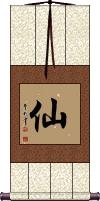
仙 means immortal (as in a being or person).
In some contexts, it can mean hermit, ascetic, man of the hills, or wizard. The Buddha is often put in this category.
In Chinese mythology and folklore, there is a famous group of eight immortals (八仙).
The 楞嚴經 (Śūraṅgama Sūtra) speaks of many kinds of immortals including walkers on the earth, fliers, wanderers at will (into space or into the deva heavens), beings with the ability to transform themselves into any form, etc.
The Spirit of Dragon and Tiger
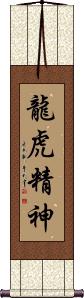
龍虎精神 means the spirit of the dragon and tiger.
It speaks to the vitality and vigor that is the nature of these two creatures.
Beyond “spirit,” the last two characters can also mean mind, soul, or heart. Therefore, you can also say this means “Heart of the Dragon and Tiger,” etc.
龍虎精神 is often titled “Ryukoseishin” in many Japanese martial arts.
The Karma/Fate/Destiny that Brings Lovers Together
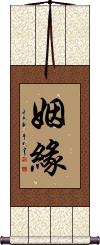
姻緣 means “Destiny that brings lovers together.” It can also be translated technically as “Predestined matrimonial affinity” (wow, talk about taking the romance out of this word - that was from the Oxford C-E dictionary).
This speaks to the fate (or karma) that brings a husband and wife together. I would translate this as “Together by fate” or “Joined by destiny” but in the context of marriage. You could use this for non-married lovers, but the first character has a suggestion that this refers to those that are married.
Flowers Bloom and Flowers Fall
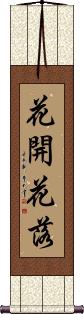
花開花落 is a complete proverb that lightly speaks of the cycle of life, or how things come and go in life.
This is used as a metaphor to suggest that youth is a temporary state that in time will pass.
This can also be used to suggest that fortunes can come and go (everything is temporary).
Note: There are two very similar versions of this proverb. The other uses a word that means wither instead of fall.
Flowers Bloom and Flowers Wither
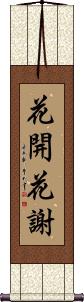
花開花謝 is a complete proverb that lightly speaks of the cycle of life, or how things come and go in life.
This is used as a metaphor to suggest that youth is a temporary state, which in time, will pass.
This proverb can be used to suggest that fortunes can come and go (everything is temporary).
Note: There are two very similar versions of this proverb. The other uses a word that means fall instead of wither.
Spiritual Strength / Strength of Spirit
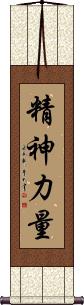
精神力量 is a title that speaks of one's soul or spirit and the capacity or strength that soul possesses.
The first two characters mean mind, heart, spirit, and/or soul.
The last two characters mean strength, capacity, or ability.
Note: Separately, these are two words in Japanese and can be pronounced, but this does not make a natural title in Japanese (best if your audience is Chinese).
Unbridled Creativity
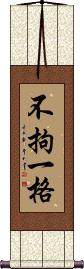
不拘一格 is a Chinese proverb that speaks of exploring different styles and not being stuck in conventional thinking.
It can also be translated as “not sticking to one pattern” or “not limited to one type (or style).” The most simple translation is “being creative” or “unbridled creativity.” Some may also say this means “not being stuck in a rut,” in the context of a designer or artist.
If you translate this, the first two characters mean “not stick to” or “not confine oneself to.”
The second two characters mean “one mode,” “one pattern,” “one form,” “one style,” or “one rule.”
Science / Universal Law
The rules of life, the universe, and everything.
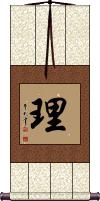
At its essence, 理 means science.
理 is a very ambiguous and open term; it speaks to the reason that all things exist, and how things work from the microscopic to the cosmic level.
In the Buddhist context, this character represents the “Universal Law.”
There are many translations for this word, including inner essence, intrinsic order, reason, logic, truth, natural science (esp. physics), principle, the underlying principles of the cosmos, the way of things, ruling principle, fundamental law, intrinsicality, universal basis, or essential element(s).
If you are a scientist, or just searching for “the answer to life, the universe, and everything,” this could be the character for you.
Beautiful Woman Proverb
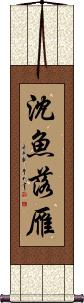
沈魚落雁 is an old proverb that literally means “fish sink, goose alights.”
...But this takes some explaining. This is a proverb from Zhuangzi (莊子), who lived in the late 4th century BC.
This figuratively refers to female beauty that is so captivating that even the birds and beasts take notice.
Perhaps a better and more accurate way to describe this is to say that it speaks of the charms of a uniquely beautiful woman who is so beautiful that fish stay on the bottom of the water and flying wild geese fall from the sky in shame.
This proverb is so famous that it is also known and used in Japan (same characters, different pronunciation).
Note: This can also be written 沉魚落雁 instead of 沈魚落雁 (just the first character varies slightly).
Wu Wei / Without Action
Daoist / Taoist Tenet
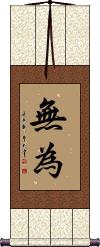
無為 or “Wu Wei” is a Daoist (Taoist) tenet that speaks to the idea of letting nature take its course.
Some will say it's about knowing when to take action and when not to. In reality, it's more about not going against the flow. What will happen is controlled by the Dao (Tao), for which one who follows the Dao will not resist or struggle against.
You can think of 無為 as the Chinese way to express “laissez-faire.”
There is a lot more to this concept, but if you are looking for this entry, you already know the expanded concept.
Warning: Outside of the Daoist context, this means idleness or inactivity (especially in Japanese, where not everyone knows this as a Daoist concept, though it does pair well with the Japanese concept of Wabi-Sabi).
Walking 100 Miles: Stopping at 90 miles, is the same as stopping half-way
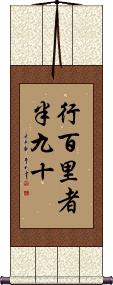
行百里者半九十 is an old Chinese proverb that speaks to the act of giving up. This phrase suggests that no matter how close you are to finishing your task or journey, giving up just before you finish is just as bad as giving up halfway.
50% finished or 90% finished, the result is the same: “You are not finished.”
You can take what you want from this proverb, but I think it suggests that you should finish what you start, and especially finish that last 10% of your journey or project so that you can honestly say “it's finished.”
Some notes: The character, 里, that I am translating as “mile” is an ancient “Chinese mile” which is actually about half a kilometer - it just doesn't sound right to say “When walking 100 half-kilometers...”
Appreciation and Love for Your Parents
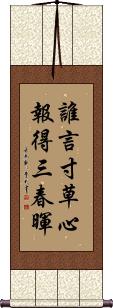
誰言寸草心報得三春暉 is the last line of a famous poem. It is perceived as a tribute or ode to your parents or mother from a child or children that have left home.
The poem was written by Meng Jiao during the Tang Dynasty (about 1200 years ago). The Chinese title is “You Zi Yin” which means “The Traveler's Recite.”
The last line as shown here speaks of the generous and warm spring sunlight which gives the grass far beyond what the little grass can could ever give back (except perhaps by showing its lovely green leaves and flourishing). The metaphor is that the sun is your mother or parents, and you are the grass. Your parents raise you and give you all the love and care you need to prepare you for the world. A debt that you can never repay, nor is repayment expected.
The first part of the poem (not written in the characters to the left) suggests that the thread in a loving mother's hands is the shirt of her traveling offspring. Vigorously sewing while wishing them to come back sooner than they left.
...This part is really hard to translate into English that makes any sense but maybe you get the idea. We are talking about a poem that is so old that many Chinese people would have trouble reading it (as if it was the King James Version of Chinese).
A sly rabbit has three openings to its den
-or- The crafty rabbit has three different entrances to its lair
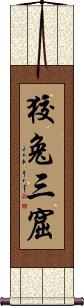
狡兔三窟 speaks to the cunning character of a sly rabbit. Such a rabbit will not have just one hole but rather a few entrances and exits from his liar.
About 2,250 years ago, a rich man told his assistant to go and buy something wonderful that he did not yet possess. He was a man that already had everything, so the assistant went to a local village that owed a great deal of money to the rich man. The assistant told the village elders that all debts were forgiven. All the villagers rejoiced and praised the rich man's name. The assistant returned to the rich man and told him he had purchased “benevolence” for him. The rich man was mildly amused but perhaps slightly confused by the action.
Sometime later, the rich man fell from the favor of the Emperor and was wiped out without a penny to his name. One day he was walking aimlessly and stumbled into the village where the debts had been forgiven. The villagers recognized the man and welcomed him with open arms, clothed, fed him, and gave him a place to live.
Without trying, the man had become like the sly and cunning rabbit. When his exit was blocked, he had another hole to emerge from - and was reborn. This story and idiom come from a book titled “The Amendment” - it's unclear whether this man actually existed or not. But the book did propel this idiom into common use in China.
Still today, this idiom about the rabbit is used in China when suggesting “backup plans,” alternate methods, and anyone with a good escape plan.
Body and Earth in Unity
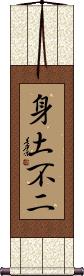
身土不二 (Shindofuni) is originally a Buddhist concept or proverb referring to the inseparability of body-mind and geographical circumstances.
This reads, “Body [and] earth [are] not two.”
Other translations or matching ideas include:
Body and land are one.
Body and earth cannot be separated.
Body earth sensory curation.
You are what you eat.
Indivisibility of the body and the land (because the body is made from food and food is made from the land).
Going further, this speaks of our human bodies and the land from which we get our food being closely connected. This phrase is often used when talking about natural and organic vegetables coming directly from the farm to provide the healthiest foods in Japan.
Character notes: 身(shin) in this context does not just mean your physical body but a concept including both body and mind.
土 (do) refers to the soil, earth, clay, land, or in some cases, locality. It's not the proper name of Earth, the planet. However, it can refer to the land or realm we live in.
Japanese note: This has been used in Japan, on and off, since 1907 as a slogan for a governmental healthy eating campaign (usually pronounced as shindofuji instead of the original shindofuni in this context). It may have been hijacked from Buddhism for this propaganda purpose, but at least this is “healthy propaganda.”
Korean note: The phrase 身土不二 was in use by 1610 A.D. in Korea, where it can be found in an early medical journal.
In modern South Korea, it's written in Hangul as 신토불이. Korea used Chinese characters (same source as Japanese Kanji) as their only written standard form of the language until about a hundred years ago. Therefore, many Koreans will recognize this as a native phrase and concept.
See Also: Strength and Love in Unity
The following table may be helpful for those studying Chinese or Japanese...
| Title | Characters | Romaji (Romanized Japanese) | Various forms of Romanized Chinese | |
| Speaks | 斯皮克斯 | sī pí kè sī si1 pi2 ke4 si1 si pi ke si sipikesi | ssu p`i k`o ssu ssupikossu ssu pi ko ssu |
|
| Speaks | スピークス | supiikusu / supikusu | ||
| Character | 人柄 | hitogara | ||
| Calm and Open Mind | 虛心 虚心 | ko shin / koshin | xū xīn / xu1 xin1 / xu xin / xuxin | hsü hsin / hsühsin |
| Green Fire | 爐火純青 炉火纯青 | lú huǒ chún qīng lu2 huo3 chun2 qing1 lu huo chun qing luhuochunqing | lu huo ch`un ch`ing luhuochunching lu huo chun ching |
|
| Inner Beauty Beauty of Spirit | 內在美 内在美 | nèi zài měi nei4 zai4 mei3 nei zai mei neizaimei | nei tsai mei neitsaimei |
|
| Family Bond Family Ties | 親緣 亲缘 | qīn yuán / qin1 yuan2 / qin yuan / qinyuan | ch`in yüan / chinyüan / chin yüan | |
| Inner Beauty Beauty of Spirit | 内面美 | nai men bi / naimenbi | ||
| Acceptance Tolerate | 容納 容纳 | róng nà / rong2 na4 / rong na / rongna | jung na / jungna | |
| Immortal Immortality | 不朽 | fukyuu / fukyu | bù xiǔ / bu4 xiu3 / bu xiu / buxiu | pu hsiu / puhsiu |
| Love the House and Its Crow | 愛屋及烏 爱屋及乌 | ài wū jí wū ai4 wu1 ji2 wu1 ai wu ji wu aiwujiwu | ai wu chi wu aiwuchiwu |
|
| Hardships and Joys | 辛酸甘苦 | shinsankanku | ||
| Having High Principles | 不為五斗米折腰 不为五斗米折腰 | bù wèi wǔ dǒu mǐ zhé yāo bu4 wei4 wu3 dou3 mi3 zhe2 yao1 bu wei wu dou mi zhe yao buweiwudoumizheyao | pu wei wu tou mi che yao puweiwutoumicheyao |
|
| Martial Arts Skills | 武技 | bugi | wǔ jì / wu3 ji4 / wu ji / wuji | wu chi / wuchi |
| Zen Understanding | 參禪 参禅 | cān chán / can1 chan2 / can chan / canchan | ts`an ch`an / tsanchan / tsan chan | |
| Immortal | 仙 | sento / sen | xiān / xian1 / xian | hsien |
| The Spirit of Dragon and Tiger | 龍虎精神 龙虎精神 | ryu ko sei shin ryukoseishin | lóng hǔ jīng shén long2 hu3 jing1 shen2 long hu jing shen longhujingshen | lung hu ching shen lunghuchingshen |
| The Karma/Fate/Destiny that Brings Lovers Together | 姻緣 姻缘 | yīn yuán / yin1 yuan2 / yin yuan / yinyuan | yin yüan / yinyüan | |
| Flowers Bloom and Flowers Fall | 花開花落 花开花落 | huā kāi huā luò hua1 kai1 hua1 luo4 hua kai hua luo huakaihualuo | hua k`ai hua lo huakaihualo hua kai hua lo |
|
| Flowers Bloom and Flowers Wither | 花開花謝 花开花谢 | huā kāi huā xiè hua1 kai1 hua1 xie4 hua kai hua xie huakaihuaxie | hua k`ai hua hsieh huakaihuahsieh hua kai hua hsieh |
|
| Spiritual Strength Strength of Spirit | 精神力量 | seishin rikiryou seishinrikiryou seishin rikiryo | jīng shén lì liàng jing1 shen2 li4 liang4 jing shen li liang jingshenliliang | ching shen li liang chingshenliliang |
| Unbridled Creativity | 不拘一格 | bù jū yī gé bu4 ju1 yi1 ge2 bu ju yi ge bujuyige | pu chü i ko puchüiko |
|
| Science Universal Law | 理 | kotowari | lǐ / li3 / li | |
| Beautiful Woman Proverb | 沈魚落雁 沈鱼落雁 | chin gyo raku gan chingyorakugan | chén yú luò yàn chen2 yu2 luo4 yan4 chen yu luo yan chenyuluoyan | ch`en yü lo yen chenyüloyen chen yü lo yen |
| Wu Wei Without Action | 無為 无为 | mui | wú wéi / wu2 wei2 / wu wei / wuwei | |
| Walking 100 Miles: Stopping at 90 miles, is the same as stopping half-way | 行百里者半九十 | xíng bǎi lǐ zhě bàn jiǔ shí xing2 bai3 li3 zhe3 ban4 jiu3 shi2 xing bai li zhe ban jiu shi xingbailizhebanjiushi | hsing pai li che pan chiu shih hsingpailichepanchiushih |
|
| Appreciation and Love for Your Parents | 誰言寸草心報得三春暉 谁言寸草心报得三春晖 | shuí yán cùn cǎo xīn bào dé sān chūn huī shui2 yan2 cun4 cao3 xin1 bao4 de2 san1 chun1 hui1 shui yan cun cao xin bao de san chun hui | shui yen ts`un ts`ao hsin pao te san ch`un hui shui yen tsun tsao hsin pao te san chun hui |
|
| A sly rabbit has three openings to its den | 狡兔三窟 | jiǎo tù sān kū jiao3 tu4 san1 ku1 jiao tu san ku jiaotusanku | chiao t`u san k`u chiaotusanku chiao tu san ku |
|
| Body and Earth in Unity | 身土不二 | shindofuni / shindofuji | ||
| In some entries above you will see that characters have different versions above and below a line. In these cases, the characters above the line are Traditional Chinese, while the ones below are Simplified Chinese. | ||||

Successful Chinese Character and Japanese Kanji calligraphy searches within the last few hours...



