Many custom options...


And formats...



Oriental in Chinese / Japanese...
Buy an Oriental calligraphy wall scroll here!
Personalize your custom “Oriental” project by clicking the button next to your favorite “Oriental” title below...
1. Asian Pride / Oriental Pride / AZN Pryde
2. Cambodia
3. Azerbaijan
4. Bangladesh
5. Azerbaijan
6. Cyprus
7. China
9. Subaru
10. Islam
11. East
Asian Pride / Oriental Pride / AZN Pryde
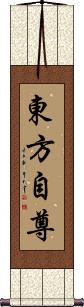
東方自尊 is the universal way to write “Asian Pride.”
We worked on this one for a long time. The effort involved both Chinese and Japanese translators and lengthy discussions. If you have been searching for this term, there is a reason that it's hard to find the way to write “Asian Pride” in Chinese and Japanese - it's because of the inherent difficulties in figuring out a universal combination of characters that can be read in all languages that use forms of Chinese characters.
This final solution that you see to the left creates a reasonable title in Chinese and an exotic (perhaps unusual) title in Japanese (This could be read as “Eastern Self-Respect” in Japanese”).
Although not as natural, it does have the same meaning as Korean Hanja, and the older generation of Vietnamese people will be able to read it.
The first two characters literally mean “Oriental” and the second two mean “pride,” “self-esteem,” or “self-respect” (we chose the most non-arrogant way to say “pride”). If you have “Asian Pride” (sometimes spelled Asian Pryde) these are the characters for you.
Note: For those who wonder, there is nothing technically wrong with the word “Oriental.” It is a correct word, and any bad meanings were created by so-called “Asian Americans” and Caucasians in the United States. To say “Asian” would not completely correct the intended meaning since that would include people from Saudi Arabia, Iraq, Iran, India, and portions of Russia.
For further proof, if you were of East Asian ancestry and born in England, you would be known as a “British Oriental” (The “Oriental stigma” is essentially an American creation and, therefore, applies mainly to the American English language - where they get a bit overzealous with political correctness).
Further, since the Chinese and Japanese word for Oriental is not English, they cannot be construed as having ill meaning. On one trip to China or Japan, you will find many things titled with these two characters, such as malls, buildings, and business names. These places also use “Oriental” as their English title (much as we do since our Chinese business name starts with these same two characters).
In short, the first two characters have the meaning that Americans attach to “Asian” but is more technically correct.
Cambodia
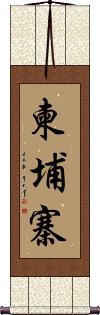
柬埔寨 is a universal way to write Cambodia in Chinese characters and Japanese Kanji.
Note: There are other names and nicknames for Cambodia in both languages.
See Also: Violet | Lotus | Asian Pride / Oriental Pride / AZN Pryde
Cambodia
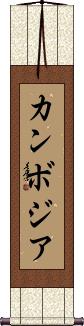
This is Cambodia in Japanese Katakana.
Note: Because this title is entirely Japanese Katakana, it should be written by a Japanese calligrapher.
See Also: Violet | Lotus | Asian Pride / Oriental Pride / AZN Pryde
Azerbaijan
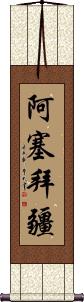
阿塞拜疆 is the Chinese name for the country of Azerbaijan.
Note: Technically Azerbaijan is in Asia but politically European.
See Also: Asian Pride / Oriental Pride / AZN Pryde | Zero
Bangladesh
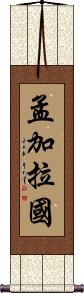
This is the Chinese name for the country of Bangladesh.
See Also: India | Asian Pride / Oriental Pride / AZN Pryde
Bangladesh
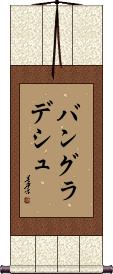
バングラデシュ is Bangladesh in Japanese Katakana.
Note: Because this title is entirely Japanese Katakana, it should be written by a Japanese calligrapher.
See Also: India | Asian Pride / Oriental Pride / AZN Pryde
Azerbaijan
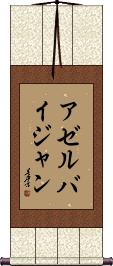
アゼルバイジャン is the Japanese Katakana title for Azerbaijan.
Note: Because this title is entirely Japanese Katakana, it should be written by a Japanese calligrapher.
See Also: Asian Pride / Oriental Pride / AZN Pryde | Zero
Cyprus
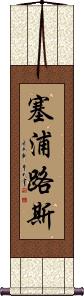
This is the Chinese name for the country of Cyprus.
See Also: Asian Pride / Oriental Pride / AZN Pryde
Cyprus
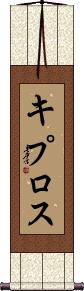
This is Cyprus in Japanese Katakana.
Note: Because this title is entirely Japanese Katakana, it should be written by a Japanese calligrapher.
See Also: Asian Pride / Oriental Pride / AZN Pryde
China
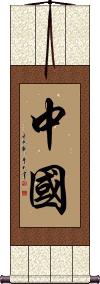
中國 is the Chinese name for the country of China.
See Also: Inspire | Zhong Kui | Iwan | Japanese Snapping Turtle | Violet | Chinese or Korean Army General | Asian Pride / Oriental Pride / AZN Pryde
China
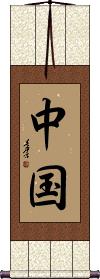
This is the country of China written in Japanese.
See Also: Inspire | Zhong Kui | Iwan | Japanese Snapping Turtle | Violet | Chinese or Korean Army General | Asian Pride / Oriental Pride / AZN Pryde
Cherry Blossom
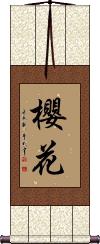
櫻花 is how to write “cherry blossom” in Chinese and traditional Japanese Kanji.
The first character means “cherry” or sometimes “cherry tree.”
The second character means “flowers” or “blossoms.”
Oddly, my Chinese dictionary also defines these two characters as “Japanese oriental cherry tree” or “Oriental cherry blossom.” However, the first character is the only one that means “cherry,” so it can refer to any cherry blossoms in the whole world (not just those in Asia).
 There is an alternate version of the first character, which has become the standard for Japanese Kanji. If you want this version, instead of the one shown to the upper left, please click on the Kanji shown to the right instead of the button above. Although this is an alternate form in Chinese, most Chinese people will think this is just the Japanese version (Chinese people
don’t
necessarily know the history and all alternate forms of Chinese characters from the past). Therefore, this version shown to the right is best if your audience is Japanese (though most Japanese will recognize the form shown in the upper left).
There is an alternate version of the first character, which has become the standard for Japanese Kanji. If you want this version, instead of the one shown to the upper left, please click on the Kanji shown to the right instead of the button above. Although this is an alternate form in Chinese, most Chinese people will think this is just the Japanese version (Chinese people
don’t
necessarily know the history and all alternate forms of Chinese characters from the past). Therefore, this version shown to the right is best if your audience is Japanese (though most Japanese will recognize the form shown in the upper left).
Subaru
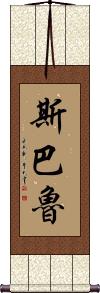
斯巴魯 is the Chinese title for the Subaru brand of automobiles.
At Oriental Outpost, we exclusively drive Subaru vehicles (purchased our 4th Subaru in 2016).
Notes: Occasionally, the title 速霸陸 is used for Subaru. The title is completely different in Japanese.
Islam
The religion of the Hui People
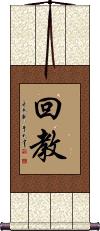
回教 means “Hui Religion” in Chinese.
It refers specifically to the Hui people (Huizu), who have typical Oriental looks but are Muslim (practice the religion of Islam). Hui people can be found throughout China, often establishing Muslim neighborhoods in many cities.
My Japanese dictionary lists this as the all-Kanji way to write Islam as well.
In Korean, the first character is used as a short name to say Muslim.
East
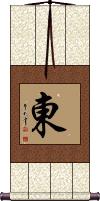
東 is the direction East in Chinese, Japanese Kanji, and old Korean Hanja.
Sometimes used as an abbreviation for the Eastern Hemisphere.
This can also be the surname Dong in China.
In Japan, this can be an abbreviation for a kind of six-stringed zither, or the personal name, Yamato.
東 is used as a suffix for many words in Asia. In fact, it's part of the CJK word 東方 meaning Orient or Oriental. The word 東方 more literally translates as “Eastern Kingdoms,” “Eastern Countries,” or simply “The East.”
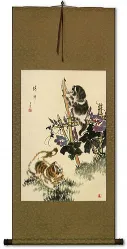
This in-stock artwork might be what you are looking for, and ships right away...


The following table may be helpful for those studying Chinese or Japanese...
| Title | Characters | Romaji (Romanized Japanese) | Various forms of Romanized Chinese | |
| Asian Pride Oriental Pride AZN Pryde | 東方自尊 东方自尊 | tou hou zi son touhouzison to ho zi son | dōng fāng zì zūn dong1 fang1 zi4 zun1 dong fang zi zun dongfangzizun | tung fang tzu tsun tungfangtzutsun |
| Cambodia | 柬埔寨 | kanbojia | jiǎn pǔ zhài jian3 pu3 zhai4 jian pu zhai jianpuzhai | chien p`u chai chienpuchai chien pu chai |
| Cambodia | カンボジア | kan po ji a kanpojia | ||
| Azerbaijan | 阿塞拜疆 | ā sài bài jiāng a1 sai4 bai4 jiang1 a sai bai jiang asaibaijiang | a sai pai chiang asaipaichiang |
|
| Bangladesh | 孟加拉國 孟加拉国 | mèng jiā lā guó meng4 jia1 la1 guo2 meng jia la guo mengjialaguo | meng chia la kuo mengchialakuo |
|
| Bangladesh | バングラデシュ | banguradeshu | ||
| Azerbaijan | アゼルバイジャン | azerubaijan | ||
| Cyprus | 塞浦路斯 | sāi pǔ lù sī sai1 pu3 lu4 si1 sai pu lu si saipulusi | sai p`u lu ssu saipulussu sai pu lu ssu |
|
| Cyprus | キプロス | ki pu ro su kipurosu | ||
| China | 中國 中国 | chū goku / chūgoku | zhōng guó zhong1 guo2 zhong guo zhongguo | chung kuo chungkuo |
| China | 中國 中国 | chuu goku / chuugoku / chu goku | ||
| Cherry Blossom | 櫻花 樱花 / 桜花 | ouka / oka | yīng huā / ying1 hua1 / ying hua / yinghua | |
| Subaru | 斯巴魯 斯巴鲁 | sī bā lǔ si1 ba1 lu3 si ba lu sibalu | ssu pa lu ssupalu |
|
| Islam | 回教 | kai kyou / kaikyou / kai kyo | huí jiào / hui2 jiao4 / hui jiao / huijiao | hui chiao / huichiao |
| East | 東 东 | higashi / tou higashi / to | dōng / dong1 / dong | tung |
| In some entries above you will see that characters have different versions above and below a line. In these cases, the characters above the line are Traditional Chinese, while the ones below are Simplified Chinese. | ||||

Successful Chinese Character and Japanese Kanji calligraphy searches within the last few hours...



