Many custom options...


And formats...



One Mind in Chinese / Japanese...
Buy an One Mind calligraphy wall scroll here!
Personalize your custom “One Mind” project by clicking the button next to your favorite “One Mind” title below...
3. One Heart / One Mind / Heart and Soul
4. The Nature of Enlightenment in One's Mind
7. Work Together with One Mind
8. One Who Does Not Do Bad Things, Worries Not of Knocks at His Door
10. Peaceful Heart / Peace of Mind / Calm Mind
12. Seeing one’s Nature and becoming a Buddha
13. Immovable Mind
14. No Mind / Mushin
15. Patience Yields Peace of Mind
16. Heijoshin / Presence of Mind
17. Alert / On Guard / Lingering Mind
20. Heart and Soul
23. Devotion / Dedication / Attentive / Focused
25. My True Love
26. Martial Morality / Martial Arts Ethics / Virtue
27. Samadhi
28. Energy Sword Body in Concert
29. 7. Right Mindfulness / Right Memory / Perfect Mindfulness
30. Contentment
31. Move On / Change Way of Thinking
33. Soul Mates
34. With all the strength of your heart
35. Whole Heart
36. Remember
37. Offering / Puja
38. Spiritual Peace / Enlightened Peace
39. Discipline / Training / Tempering Character
41. Samadhi
42. Soul / Spirit
44. Purified Spirit / Enlightened Attitude
45. Unwavering Determination and Resolve
46. 8. Right Concentration / Perfect Concentration
47. Devotion / Diligence / Vigorous / Energetic
48. Spiritual Strength / Strength of Spirit
49. Concentration
51. Spirit / Spiritual Essence
53. Zen Buddhism
54. Unmoved by the Eight Winds
55. Push or Knock
Morality of Mind
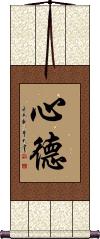
The idea of 心德 or “morality of mind” goes along with 行德 or “wu de” (martial morality or virtues of the warrior).
Here, the first character is a representation of your heart or mind.
The second character refers to morality or virtue.
This can also be translated as “morality of heart,” “virtue of heart,” or “virtue of the mind.”
Since ancient times in Asia, the idea of your mind (where your soul resides and your thought originates) has been associated with the heart. Just as in western culture, where we say “it comes from the heart” or “heartfelt emotions,” there is a belief that your heart and mind are one and the same (medical science now begs to differ).
See Also: Morality of Deed | Martial Morality
Mind of the Beginner
Shoshin
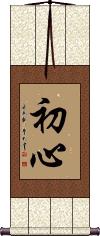
初心 is often translated in Japanese as “beginner's mind” or “beginner's spirit.”
In Chinese, the dictionary definition is “one's original intention.”
The first character means first, initial, primary, junior, beginning, or basic.
The second character means heart, mind, soul, or essence.
初心 is one of the five spirits of the warrior (budo) and is often used as a Japanese martial arts tenet. Under that context, places such as the Budo Dojo define it this way: The state of shoshin is that of a beginners mind. It is a state of awareness that always remains fully conscious, aware, and prepared to see things for the first time. The attitude of shoshin is essential to continued learning.
One Heart / One Mind / Heart and Soul
Isshin
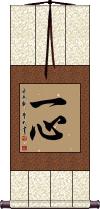
一心 can be translated as “one mind,” “single-minded focus,” or “wholehearted devotion,” from Chinese, Japanese Kanji, and old Korean Hanja.
Colloquially or figuratively, it means: wholeheartedly; heart and soul; of one mind; single-mindedness, wholeheartedness; one's whole heart; with the whole mind or heart; one mind in heart.
I'm not kidding, all of those came right from the dictionary for this one title.
In martial arts usage, this term emphasizes total commitment, where intent, attention, and action are unified without distraction.
In Japanese budō, it often conveys wholehearted dedication to practice or principle, whereas in Chinese usage it tends toward inner mental cultivation.
In Buddhism, this can refer to the bhūtatathatā, or the whole of things; the universe as one mind, or a spiritual unity.
In Japanese, this can be the female given name, Hitomi.
The Nature of Enlightenment in One's Mind
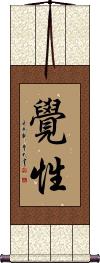
覺性 represents “The enlightened mind free from all illusion,” “The nature of enlightenment in one's mind,” or “The Buddha-nature.”
To reach this “enlightened nature,” one must form their mind into and utilize their mind as the agent of knowledge, or enlightenment.
Lingering Mind
Zanshin
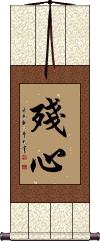
First off, 殘心 should only be used in the context of Japanese martial arts. In Chinese, it's a rather sad title (like a broken heart). In Chinese, the first character alone means destroyed, spoiled, ruined, injured, cruel, oppressive, savage, incomplete, or disabled. However, in Japanese, it's remainder, leftover, balance, or lingering.
The second character means heart, mind, soul, or essence in both languages.
殘心 is one of the five spirits of the warrior (budo) and is often used as a Japanese martial arts tenet. Under that context, places such as the Budo Dojo define it this way: The spirit of zanshin is the state of the remaining or lingering spirit. It is often described as a sustained and heightened state of awareness and mental follow-through. However, true zanshin is a state of focus or concentration before, during, and after the execution of a technique, where a link or connection between uke and nage is preserved. Zanshin is the state of mind that allows us to stay spiritually connected, not only to a single attacker but to multiple attackers and even an entire context; a space, a time, an event.
 In modern Japan (and Simplified Chinese), they use a different version of the first character, as seen to the right. Click on this character to the right instead of the button above if you want this modern Japanese version of lingering mind / zanshin.
One Mind / Unity
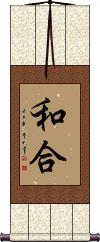
和合 means to blend, unite, or be of one mind.
和合 is usually used as a Buddhist term. It can also be defined as harmony, concord, agreement, unity, union, and harmonize/harmonization.
Work Together with One Mind
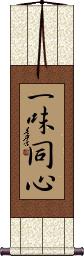
一味同心 is a Japanese phrase that refers to people working together with one mind.
One Who Does Not Do Bad Things, Worries Not of Knocks at His Door
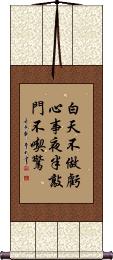
白天不做亏心事夜半敲门不吃惊 literally translates as: [If one does] not do bad things in the daytime, one need not be alarmed at knocks on the door in the middle of the night.
The meaning is something like, “A quiet conscience sleeps in thunder.” Basically, the message is, “don't commit crimes and you won't be jumpy every time the doorbell rings (so don't do anything wrong and your life will have fewer worries and you can sleep at night).”
Loving Heart / One’s Love
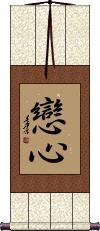
戀心 literally means “loving heart.” It can also be translated as “one's love” or “awakening of love.”
戀心 is used exclusively for love between boyfriends and girlfriends or husband and wife.
Breaking down the meaning of each Kanji, the first means love, affection, or tender passion. The second Kanji means heart, mind, or soul (most will read it as the heart).
See Also: Compassion | Love
Peaceful Heart / Peace of Mind / Calm Mind
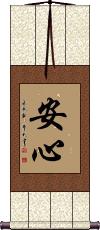
安心 can be defined as relief, peace of mind, feeling at ease, to be relieved, to set one's mind at rest, and easiness.
安心 is a nice word that encompasses great meanings within just two characters. Some of the other meanings include pacifying, settling the mind, and peace of mind. It's also the idea of feeling a sense of security, safety, and confidence in your state of well-being.
This can be used by everyone, but some consider it to be a Buddhist concept (You'll find it in your Zen dictionary).
Note: Can be romanized as Anshin or Anjin in Japanese.
The Original Mind
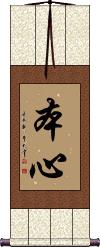
In Zen Buddhism, 本心 means “original mind” or “original heart,” which refers to one's Buddha-nature present from birth.
This can also be translated as true feelings, real intention, one's own heart, one's right mind, one's senses, one's conscience, or fundamental mind.
Note: 心 can mean heart or mind - thought in ancient Asia to be the same organ.
Seeing one’s Nature and becoming a Buddha
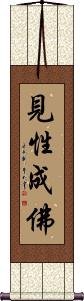
見性成佛 is a universal phrase that suggests that one may see one's nature and accomplish Buddhahood.
見性 suggests penetrating deep inside oneself to see one's “Original finally
Mind.”
成佛 refers to a sentient being who dispenses with illusions and delusions
through ascetic practice, is enlightened to the truth, and becomes a Buddha.
This is used by Mahayana, Chan, and Zen Buddhists in China, Korea, and Japan.
You will also see this with the last character written as 仏 in Japanese. In the religious context, 佛 is commonly used to mean Buddha. If you want the other version, see Kenshō Jōbutsu 見性成仏
Immovable Mind
fudoshin
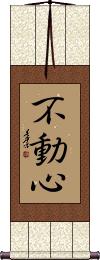
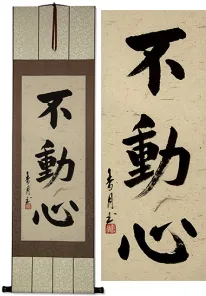
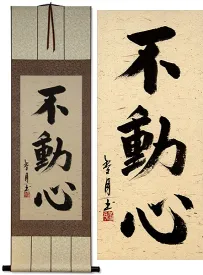
不動心 is one of the five spirits of the warrior (budo) and is often used as a Japanese martial arts tenet.
Under that context, places such as the Budo Dojo define it this way: An unshakable mind and an immovable spirit is the state of fudoshin. It is courage and stability displayed both mentally and physically. Rather than indicating rigidity and inflexibility, fudoshin describes a condition that is not easily upset by internal thoughts or external forces. It is capable of receiving a strong attack while retaining composure and balance. It receives and yields lightly, grounds to the earth, and reflects aggression back to the source.
Other translations of this title include unwavering mind, immovable mind, unwavering composure, imperturbability, steadfastness, keeping a cool head in an emergency, or keeping one's calm (during a fight).
The first two Kanji alone mean immobility, firmness, fixed, steadfastness, motionless, and idle.
The last Kanji means heart, mind, soul, or essence.
Together, these three Kanji create a title defined as “immovable mind” within the context of Japanese martial arts. However, in Chinese, it would mean “motionless heart,” and in Korean Hanja, “wafting heart” or “floating heart.”
No Mind / Mushin
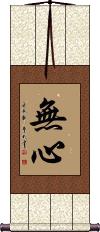
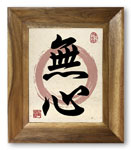
In Japanese, 無心 means innocent or without knowledge of good and evil. It literally means “without mind.”
無心 is one of the five spirits of the warrior (budo) and is often used as a Japanese martial arts tenet. Under that context, places such as the Budo Dojo define it this way: “No mind, a mind without ego. A mind like a mirror which reflects and dos not judge.” The original term was “mushin no shin,” meaning “mind of no mind.” It is a state of mind without fear, anger, or anxiety. Mushin is often described by the phrase “Mizu no Kokoro,” which means “mind like water.” The phrase is a metaphor describing the pond that clearly reflects its surroundings when calm but whose images are obscured once a pebble is dropped into its waters.
This has a good meaning in conjunction with Chan / Zen Buddhism in Japan. However, out of that context, it means mindlessness or absent-mindedness. To non-Buddhists in China, this is associated with doing something without thinking.
In Korean, this usually means indifference.
Use caution and know your audience before ordering this selection.
More info: Wikipedia: Mushin
Patience Yields Peace of Mind
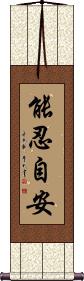
This ancient Chinese proverb can be translated as “Patience brings peace of mind,” “One who has patience finds peace,” and a few other ways.
Heijoshin / Presence of Mind
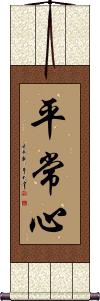
平常心 is the title Heijoshin, as associated with Kendo and Aikido schools of Japanese martial arts.
平常心 is also a word in Japanese that can be translated as “one's self-possession” or “presence of mind.”
In Chinese and Korean, this means “simplicity heart,” “composure,” “calmness,” or a “sense of orderliness.” In Chinese and Korean, this implies that you enjoy what you have, keep your heart in balance, and have no over-blown ambitions.
Alert / On Guard / Lingering Mind
Zanshin
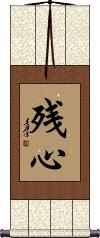
残心 is a Japanese Kanji word meaning: continued alertness; unrelaxed alertness; remaining on one's guard; lingering mind, and being prepared for a counterstrike. This context is used in martial arts, which is probably why you are looking up this word.
In archery and golf, it can be the follow-through.
In the context of love and relationships, it can be lingering affection, attachment, regret, regrets, or reluctance.
Isshin-Ryu / Isshin Style

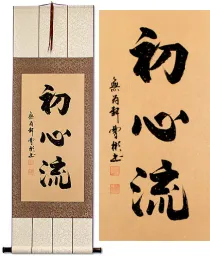
一心流 is the title for Isshin-Ryu.
The literal meaning is “one heart method.” You could also translate it as “Unified Hearts Method,” “One-Mind School” or “One-Heart Style.”
It implies people doing things as if with one heart and mind.
As a style or lineage name, this phrase suggests a school founded on simplicity, unity of intent, and clarity of principle rather than excessive technical complexity.
The second Kanji can be defined as the heart, mind, or essence of your being. Clearly, there's a multitude of ways you can define this title in English.
See Also: Isshin-Kai
Always in My Heart
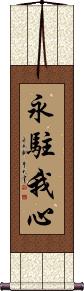
永駐我心 is one of a few ways to write “always in my heart” or “forever in my heart” in Chinese.
The first character means eternal, forever, or always.
The second character means resides, in, or stationed (in the case of troops).
The third character means me, my, or mine.
The last character means heart (but can also mean mind or soul).
Heart and Soul
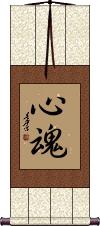
心魂 is “heart and soul” in Japanese Kanji.
The first character means heart (but can also mean mind or soul).
The last character means soul or spirit (spiritual essence).
Heart and Soul
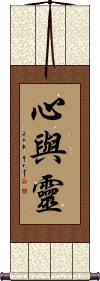
心與靈 is “heart and soul” in Chinese.
The first character means heart (but can also mean mind or soul).
The middle character is like the English “and.”
The last character means soul, spirit, or spiritual energy.
Spiritual Soul Mates
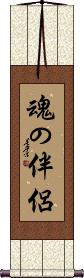
魂の伴侶 is a Japanese-only title for soulmates.
魂 means soul, spirit, immortal soul (the part of you that lives beyond your physical body), or the conscious mind. In the Buddhist context, this is vijñāna or viññāṇa (consciousness, life force, or mind).
の is a possessive article that connects everything here.
伴侶 means mates, companions, partners, and spouses.
Soul Mates at Heart
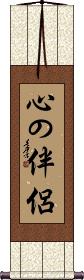
心の伴侶 is a Japanese-only title for soulmates.
心 means heart, soul, mind, core, or center. In ancient times, the heart was believed to be the mind or center of your soul and being.
の is a possessive article that connects everything here.
伴侶 means mates, companions, partners, and spouses.
This Japanese version of soulmates is about two partners, coupled or joined by their hearts.
Devotion / Dedication / Attentive / Focused
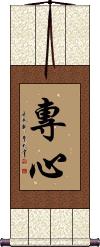
專心 makes a word that means “paying attention with your heart.”
It's often translated as “dedication,” as in “be absorbed in” or “concentrate one's efforts.” It's also used to mean “with the single mind,” “whole-heartedly,” “paying attention,” “undivided attention,” “concentration (-ed),” “engrossed,” “devotionally (listening/watching),” and/or “attentive.”
The first character means “for a particular person, occasion, or purpose,” “focused on one single thing,” “concentrated,” and sometimes, “special.”
The second character means “heart” or “mind” by itself.
My favorite translation, which comes from the Oxford Advanced Chinese/English Dictionary, is, “wholehearted devotion.”
If it seems like the meaning of this word is quite open, you are correct. The context in which the word is used matters a lot. It can mean different things depending on how you use it. This makes it kind of nice as you can decide what this means to you (within some limits). This is always positive in meaning, so even if a Chinese person reads it differently than you, it will still have a good meaning.
 In Japanese, they tend to use a variation of the second character which has one less stroke. If you want your calligraphy written this Japanese form, please click on the Kanji shown to the right instead of the button above. Note: Japanese and Chinese people will recognize either form.
Forever In My Heart
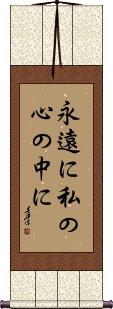
永遠に私の心の中に means “forever in my heart” or “always in my heart” in Japanese.
The character breakdown:
永遠 (eien) eternity; perpetuity; immortality; permanence.
に (ni) indicates the location of a person or thing.
私の (watashi no) my; mine.
心の中 (kokoro no naka) the middle of one's mind; the midst of one's heart.
に (ni) indicates the location of a person or thing (makes this “in” the middle of one's heart).
Note: There’s more than one way to say "Forever in My Heart" in Japanese, so you’ll find another version in our database. This is the very verbose version.
Note: Because this selection contains some special Japanese Hiragana characters, it should be written by a Japanese calligrapher.
Forever In My Heart
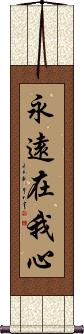
永遠在我心 means “forever in my heart” or “always in my heart” in Chinese.
This is the shorter, somewhat lyrical version of this phrase.
永遠 forever/eternal
在 at/in/exists
我 me/myself/my
心 heart/mind/soul
My True Love
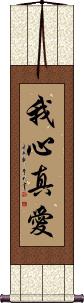
我心真愛 is a slightly poetic way to express this sentiment to someone.
The meaning is “My True Love,” but the characters directly translate as “I/Me/My Heart/Mind True/Real Love.”
Note that Chinese grammar and construction are different, so this sounds very eloquent and artsy in Chinese.
In Korean Hanja, the third character should be written differently. Just let me know when you place your order if you want that version - it will still make sense in Chinese. This phrase makes sense in Korean but is not commonly used.
Martial Morality / Martial Arts Ethics / Virtue
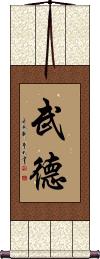
This refers to the virtue, morality, and ethics that any practitioner of martial arts should possess.
This can be used in both Chinese and Japanese in place of English terms such as “soldierly virtue,” “good conduct” (military), “warrior ethics,” and being honorable regarding any fight or competition.
In Japanese, there is a slight variation in the last character, making it 武徳 instead of 武德 in Japan. And yes, just one little horizontal stroke is omitted. If you need the Japanese version, please choose a Japanese calligrapher, or drop me a note so that I make sure you get the characters you intend.
See Also: Morality of Mind | Morality of Deed
Samadhi
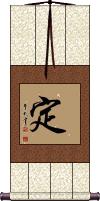
定 is the single-character way to express the idea of Samadhi in Chinese and Japanese.
A single-character title like this is open to a lot of interpretation. So 定 can mean to set, to fix, to determine, to decide, to order, certainly, truly, settle, or compose the mind.
In the Buddhist context, this means “Perfect absorption of thought into the one object of meditation,” “The mind fixed in one direction,” “Internal state of imperturbability or tranquility,” or “Exempt from all external sensations.”
Energy Sword Body in Concert
Spirit, Sword & Body as One
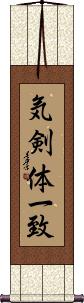
气剑体一致 often gets translated as “Mind Sword Body,” or “Spirit, Sword, and Body as One.” But I think these translations don't tell you enough about what this is really saying.
In this context, 気, which is the modern Japanese version of 氣, means spiritual and unseen energy or “life energy.” In some cases, 気 can be translated as spirit, feeling, or nature. If defined as the mind, it's more about the invisible or intangible parts of one's mind (or soul).
剣 is the Japanese version of 劍 meaning sword.
体 is the modern Japanese version of 體 meaning body.
The Kanji 一 means one, and in this case, suggests “all in one.”
The Kanji 到 means to send, deliver, or convey. But together, 一到 suggests all these things in agreement, union cooperation, or in concert.
Note: Arguments exist as to whether this should be romanized as Kikentaiitchi, Kikentaiicchi, or kikentaiichi. Technically, if you drop the last character, you get 気剣体一 and kikentaiichi (ki ken tai ichi), which is also a valid phrase.
7. Right Mindfulness / Right Memory / Perfect Mindfulness
Samyak Smriti / Samyak Smrti / Samma Sati
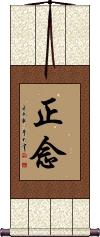
正念 is one of the Noble Eightfold Paths of Buddhism. Right Mindfulness, along with Right Effort and Right Concentration, constitute the path to Concentration or Perfect Thought.
Right Mindfulness is about remaining focused on one's body, feelings, mind, and mental qualities. It's also about being ardent, aware, and mindful, and supposes that you've already put aside worldly desire and aversion.
Monk Bhikkhu Bodhi described this as “The mind is deliberately kept at the level of bare attention, a detached observation of what is happening within us and around us in the present moment.” When practicing right mindfulness, the mind is trained to remain in the present, open, quiet, and alert, contemplating the present event.
Another definition: Ongoing mindfulness of body, feelings, thinking, and objects of thought.
This term is exclusively used by devout Buddhists. It is not a common term, and is remains an unknown concept to most Japanese and Chinese people.
See Also: Buddhism | Enlightenment | Noble Eightfold Path
Contentment
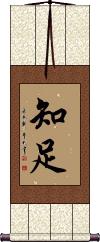
知足 means content with one's situation or to know contentment (hence happiness).
From the Zen Buddhist context, Chisoku or 知足 (knowing what’s enough) means always to know and be
satisfied with one’s lot.
Human pain and suffering are born of greed, and that greed arises because we do not know what’s enough.
The Chinese philosopher, Menzi (372-289 BCE) said, “to nourish the mind, there is nothing better than to make the desires few.”
This relays the idea that the best method to cultivate the mind is to have little desire.
Move On / Change Way of Thinking
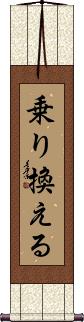
乗り換える is the Japanese way to say “move on.” This can also be translated as “to change one's mind,” “to change methods,” or “to change one's way of thinking.” For instance, if you changed your love interest or political ideology, you might describe the act of that change with this title.
Colloquially in Japan, this is also used to describe the act of transferring trains or changing from one bus or train to another.
Note: Because this selection contains some special Japanese Hiragana characters, it should be written by a Japanese calligrapher.
Idea / Thought / Meaning
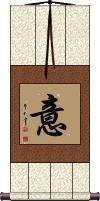
意 is the Chinese, Japanese Kanji, and old Korean Hanja for an idea, intention, meaning, thought, wish, desire, intention, feelings, and thoughts.
In Buddhism, this is the last of the six means of perception (the others are sight, hearing, smell, taste, and touch, and this one represents the mind). It does not literally mean “mind,” but rather something more like mental powers, intellect, intelligence, faculty of thought, or understanding in the Buddhist context.
Soul Mates
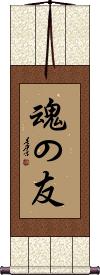
魂の友 is one of a few ways to write “Soul Mates” in Japanese.
The first Kanji means soul, spirit, ghost, immortal soul, the mind, or conscious mind. From Sanskrit, it's Vijñāna.
The middle character is a Japanese Hiragana connecting or possessive article that links the two ideas together.
The last Kanji means friends or friendship.
With all the strength of your heart
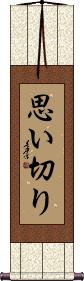
思い切り can be translated as “with all one's strength,” “with all one's heart,” “to the limits of your heart,” or “to the end of your heart/emotions.”
The character breakdown:
思い (omoi) thought; mind; heart; feelings; emotion; sentiment; love; affection; desire; wish; hope; expectation; imagination; experience
切り (kiri) bounds; limits.
Note: Because this selection contains some special Japanese Hiragana characters, it should be written by a Japanese calligrapher.
Whole Heart
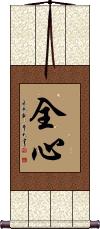
全心 is a short title that means “with heart and soul” or “one's whole heart.”
It literally reads “whole heart” or “complete mind.”
The first character means all, whole, entire, or complete.
The second character means heart but can also refer to the mind or soul.
Remember
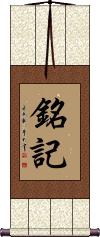
銘記 means to keep in mind, to take note of, or simply to remember, in Chinese characters and Japanese Kanji.
The first character means to engrave, inscribe, or carve an inscription.
The second character means to remember, note, mark, sign, record, history, chronicle, or annals.
When used in the context of a person, this means to engrave on the heart or to inscribe a memory in one's mind. In short, it's the idea of deeply remembering something, some event, or someone forever.
Offering / Puja
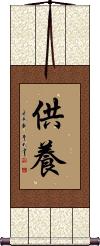
供養 is the Chinese, Japanese, and Korean rough equivalent to the Sanskrit word, Pūjā.
The meaning is: To make offerings (to the Gods), to supply, to provide for one's elders, to support one's parents, a memorial service for the dead, holding a service, any offering for body or mind, to make offerings of whatever nourishes (e.g., food, goods, incense, lamps, scriptures, the doctrine).
The final meaning varies greatly depending on the context in which the word is used.
Spiritual Peace / Enlightened Peace
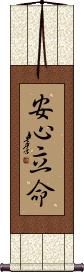
These Japanese Kanji, 安心立命, can be translated as “religious enlightenment” or “spiritual peace gained through faith.”
Other dictionaries define as “spiritual peace and enlightenment” or “keeping an unperturbed mind through faith.”
My Buddhist dictionary defines it as “spiritual peace and realization of enlightenment.”
In the Zen school, this is about settling one's body and life; attaining complete peace, and establishing one's course of life in accord with the ultimate reality.
Discipline / Training / Tempering Character
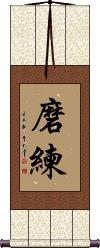
磨鍊 is a form of discipline which suggests training of the mind and character, aimed at producing self-control, obedience, etc.
One of my Chinese-English dictionaries even translates this as “tempering oneself” or turning yourself into hardened steel.
In old Korean Hanja, they use these characters in reverse order but with the same meaning. If you want the Korean version, please click this link instead of the button above: Korean version.
Let It Be / Be Relieved
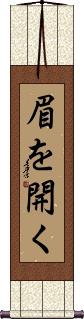
眉を開く is a Japanese proverb and expression that means “to feel relieved,” “to forget about one's troubles,” or “to settle into peace of mind.”
The literal words suggest relaxing your eyebrows or face. Allow worry or concern to go away, and just be content with “letting it be.”
Note: Because this selection contains some special Japanese Hiragana characters, it should be written by a Japanese calligrapher.
Samadhi

In Buddhism, “三摩提” is the transliteration of the Sanskrit word Samādhi, which means equanimity, concentration, and determination.
It is one of the Buddhist practices aimed at eliminating all distractions and calming the mind.
Sometimes written in a shorter form of 三昧 (san mei).
Soul / Spirit
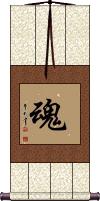
魂 means soul or spirit as in the immortal soul that can be detached from the body.
This can also refer to one's Yang energy or spirit.
In the Buddhist context, this can be the soul, conscious mind, or vijñāna.
God is Always With You
God is With Me Always
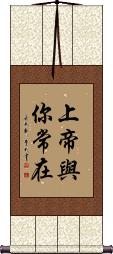
The direct translation of the Chinese characters, 上帝与你常在, is “God Together [with] You Always Exist.”
Keep in mind that Chinese grammar is sometimes very different from English. This makes perfect sense in Chinese.
Note: The title for God is the first two characters - the other words in the direct translation represent one character each.
Purified Spirit / Enlightened Attitude
A Japanese martial arts title/concept
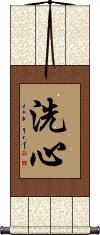
The first Kanji alone means to wash, bathe, primness, cleanse or purify.
The second Kanji means heart, mind, soul, or essence.
Together, these two Kanji create a word defined as “purified spirit” or “enlightened attitude” within Japanese martial arts.
洗心 is one of the five spirits of the warrior (budo) and is often used as a Japanese martial arts tenet. Under that context, it's often defined as a spirit that protects and harmonizes the universe. Senshin is a spirit of compassion that embraces and serves all humanity and whose function is to reconcile discord in the world. It holds all life to be sacred. It is the Buddha mind.
This title will only be familiar to Japanese who practice certain martial arts. Others may not recognize this word at all.
洗心 does not show up as a word in too many Chinese dictionaries, but it can be read and has the same meaning in Chinese.
 There is an issue with the first character. The original, and probably most correct version is shown above. However, many dojo documents and other sources have used a more simple first character. Arguments ensue about which version is correct. If you want to be correct in the Japanese language, use the "Select and Customize" button above. If you want to match the Kanji used by your dojo, click the Kanji shown to the right. There is a slightly different meaning with this first character which means before, ahead, previous, future, precedence.
Unwavering Determination and Resolve
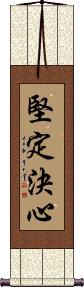
This can be translated as unwavering determination, unwavering resolve, or strong determination.
堅定 means unwavering, firm, steady, staunch, and/or resolute.
決心 means determination, resolve, resolution, determined, firm and resolute, or to make up one's mind.
If you want a longer version, 堅定不移的決心 is also a popular phrase with a similar meaning. Contact me if you want that instead.
8. Right Concentration / Perfect Concentration
Samyak Samadhi / Samma Samadhi
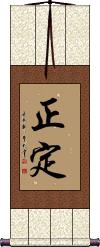
正定 is one of the Noble Eightfold Paths of Buddhism. Right Concentration, along with Right Effort and Right Mindfulness, constitute the path to Concentration or Perfect Thought.
Right Concentration has to do with leaving behind sensuality, unwholesome states, as well as pleasure and pain. 正定 is a complex idea, but once you have achieved the shedding of worldly sensation, you can truly concentrate and find a higher level of awareness.
Another definition: Concentration of mind that finds its high point in the four absorptions.
This term is exclusively used by devout Buddhists. It is not a common term, and is remains an unknown concept to most Japanese and Chinese people.
See Also: Buddhism | Enlightenment | Noble Eightfold Path
Devotion / Diligence / Vigorous / Energetic
vīrya
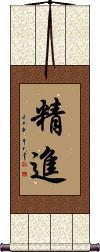
精進 is a wide-ranging word that is used in Chinese, Japanese, and Korean.
It can mean devotion, diligence, concentration, aggressive, enterprising, vigorous, energetic, purification, pushing, asceticism, assiduity, or virility. 精進 is deep, and these two characters can express ideas that take a full English phrase to describe, such as “concentration of mind,” “to forge ahead vigorously,” or “to dedicate oneself to progress.”
Used in the context of Buddhism, it means “making earnest efforts to cultivate virtue and get rid of evil” or “zeal in one's quest for enlightenment.”
Spiritual Strength / Strength of Spirit
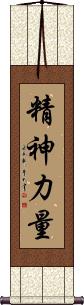
精神力量 is a title that speaks of one's soul or spirit and the capacity or strength that soul possesses.
The first two characters mean mind, heart, spirit, and/or soul.
The last two characters mean strength, capacity, or ability.
Note: Separately, these are two words in Japanese and can be pronounced, but this does not make a natural title in Japanese (best if your audience is Chinese).
Concentration
Chung shin tong il
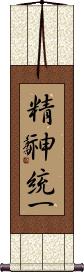
精神統一 means concentration of mind or mental concentration in old Korean Hanja and Japanese.
This concentration title is one of the 8 Key Concepts of Tang Soo Do.
You'll often see this romanized from Korean as “Chung Shin Tong Il.”
If you want to order the modern Korean Hangul version, click on the Hangul characters in the pronunciation box. Otherwise, this title is valid Korean Hanja (from the 1600 years that Korea used Chinese characters).
Hishiryo / Not-Thinking
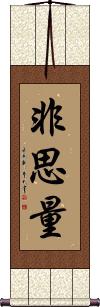
Hishiryō (非思量) literally means not-thinking.
Hishiryo can be described as a state of mind beyond thinking and non-thinking during the practice of Zazen.
Shiryō (思量) means “thinking,” and hi (非) is a prefix for negation and opposition.
Therefore, hishiryo amounts to “unthink” or “not the matter of thinking.” The word hishiryo appears in Dogen Zenji’s Fukanzazengi, Shobogenzo Zazengi, Shobogenzo Zazenshin, and Keizan Zenji’s Zazen Yojinki. It is one of the most important words used to describe zazen. Hishiryo in these writings comes from a dialogue between Yakusan Igen (745-828) and an unnamed monk, which is described in Keitoku, Dentoroku, and other Zen texts.
The above is an abridged except from School of Shodo: Hishiryo
I suggest you visit that page for a full explanation.
Spirit / Spiritual Essence
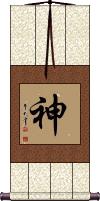
神 is the simplest way to write spirit in Chinese, Japanese Kanji, and old Korean.
This single character alone will conjure up ideas of the spiritual world. 神 can also be translated as “vital awareness” as in the fact that one must know they exist to exist (I think, therefore, I am).
Other translations include:
God, deity, mysterious, divine essence, lively, spiritual being, divinity, supernatural, soul, mind, nerves, and energy. In some extended context, it can mean genius or unusual.
Japanese romanizations vary a lot when this character is combined into other words. However, shin is the original pronunciation taken from Chinese into Japanese. You'll also see it romanized as kami, gami, jin, and a few others, depending on context.
Body and Earth in Unity
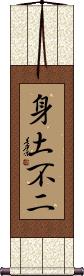
身土不二 (Shindofuni) is originally a Buddhist concept or proverb referring to the inseparability of body-mind and geographical circumstances.
This reads, “Body [and] earth [are] not two.”
Other translations or matching ideas include:
Body and land are one.
Body and earth can not be separated.
Body earth sensory curation.
You are what you eat.
Indivisibility of the body and the land (because the body is made from food and food is made from the land).
Going further, this speaks of our human bodies and the land from which we get our food being closely connected. This phrase is often used when talking about natural and organic vegetables coming directly from the farm to provide the healthiest foods in Japan.
Character notes: 身(shin) in this context does not just mean your physical body but a concept including both body and mind.
土 (do) refers to the soil, earth, clay, land, or in some cases, locality. It's not the proper name of Earth, the planet. However, it can refer to the land or realm we live in.
Japanese note: This has been used in Japan, on and off, since 1907 as a slogan for a governmental healthy eating campaign (usually pronounced as shindofuji instead of the original shindofuni in this context). It may have been hijacked from Buddhism for this propaganda purpose, but at least this is “healthy propaganda.”
Korean note: The phrase 身土不二 was in use by 1610 A.D. in Korea, where it can be found in an early medical journal.
In modern South Korea, it's written in Hangul as 신토불이. Korea used Chinese characters (same source as Japanese Kanji) as their only written standard form of the language until about a hundred years ago. Therefore, many Koreans will recognize this as a native phrase and concept.
See Also: Strength and Love in Unity
Zen Buddhism
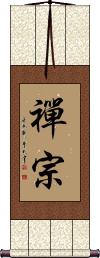
禪宗 is one way to title “Zen Buddhism.” Because the original pronunciation of Zen in Chinese is Chan, you'll also see this expressed as Chan Buddhism.
From the Buddhist Dictionary:
The Chan, meditative or intuitional, sect is usually said to have been established in China by Bodhidharma, the twenty-eighth patriarch, who brought the tradition of the Buddha-mind from India. This sect, believing in direct enlightenment, disregarded ritual and sūtras and depended upon the inner light and personal influence for the propagation of its tenets, founding itself on the esoteric tradition supposed to have been imparted to Kāśyapa by the Buddha, who indicated his meaning by plucking a flower without further explanation. Kāśyapa smiled in apprehension and is supposed to have passed on this mystic method to the patriarchs. The successor of Bodhidharma was 慧可 Huike, and he was succeeded by 僧璨 Sengcan, 道信 Daoxin, 弘忍 Hongren, 慧能 Huineng, and 神秀 Shenxiu, the sect dividing under the two latter into the southern and northern schools: the southern school became prominent, producing 南嶽 Nanyue and 靑原 Qingyuan, the former succeeded by 馬祖 Mazu, the latter by 石頭 Shitou. From Mazu's school arose the five later schools.
Unmoved by the Eight Winds

八風吹不動 is an ancient Buddhist phrase from about 1000 years ago.
Literal meaning: “The Eight Winds cannot move [me].”
The original famous anecdote is from Song Dynasty China, involving the poet-official 蘇東坡 (Su Dongpo / Su Shi, 1037–1101) and Zen master 佛印 (Foyin).
Su Dongpo wrote 八風吹不動,一屁打過江
“The Eight Winds cannot move me; Yet one fart blows me across the river.”
Foyin’s irreverent reply exposed Su Dongpo’s ego, which is kind of a classic Zen/Chan teaching story.
利 gain
衰 loss
毀 disgrace
譽 praise
稱 honor
譏 ridicule
苦 suffering
樂 pleasure
“The Eight Winds cannot move [him / the mind].”
“Unmoved by the Eight Winds.”
“The Eight Winds do not move me.”
“Not moved by the Eight Winds.”
“Unshaken by the Eight Winds.”
“Unaffected by the Eight Winds.”
“Unmoved by worldly forces.”
“Steadfast against the Eight Winds.”
“Remaining unmoved amid the Eight Winds.”
There is a shorter Japanese Zen version, 八風不動, which drops the middle character. Often romanized as happū fudō. The romanization of 八風吹不動 is arguably happū fukedomo ugokazu or happū sui fudō.
Push or Knock
To weigh one's words
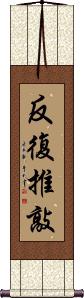
During the Tang Dynasty, a man named Jia Dao (born in the year 779), a well-studied scholar and poet, went to the capital to take the imperial examination.
One day as he rides a donkey through the city streets, a poem begins to form in his mind. A portion of the poem comes into his head like this:
“The bird sits on the tree branch near a pond,
A monk approaches and knocks at the gate...”
At the same time, he wondered if the word “push” would be better than “knock” in his poem.
As he rides down the street, he imagines the monk pushing or knocking. Soon he finds himself making motions of pushing and shaking a fist in a knocking motion as he debates which word to use. He is quite a sight as he makes his way down the street on his donkey with hands and fists flying about as the internal debate continues.
As he amuses people along the street, he becomes completely lost in his thoughts and does not see the mayor's procession coming in the opposite direction. Jia Bao is blocking the way for the procession to continue down the road, and the mayor's guards immediately decide to remove Jia Bao by force. Jia Bao, not realizing that he was in the way, apologizes, explains his poetic dilemma and awaits his punishment for blocking the mayor's way.
The mayor, Han Yu, a scholar and author of prose himself, finds himself intrigued by Jia Dao's poem and problem. Han Yu gets off his horse and addresses Jia Bao, stating, “I think knock is better.” The relieved Jia Bao raises his head and is invited by the mayor to join the procession, and are seen riding off together down the street, exchanging their ideas and love of poetry.
In modern Chinese, this 反復推敲 idiom is used when someone is trying to decide which word to use in their writing or when struggling to decide between two things when neither seems to have a downside.
This in-stock artwork might be what you are looking for, and ships right away...

Gallery Price: $72.00
Your Price: $39.88
Gallery Price: $200.00
Your Price: $118.88
Gallery Price: $200.00
Your Price: $118.88

Gallery Price: $202.00
Your Price: $111.88

Gallery Price: $106.00
Your Price: $58.88

Gallery Price: $268.00
Your Price: $148.77
Gallery Price: $198.00
Your Price: $109.88

Gallery Price: $61.00
Your Price: $33.88

Gallery Price: $61.00
Your Price: $33.88

Gallery Price: $61.00
Your Price: $33.88


Gallery Price: $60.00
Your Price: $36.88
The following table may be helpful for those studying Chinese or Japanese...
| Title | Characters | Romaji (Romanized Japanese) | Various forms of Romanized Chinese | |
| Morality of Mind | 心德 | xīn dé / xin1 de2 / xin de / xinde | hsin te / hsinte | |
| Mind of the Beginner | 初心 | sho shin / shoshin | chū xīn / chu1 xin1 / chu xin / chuxin | ch`u hsin / chuhsin / chu hsin |
| One Heart One Mind Heart and Soul | 一心 | isshin / ishin | yī shì dài yi1 shi4 dai4 yi shi dai yishidai | i shih tai ishihtai |
| The Nature of Enlightenment in One's Mind | 覺性 觉性 | kakushou / kakusho | jué xìng / jue2 xing4 / jue xing / juexing | chüeh hsing / chüehhsing |
| Lingering Mind | 殘心 残心 | zan shin / zanshin | cán xīn / can2 xin1 / can xin / canxin | ts`an hsin / tsanhsin / tsan hsin |
| One Mind Unity | 和合 | wagou / wago wago / wago | hé hé / he2 he2 / he he / hehe | ho ho / hoho |
| Work Together with One Mind | 一味同心 | ichi mi dou shin ichimidoushin ichi mi do shin | ||
| One Who Does Not Do Bad Things, Worries Not of Knocks at His Door | 白天不做虧心事夜半敲門不吃驚 白天不做亏心事夜半敲门不吃惊 | bái tiān bú zuò kuī xīn shì yè bàn qiāo mén bù chī jīng bai2 tian1 bu2 zuo4 kui1 xin1 shi4 ye4 ban4 qiao1 men2 bu4 chi1 jing1 bai tian bu zuo kui xin shi ye ban qiao men bu chi jing | pai t`ien pu tso k`uei hsin shih yeh pan ch`iao men pu ch`ih ching pai tien pu tso kuei hsin shih yeh pan chiao men pu chih ching |
|
| Loving Heart One’s Love | 戀心 恋心 | koi gokoro / koigokoro | ||
| Peaceful Heart Peace of Mind Calm Mind | 安心 | an shin / anshin | ān xīn / an1 xin1 / an xin / anxin | an hsin / anhsin |
| The Original Mind | 本心 | hon shin / honshin | běn xīn / ben3 xin1 / ben xin / benxin | pen hsin / penhsin |
| Seeing one’s Nature and becoming a Buddha | 見性成佛 见性成佛 | ken shou jou butsu kenshoujoubutsu ken sho jo butsu | jiàn xìng chéng fó jian4 xing4 cheng2 fo2 jian xing cheng fo jianxingchengfo | chien hsing ch`eng fo chienhsingchengfo chien hsing cheng fo |
| Immovable Mind | 不動心 | fu dou shin fudoushin fu do shin | ||
| No Mind Mushin | 無心 无心 | mu shin / mushin | wú xīn / wu2 xin1 / wu xin / wuxin | wu hsin / wuhsin |
| Patience Yields Peace of Mind | 能忍自安 | néng rěn zì ān neng2 ren3 zi4 an1 neng ren zi an nengrenzian | neng jen tzu an nengjentzuan |
|
| Heijoshin Presence of Mind | 平常心 | hei jou shin heijoushin hei jo shin | píng cháng xīn ping2 chang2 xin1 ping chang xin pingchangxin | p`ing ch`ang hsin pingchanghsin ping chang hsin |
| Alert On Guard Lingering Mind | 残心 | zan shin / zanshin | ||
| Isshin-Ryu Isshin Style | 一心流 | isshin ryuu isshinryuu ishin ryu | yī xīn liú yi1 xin1 liu2 yi xin liu yixinliu | i hsin liu ihsinliu |
| Always in My Heart | 永駐我心 永驻我心 | yǒng zhù wǒ xīn yong3 zhu4 wo3 xin1 yong zhu wo xin yongzhuwoxin | yung chu wo hsin yungchuwohsin |
|
| Heart and Soul | 心魂 | shin kon / shinkon | ||
| Heart and Soul | 心與靈 心与灵 | xīn yǔ líng xin1 yu3 ling2 xin yu ling xinyuling | hsin yü ling hsinyüling |
|
| Spiritual Soul Mates | 魂の伴侶 | tamashii no han ryo tamashiinohanryo tamashi no han ryo | ||
| Soul Mates at Heart | 心の伴侶 | kokoro no han ryo kokoronohanryo | ||
| Devotion Dedication Attentive Focused | 專心 / 専心 / 耑心 专心 | sen shin / senshin | zhuān xīn zhuan1 xin1 zhuan xin zhuanxin | chuan hsin chuanhsin |
| Forever In My Heart | 永遠に私の心の中に | ei en ni watashi no kokoro no naka ni | ||
| Forever In My Heart | 永遠在我心 永远在我心 | yǒng yuǎn zài wǒ xīn yong3 yuan3 zai4 wo3 xin1 yong yuan zai wo xin yongyuanzaiwoxin | yung yüan tsai wo hsin yungyüantsaiwohsin |
|
| My True Love | 我心真愛 我心真爱 | wǒ xīn zhēn ài wo3 xin1 zhen1 ai4 wo xin zhen ai woxinzhenai | wo hsin chen ai wohsinchenai |
|
| Martial Morality Martial Arts Ethics Virtue | 武德 | bu toku / butoku | wǔ dé / wu3 de2 / wu de / wude | wu te / wute |
| Samadhi | 定 | sada | dìng / ding4 / ding | ting |
| Energy Sword Body in Concert | 気剣体一致 / 氣劍體一致 气剑体一致 | ki ken tai icchi kikentaiicchi ki ken tai ichi | ||
| 7. Right Mindfulness Right Memory Perfect Mindfulness | 正念 | sei nen / seinen | zhèng niàn zheng4 nian4 zheng nian zhengnian | cheng nien chengnien |
| Contentment | 知足 | chisoku | zhī zú / zhi1 zu2 / zhi zu / zhizu | chih tsu / chihtsu |
| Move On Change Way of Thinking | 乗り換える | norikaeru | ||
| Idea Thought Meaning | 意 | kokoro | yì / yi4 / yi | i |
| Soul Mates | 魂の友 | tamashii no tomo tamashiinotomo tamashi no tomo | ||
| With all the strength of your heart | 思い切り | omoi kiri / omoikiri | ||
| Whole Heart | 全心 | zenshin | quán xīn / quan2 xin1 / quan xin / quanxin | ch`üan hsin / chüanhsin / chüan hsin |
| Remember | 銘記 | mei ki / meiki | míng jì / ming2 ji4 / ming ji / mingji | ming chi / mingchi |
| Offering Puja | 供養 供养 | ku you / kuyou / ku yo | gòng yǎng gong4 yang3 gong yang gongyang | kung yang kungyang |
| Spiritual Peace Enlightened Peace | 安心立命 | an jin ritsu myou anjinritsumyou an jin ritsu myo | ||
| Discipline Training Tempering Character | 磨練 / 磨鍊 / 磨鍊 磨练 | mó liàn / mo2 lian4 / mo lian / molian | mo lien / molien | |
| Let It Be Be Relieved | 眉を開く | mayu o hira ku mayuohiraku | ||
| Samadhi | 三摩提 | sanmaji | sān mó tí san1 mo2 ti2 san mo ti sanmoti | san mo t`i sanmoti san mo ti |
| Soul Spirit | 魂 | tamashi / kon | hún / hun2 / hun | |
| God is Always With You | 上帝與你常在 上帝与你常在 | shàng dì yǔ nǐ cháng zài shang4 di4 yu3 ni3 chang2 zai4 shang di yu ni chang zai shangdiyunichangzai | shang ti yü ni ch`ang tsai shangtiyünichangtsai shang ti yü ni chang tsai |
|
| Purified Spirit Enlightened Attitude | 洗心 先心 | sen shin / senshin | xǐ xīn / xi3 xin1 / xi xin / xixin | hsi hsin / hsihsin |
| Unwavering Determination and Resolve | 堅定決心 坚定决心 | jiān dìng jué xīn jian1 ding4 jue2 xin1 jian ding jue xin jiandingjuexin | chien ting chüeh hsin chientingchüehhsin |
|
| 8. Right Concentration Perfect Concentration | 正定 | sei jou / seijou / sei jo | zhèng dìng zheng4 ding4 zheng ding zhengding | cheng ting chengting |
| Devotion Diligence Vigorous Energetic | 精進 精进 | shoujin / shojin | jīng jìn / jing1 jin4 / jing jin / jingjin | ching chin / chingchin |
| Spiritual Strength Strength of Spirit | 精神力量 | seishin rikiryou seishinrikiryou seishin rikiryo | jīng shén lì liàng jing1 shen2 li4 liang4 jing shen li liang jingshenliliang | ching shen li liang chingshenliliang |
| Concentration | 精神統一 | seishintouitsu seishintoitsu | ||
| Hishiryo Not-Thinking | 非思量 | hi shi ryou hishiryou hi shi ryo | fēi sī liáng fei1 si1 liang2 fei si liang feisiliang | fei ssu liang feissuliang |
| Spirit Spiritual Essence | 神 | shin / kami | shén / shen2 / shen | |
| Body and Earth in Unity | 身土不二 | shindofuni / shindofuji | ||
| Zen Buddhism | 禪宗 禅宗 | zen shuu / zenshuu / zen shu | chán zōng chan2 zong1 chan zong chanzong | ch`an tsung chantsung chan tsung |
| Unmoved by the Eight Winds | 八風吹不動 八风吹不动 | happuu sui fudou happuusuifudou hapu sui fudo | bā fēng chuī bù dòng ba1 feng1 chui1 bu4 dong4 ba feng chui bu dong bafengchuibudong | pa feng ch`ui pu tung pafengchuiputung pa feng chui pu tung |
| Push or Knock | 反復推敲 反复推敲 | fǎn fù tuī qiāo fan3 fu4 tui1 qiao1 fan fu tui qiao fanfutuiqiao | fan fu t`ui ch`iao fanfutuichiao fan fu tui chiao |
|
| In some entries above you will see that characters have different versions above and below a line. In these cases, the characters above the line are Traditional Chinese, while the ones below are Simplified Chinese. | ||||

Successful Chinese Character and Japanese Kanji calligraphy searches within the last few hours...



