Many custom options...


And formats...



Lower in Chinese / Japanese...
Buy a Lower calligraphy wall scroll here!
Personalize your custom “Lower” project by clicking the button next to your favorite “Lower” title below...
1. Lower
2. Water Dragon / Coiled Dragon
3. Forgiveness
4. Strong Hearted / Strong Willed
5. Tolerance
6. Shit / Defecate / Excrement / Feces / Poop
7. Generosity
8. Star
9. Clarity
10. Musashi
Lower

洛厄 is the name Lower in Chinese (Mandarin).
Lower

ローワー is the name Lower in Japanese Katakana.
Note: Because this title is entirely Japanese Katakana, it should be written by a Japanese calligrapher.
Water Dragon / Coiled Dragon
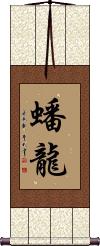
蟠龍 is sometimes seen as a lower-level of dragon or a dragon that has not-yet-reached its potential.
蟠龍 is often defined as a “lake dragon” that has not ascended to heaven.
Another way to put that is a dragon coiled on the earth, which has not yet ascended to the sky.
Forgiveness (from the top down)
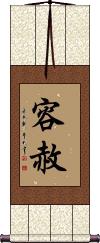
容赦 is the kind of forgiveness that a king might give to his subjects for crimes or wrong-doings.
容赦 is a rather high-level forgiveness. Meaning that it goes from a higher level to a lower (not the reverse).
Alone, the first character can mean “to bear,” “to allow,” and/or “to tolerate,” and the second can mean “to forgive,” “to pardon,” and/or “to excuse.”
When you put both characters together, you get forgiveness, pardon, mercy, leniency, or going easy (on someone).
See Also: Benevolence
Strong Hearted / Strong Willed
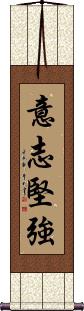
意志堅強 can mean either “strong-hearted,” “strong-willed” or “determination.”
The first two characters can mean “will,” “willpower,” “determination,” “volition,” “intention,” or “intent.” But, it should be noted that this first part possesses the element of “heart” in the lower portion of both characters (they also partially carry the meaning “with the whole heart”).
The last two characters mean “strong” or “staunch.”
Chinese word order and grammar are a bit different than English, so in this case, they are in reverse order of English but have the correct meaning in a natural form.
See Also: Strong Willed | Discipline | Will-Power / Self
Tolerance
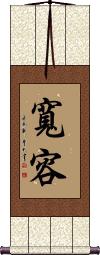
Being tolerant is accepting differences. You don't expect others to think, look, speak or act just like you. You are free of prejudice, knowing that all people have feelings, needs, hopes, and dreams. Tolerance is also accepting things you wish were different with patience and flexibility.
寬容 can also be translated as magnanimity, generosity, or leniency.
Note: There is a tiny deviation in the first character when written in Japanese. If you choose our Japanese master calligrapher, the little dot on the lower right of the first character will be omitted. With or without the dot, this can be read in Chinese, Japanese, and old Korean.
See Also: Patience and Preparation
Shit / Defecate / Excrement / Feces / Poop
NOT APPROPRIATE FOR
CUSTOM CALLIGRAPHY
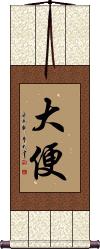
Seems many you want to know how to write “shit” in Chinese, Japanese Kanji, and old Korean Hanja. Well, here it is.
Do not, under any circumstances, try to order this selection for a wall scroll. None of the calligraphers that I work with would dare to lower themselves to such a level and actually write “shit” for you. 大便 is only here for reference. 大便 is not appropriate for custom calligraphy!
大便 is thousands of years old and was absorbed into both Japanese and Korean (if you note, the pronunciation is very similar in all three languages).
This version is sometimes used as a verb (when used with some other words).
Generosity
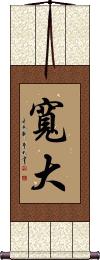
寬大 is a Chinese, Japanese, and Korean word that means Generosity.
Generosity is giving and sharing. You share freely, not with the idea of receiving something in return. You find ways to give others happiness and give just for the joy of giving. Generosity is one of the best ways to show love and friendship.
寬大 can also be translated as charitable, magnanimity, liberality, or in some contexts, broad-mindedness.
Note: There is a tiny deviation in the first character when written in Japanese. If you choose our Japanese master calligrapher, the little dot on the lower right of the first character will be omitted. With or without the dot, this can be read in Chinese, Japanese Kanji, and old Korean Hanja.
See Also: Benevolence | Lotus | Charity
Star
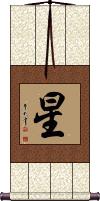
星 is how “star” is written in Chinese, Japanese, and old Korean.
Thousands of years ago, when this character was first developed, there was the belief that you could see remnants of stars in everything. In fact, some early Chinese men of science suggested that all living things came from “stardust” or cosmic debris. This could explain why the upper portion of This means “sun” (a star itself) and the lower portion means “birth” or “life.”
Oddly enough, modern-day scientists suggest that we are all made up of cosmic dust. Seems they were getting it right in China at a time when the western world thought the Earth was flat and the Church was claiming that the sun and all cosmic bodies revolved around the Earth.
Clarity
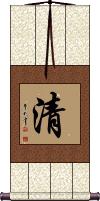
清 is a word that means clarity or clear in Chinese, Japanese Kanji, and old Korean Hanja.
Looking at the parts of this character, you have three splashes of water on the left, “life” on the top right, and the moon on the lower right.
Because of something Confucius said about 2500 years ago, you can imagine that This means “live life with clarity like bright moonlight piercing pure water.” The Confucian idea is something like “Keep clear what is pure in yourself, and let your pure nature show through.” similar to saying, “Don't pollute your mind or body, so that they remain clear.”
This might be stretching the definition of this single Chinese character but the elements are there, and “clarity” is a powerful idea.
Korean note: Korean pronunciation is given above but this character is written with a slight difference in the “moon radical” in Korean. However, anyone who can read Korean Hanja, will understand this character with no problem (this is considered an alternate form in Korean). If you want the more standard Korean Hanja form (which is an alternate form in Chinese), just let me know.
Japanese note: When reading in Japanese, this Kanji has additional meanings of pure, purify, or cleanse (sometimes to remove demons or “exorcise”). Used more in compound words in Japanese than as a stand-alone Kanji.
Musashi
The most famous Samurai
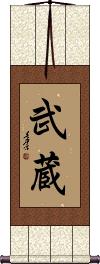
Miyamoto Musashi is probably the most famous Samurai in all of Japanese history.
武蔵 is the short title for a man long in legend. While coming from a lower class, his new sword and fighting techniques put him on par with the best that feudal Japan had to offer. His long career started with his first duel at age 13!
He is credited with using two swords at once and never losing a single battle in his career. After becoming a Buddhist, and getting older, like many old warriors, he took up a peaceful and solitary life until his death around 1645 A.D.
Note: Technically, Musashi is his given name, and Miyamoto is his surname. However, it's suggested that he assumed both of these names and had a few other names in childhood, as well as being given a Buddhist name. It's hard to know what to call him, as with most Kanji, there are multiple pronunciations. The characters for Musashi can also be pronounced Takezō. But everyone in modern times seems to know him by the name Musashi.
This in-stock artwork might be what you are looking for, and ships right away...
These search terms might be related to Lower:
Junior
Lesser
Life is a Dew Drop
Minor
Not Only Can Water Float a Boat, It Can Sink It Also
Rain Drop
Sink
To Cut and Polish Each Other
The following table may be helpful for those studying Chinese or Japanese...
| Title | Characters | Romaji (Romanized Japanese) | Various forms of Romanized Chinese | |
| Lower | 洛厄 | luò è / luo4 e4 / luo e / luoe | lo o / loo | |
| Lower | ローワー | roowaa / rowa | ||
| Water Dragon Coiled Dragon | 蟠龍 蟠龙 | han ryuu / hanryuu / han ryu | pān lóng / pan1 long2 / pan long / panlong | p`an lung / panlung / pan lung |
| Forgiveness (from the top down) | 容赦 | you sha / yousha / yo sha | róng shè / rong2 she4 / rong she / rongshe | jung she / jungshe |
| Strong Hearted Strong Willed | 意志堅強 意志坚强 | yì zhì jiān qiáng yi4 zhi4 jian1 qiang2 yi zhi jian qiang yizhijianqiang | i chih chien ch`iang ichihchienchiang i chih chien chiang |
|
| Tolerance | 寬容 宽容 | kanyou / kanyo | kuān róng kuan1 rong2 kuan rong kuanrong | k`uan jung kuanjung kuan jung |
| Shit Defecate Excrement Feces Poop | 大便 | dai ben / daiben | dà biàn / da4 bian4 / da bian / dabian | ta pien / tapien |
| Generosity | 寬大 宽大 | kandai | kuān dà / kuan1 da4 / kuan da / kuanda | k`uan ta / kuanta / kuan ta |
| Star | 星 | hoshi | xīng / xing1 / xing | hsing |
| Clarity | 清 | sei | qīng / qing1 / qing | ch`ing / ching |
| Musashi | 武蔵 | mu sashi / musashi | ||
| In some entries above you will see that characters have different versions above and below a line. In these cases, the characters above the line are Traditional Chinese, while the ones below are Simplified Chinese. | ||||

Successful Chinese Character and Japanese Kanji calligraphy searches within the last few hours...



