Many custom options...


And formats...



Lesser in Chinese / Japanese...
Buy a Lesser calligraphy wall scroll here!
Personalize your custom “Lesser” project by clicking the button next to your favorite “Lesser” title below...
Lesser

萊瑟 is the name Lesser in Chinese (Mandarin).
Lesser

レッサー is the name Lesser in Japanese Katakana.
Note: Because this title is entirely Japanese Katakana, it should be written by a Japanese calligrapher.
Red Panda / Firefox
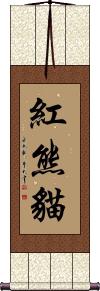
紅熊貓 is the Chinese title for the red panda or firefox.
Some also call this the lesser Panda.
Fire Dragon
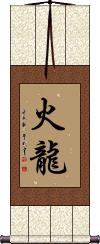
火龍 is how to write “Fire Dragon” in Chinese and Japanese Kanji.
This title is used more often in Chinese, a little lesser known in Japanese.
See Also: Dragon
Ninja
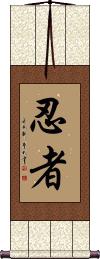
In feudal Japan, ninjas or shinobi (literally, “one who is concealed” or “one that endures”) were sometimes assassins and agents of espionage. The ninja, like samurai, followed their special code of conduct.
The role of the ninja has been romanticized in many American movies (and to a lesser extent in Japanese movies). Because the ninja craze has taken off in the west, Japan has followed the trend, and you'll see plenty of ninja-related imagery in Japan. Note that when writing this as Kanji, Japanese tend to write the first character in the form shown to the right. If you select a Japanese calligrapher, please expect that form. Our Chinese calligraphers can also write it in Japanese form, but only if you request it (in the special instructions about your order during checkout).
See Also: Samurai | Warrior | Ninjutsu / Ninjitsu
These search terms might be related to Lesser:
Not the results for Lesser that you were looking for?
Below are some entries from our dictionary that may match your Lesser search...
| Characters If shown, 2nd row is Simp. Chinese |
Pronunciation Romanization |
Simple Dictionary Definition |
媛 see styles |
yuàn yuan4 yüan hime ひめ |
More info & calligraphy: Beauty / Beautiful Princess(out-dated kanji) (1) princess; young lady of noble birth; (n-suf,n) (2) girl; (prefix) (3) small; cute; lesser (in names of species); (4) (archaism) (kyb:) prostitute; (female given name) Hime |
紅熊貓 红熊猫 see styles |
hóng xióng māo hong2 xiong2 mao1 hung hsiung mao |
More info & calligraphy: Red Panda / Firefox |
レッサー see styles |
ressaa / ressa レッサー |
More info & calligraphy: Lesser |
下 see styles |
xià xia4 hsia shimo しも |
down; downwards; below; lower; later; next (week etc); second (of two parts); to decline; to go down; to arrive at (a decision, conclusion etc); measure word to show the frequency of an action (1) (ant: 上・かみ・1) lower reaches (of a river); (2) bottom; lower part; (3) lower half (of the body, esp. the privates); feces (faeces); urine; menses; (4) end; far from the imperial palace (i.e. far from Kyoto, esp. of western Japan); (can be adjective with の) (5) dirty (e.g. dirty jokes, etc.); (place-name, surname) Shimo hīna, adhara. Below, lower, inferior, low; to descend, let down, put down. |
姫 see styles |
jī ji1 chi remon れもん |
Japanese variant of 姬; princess; imperial concubine (1) princess; young lady of noble birth; (n-suf,n) (2) girl; (prefix) (3) small; cute; lesser (in names of species); (4) (archaism) (kyb:) prostitute; (female given name) Remon |
従 see styles |
cóng cong2 ts`ung tsung yori より |
old variant of 從|从[cong2] (prefix) (archaism) (See 大い・2) lesser (of equal court ranks); lower; junior; (female given name) Yori |
下乘 see styles |
xià shèng xia4 sheng4 hsia sheng gejō |
The lower yāna, i.e. Hīnayāna; likened to an old worn-out horse. To alight from (a vehicle, horse, etc.). |
下根 see styles |
xià gēn xia4 gen1 hsia ken shimone しもね |
(place-name, surname) Shimone Those (born) with base character, or of low capacity. |
別劫 别劫 see styles |
bié jié bie2 jie2 pieh chieh betsukō |
antara-kalpas, small or intermediate kalpas, v. 劫. |
子規 子规 see styles |
zǐ guī zi3 gui1 tzu kuei shiki しき |
cuckoo (form) (See ホトトギス) lesser cuckoo (Cuculus poliocephalus); (person) Masaoka Shiki (1867-1902) |
寧可 宁可 see styles |
nìng kě ning4 ke3 ning k`o ning ko neika |
preferably; one would prefer to...(or not to...); would rather; (would) be better to; (to pick) the lesser of two evils would rather |
小乗 see styles |
shoujou / shojo しょうじょう |
{Buddh} (See 大乗・だいじょう・1) Hinayana (Buddhism); the Lesser Vehicle |
小乘 see styles |
xiǎo shèng xiao3 sheng4 hsiao sheng shōjō |
Hinayana, the Lesser Vehicle; Buddhism in India before the Mayahana sutras; also pr. [Xiao3 cheng2] Hīnayāna 希那衍. The small, or inferior wain, or vehicle; the form of Buddhism which developed after Śākyamuni's death to about the beginning of the Christian era, when Mahāyāna doctrines were introduced. It is the orthodox school and more in direct line with the Buddhist succession than Mahāyānism which developed on lines fundamentally different. The Buddha was a spiritual doctor, less interested in philosophy than in the remedy for human misery and perpetual transmigration. He "turned aside from idle metaphysical speculations; if he held views on such topics, he deemed them valueless for the purposes of salvation, which was his goal" (Keith). Metaphysical speculations arose after his death, and naturally developed into a variety of Hīnayāna schools before and after the separation of a distinct school of Mahāyāna. Hīnayāna remains the form in Ceylon, Burma, and Siam, hence is known as Southern Buddhism in contrast with Northern Buddhism or Mahāyāna, the form chiefly prevalent from Nepal to Japan. Another rough division is that of Pali and Sanskrit, Pali being the general literary language of the surviving form of Hīnayāna, Sanskrit of Mahāyāna. The term Hīnayāna is of Mahāyānist origination to emphasize the universalism and altruism of Mahāyāna over the narrower personal salvation of its rival. According to Mahāyāna teaching its own aim is universal Buddhahood, which means the utmost development of wisdom and the perfect transformation of all the living in the future state; it declares that Hīnayāna, aiming at arhatship and pratyekabuddhahood, seeks the destruction of body and mind and extinction in nirvāṇa. For arhatship the 四諦Four Noble Truths are the foundation teaching, for pratyekabuddhahood the 十二因緣 twelve-nidānas, and these two are therefore sometimes styled the two vehicles 二乘. Tiantai sometimes calls them the (Hīnayāna) Tripiṭaka school. Three of the eighteen Hīnayāna schools were transported to China: 倶舍 (Abhidharma) Kośa; 成實 Satya-siddhi; and the school of Harivarman, the律 Vinaya school. These are described by Mahāyānists as the Buddha's adaptable way of meeting the questions and capacity of his hearers, though his own mind is spoken of as always being in the absolute Mahāyāna all-embracing realm. Such is the Mahāyāna view of Hīnayāna, and if the Vaipulya sūtras and special scriptures of their school, which are repudiated by Hīnayāna, are apocryphal, of which there seems no doubt, then Mahāyāna in condemning Hīnayāna must find other support for its claim to orthodoxy. The sūtras on which it chiefly relies, as regards the Buddha, have no authenticity; while those of Hīnayāna cannot be accepted as his veritable teaching in the absence of fundamental research. Hīnayāna is said to have first been divided into minority and majority sections immediately after the death of Śākyamuni, when the sthāvira, or older disciples, remained in what is spoken of as "the cave", some place at Rājagṛha, to settle the future of the order, and the general body of disciples remained outside; these two are the first 上坐部 and 大衆部 q. v. The first doctrinal division is reported to have taken place under the leadership of the monk 大天 Mahādeva (q.v.) a hundred years after the Buddha's nirvāṇa and during the reign of Aśoka; his reign, however, has been placed later than this by historians. Mahādeva's sect became the Mahāsāṅghikā, the other the Sthāvira. In time the two are said to have divided into eighteen, which with the two originals are the so-called "twenty sects" of Hīnayāna. Another division of four sects, referred to by Yijing, is that of the 大衆部 (Arya) Mahāsaṅghanikāya, 上座部 Āryasthavirāḥ, 根本說一切有部 Mūlasarvāstivādaḥ, and 正量部 Saṃmatīyāḥ. There is still another division of five sects, 五部律. For the eighteen Hīnayāna sects see 小乘十八部. |
小千 see styles |
xiǎo qiān xiao3 qian1 hsiao ch`ien hsiao chien shōsen |
lesser chiliocosm |
小半 see styles |
xiǎo bàn xiao3 ban4 hsiao pan kohan こはん |
a portion smaller than a half; the lesser part; the smaller part (surname) Kohan |
小宗 see styles |
xiǎo zōng xiao3 zong1 hsiao tsung komune こむね |
(surname) Komune The sects of Hīnayāna. |
小寒 see styles |
xiǎo hán xiao3 han2 hsiao han kosamu こさむ |
Lesser Cold, 23rd of the 24 solar terms 二十四節氣|二十四节气 6th-19th January (See 二十四節気) "minor cold" solar term (approx. January 6); (female given name) Kosamu |
小弯 see styles |
shouwan / showan しょうわん |
lesser curvature of stomach; curvatura ventriculi minor |
小戒 see styles |
xiǎo jiè xiao3 jie4 hsiao chieh shōkai |
lesser precepts |
小暑 see styles |
xiǎo shǔ xiao3 shu3 hsiao shu shousho / shosho しょうしょ |
Xiaoshu or Lesser Heat, 11th of the 24 solar terms 二十四節氣|二十四节气 7th-22nd July (See 二十四節気) "minor heat" solar term (approx. July 7) |
小果 see styles |
xiǎo guǒ xiao3 guo3 hsiao kuo shōka |
lesser fruits |
小根 see styles |
xiǎo gēn xiao3 gen1 hsiao ken kone こね |
(surname) Kone 小機 Having a mind fit only for Hīnayāna doctrine. |
小機 小机 see styles |
xiǎo jī xiao3 ji1 hsiao chi shōki |
小根; Having a mind fit only for Hīnayāna doctrine. |
小法 see styles |
xiǎo fǎ xiao3 fa3 hsiao fa shōhō |
The laws or methods of Hīnayāna. |
小滿 小满 see styles |
xiǎo mǎn xiao3 man3 hsiao man |
Xiaoman or Lesser Full Grain, 8th of the 24 solar terms 二十四節氣|二十四节气 21st May-5th June |
小篆 see styles |
xiǎo zhuàn xiao3 zhuan4 hsiao chuan shouten / shoten しょうてん |
the small or lesser seal, the form of Chinese character standardized by the Qin dynasty (See 六体) small seal script (arising during China's Warring States period) |
小網 see styles |
koami こあみ |
lesser omentum; (surname) Koami |
小罪 see styles |
xiǎo zuì xiao3 zui4 hsiao tsui shouzai / shozai しょうざい |
(1) {Christn} venial sin; lesser sin; (2) small sin; small crime minor transgression; slight fault |
小聖 小圣 see styles |
xiǎo shèng xiao3 sheng4 hsiao sheng kosato こさと |
(female given name) Kosato The Hīnayāna saint, or arhat. The inferior saint, or bodhisattva, as compared with the Buddha. |
小行 see styles |
xiǎo xíng xiao3 xing2 hsiao hsing shōgyō |
The practice, or discipline of Hīnayāna; also, urination. |
Click here for more Lesser results from our dictionary
The following table may be helpful for those studying Chinese or Japanese...
| Title | Characters | Romaji (Romanized Japanese) | Various forms of Romanized Chinese | |
| Lesser | 萊瑟 莱瑟 | lái sè / lai2 se4 / lai se / laise | ||
| Lesser | レッサー | ressaa / resa | ||
| Red Panda Firefox | 紅熊貓 红熊猫 | hóng xióng māo hong2 xiong2 mao1 hong xiong mao hongxiongmao | hung hsiung mao hunghsiungmao |
|
| Fire Dragon | 火龍 火龙 | hi ryuu / hiryuu / hi ryu | huǒ lóng / huo3 long2 / huo long / huolong | huo lung / huolung |
| Ninja | 忍者 | ninja | rěn zhě / ren3 zhe3 / ren zhe / renzhe | jen che / jenche |
| In some entries above you will see that characters have different versions above and below a line. In these cases, the characters above the line are Traditional Chinese, while the ones below are Simplified Chinese. | ||||

Successful Chinese Character and Japanese Kanji calligraphy searches within the last few hours...



