Many custom options...


And formats...



Death Old Age in Chinese / Japanese...
Buy a Death Old Age calligraphy wall scroll here!
Personalize your custom “Death Old Age” project by clicking the button next to your favorite “Death Old Age” title below...
Birth Old-Age Sickness Death
Born to Suffer
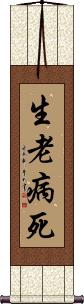
生老病死 means “to be born, to grow old, to get sick and to die” or “birth, aging, sickness, and death.”
This is an old somewhat-morbid Chinese proverb that is also used in Korean and Japanese. It figuratively means the fate of humankind (i.e. mortality) or suggests that we are all born to suffer.
In the Buddhist context, there are the “four inevitables in human life” or “four afflictions that are the lot of every human” known as “四苦” (literally “four afflictions”). Sometimes this proverb is written with that affliction character, 苦, at the end like 生老病死苦.
The White Hairs of Old Age
Until death do us part
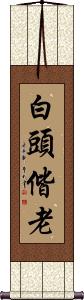
白頭偕老 is a Chinese proverb that means (to live together until the) white hairs of old age.
This is the Chinese way of saying “to live to a ripe old age in conjugal bliss” or “until death do us part.”
Blessings on this Home
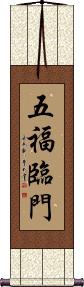
五福臨門 means “five good fortunes arrive [at the] door.”
It is understood to mean “may the five blessings descend upon this home.”
These blessings are known in ancient China to be: longevity, wealth, health, virtue, and natural death (living to old age). This is one of several auspicious sayings you might hear during the Chinese New Year.
Musashi
The most famous Samurai
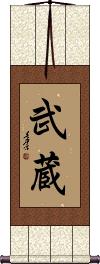
Miyamoto Musashi is probably the most famous Samurai in all of Japanese history.
武蔵 is the short title for a man long in legend. While coming from a lower class, his new sword and fighting techniques put him on par with the best that feudal Japan had to offer. His long career started with his first duel at age 13!
He is credited with using two swords at once and never losing a single battle in his career. After becoming a Buddhist, and getting older, like many old warriors, he took up a peaceful and solitary life until his death around 1645 A.D.
Note: Technically, Musashi is his given name, and Miyamoto is his surname. However, it's suggested that he assumed both of these names and had a few other names in childhood, as well as being given a Buddhist name. It's hard to know what to call him, as with most Kanji, there are multiple pronunciations. The characters for Musashi can also be pronounced Takezō. But everyone in modern times seems to know him by the name Musashi.
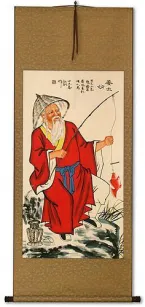
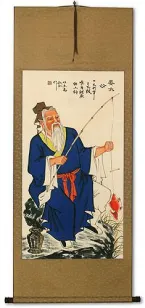
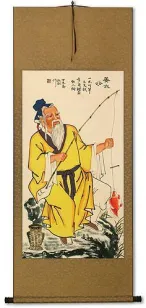
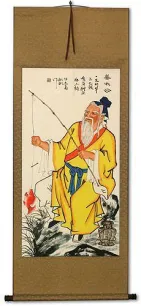
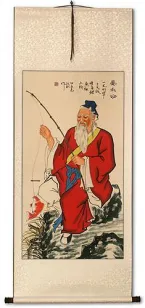
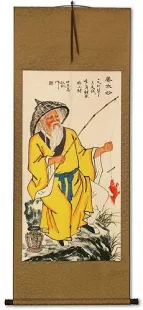
This in-stock artwork might be what you are looking for, and ships right away...

Gallery Price: $71.00
Your Price: $39.00
Not the results for Death Old Age that you were looking for?
Below are some entries from our dictionary that may match your Death Old Age search...
| Characters If shown, 2nd row is Simp. Chinese |
Pronunciation Romanization |
Simple Dictionary Definition |
天使 see styles |
tiān shǐ tian1 shi3 t`ien shih tien shih yukari ゆかり |
More info & calligraphy: Angel / Messenger of Heaven(noun - becomes adjective with の) angel; (female given name) Yukari Divine messengers, especially those of Yama; also his 三天使 three messengers, or lictors— old age, sickness, death; and his 五天使 or 五大使, i. e. the last three together with rebirth and prisons or punishments on earth. |
生老病死 see styles |
shēng lǎo bìng sǐ sheng1 lao3 bing4 si3 sheng lao ping ssu shouroubyoushi / shorobyoshi しょうろうびょうし |
More info & calligraphy: Birth Old-Age Sickness Death(yoji) {Buddh} the four inevitables in human life (birth, aging, sickness, and death) Birth, age, sickness, death, the 四苦 four afflictions that are the lot of every man. The five are the above four and 苦 misery, or suffering. |
相 see styles |
xiàng xiang4 hsiang tasuku たすく |
appearance; portrait; picture; government minister; (physics) phase; (literary) to appraise (esp. by scrutinizing physical features); to read sb's fortune (by physiognomy, palmistry etc) (1) aspect; appearance; look; (2) physiognomy (as an indication of one's fortune); (3) {gramm} aspect; (4) {physics;chem} phase (e.g. solid, liquid and gaseous); (given name) Tasuku lakṣana 攞乞尖拏. Also, nimitta. A 'distinctive mark, sign', 'indication, characteristic', 'designation'. M. W. External appearance; the appearance of things; form; a phenomenon 有爲法 in the sense of appearance; mutual; to regard. The four forms taken by every phenomenon are 生住異滅 rise, stay, change, cease, i. e. birth, life, old age, death. The Huayan school has a sixfold division of form, namely, whole and parts, together and separate, integrate and disintegrate. A Buddha or Cakravartī is recognized by his thirty-two lakṣana , i. e. his thirty-two characteristic physiological marks. |
五官 see styles |
wǔ guān wu3 guan1 wu kuan gokan ごかん |
five sense organs of TCM (nose, eyes, lips, tongue, ears 鼻目口舌耳); facial features the five sense organs; (place-name) Gokan The five controlling powers, v. 五大使, birth, old age, sickness, death, and the (imperial) magistrate. |
八苦 see styles |
bā kǔ ba1 ku3 pa k`u pa ku hakku はっく |
the eight distresses - birth, age, sickness, death, parting with what we love, meeting with what we hate, unattained aims, and all the ills of the five skandhas (Buddhism) {Buddh} the eight kinds of suffering (birth, old age, disease, death, parting from loved ones, meeting disliked ones, not getting what one seeks, pains of the five skandha) The eight distresses―birth, age, sickness, death, parting with what we love, meeting with what we hate, unattained aims, and all the ills of the five skandhas. |
四苦 see styles |
sì kǔ si4 ku3 ssu k`u ssu ku shiku しく |
{Buddh} the four kinds of suffering (birth, old age, disease, death) The four miseries, or sufferings — birth, age, disease, and death. |
滅觀 灭观 see styles |
miè guān mie4 guan1 mieh kuan mekkan |
The contemplation of extinction: the destruction of ignorance is followed by the annihilation of karma, of birth, old age, and death. |
老死 see styles |
lǎo sǐ lao3 si3 lao ssu roushi / roshi ろうし |
to die of old age (n,vs,vi) dying of old age jarāmaraṇa, decrepitude and death; one of the twelve nidānas, a primary dogma of Buddhism that decrepitude and death are the natural products of the maturity of the five skandhas. |
非常 see styles |
fēi cháng fei1 chang2 fei ch`ang fei chang hijou / hijo ひじょう |
very; really; unusual; extraordinary (1) emergency; (adjectival noun) (2) extreme; great; extraordinary; remarkable; unusual; terrible; severe anitya, 無常 impermanent, transient, illusory, as evidenced by old age, disease, and death. |
尼陀那 see styles |
ní tuó nà ni2 tuo2 na4 ni t`o na ni to na nidana |
nidāna, a band, bond, link, primary cause. I. The 十二因緣 twelve causes or links in the chain of existence: (1) jarā-maraṇa 老死 old age and death. (2) jāti 生 (re) birth. (3) bhava 有 existence. (4) upādāna 取 laying hold of, grasping. (5) tṛṣṇā 愛 love, thirst, desire. (6) vedana 受 receiving, perceiving, sensation. (7) sparśa 觸 touch, contact, feeling. (8) ṣaḍ-āyatana, 六入 the six senses. (9) nāma-rūpa 名色 name and form, individuality (of things). (10) vijñāna 六識 the six forms of perception, awareness or discernment. (11) saṃskāra 行 action, moral conduct. (12) avidyā 無明 unenlightenment, 'ignorance which mistakes the illusory phenomena of this world for realities. ' Eitel. These twelve links are stated also in Hīnayāna in reverse order, beginning with avidyā and ending with jarā-maraṇa. The Fanyimingyi says the whole series arises from 無明 ignorance, and if this can be got rid of the whole process of 生死 births and deaths (or reincarnations) comes to an end. II. Applied to the purpose and occasion of writing sutras, nidāna means (1) those written because of a request or query; (2) because certain precepts were violated; (3) because of certain events. |
七不可避 see styles |
qī bù kě bì qi1 bu4 ke3 bi4 ch`i pu k`o pi chi pu ko pi shichi fukahi |
The seven unavoidables— rebirth, old age, sickness, death, punishment (for sin), happiness (for goodness), consequences (cause and effect 因緣). |
三種身苦 三种身苦 see styles |
sān zhǒng shēn kǔ san1 zhong3 shen1 ku3 san chung shen k`u san chung shen ku sanshu shinku |
The three duḥkha or afflictions of the body — old age, sickness, death. |
五大使者 see styles |
wǔ dà shǐ zhě wu3 da4 shi3 zhe3 wu ta shih che go dai shisha |
五天使者 The five dūta, i. e. great lictors, or deva-messengers— birth, old age, disease, death, earthly laws and punishments— said to be sent by Māra as warnings. |
十二因緣 十二因缘 see styles |
shí èr yīn yuán shi2 er4 yin1 yuan2 shih erh yin yüan jūni innen |
Dvādaśaṅga pratītyasamutpāda; the twelve nidānas; v. 尼 and 因; also 十二緣起; 因緣有支; 因緣率連; 因緣棘園; 因緣輪; 因緣重城; 因緣觀; 支佛觀. They are the twelve links in the chain of existence: (1) 無明avidyā, ignorance, or unenlightenment; (2) 行 saṃskāra, action, activity, conception, "dispositions," Keith; (3) 識 vijñāna, consciousness; (4) 名色 nāmarūpa, name and form; (5) 六入 ṣaḍāyatana, the six sense organs, i.e. eye, ear, nose, tongue, body, and mind; (6) 觸 sparśa, contact, touch; (7) 受 vedanā, sensation, feeling; (8) 愛 tṛṣṇā, thirst, desire, craving; (9) 取 upādāna, laying hold of, grasping; (10) 有 bhava, being, existing; (11) 生 jāti, birth; (12) 老死 jarāmaraṇa, old age, death. The "classical formula" reads "By reason of ignorance dispositions; by reason of dispositions consciousness", etc. A further application of the twelve nidānas is made in regard to their causaton of rebirth: (1) ignorance, as inherited passion from the beginningless past ; (2) karma, good and evil, of past lives; (3) conception as a form of perception; (4) nāmarūpa, or body and mind evolving (in the womb); (5) the six organs on the verge of birth; (6) childhood whose intelligence is limited to sparśa, contact or touch; (7) receptivity or budding intelligence and discrimination from 6 or 7 years; (8) thirst, desire, or love, age of puberty; (9) the urge of sensuous existence; (10) forming the substance, bhava, of future karma; (11) the completed karma ready for rebirth; (12) old age and death. The two first are associated with the previous life, the other ten with the present. The theory is equally applicable to all realms of reincarnation. The twelve links are also represented in a chart, at the centre of which are the serpent (anger), boar (ignorance, or stupidity), and dove (lust) representing the fundamental sins. Each catches the other by the tail, typifying the train of sins producing the wheel of life. In another circle the twelve links are represented as follows: (1) ignorance, a blind woman; (2) action, a potter at work, or man gathering fruit; (3) consciousness, a restless monkey; (4) name and form, a boat; (5) sense organs, a house; (6) contact, a man and woman sitting together; (7) sensation, a man pierced by an arrow; (8) desire, a man drinking wine; (9) craving, a couple in union; (10) existence through childbirth; (11) birth, a man carrying a corpse; (12) disease, old age, death, an old woman leaning on a stick. v. 十二因緣論 Pratītya-samutpāda śāstra. |
四苦八苦 see styles |
sì kǔ bā kǔ si4 ku3 ba1 ku3 ssu k`u pa k`u ssu ku pa ku shikuhakku しくはっく |
(n,vs,vi) (1) (yoji) being in dire distress; being hard put to it; being hard pressed (for money); (2) (yoji) {Buddh} (See 四苦,八苦) the four and eight kinds of suffering (birth, old age, disease, death, parting from loved ones, meeting disliked ones, not getting what one seeks, pains of the five skandha) four and eight kinds of suffering |
生病老死 see styles |
seibyouroushi / sebyoroshi せいびょうろうし |
{Buddh} birth, illness, old age and death |
緣生有老死 缘生有老死 see styles |
yuán shēng yǒu lǎo sǐ yuan2 sheng1 you3 lao3 si3 yüan sheng yu lao ssu enshō urōshi |
conditioned by birth there arise old age and death |
The following table may be helpful for those studying Chinese or Japanese...
| Title | Characters | Romaji (Romanized Japanese) | Various forms of Romanized Chinese | |
| Birth Old-Age Sickness Death | 生老病死 | shou rou byou shi shouroubyoushi sho ro byo shi | shēng lǎo bìng sǐ sheng1 lao3 bing4 si3 sheng lao bing si shenglaobingsi | sheng lao ping ssu shenglaopingssu |
| The White Hairs of Old Age | 白頭偕老 白头偕老 | bái tóu xié lǎo bai2 tou2 xie2 lao3 bai tou xie lao baitouxielao | pai t`ou hsieh lao paitouhsiehlao pai tou hsieh lao |
|
| Blessings on this Home | 五福臨門 五福临门 | wǔ fú lín mén wu3 fu2 lin2 men2 wu fu lin men wufulinmen | ||
| Musashi | 武蔵 | mu sashi / musashi | ||
| In some entries above you will see that characters have different versions above and below a line. In these cases, the characters above the line are Traditional Chinese, while the ones below are Simplified Chinese. | ||||

Successful Chinese Character and Japanese Kanji calligraphy searches within the last few hours...



