Many custom options...


And formats...



Corpus in Chinese / Japanese...
Buy a Corpus calligraphy wall scroll here!
Personalize your custom “Corpus” project by clicking the button next to your favorite “Corpus” title below...
Corpus

科珀斯 is the name Corpus in Chinese (Mandarin).
Corpus

コーパス is the name Corpus in Japanese Katakana.
Note: Because this title is entirely Japanese Katakana, it should be written by a Japanese calligrapher.
Taido
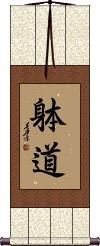
Taidō (The Way of the Body) is a style of Karate practiced in Japan and popular worldwide.
Taidō or 躰道 traces a lineage from Genseiryū (玄制流), which came from Shuri-te (首里手), one of the original martial arts schools of ancient Okinawa.
The first character 躰 is a variant of the original Chinese character 體. In modern Japan, they tend to use 体, a more simple character form. 体 is also the modern Simplified Chinese form of 體.
The 躰 character is correct for this 躰道 martial arts title. But it can be confusing with so many variants out there, not to mention other homophonic Japanese words that also romanize as Taidō or Taidou.
To have a bit more fun with this 躰 character, it has a 身 radical on the left, which sets it apart. The meaning doubles up on the “body” as 身 (shin) is a character that also means body in Japanese and Chinese. On the right is 本, which often means root, stem, origin, source, or fundamental (but can also mean “book” in some contexts). This has deviated from the original 體 which was 骨 (bone) + 豊 (vessel). Hence, the body was your “bone vessel” in ancient Asia.
The meaning of 躰, as well as 體 and 体, is usually translated as the body. When related to the physical body, it can also refer to the torso, trunk, build, physique, or the constitution of a person. As an extension of this, it can also refer to someone's health (good body = good health).
However, depending on the context, it can encompass other meanings such as form, style, system, experience, aspect, corpus, corporeal, substance, or essentials.
The second character, 道, is recognized and well-known as the “Way” and is the same “do” as in Karate-do or Aikido.
These search terms might be related to Corpus:
Body
Body / Karada
Body and Earth in Unity
Body and Mind
Body Mind Spirit
Energy Sword Body in Concert
Fierce and Courageous Training Defeats the Strong and Protects the Body.
Kill / Massacre / Mass Killing
Mind Body Spirit
Pain is Weakness Leaving the Body
Strong Body, Strong Mind
Strong Mind Strong Body
Warriors: Quality Over Quantity
Not the results for Corpus that you were looking for?
Below are some entries from our dictionary that may match your Corpus search...
| Characters If shown, 2nd row is Simp. Chinese |
Pronunciation Romanization |
Simple Dictionary Definition |
體 体 see styles |
tǐ ti3 t`i ti tai |
body; form; style; system; substance; to experience; aspect (linguistics) Body, limbs; corpus, corporeal; the substance, the essentials; to show respect to, accord with. |
コーバス see styles |
koobasu コーバス |
corpus; corpora; (surname) Covas |
一體 一体 see styles |
yī tǐ yi1 ti3 i t`i i ti ittai |
an integral whole; all concerned; everybody Though externally differing, in nature the same; the fundamental unity of the universe. 天地與我同根, 萬物與我一體 Heaven, earth, and myself have the same root; all things are one corpus with me. |
心性 see styles |
xīn xìng xin1 xing4 hsin hsing shinsei / shinse しんせい |
one's nature; temperament mind; disposition; nature Immutable mind-corpus, or mind-nature, the self-existing fundamental pure mind, the all, the Tathāgata-garbha, or 如來藏心; 自性淸淨心; also described in the 起信論 Awakening of Faith as immortal 不生不滅. Another definition identifies 心 with 性 saying 性卽是心, 心卽是佛 the nature is the mind, and mind is Buddha; another, that mind and nature are the same when 悟 awake and understanding, but differ when 迷 in illusion; and further, in reply to the statement that the Buddha-nature is eternal but the mind not eternal, it is said, the nature is like water, the mind like ice, illusion turns nature to mental ice form, awakening melts it back to its proper nature. |
教體 教体 see styles |
jiào tǐ jiao4 ti3 chiao t`i chiao ti kyōtai |
The body, or corpus of doctrine; the whole teaching. |
眞身 see styles |
zhēn shēn zhen1 shen1 chen shen shinshin |
The true body, corpus of truth, dharmakāya, Buddha as absolute. |
罪体 see styles |
zaitai ざいたい |
corpus delicti (concrete evidence of a crime, e.g. a bullet-riddled body) |
脳梁 see styles |
nouryou / noryo のうりょう |
{anat} corpus callosum |
駄都 see styles |
tuó dōu tuo2 dou1 t`o tou to tou |
dhātu, intp. by 界 field, area, sphere; 體 embodiment, body, corpus; 性nature, characteristic. It means that which is placed or laid; a deposit, foundation, constituent, ingredient, element; also a śarīra, or relic of Buddha The two dhātus are the conditioned and unconditioned, phenomenal and noumenal; the three are the realms of desire, of form, and of the formless; the four are earth, water, fire, and air; the six add space and intelligence; the eighteen are the twelve āyatanas, with six sensations added. |
黃體 黄体 see styles |
huáng tǐ huang2 ti3 huang t`i huang ti |
corpus luteum (glands in female mammals producing progesterone) See: 黄体 |
黄体 see styles |
outai / otai おうたい |
{anat} corpus luteum |
側心体 see styles |
sokushintai そくしんたい |
{ent} corpus cardiacum |
十如是 see styles |
shí rú shì shi2 ru2 shi4 shih ju shih juunyoze / junyoze じゅうにょぜ |
{Buddh} ten thusnesses (in Tendai) The ten essential qualities, or characteristics, of thing, according to the 方便chapter of the Lotus sūtra: 相如是 form; 性如是 nature; 體如是 corpus or embodiment; 力如是 powers; 作如是 function; 因如是 primary cause; 果如是 environmental cause; 果如是 effect; 報如是 karmic reward; 本末究竟等 the inseparability, or inevitability of them all. |
扁桃体 see styles |
hentoutai / hentotai へんとうたい |
(noun - becomes adjective with の) amygdala; amygdaloid nucleus; corpus amygdaloideum |
海綿体 see styles |
kaimentai かいめんたい |
{anat} cavernous body; body of (genital) erectile tissue (incl. corpus cavernosum and corpus spongiosum) |
海綿體 海绵体 see styles |
hǎi mián tǐ hai3 mian2 ti3 hai mien t`i hai mien ti |
erectile tissue (genital); corpus cavernosum |
線条体 see styles |
senjoutai / senjotai せんじょうたい |
{anat} corpus striatum; striatum |
聖体祭 see styles |
seitaisai / setaisai せいたいさい |
{Christn} (See 聖体・2) Feast of Corpus Christi |
聖體節 圣体节 see styles |
shèng tǐ jié sheng4 ti3 jie2 sheng t`i chieh sheng ti chieh |
Corpus Christi (Catholic festival on second Thursday after Whit Sunday) |
胼胝体 see styles |
benchitai べんちたい |
(See 脳梁) corpus callosum |
胼胝體 胼胝体 see styles |
pián zhī tǐ pian2 zhi1 ti3 p`ien chih t`i pien chih ti |
(anatomy) corpus callosum See: 胼胝体 |
脂肪体 see styles |
shiboutai / shibotai しぼうたい |
corpus adiposum |
語料庫 语料库 see styles |
yǔ liào kù yu3 liao4 ku4 yü liao k`u yü liao ku |
corpus |
アラタ体 see styles |
aratatai アラタたい |
{ent} corpus allatum |
人身保護 see styles |
jinshinhogo じんしんほご |
{law} habeas corpus |
子宮体部 see styles |
shikyuutaibu / shikyutaibu しきゅうたいぶ |
corpus uteri; uterine body; body of the uterus |
有罪証拠 see styles |
yuuzaishouko / yuzaishoko ゆうざいしょうこ |
corpus delicti |
本覺眞如 本觉眞如 see styles |
běn jué zhēn rú ben3 jue2 zhen1 ru2 pen chüeh chen ju hongaku shinnyo |
The 眞如, i. e. bhūtatathatā, is the 體 corpus, or embodiment; the 本覺 is the 相 or form of primal intelligence; the former is the 理 or fundamental truth, the latter is the 智, i. e. the knowledge or wisdom of it; together they form the whole embodiment of the buddha-dharmakāya. |
解境十佛 see styles |
jiě jìng shí fó jie3 jing4 shi2 fo2 chieh ching shih fo gekyō no jūbutsu |
All existence discriminated as ten forms of Buddha. The Huayan school sees all things as pan-Buddha, but discriminates them into ten forms: all the living, countries (or places), karma, śrāvakas, pratyekabuddhas, bodhisattvas, tathāgatas, 智 jñānakāya, dharmakāya, and space; i.e. each is a 身 corpus of the Buddha. |
言語資料 see styles |
gengoshiryou / gengoshiryo げんごしりょう |
{ling} corpus; linguistic data; text corpus |
Click here for more Corpus results from our dictionary
The following table may be helpful for those studying Chinese or Japanese...
| Title | Characters | Romaji (Romanized Japanese) | Various forms of Romanized Chinese | |
| Corpus | 科珀斯 | kē pò sī ke1 po4 si1 ke po si keposi | k`o p`o ssu kopossu ko po ssu |
|
| Corpus | コーパス | koopasu / kopasu | ||
| Taido | 躰道 | tai dou / taidou / tai do | ||

Successful Chinese Character and Japanese Kanji calligraphy searches within the last few hours...



