Many custom options...


And formats...



Through in Chinese / Japanese...
Buy a Through calligraphy wall scroll here!
Personalize your custom “Through” project by clicking the button next to your favorite “Through” title below...
1. Through the Ups and Downs of Life
2. Truth Flashed Through The Mind
3. Skill Acquired Through Hard Training
4. Reach Peace and Calm Through Meditation
5. Daodejing / Tao Te Ching - Chapter 54
6. Great Wisdom
7. Spiritual Peace / Enlightened Peace
8. Read
10. Reincarnation / Life in Flux
11. There is one single thread binding my Way together
12. Great Illumination of Wisdom
13. Appreciation of Truth by Meditation
14. Accept Your Mistake and Move On
16. Unbreakable
18. Yue Fei
21. Dragon Hall
22. Forest Bathing
24. Samadhi
25. Enlightenment
26. One who is drenched in rain does not fear drops of dew
28. Unwavering Hall / Fudoshinkan
29. Alert / On Guard / Lingering Mind
31. Seeing one’s Nature and becoming a Buddha
32. You May Learn from Victory, You Will Learn from Failure
34. Good Health / Healthy / Vigor
35. You must endure a harsh winter to appreciate the warmth of springtime
36. Trust No One / Trust No Man
37. Strong bones come from hard knocks
38. Hyakuren-Jitoku
40. Flowers Fall / The End Comes
41. Daodejing / Tao Te Ching - Chapter 27
42. Learn From Your Predecessors
43. Love and Honor
44. Smooth Sailing
45. Flower in the Mirror, Moon on Water
46. Clarity
47. Learn New Ways From Old / Onkochishin
48. The Middle Way
49. Lingering Mind
50. Daoism / Taoism
51. Tai Chi Chuan / Tai Ji Quan
52. Reiki
53. Push or Knock
55. Mountain Travels Poem by Dumu
57. Life is Short
Through the Ups and Downs of Life
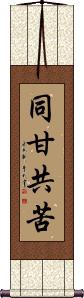
同甘共苦 is a Chinese proverb that talks of “shared delights and common hardships.”
This can be translated and understood in a few different ways, including...
To share life's joys and sorrows.
For better or for worse.
Through joys and sorrows of life.
Through all life's ups and downs.
To go through thick and thin.
To stick together through thick and thin.
To share the joys and sorrows of life.
To share pleasures and pains.
To partake in each other's joys and sorrows.
To take “for better or for worse.”
Truth Flashed Through The Mind
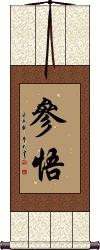
參悟 is a Chan / Zen Buddhism concept that means “to understand (mystery) from meditation” or “to see truth flash through the mind.”
參悟 is a pretty deep idea; therefore, your study and contemplation may be required before fully appreciating it.
Skill Acquired Through Hard Training
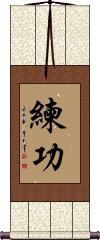
練功 is a martial arts term that can mean to practice and attain working skills, feats of practice/practise, or skills acquired through hard training.
練功 is often used as a martial arts term but can apply to other skills (or professions).
Reach Peace and Calm Through Meditation
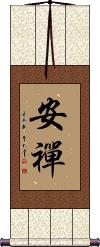
安禪 creates a title that means to reach peace and calm through meditation.
安禪 is an excellent wall scroll for your relaxation or meditation room.
This is also a Buddhist-related term that encompasses the idea of entering into dhyana meditation.
This is also used in Japanese, but in modern times, the second character has changed, so it's 安禅 now. If you want the modern Japanese version, just choose a Japanese calligrapher, and let me know when you place your order.
Daodejing / Tao Te Ching - Chapter 54
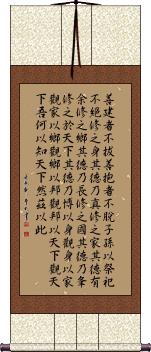
This is the Mawangdui version of Daodejing chapter 54.
By its virtue alone can one generation after another carry on the ancestral sacrifice.
Apply it to yourself, and by its power, you will be freed from dross.
Apply it to your household, and your household shall thereby have abundance.
Apply it to the village, and the village will be made secure.
Apply it to the kingdom, and the kingdom shall thereby be made to flourish.
Apply it to an empire, and the empire shall thereby be extended.
Therefore just as through oneself, one may contemplate Oneself;
So through the household one may contemplate the Household;
And through the village, one may contemplate the Village;
And through the kingdom, one may contemplate the Kingdom;
And through the empire, one may contemplate the Empire.
How do I know that the empire is so? By this.
What is firmly rooted cannot be pulled out;
What is tightly held in the arms will not slip loose;
Through this, the offering of sacrifice by descendants will never come to an end.
Cultivate it in your person, and its virtue will be genuine;
Cultivate it in the family, and its virtue will be more than sufficient;
Cultivate it in the hamlet, and its virtue will endure;
Cultivate it in the state, and its virtue will abound;
Cultivate it in the empire, and its virtue will be pervasive.
Hence look at the person through the person;
Look at the family through the family;
Look at the hamlet through the hamlet;
Look at the state through the state;
Look at the empire through the empire.
How do I know that the empire is like that?
By means of this.
Great Wisdom
Prajñā
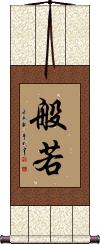
般若 means great wisdom or wondrous knowledge.
In the Buddhist context, this is prajna or prajñā, to know, to understand, to have the wisdom required to attain enlightenment.
Since this is a wisdom that transcends the realm of logic, the pure, absolute wisdom beyond the reach of words and concepts, it is not obtained through learning but is realized for the first time through a religious experience.
Spiritual Peace / Enlightened Peace
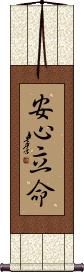
These Japanese Kanji, 安心立命, can be translated as “religious enlightenment” or “spiritual peace gained through faith.”
Other dictionaries define as “spiritual peace and enlightenment” or “keeping an unperturbed mind through faith.”
My Buddhist dictionary defines it as “spiritual peace and realization of enlightenment.”
In the Zen school, this is about settling one's body and life; attaining complete peace, and establishing one's course of life in accord with the ultimate reality.
Read
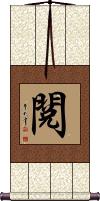
閱 is a Chinese character that means to read. It can also refer to observing (the world, and learning from it), or gaining life experiences. 閱 is a good character to relay the idea of being “well-read,” which can include reading books, studying, and learning through experience.
The dictionary definition also includes: to inspect; to review; to peruse; to go through; to experience.
Technically, this is also a Japanese Kanji but only some Japanese Buddhists use it (most of the population will not recognize it).
In Chinese and Japanese Buddhism, this means examining, inspecting, and/or looking over.
Great Ambitions
Brave the wind and the waves
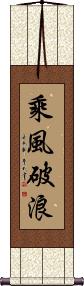
乘風破浪 is a Chinese proverb that represents having great ambitions.
The British might say “to plough through.” Another way to understand it is “surmount all difficulties and forge ahead courageously.”
This can also be translated as “braving the wind and waves,” “to brave the wind and the billows,” “to ride the wind and crest the waves,” or “to be ambitious and unafraid.”
Literally, it reads: “ride (like a chariot) [the] wind [and] break/cleave/cut [the] waves,” or “ride [the] wind [and] slash [through the] waves.”
乘風破浪 is a great proverb to encourage yourself or someone else not to be afraid of problems or troubles, and when you have a dream, just go for it.
There is an alternate version, 長風破浪, but 乘風破浪 is far more common.
Reincarnation / Life in Flux
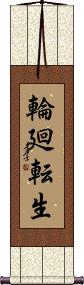
輪廻転生 is a Japanese Zen quote or proverb that expresses the idea of all things being in flux through the endless circle of birth, death, and rebirth or the circle of transmigration.
There is one single thread binding my Way together
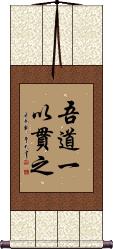
吾道一以貫之 is a phrase from the Analects of Confucius that translates as “My Way has one thread that runs through it.”
Other translations include:
My Way is penetrated by a single thread.
There is one single thread binding my Way together.
My Way is run through with a unifying thread.
My Way is Consistent.
And sometimes poetic license is taken, and it is translated as:
My Way is the only one; I'll treasure it and stick to it with humility until the end.
After this was said, some 2500+ years ago, another disciple of Confucius clarified the meaning by stating, “Our master's Way is to be loyal and have a sense of reciprocity.”
In Japanese, this is purported to be romanized as “Waga michi ichi wo motte kore wo tsuranuku,” though some will argue the true pronunciation.
Note: Sometimes written 吾道以一貫之 instead of 吾道一以貫之 with no difference in meaning.
Great Illumination of Wisdom
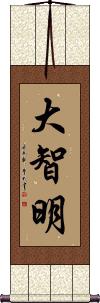
大智明 is a Zen Buddhist title that means the great illumination of wisdom.
This refers to wisdom so bright that it shines through obviously to all in its presence.
Appreciation of Truth by Meditation
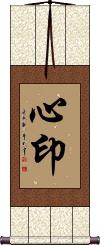
心印 is a Buddhist concept that simply stated is “appreciation of truth by meditation.”
It's a deep subject, but my understanding is that you can find truth through meditation, and once you've found the truth, you can learn to appreciate it more through further meditation. This title is not commonly used outside of the Buddhist community (your Asian friends may or may not understand it). The literal translation would be something like “the mind seal,” I've seen this term translated this way from Japanese Buddhist poetry. But apparently, the seal that is stamped deep in your mind is the truth. You just have to meditate to find it.
Soothill defines it this way: Mental impression, intuitive certainty; the mind is the Buddha-mind in all, which can seal or assure the truth; the term indicates the intuitive method of the Chan (Zen) school, which was independent of the spoken or written word.
Reference: Soothill-Hodous Dictionary of Chinese Buddhism
See Also: Zen
Accept Your Mistake and Move On

將錯就錯 is a Chinese proverb that literally means, “If it's wrong, it's wrong.”
This proverb is a suggestion to make the best after a mistake, to accept an error and adapt to it, and to muddle through.
Knowledge from Experience
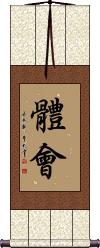
體會 is a Chinese word that basically means “knowledge [comes from] experience,” or “to learn through experience.”
This can also mean realizing or gaining understanding from your experiences.
Unbreakable
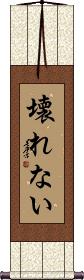
壊れない means unbreakable in Japanese.
The first two characters mean to be broken, to break, to fall through, and to come to nothing. But the last two characters create a negative meaning (like adding “un-” to “breakable”).
Note: Because this selection contains some special Japanese Hiragana characters, it should be written by a Japanese calligrapher.
See Also: Indomitable Spirit
Endure and Survive
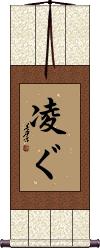
凌ぐ is a Japanese word that means to endure and survive.
The full list of definitions includes to endure, to keep out (e.g. rain), to stave off (e.g. starvation), to pull through, to get over, to survive, to surpass, to outdo, to excel, to eclipse, and/or to defy.
Yue Fei
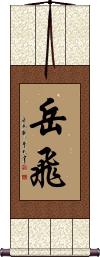
岳飛 is the name of General Yue Fei (1103-1142). He was a famous General of the Song Dynasty army in China. Many legendary stories have been written about him, and passed down through the generations.
In Japanese, this can be the personal name, Gakuhi.
There is always a way out
Never say die
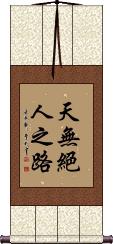
天無絕人之路 is a proverb that means “Heaven never bars one's way,” “Don't despair and you will find a way through,” and “Never give up hope,” and is the Chinese way to say “Never say die.”
Tetsu / Penetrating
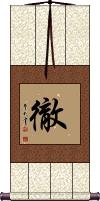
徹 is commonly used in Japan as a given name, romanized as Tetsu.
The meaning of this Kanji is: thorough; penetrating; to pervade; to pass through; pervious; perspicacious; throughout; communal.
徹 can also be romanized as Michi; Tooru; Touru; Tetsuji; Tsuyoshi; Choru; Osamu; Itaru; or Akira.
Dragon Hall

龍館 can be translated as “dragon hall” or “dragon school”.
Through history, and depending on context, 館 has a lot of possible meanings such as building, shop, embassy, consulate, schoolroom, mansion, palace, manor house, castle, small fortress, or official residence (of a government official).
Forest Bathing
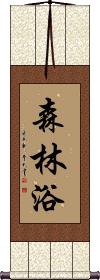
森林浴 is the title for forest bathing or Shinrinyoku in Japanese and Senlinyu in Chinese.
This is simply the practice of spending time in a forest, often including walking or deep breathing as a form of therapy.
Also defined as forest therapy or a peaceful walk through the woods for health benefits.
Diligent Study Proverb
Drill a hole in the wall to get light to read by.
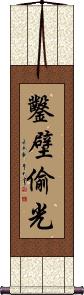
鑿壁偷光 is a Chinese proverb that means “Bore a hole in the wall to make use of the neighbor's light to study.”
This is a nice gift for a very studious person.
Kuang Heng was born during the Western Han period. He has been very fond of reading ever since he was young. However, he could not attend school since his family was poor, and he had to borrow books from people to learn.
To borrow these books, he normally did chores for people who had them. When he became older, he had to work in the field from sunrise to sunset since his family's financial situation did not improve. Thus, he tried to study at night, but he had no lamp.
One day, he noticed the light from the neighbor's house coming through a crack in the wall. This made him very happy, so he dug a larger hole from the crack and read in the light that shone through. This diligent study eventually made him an accomplished person.
Samadhi
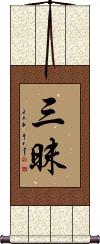
三昧 is the Chinese, Japanese Kanji, and old Korean Hanja way to write Samādhi.
Samadhi is the state of intense concentration achieved through meditation.
Some will define Samādhi as putting together, composing the mind, intent contemplation, perfect absorption, or union of the meditator with the object of meditation.
Enlightenment
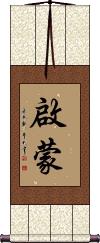
啟蒙 is the Chinese word for enlightenment.
The first character means to open, to start, to begin, to commence, or to explain. The second character means deception or ignorance. It suggests that enlightenment is the opening or cutting through what deceives you in the world or the ignorance of the world. This title can also mean to educate.
 The Japanese and Korean version of the first character of this title varies slightly from the Chinese. Please click on the Kanji to the right, instead of the button above, if you want the Japanese/Korean version.
One who is drenched in rain does not fear drops of dew
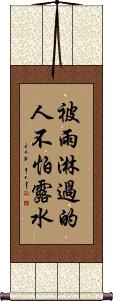
被雨淋過的人不怕露水 is a Chinese proverb that literally translates as “One who has been drenched by the rain is not afraid of dew drops.”
Figuratively, this means:
One who has gone through hardships is not afraid of (minor)setbacks.
Chaquan / Cha Quan
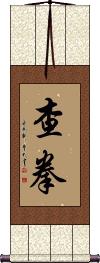
查拳 is the title for the Chaquan, Chāquán, or Cha Quan style of Chinese martial arts.
The meaning is “Inquisitive Fist,” and it falls under the category of the Northern Schools.
Cha Quan features graceful movements and acrobatic stunts (often flying through the air). Many different forms of weapons are used in Cha Quan.
Unwavering Hall / Fudoshinkan

不動心館 can be translated as “Fudoshinkan,” or “Immovable Mind Hall.”
Fudoshinkan (不動心館) refers to various Japanese martial arts schools, primarily focusing on Aikido, Iaido (sword art), and Jodo (short staff), emphasizing the concept of Fudoshin (不動心) – a calm, immovable mind in the face of challenge, reflecting traditional samurai spirit through dynamic training and inner peace
Immovable mind; unwavering composure. Hall/school (as in -kan / -gwan).
Alert / On Guard / Lingering Mind
Zanshin
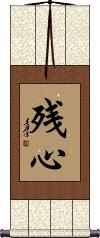
残心 is a Japanese Kanji word meaning: continued alertness; unrelaxed alertness; remaining on one's guard; lingering mind, and being prepared for a counterstrike. This context is used in martial arts, which is probably why you are looking up this word.
In archery and golf, it can be the follow-through.
In the context of love and relationships, it can be lingering affection, attachment, regret, regrets, or reluctance.
Joyfulness / Happiness
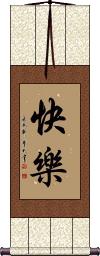
快樂 or joyfulness is an inner sense of peace and happiness.
You appreciate the gifts each day brings. Without joyfulness, when the fun stops, our happiness stops. Joy can carry us through hard times even when we are feeling very sad.
快樂 can also mean pleasure, enjoyment, delight, cheerfulness, or merry. In some ways, this is the essence that makes someone perceived as a charming person.
See Also: Happiness
Seeing one’s Nature and becoming a Buddha
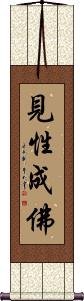
見性成佛 is a universal phrase that suggests that one may see one's nature and accomplish Buddhahood.
見性 suggests penetrating deep inside oneself to see one's “Original finally
Mind.”
成佛 refers to a sentient being who dispenses with illusions and delusions
through ascetic practice, is enlightened to the truth, and becomes a Buddha.
This is used by Mahayana, Chan, and Zen Buddhists in China, Korea, and Japan.
You will also see this with the last character written as 仏 in Japanese. In the religious context, 佛 is commonly used to mean Buddha. If you want the other version, see Kenshō Jōbutsu 見性成仏
You May Learn from Victory, You Will Learn from Failure
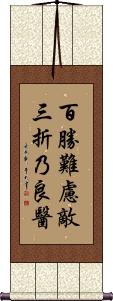
百胜难虑敌三折乃良医 is a Chinese proverb that literally translates as: [Even a general who has won a] hundred victories [may be] hard put to see through the enemy's [strategy], [but one who has] broken [his] arm three [times] [will] be a good doctor.
Figuratively, this means: One cannot always depend on past successes to guarantee future success but one can always learn from lessons drawn from failure.
See Also: Failure - Mother of Success | Experience - Mother of Success | Fall Down 7 Times Get Up 8 | Hard Knocks
Believe / Faith / Trust
śraddhā
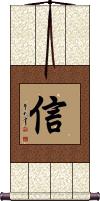
信 can mean to believe, truth, faith, fidelity, sincerity, trust, and confidence in Chinese, old Korean Hanja, and Japanese Kanji.
This single character is often part of other words with similar meanings.
It is one of the five basic tenets of Confucius.
In Chinese, it sometimes has the secondary meaning of a letter (as in the mail) depending on context but it will not be read that way when seen on a wall scroll.
In the Buddhist context, this is śraddhā (faith through hearing or being taught).
Good Health / Healthy / Vigor
Also suggests being at peace
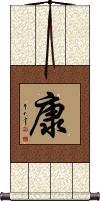
康 is a single character that means good health or vigor in Chinese, Japanese Kanji, and old Korean Hanja.
康 can also mean peaceful, at ease, or abundant in some contexts.
Please note that this is rarely seen alone in Japanese Kanji. In Japanese, it is used both for health-related compound words and to denote the kouhou through koushou eras of Japan.
In Korean, this can also be the family name “Kang” (caution: not the only family name romanized as Kang in Korean).
You must endure a harsh winter to appreciate the warmth of springtime
You must know hardship to appreciate happiness
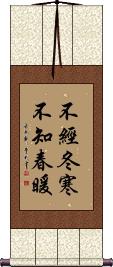
This literally translates as: Without having experienced the cold of winter, one cannot appreciate the warmth of spring.
Figuratively, this means: One cannot truly appreciate happiness without having gone through hardship.
There are many contrasts in life. One simply cannot fully know what joy is without having experienced misery, difficulty, and pain. How could you explain “light” if you did not have “darkness” to compare it to?
Embrace hardship, as it makes the good times seem even better.
Trust No One / Trust No Man
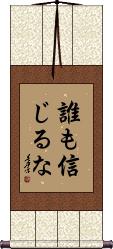
誰も信じるな is as close as you can get to the phrase “trust no man” in Japanese, though no gender is specified.
The first two characters mean everyone or anyone but change to “no one” with the addition of a negative verb.
The third through fifth characters express the idea of believing in, placing trust in, confiding in, or having faith in.
The last character makes the sentence negative (without the last character, this would mean “trust everyone,” with that last character, it's “trust no one”).
Note: Because this selection contains some special Japanese Hiragana characters, it should be written by a Japanese calligrapher.
Strong bones come from hard knocks
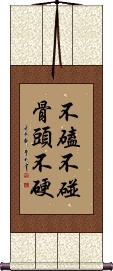
不磕不碰骨頭不硬 is a Chinese proverb that literally translates as: Without being knocked around a bit, [one's] bones won't become hard.
Figuratively, this means: One can't become strong without first being tempered by “hard knocks.”
While true for everyone, this sounds like the “Iron Body” form of Kung Fu, where practitioners' bodies are beaten (and often bone fractured) in order to become stronger.
For the rest of us, this is just about how we can be tempered and build character through the hardships in our lives.
This is not a common title for a wall scroll in China.
Hyakuren-Jitoku
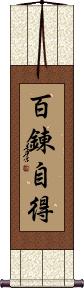
百錬自得 is a Japanese proverb that means only if you practice something 100 times will it become a part of yourself.
Some translate it in a short form like “Well train, self-gain.”
The first two characters are a word that means “100 forges” (or to forge 100 times). It translates more naturally as well-tempered, well-drilled, or well-trained.
The last two characters mean “self-benefit” or “self-gain.” It can also be translated into English as contented, self-satisfaction, realizing (through one's ability), or being paid back for one's deeds.
Cutting and Polishing

切磋琢磨 literally means “cutting, filing, carving, polishing” in Chinese, Japanese Kanji, and old Korean Hanja.
Originally describing polishing jade, 切磋琢磨 became a metaphor for people refining one another through study or interaction.
This can have the following interpretations:
To learn by exchanging ideas or experiences.
Mutual encouragement (to improve).
Cultivating one's character by studying hard.
Peers improving each other.
Mutual refinement.
Diligent application.
Intellectual sharpening.
In the context of self-reflection, it can mean discussing and pondering.
切磋琢磨 is probably the closest philosophical equivalent to “iron sharpens iron.”
Flowers Fall / The End Comes
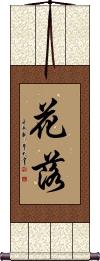
花落 means flower fall (closes and loses its petals).
It suggests nearing the end of something. A time that some might call “The sunset of life.” 花落 often follows 花開 or “flower open” to talk of the cycle of life.
We offer this as a possible companion to a “flower open” scroll (to be placed side by side or at either side of a doorway to say “things come and go” - a cool metaphor for a doorway). If placed in a doorway, it could be used to suggest to your guests that things bloom when they arrive through your door but wither when they leave (a great compliment).
See Also: Flowers Bloom
Daodejing / Tao Te Ching - Chapter 27
The Mastery of Effortless Skill

Chapter 27 of the Daodejing reveals a profound truth about mastery: the highest skill leaves no trace, requires no force, and appears almost invisible.
善行無轍跡,
善言無瑕謫,
善數不用籌策,
善閉無關鍵而不可開,
善結無繩約而不可解。
是以聖人常善救人,
故無棄人;
常善救物,
故無棄物。
是謂襲明。
故善人者,不善人之師;
不善人者,善人之資。
不貴其師,不愛其資,
雖智大迷,
是謂要妙。
The sage moves through life with such natural harmony that nothing seems imposed; doors need no locks, knots require no rope, and actions leave no mark behind.
This is the essence of wúwéi (effortless action), where true ability arises from deep alignment with the Tao rather than deliberate effort.
At its heart, this chapter teaches compassion without exception. The sage “abandons no one and nothing,” recognizing value in all people and all things. Even those who seem flawed or unrefined are not rejected, but understood as part of a greater whole with each person both a student and a teacher in the unfolding of life.
Laozi reminds us that wisdom is not about perfection or control, but about subtle awareness. The truly skilled individual does not rely on tools, rules, or rigid structures; instead, they embody an intuitive understanding that makes their actions naturally complete.
In this way, excellence becomes quiet, effortless, and beyond imitation.
This teaching also reflects a deeper philosophical insight: Opposites are interdependent. The “good” person learns from the “not good,” and the “not good” provides the material for growth. To reject either is to misunderstand the balance of existence itself.
As calligraphy, Daodejing Chapter 27 serves as a reminder to cultivate inner mastery rather than outward display. It is a meditation on refinement, humility, and the quiet power of skill perfected through harmony with the natural order.
Note: The Chinese text used here is based on the early Mawangdui silk manuscript tradition (2nd century BCE). The Guodian manuscripts do NOT preserve Chapter 27 in full form.
Learn From Your Predecessors
When the cart in front overturns, be cautious with your own
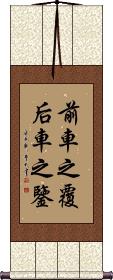
前車之覆后車之鑒 is a Chinese proverb that suggests looking at the circumstances and toils of those you proceeded before you and learning from their experience.
This more literally means “the cart in front overturns, a warning to the following cart.”
This is figuratively translated as “draw a lesson from the failure of one's predecessor,” “learn from past mistakes,” or compared to the English idiom, “once bitten twice shy.”
Other more-direct translations:
Make the overturning of the chariot in front a warning for the chariot behind.
Learn caution through an unpleasant experience.
The wrecked coach in front should be a warning.
The overturned cart in front serves as a warning to the carts behind.
Love and Honor
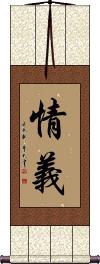
情義 means to love and honor in Chinese. 情義 is more or less the kind of thing you'd find in marriage vows.
The first character suggests emotions, passion, heart, humanity, sympathy, and feelings.
In this context, the second character means to honor your lover's wishes and treat them justly and righteously (fairly). That second character can also be translated as “obligation,” as in the obligation a husband and wife have to love each other even through difficult times.
In the context outside of a couple's relationship, this word can mean “comradeship.”
Japanese may see this more as “humanity and justice” than “love and honor.” It's probably best if your target is Chinese.
This is the short and sweet form, there is also a longer poetic form (you can find it here: Love and Honor if it’s not on the page you are currently viewing).
See Also: Love and Honor
Smooth Sailing
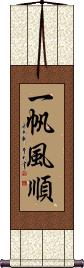
一帆風順 is just what you think it means. It suggests that you are on a trouble-free voyage through life, or literally on a sailing ship or sailboat. It is often used in China as a wish for good luck on a voyage or as you set out on a new quest or career in your life. Some may use this in place of “bon voyage.”
The literal meaning is “Once you raise your sail, you will get the wind you need, and it will take you where you want to go.” Another way to translate it is “Your sail and the wind follow your will.”
This is a great gift for a mariner, sailor, adventurer, or someone starting a new career.
Note: Can be understood in Korean Hanja but is rarely used.
See Also: Bon Voyage | Adventure | Travel
Flower in the Mirror, Moon on Water
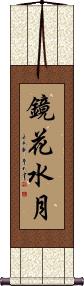
鏡花水月 is an old Asian proverb that means “flowers in a mirror and the moon reflected in the lake” or “flowers reflected on a mirror and the moon reflected on the water's surface.”
Literally, 鏡花水月 reads “Mirror Flower, Water Moon.”
Figuratively this can be used to represent a lot of different ideas. It can be used to express an unrealistic rosy view or viewing things through rose-tinted spectacles. So you can use it to relay an idea about something that is visible but has no substance,
something that can be seen but not touched, or something beautiful but unattainable such as dreams or a mirage.
This expression is used to describe things like the subtle and profound beauty of poems that cannot be described in words.
鏡 = Mirror (or lens)
花 = Flower(s)
水 = Water
月 = Moon
Can also be written 水月鏡花 (just a slight change in word/character order).
Clarity
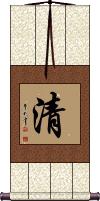
清 is a word that means clarity or clear in Chinese, Japanese Kanji, and old Korean Hanja.
Looking at the parts of this character, you have three splashes of water on the left, “life” on the top right, and the moon on the lower right.
Because of something Confucius said about 2500 years ago, you can imagine that this character means “live life with clarity like bright moonlight piercing pure water.” The Confucian idea is something like “Keep clear what is pure in yourself, and let your pure nature show through.” Kind of like saying, “Don't pollute your mind or body, so that they remain clear.”
This might be stretching the definition of this single Chinese character but the elements are there, and “clarity” is a powerful idea.
Korean note: Korean pronunciation is given above but this character is written with a slight difference in the "moon radical" in Korean. However, anyone who can read Korean Hanja, will understand this character with no problem (this is considered an alternate form in Korean). If you want the more standard Korean Hanja form (which is an alternate form in Chinese), just let me know.
Japanese note: When reading in Japanese, this Kanji has additional meanings of pure, purify, or cleanse (sometimes to remove demons or "exorcise"). Used more in compound words in Japanese than as a stand-alone Kanji.
Learn New Ways From Old / Onkochishin
New ideas coming from past history
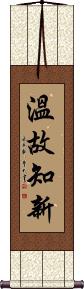
溫故知新 is a proverb from Confucius that is used in Chinese, Japanese, and Korean cultures.
It can be translated in several ways:
Coming up with new ideas based on things learned in the past.
Examine things of the past, and obtain new knowledge.
Developing new ideas based on the study of the past.
Gain new insights through restudying old issues.
Understand the present by reviewing the past.
Learning from the past.
Review the old and know the new.
Taking a lesson from the past.
Taking a lesson from the wisdom of the ancients.
Follow the old ways.
The direct translation would be, “By asking old things, know new things.”
The Character meanings breakdown this way:
溫故 = ask old
知新 = know new
Explained: To learn new things that are outside of your experience, you can learn from old things of the past. You can find wisdom in history.
 VS.
VS. 
Note: Japanese use a variant of the first Kanji in modern times.
Therefore if you order this from a Japanese calligrapher, expect the first Kanji to look like 温 instead of 溫.
In addition to 温故知新 as mentioned above, this is sometimes written as 温古知新 in Japan.
The Middle Way
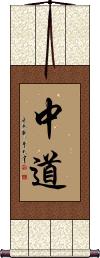
In the most basic translation, 中道 means road through the middle or middle road.
The expanded meaning can be moderation or the golden mean.
But if you are looking for this title, you are probably seeking the Buddhist definition, which is more complex.
中道 is the middle way or middle path of Buddhism. This has various interpretations. In general, it denotes the mean between two extremes and has special reference to the mean between realism and nihilism, or eternal substantial existence and annihilation.
The Buddha teaches that one should not take things to extremes. Don't be extremely evil and engage in debauchery and murder. But do not spend every waking out trying to be a perfect saint. Instead, take the middle path, try to help others, show loving kindness wherever you can, and try not to do harm. If you inadvertently harm another being, make amends if you can, and move on. Realize you are not perfect, but in time, a path of moderation lead toward proper living and enlightenment.
Lingering Mind
Zanshin
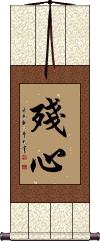
First off, 殘心 should only be used in the context of Japanese martial arts. In Chinese, it's a rather sad title (like a broken heart). In Chinese, the first character alone means destroyed, spoiled, ruined, injured, cruel, oppressive, savage, incomplete, or disabled. However, in Japanese, it's remainder, leftover, balance, or lingering.
The second character means heart, mind, soul, or essence in both languages.
殘心 is one of the five spirits of the warrior (budo) and is often used as a Japanese martial arts tenet. Under that context, places such as the Budo Dojo define it this way: The spirit of zanshin is the state of the remaining or lingering spirit. It is often described as a sustained and heightened state of awareness and mental follow-through. However, true zanshin is a state of focus or concentration before, during, and after the execution of a technique, where a link or connection between uke and nage is preserved. Zanshin is the state of mind that allows us to stay spiritually connected, not only to a single attacker but to multiple attackers and even an entire context; a space, a time, an event.
 In modern Japan (and Simplified Chinese), they use a different version of the first character, as seen to the right. Click on this character to the right instead of the button above if you want this modern Japanese version of lingering mind / zanshin.
Daoism / Taoism
Literally: The Way or Road
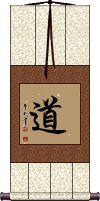
道 is the character “dao” which is sometimes written as “tao” but pronounced like “dow” in Mandarin.
道 is the base of what is known as “Taoism.” If you translate this literally, it can mean “the way” or “the path.”
Dao is believed to be that which flows through all things and keeps them in balance. It incorporates the ideas of yin and yang (e.g. there would be no love without hate, no light without dark, no male without female.)
The beginning of Taoism can be traced to a mystical man named
Lao Zi (604-531 BC), who followed, and added to the teachings of Confucius.
More about Taoism / Daoism here.
Note that this is pronounced “dou” and sometimes “michi” when written alone in Japanese but pronounced “do” in word compounds such as Karate-do and Bushido. It's also “do” in Korean.
Alternate translations and meanings: road, way, path; truth, principle province.
Important Japanese note: In Japanese, this will generally be read with the road, way, or path meaning. Taoism is not as popular or well-known in Japan so Daoist/Taoist philosophy is not the first thing a Japanese person will think of when they read this character.
See our Taoism Page
Tai Chi Chuan / Tai Ji Quan
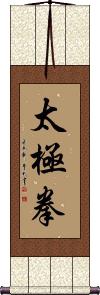
太極拳 is the famous Taoist meditation and martial art exercise. The direct translation of these characters would be something like “grand ultimate fist,” but that does not quite hit the mark for what this title really means.
An early-morning walk through any city in China near a park or an open area will yield a view of Chinese people practicing this ancient technique.
A typical scene is an old man of no less than 80 years on this earth, with a wispy white beard and perhaps a sword in one hand. He makes slow moves that are impossibly smooth. He is steady-footed and always in balance. For him, time is meaningless and proper form, and technique is far more important than speed.
For the younger generation, faster moves may look impressive and seem smooth to the casual observer. But more discipline and mental strength are needed to create perfectly smooth moves in virtual slow motion.
Note: There are two ways to Romanize these Chinese characters, as seen in the title above. The pronunciation and actual characters are the same in Chinese. If you really used English sounds/words to pronounce this, it would be something like “tie jee chew-on” (make the “chew-on” one flowing syllable).
Reiki
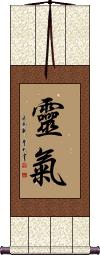
靈氣 is the title of a healing practice now found globally but with origins in Japan.
Special note: Outside of the context of the healing practice of Reiki, this means “aura” or “spiritual essence that surrounds all living things.” A Japanese person unfamiliar with the practice will take the “aura” meaning.
Reiki is a technique for stress reduction and relaxation that also heals. It can be compared to massage but is based on the idea that an unseen “life force energy” flows through us and is what causes us to be alive. If your life force energy is low, you'll be more likely to get sick or feel stressed. If your life force energy is abundant and flowing well, you become more capable of being happy and healthy.
There is a lot of information available if you want to Google this term - my job is to offer the calligraphy while you can decide if it is right for you.


Note: We are showing the ancient (traditional) form of the Reiki Kanji. I have seen Reiki written with the slightly simplified version and this more classic form. If you want the form of Reiki with the two strokes in the shape of an X on the second character and the modern first character, simply click on the Kanji characters to the right.
Note: 靈氣 is also a Chinese word, but in Chinese, these characters create a word that refers to a smart person or someone with high aspirations. It is not read as a healing method in Chinese.
In Korean Hanja, this can be read as a “mysterious atmosphere” by a Korean who is not familiar with the practice of Reiki (still has a cool meaning in Korean).
Push or Knock
To weigh one's words
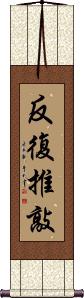
During the Tang Dynasty, a man named Jia Dao (born in the year 779), a well-studied scholar and poet, went to the capital to take the imperial examination.
One day as he rides a donkey through the city streets, a poem begins to form in his mind. A portion of the poem comes into his head like this:
“The bird sits on the tree branch near a pond,
A monk approaches and knocks at the gate...”
At the same time, he wondered if the word “push” would be better than “knock” in his poem.
As he rides down the street, he imagines the monk pushing or knocking. Soon he finds himself making motions of pushing and shaking a fist in a knocking motion as he debates which word to use. He is quite a sight as he makes his way down the street on his donkey with hands and fists flying about as the internal debate continues.
As he amuses people along the street, he becomes completely lost in his thoughts and does not see the mayor's procession coming in the opposite direction. Jia Bao is blocking the way for the procession to continue down the road, and the mayor's guards immediately decide to remove Jia Bao by force. Jia Bao, not realizing that he was in the way, apologizes, explains his poetic dilemma and awaits his punishment for blocking the mayor's way.
The mayor, Han Yu, a scholar and author of prose himself, finds himself intrigued by Jia Dao's poem and problem. Han Yu gets off his horse and addresses Jia Bao, stating, “I think knock is better.” The relieved Jia Bao raises his head and is invited by the mayor to join the procession, and are seen riding off together down the street, exchanging their ideas and love of poetry.
In modern Chinese, this 反復推敲 idiom is used when someone is trying to decide which word to use in their writing or when struggling to decide between two things when neither seems to have a downside.
Broken Mirror Rejoined
Used in modern times for divorced couples that come back together
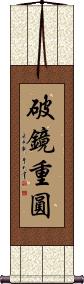
破鏡重圓 is about a husband and wife who were separated and reunited.
About 1500 years ago in China, there lived a beautiful princess named Le Chang. She and her husband Xu De Yan loved each other very much. But when the army of the Sui Dynasty was about to attack their kingdom, disposed of all of their worldly possessions and prepared to flee into exile.
They knew that in the chaos, they might lose track of each other, so the one possession they kept was a bronze mirror which is a symbol of unity for a husband and wife. They broke the mirror into two pieces, and each of them kept half of the mirror. They decided that if separated, they would try to meet at the fair during the 15th day of the first lunar month (which is the lantern festival). Unfortunately, the occupation was brutal, and the princess was forced to become the mistress of the new commissioner of the territory, Yang Su.
At the Lantern Festival the next year, the husband came to the fair to search for his wife. He carried with him his half of the mirror. As he walked through the fair, he saw the other half of the mirror for sale at a junk market by a servant of the commissioner. The husband recognized his wife's half of the mirror immediately, and tears rolled down his face as he was told by the servant about the bitter and loveless life that the princess had endured.
As his tears dripped onto the mirror, the husband scratched a poem into his wife's half of the mirror:
You left me with the severed mirror,
The mirror has returned, but absent are you,
As I gaze in the mirror, I seek your face,
I see the moon, but as for you, I see not a trace.
The servant brought the inscribed half of the mirror back to the princess. For many days, the princess could not stop crying when she found that her husband was alive and still loved her.
Commissioner Yang Su, becoming aware of this saga, realized that he could never obtain the princess's love. He sent for the husband and allowed them to reunite.
This proverb, 破鏡重圓, is now used to describe a couple who has been torn apart for some reason (usually divorce) but have come back together (or remarried).
It seems to be more common these days in America for divorced couples to reconcile and get married to each other again. This will be a great gift if you know someone who is about to remarry their ex.
Mountain Travels Poem by Dumu

This poem was written almost 1200 years ago during the Tang dynasty.
It depicts traveling up a place known as Cold Mountain, where some hearty people have built their homes. The traveler is overwhelmed by the beauty of the turning leaves of the maple forest that surrounds him just as night overtakes the day, and darkness prevails. His heart implores him to stop, and take in all of the beauty around him.
First, before you get to the full translation, I must tell you that Chinese poetry is a lot different than what we have in the west. Chinese words simply don't rhyme in the same way that English or other western languages do. Chinese poetry depends on rhythm and a certain beat of repeated numbers of characters.
I have done my best to translate this poem keeping a certain feel of the original poet. But some of the original beauty of the poem in its original Chinese will be lost in translation.
Far away on Cold Mountain, a stone path leads upwards.
Among white clouds, people's homes reside.
Stopping my carriage I must, as to admire the maple forest at nights fall.
In awe of autumn leaves showing more red than even flowers of early spring.
Hopefully, this poem will remind you to stop, and “take it all in” as you travel through life.
The poet's name is “Du Mu” in Chinese that is: 
 .
.
The title of the poem, “Mountain Travels” is: 

You can have the title, poet's name, and even “Tang Dynasty” written as an inscription on your custom wall scroll if you like.
More about the poet:
Dumu lived from 803-852 AD and was a leading Chinese poet during the later part of the Tang dynasty.
He was born in Chang'an, a city in central China and the former capital of the ancient Chinese empire in 221-206 BC. In present-day China, his birthplace is currently known as Xi'an, the home of the Terracotta Soldiers.
He was awarded his Jinshi degree (an exam administered by the emperor's court which leads to becoming an official of the court) at the age of 25 and went on to hold many official positions over the years. However, he never achieved a high rank, apparently because of some disputes between various factions, and his family's criticism of the government. His last post in the court was his appointment to the office of Secretariat Drafter.
During his life, he wrote scores of narrative poems, as well as a commentary on the Art of War and many letters of advice to high officials.
His poems were often very realistic and often depicted everyday life. He wrote poems about everything, from drinking beer in a tavern to weepy poems about lost love.
The thing that strikes you most is the fact even after 1200 years, not much has changed about the beauty of nature, toils, and troubles of love and beer drinking.
Better Late Than Never
It's Never Too Late Too Mend
Long ago in what is now China, there were many kingdoms throughout the land. This time period is known as “The Warring States Period” by historians because these kingdoms often did not get along with each other.
Sometime around 279 B.C. the Kingdom of Chu was a large but not particularly powerful kingdom. Part of the reason it lacked power was the fact that the King was surrounded by “yes men” who told him only what he wanted to hear. Many of the King's court officials were corrupt and incompetent which did not help the situation.
The King was not blameless himself, as he started spending much of his time being entertained by his many concubines.
One of the King's ministers, Zhuang Xin, saw problems on the horizon for the Kingdom, and warned the King, “Your Majesty, you are surrounded by people who tell you what you want to hear. They tell you things to make you happy and cause you to ignore important state affairs. If this is allowed to continue, the Kingdom of Chu will surely perish, and fall into ruins.”
This enraged the King who scolded Zhuang Xin for insulting the country and accused him of trying to create resentment among the people. Zhuang Xin explained, “I dare not curse the Kingdom of Chu but I feel that we face great danger in the future because of the current situation.” The King was simply not impressed with Zhuang Xin's words.
Seeing the King's displeasure with him and the King's fondness for his court of corrupt officials, Zhuang Xin asked permission from the King that he may take leave of the Kingdom of Chu, and travel to the State of Zhao to live. The King agreed, and Zhuang Xin left the Kingdom of Chu, perhaps forever.
Five months later, troops from the neighboring Kingdom of Qin invaded Chu, taking a huge tract of land. The King of Chu went into exile, and it appeared that soon, the Kingdom of Chu would no longer exist.
The King of Chu remembered the words of Zhuang Xin and sent some of his men to find him. Immediately, Zhuang Xin returned to meet the King. The first question asked by the King was “What can I do now?”
Zhuang Xin told the King this story:
A shepherd woke one morning to find a sheep missing. Looking at the pen saw a hole in the fence where a wolf had come through to steal one of his sheep. His friends told him that he had best fix the hole at once. But the Shepherd thought since the sheep is already gone, there is no use fixing the hole.
The next morning, another sheep was missing. And the Shepherd realized that he must mend the fence at once. Zhuang Xin then went on to make suggestions about what could be done to reclaim the land lost to the Kingdom of Qin, and reclaim the former glory and integrity of the Kingdom of Chu.
The Chinese idiom shown above came from this reply from Zhuang Xin to the King of Chu almost 2,300 years ago.
It translates roughly into English as...
“Even if you have lost some sheep, it's never too late to mend the fence.”
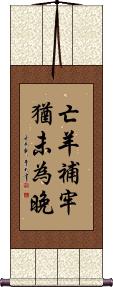
This proverb, 亡羊补牢犹未为晚, is often used in modern China when suggesting in a hopeful way that someone change their ways, or fix something in their life. It might be used to suggest fixing a marriage, quitting smoking, or getting back on track after taking an unfortunate path in life among other things one might fix in their life.
I suppose in the same way that we might say, “Today is the first day of the rest of your life” in our western cultures to suggest that you can always start anew.
Note: This does have Korean pronunciation but is not a well-known proverb in Korean (only Koreans familiar with ancient Chinese history would know it). Best if your audience is Chinese.
Life is Short
A 100-year-old is but a traveler passing through this life
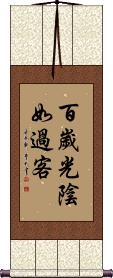
百歲光陰如過客 directly translates as: [Even a] hundred-year-old [person] is [just a] traveler passing by.
The simple message is, “Human life is short.” Of course, there is an unspoken suggestion that you should make the best of your time here on earth.
This in-stock artwork might be what you are looking for, and ships right away...

Gallery Price: $178.00
Your Price: $98.88

Gallery Price: $60.00
Your Price: $36.88
Gallery Price: $65.00
Your Price: $39.88
Gallery Price: $126.00
Your Price: $69.88

Gallery Price: $265.00
Your Price: $99.88
Gallery Price: $176.00
Your Price: $97.77
Gallery Price: $150.00
Your Price: $73.88
Gallery Price: $72.00
Your Price: $39.88
Gallery Price: $70.00
Your Price: $39.88
Gallery Price: $200.00
Your Price: $109.88

Gallery Price: $106.00
Your Price: $58.88
These search terms might be related to Through:
Family Over Everything
Mind Over Matter
My Life is Complete Because of You
Respect Out of Fear is Never Genuine; Reverence Out of Respect is Never False
The True and Complete Enlightenment
True Victory is Victory Over Oneself
Uniform / Complete / Perfect / Order
Via
Warriors: Quality Over Quantity
The following table may be helpful for those studying Chinese or Japanese...
| Title | Characters | Romaji (Romanized Japanese) | Various forms of Romanized Chinese | |
| Through the Ups and Downs of Life | 同甘共苦 | tóng gān gòng kǔ tong2 gan1 gong4 ku3 tong gan gong ku tonggangongku | t`ung kan kung k`u tungkankungku tung kan kung ku |
|
| Truth Flashed Through The Mind | 參悟 参悟 | cān wù / can1 wu4 / can wu / canwu | ts`an wu / tsanwu / tsan wu | |
| Skill Acquired Through Hard Training | 練功 练功 | renkou / renko | liàn gōng lian4 gong1 lian gong liangong | lien kung lienkung |
| Reach Peace and Calm Through Meditation | 安禪 安禅 | an zen / anzen | ān chán / an1 chan2 / an chan / anchan | an ch`an / anchan / an chan |
| Daodejing Tao Te Ching - Chapter 54 | 善建者不拔善抱者不脫子孫以祭祀不絕修之身其德乃真修之家其德有余修之鄉其德乃長修之國其德乃夆修之於天下其德乃博以身觀身以家觀家以鄉觀鄉以邦觀邦以天下觀天下吾何以知天下然茲以此 善建者不拔善抱者不脱子孙以祭祀不绝修之身其德乃真修之家其德有余修之乡其德乃长修之国其德乃夆修之于天下其德乃博以身观身以家观家以乡观乡以邦观邦以天下观天下吾何以知天下然兹以此 | shàn jiàn zhě bù bá shàn bào zhě bù tuō zǐ sūn yǐ jì sì bù jué xiū zhī shēn qí dé nǎi zhēn xiū zhī jiā qí dé yǒu yú xiū zhī xiāng qí dé nǎi zhǎng xiū zhī guó qí dé nǎi féng xiū zhī yú tiān xià qí dé nǎi bó yǐ shēn guān shēn yǐ jiā guān jiā yǐ xiāng guān xiāng yǐ bāng guān bāng yǐ tiān xià guān tiān xià wú hé yǐ zhī tiān xià rán zī yǐ cǐ shan4 jian4 zhe3 bu4 ba2 shan4 bao4 zhe3 bu4 tuo1 zi3 sun1 yi3 ji4 si4 bu4 jue2 xiu1 zhi1 shen1 qi2 de2 nai3 zhen1 xiu1 zhi1 jia1 qi2 de2 you3 yu2 xiu1 zhi1 xiang1 qi2 de2 nai3 zhang3 xiu1 zhi1 guo2 qi2 de2 nai3 feng2 xiu1 zhi1 yu2 tian1 xia4 qi2 de2 nai3 bo2 yi3 shen1 guan1 shen1 yi3 jia1 guan1 jia1 yi3 xiang1 guan1 xiang1 yi3 bang1 guan1 bang1 yi3 tian1 xia4 guan1 tian1 xia4 wu2 he2 yi3 zhi1 tian1 xia4 ran2 zi1 yi3 ci3 shan jian zhe bu ba shan bao zhe bu tuo zi sun yi ji si bu jue xiu zhi shen qi de nai zhen xiu zhi jia qi de you yu xiu zhi xiang qi de nai zhang xiu zhi guo qi de nai feng xiu zhi yu tian xia qi de nai bo yi shen guan shen yi jia guan jia yi xiang guan xiang yi bang guan bang yi tian xia guan tian xia wu he yi zhi tian xia ran zi yi ci | shan chien che pu pa shan pao che pu t`o tzu sun i chi ssu pu chüeh hsiu chih shen ch`i te nai chen hsiu chih chia ch`i te yu yü hsiu chih hsiang ch`i te nai chang hsiu chih kuo ch`i te nai feng hsiu chih yü t`ien hsia ch`i te nai po i shen kuan shen i chia kuan chia i hsiang kuan hsiang i pang kuan pang i t`ien hsia kuan t`ien hsia wu ho i chih t`ien hsia jan tzu i tz`u shan chien che pu pa shan pao che pu to tzu sun i chi ssu pu chüeh hsiu chih shen chi te nai chen hsiu chih chia chi te yu yü hsiu chih hsiang chi te nai chang hsiu chih kuo chi te nai feng hsiu chih yü tien hsia chi te nai po i shen kuan shen i chia kuan chia i hsiang kuan hsiang i pang kuan pang i tien hsia kuan tien hsia wu ho i chih tien hsia jan tzu i tzu |
|
| Great Wisdom | 般若 | hannya | bō rě / bo1 re3 / bo re / bore | po je / poje |
| Spiritual Peace Enlightened Peace | 安心立命 | an jin ritsu myou anjinritsumyou an jin ritsu myo | ||
| Read | 閱 阅 | yuè / yue4 / yue | yüeh | |
| Great Ambitions | 乘風破浪 乘风破浪 | chéng fēng pò làng cheng2 feng1 po4 lang4 cheng feng po lang chengfengpolang | ch`eng feng p`o lang chengfengpolang cheng feng po lang |
|
| Reincarnation Life in Flux | 輪廻転生 | rinne tenshou rinnetenshou rinne tensho | ||
| There is one single thread binding my Way together | 吾道一以貫之 吾道一以贯之 | ware dou tsurayuki waredoutsurayuki ware do tsurayuki | wú dào yī yǐ guàn zhī wu2 dao4 yi1 yi3 guan4 zhi1 wu dao yi yi guan zhi wudaoyiyiguanzhi | wu tao i i kuan chih wutaoiikuanchih |
| Great Illumination of Wisdom | 大智明 | dai chi myou daichimyou dai chi myo | dà zhì míng da4 zhi4 ming2 da zhi ming dazhiming | ta chih ming tachihming |
| Appreciation of Truth by Meditation | 心印 | shin nin / shinnin | xīn yìn / xin1 yin4 / xin yin / xinyin | hsin yin / hsinyin |
| Accept Your Mistake and Move On | 將錯就錯 将错就错 | jiāng cuò jiù cuò jiang1 cuo4 jiu4 cuo4 jiang cuo jiu cuo jiangcuojiucuo | chiang ts`o chiu ts`o chiangtsochiutso chiang tso chiu tso |
|
| Knowledge from Experience | 體會 体会 | tǐ huì / ti3 hui4 / ti hui / tihui | t`i hui / tihui / ti hui | |
| Unbreakable | 壊れない | kowa re na i kowarenai | ||
| Endure and Survive | 凌ぐ | shinogu | ||
| Yue Fei | 岳飛 岳飞 | gakuhi | yuè fēi / yue4 fei1 / yue fei / yuefei | yüeh fei / yüehfei |
| There is always a way out | 天無絕人之路 天无绝人之路 | tiān wú jué rén zhī lù tian1 wu2 jue2 ren2 zhi1 lu4 tian wu jue ren zhi lu tianwujuerenzhilu | t`ien wu chüeh jen chih lu tienwuchüehjenchihlu tien wu chüeh jen chih lu |
|
| Tetsu Penetrating | 徹 彻 | tetsu | chè / che4 / che | ch`e / che |
| Dragon Hall | 龍館 | ryū kan / ryūkan | lóng guǎn long2 guan3 long guan longguan | lung kuan lungkuan |
| Forest Bathing | 森林浴 | shin rin yoku shinrinyoku | sēn lín yù sen1 lin2 yu4 sen lin yu senlinyu | sen lin yü senlinyü |
| Diligent Study Proverb | 鑿壁偷光 凿壁偷光 | záo bì tōu guāng zao2 bi4 tou1 guang1 zao bi tou guang zaobitouguang | tsao pi t`ou kuang tsaopitoukuang tsao pi tou kuang |
|
| Samadhi | 三昧 | san mai / sanmai | sān mèi / san1 mei4 / san mei / sanmei | |
| Enlightenment | 啟蒙 启蒙 | keimou / keimo | qǐ méng / qi3 meng2 / qi meng / qimeng | ch`i meng / chimeng / chi meng |
| One who is drenched in rain does not fear drops of dew | 被雨淋過的人不怕露水 被雨淋过的人不怕露水 | bèi yǔ lín guò de rén bù pà lù shuǐ bei4 yu3 lin2 guo4 de ren2 bu4 pa4 lu4 shui3 bei yu lin guo de ren bu pa lu shui | pei yü lin kuo te jen pu p`a lu shui pei yü lin kuo te jen pu pa lu shui |
|
| Chaquan Cha Quan | 查拳 | chá quán / cha2 quan2 / cha quan / chaquan | ch`a ch`üan / chachüan / cha chüan | |
| Unwavering Hall Fudoshinkan | 不動心館 | fudōshin-kan | bù dòng xīn guǎn bu4 dong4 xin1 guan3 bu dong xin guan budongxinguan | pu tung hsin kuan putunghsinkuan |
| Alert On Guard Lingering Mind | 残心 | zan shin / zanshin | ||
| Joyfulness Happiness | 快樂 快乐 | kai raku / kairaku | kuài lè / kuai4 le4 / kuai le / kuaile | k`uai le / kuaile / kuai le |
| Seeing one’s Nature and becoming a Buddha | 見性成佛 见性成佛 | ken shou jou butsu kenshoujoubutsu ken sho jo butsu | jiàn xìng chéng fó jian4 xing4 cheng2 fo2 jian xing cheng fo jianxingchengfo | chien hsing ch`eng fo chienhsingchengfo chien hsing cheng fo |
| You May Learn from Victory, You Will Learn from Failure | 百勝難慮敵三折乃良醫 百胜难虑敌三折乃良医 | bǎi shèng nán lǜ dí sān zhé nǎi liáng yī bai3 sheng4 nan2 lv4 di2 san1 zhe2 nai3 liang2 yi1 bai sheng nan lv di san zhe nai liang yi | pai sheng nan lü ti san che nai liang i | |
| Believe Faith Trust | 信 | shin | xìn / xin4 / xin | hsin |
| Good Health Healthy Vigor | 康 | kou / ko | kāng / kang1 / kang | k`ang / kang |
| You must endure a harsh winter to appreciate the warmth of springtime | 不經冬寒不知春暖 不经冬寒不知春暖 | bù jīng dōng hán bù zhī chūn nuǎn bu4 jing1 dong1 han2 bu4 zhi1 chun1 nuan3 bu jing dong han bu zhi chun nuan | pu ching tung han pu chih ch`un nuan pu ching tung han pu chih chun nuan |
|
| Trust No One Trust No Man | 誰も信じるな | dare mo shin ji ru na daremoshinjiruna | ||
| Strong bones come from hard knocks | 不磕不碰骨頭不硬 不磕不碰骨头不硬 | bù kē bù pèng gǔ tóu bù yìng bu4 ke1 bu4 peng4 gu3 tou2 bu4 ying4 bu ke bu peng gu tou bu ying bukebupenggutoubuying | pu k`o pu p`eng ku t`ou pu ying pukopupengkutoupuying pu ko pu peng ku tou pu ying |
|
| Hyakuren-Jitoku | 百錬自得 | hyaku ren ji toku hyakurenjitoku | ||
| Cutting and Polishing | 切磋琢磨 | sessata kuma sessatakuma sesata kuma | ||
| Flowers Fall The End Comes | 花落 | huā sà / hua1 luo4 / hua luo / hualuo | hua lo / hualo | |
| Daodejing Tao Te Ching - Chapter 27 | 善行無轍跡善言無瑕謫善數不用籌策善閉無關鍵而不可開善結無繩約而不可解是以聖人常善救人故無棄人常善救物故無棄物是謂襲明故善人者不善人之師不善人者善人之資不貴其師不愛其資雖智大迷是謂要妙 善行无辙迹善言无瑕谪善数不用筹策善闭无关键而不可开善结无绳约而不可解是以圣人常善救人故无弃人常善救物故无弃物是谓袭明故善人者不善人之师不善人者善人之资不贵其师不爱其资虽智大迷是谓要妙 | shàn xíng wú zhé jì shàn yán wú xiá zhé shàn shù bù yòng chóu cè shàn bì wú guān jiàn ér bù kě kāi shàn jié wú shéng yuē ér bù kě jiě shì yǐ shèng rén cháng shàn jiù rén gù wú qì rén cháng shàn jiù wù gù wú qì wù shì wèi xí míng gù shàn rén zhě bù shàn rén zhī shī bù shàn rén zhě shàn rén zhī zī bù guì qí shī bù ài qí zī suī zhì dà mí shì wèi yào miào shan4 xing2 wu2 zhe2 ji4 shan4 yan2 wu2 xia2 zhe2 shan4 shu4 bu4 yong4 chou2 ce4 shan4 bi4 wu2 guan1 jian4 er2 bu4 ke3 kai1 shan4 jie2 wu2 sheng2 yue1 er2 bu4 ke3 jie3 shi4 yi3 sheng4 ren2 chang2 shan4 jiu4 ren2 gu4 wu2 qi4 ren2 chang2 shan4 jiu4 wu4 gu4 wu2 qi4 wu4 shi4 wei4 xi2 ming2 gu4 shan4 ren2 zhe3 bu4 shan4 ren2 zhi1 shi1 bu4 shan4 ren2 zhe3 shan4 ren2 zhi1 zi1 bu4 gui4 qi2 shi1 bu4 ai4 qi2 zi1 sui1 zhi4 da4 mi2 shi4 wei4 yao4 miao4 shan xing wu zhe ji shan yan wu xia zhe shan shu bu yong chou ce shan bi wu guan jian er bu ke kai shan jie wu sheng yue er bu ke jie shi yi sheng ren chang shan jiu ren gu wu qi ren chang shan jiu wu gu wu qi wu shi wei xi ming gu shan ren zhe bu shan ren zhi shi bu shan ren zhe shan ren zhi zi bu gui qi shi bu ai qi zi sui zhi da mi shi wei yao miao | shan hsing wu che chi shan yen wu hsia che shan shu pu yung ch`ou ts`e shan pi wu kuan chien erh pu k`o k`ai shan chieh wu sheng yüeh erh pu k`o chieh shih i sheng jen ch`ang shan chiu jen ku wu ch`i jen ch`ang shan chiu wu ku wu ch`i wu shih wei hsi ming ku shan jen che pu shan jen chih shih pu shan jen che shan jen chih tzu pu kuei ch`i shih pu ai ch`i tzu sui chih ta mi shih wei yao miao shan hsing wu che chi shan yen wu hsia che shan shu pu yung chou tse shan pi wu kuan chien erh pu ko kai shan chieh wu sheng yüeh erh pu ko chieh shih i sheng jen chang shan chiu jen ku wu chi jen chang shan chiu wu ku wu chi wu shih wei hsi ming ku shan jen che pu shan jen chih shih pu shan jen che shan jen chih tzu pu kuei chi shih pu ai chi tzu sui chih ta mi shih wei yao miao |
|
| Learn From Your Predecessors | 前車之覆后車之鑒 前车之覆后车之鉴 | qián chē zhī fù hòu chē zhī jiàn qian2 che1 zhi1 fu4 hou4 che1 zhi1 jian4 qian che zhi fu hou che zhi jian | ch`ien ch`e chih fu hou ch`e chih chien chien che chih fu hou che chih chien |
|
| Love and Honor | 情義 情义 | qíng yì / qing2 yi4 / qing yi / qingyi | ch`ing i / chingi / ching i | |
| Smooth Sailing | 一帆風順 一帆风顺 | yī fán fēng shùn yi1 fan2 feng1 shun4 yi fan feng shun yifanfengshun | i fan feng shun ifanfengshun |
|
| Flower in the Mirror, Moon on Water | 鏡花水月 镜花水月 | kyou ka sui getsu kyoukasuigetsu kyo ka sui getsu | jìng huā shuǐ yuè jing4 hua1 shui3 yue4 jing hua shui yue jinghuashuiyue | ching hua shui yüeh chinghuashuiyüeh |
| Clarity | 清 | sei | qīng / qing1 / qing | ch`ing / ching |
| Learn New Ways From Old Onkochishin | 溫故知新 温故知新 | on ko chi shin onkochishin | wēn gù zhī xīn wen1 gu4 zhi1 xin1 wen gu zhi xin wenguzhixin | wen ku chih hsin wenkuchihhsin |
| The Middle Way | 中道 | chuu dou / chuudou / chu do | zhōng dào zhong1 dao4 zhong dao zhongdao | chung tao chungtao |
| Lingering Mind | 殘心 残心 | zan shin / zanshin | cán xīn / can2 xin1 / can xin / canxin | ts`an hsin / tsanhsin / tsan hsin |
| Daoism Taoism | 道 | michi / -do | dào / dao4 / dao | tao |
| Tai Chi Chuan Tai Ji Quan | 太極拳 太极拳 | tai kyoku ken taikyokuken | tài jí quán tai4 ji2 quan2 tai ji quan taijiquan | t`ai chi ch`üan taichichüan tai chi chüan |
| Reiki | 靈氣 灵气 霊気 | reiki | líng qì / ling2 qi4 / ling qi / lingqi | ling ch`i / lingchi / ling chi |
| Push or Knock | 反復推敲 反复推敲 | fǎn fù tuī qiāo fan3 fu4 tui1 qiao1 fan fu tui qiao fanfutuiqiao | fan fu t`ui ch`iao fanfutuichiao fan fu tui chiao |
|
| Broken Mirror Rejoined | 破鏡重圓 破镜重圆 | pò jìng chóng yuán po4 jing4 chong2 yuan2 po jing chong yuan pojingchongyuan | p`o ching ch`ung yüan pochingchungyüan po ching chung yüan |
|
| Mountain Travels Poem by Dumu | 遠上寒山石徑斜白雲生處有人家停車坐愛楓林晚霜葉紅於二月花 远上寒山石径斜白云生处有人家停车坐爱枫林晚霜叶红于二月花 | yuǎn shàng hán shān shí jìng xiá bái yún shēng chù yǒu rén jiā tíng chē zuò ài fēng lín wǎn shuàng yè hóng yú èr yuè huā yuan3 shang4 han2 shan1 shi2 jing4 xia2 bai2 yun2 sheng1 chu4 you3 ren2 jia1 ting2 che1 zuo4 ai4 feng1 lin2 wan3 shuang4 ye4 hong2 yu2 er4 yue4 hua1 yuan shang han shan shi jing xia bai yun sheng chu you ren jia ting che zuo ai feng lin wan shuang ye hong yu er yue hua | yüan shang han shan shih ching hsia pai yün sheng ch`u yu jen chia t`ing ch`e tso ai feng lin wan shuang yeh hung yü erh yüeh hua yüan shang han shan shih ching hsia pai yün sheng chu yu jen chia ting che tso ai feng lin wan shuang yeh hung yü erh yüeh hua |
|
| Better Late Than Never | 亡羊補牢猶未為晚 亡羊补牢犹未为晚 | wáng yáng bǔ láo yóu wèi wéi wǎn wang2 yang2 bu3 lao2 you2 wei4 wei2 wan3 wang yang bu lao you wei wei wan | wang yang pu lao yu wei wei wan wangyangpulaoyuweiweiwan |
|
| Life is Short | 百歲光陰如過客 百岁光阴如过客 | bǎi suì guāng yīn rú guò kè bai3 sui4 guang1 yin1 ru2 guo4 ke4 bai sui guang yin ru guo ke baisuiguangyinruguoke | pai sui kuang yin ju kuo k`o paisuikuangyinjukuoko pai sui kuang yin ju kuo ko |
|
| In some entries above you will see that characters have different versions above and below a line. In these cases, the characters above the line are Traditional Chinese, while the ones below are Simplified Chinese. | ||||

Successful Chinese Character and Japanese Kanji calligraphy searches within the last few hours...



