Many custom options...


And formats...



Travel in Chinese / Japanese...
Buy a Travel calligraphy wall scroll here!
Personalize your custom “Travel” project by clicking the button next to your favorite “Travel” title below...
2. Adventure
3. Better to Travel 10,000 Miles than Read 10,000 Books
4. Read 10,000 Books, Travel 10,000 Miles
5. Adventure
Journey / Travel
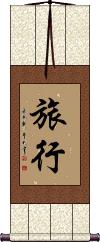
旅行 means journey or travels. It is sometimes used to refer to a vacation.
If you like a good adventure, maybe this is the word for you.
Journey / Travel
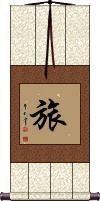
旅 is a single Chinese character, Japanese Kanji, and old Korean Hanja that means trip, travel, or journey.
In an older context, this could refer to an army brigade or a 500-man battalion from the Zhou-dynasty Chinese army.
Adventure
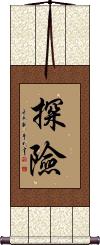
If you lead a life of adventure (like I do), a 探險 wall scroll is for you.
Alone, the first character can mean “to explore,” “to search out,” or “to scout.” The second character holds the meanings of “dangerous” and “rugged.” Together these two characters create the word that means “adventure” or “to explore.”
探険 is a modern Japanese Kanji version, but it more precisely means exploration or expedition rather than adventure. 探險 is the old/ancient Japanese version used before WWII. Let us know if you want the modern Japanese version instead.
See Also: Bon Voyage
Better to Travel 10,000 Miles than Read 10,000 Books
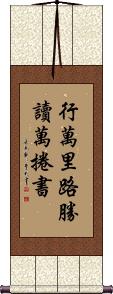
行万里路胜读万卷书 translates a few ways:
To travel ten thousand miles beats reading ten-thousand books.
Better to travel ten thousand li than to read ten thousand books. (a “li” is an ancient Chinese mile)
Traveling thousands of miles is better than reading thousands of books.
No matter how you slice it, this Chinese proverb is claiming that experience is more profound and meaningful than what you can get from a book. Go do it! Don't just read about it.
Read 10,000 Books, Travel 10,000 Miles
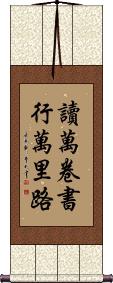
讀萬卷書行萬里路 is a lifelong suggestion for expanding your horizons by gaining knowledge, experience, and seeing the world.
Of course, this was written long ago when it was hard to travel 10,000 miles (at least 1000 years before the invention of the airplane).
With air travel and the business I'm in, I often achieve that lifetime goal on a monthly basis.
However, I am a little behind in the book count.
Note: An ancient Chinese mile (里 or lǐ) referred to in this proverb is about a third of a British/American mile. However, at that time, this was a great distance to travel.
Adventure
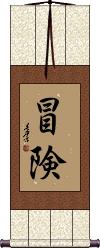
冒険 is a common Japanese way to say “Adventure.”
The first character can mean “to risk,” “to defy” or “to dare.” The second character means “inaccessible place” or “impregnable position.” Together, you get the idea of why these two characters mean adventure when put them together in Japanese.
Note: The second character is a morphed Japanese Kanji. The original Chinese version is also available and holds the same root meaning.
Adventure
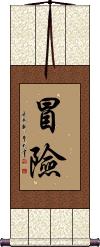
冒險 is another Chinese and Korean word for “Adventure.”
This is more of a “risk-taking” version of adventure.
The first character can mean “brave” and “bold.” The second character means “dangerous” and “rugged.” Together they can be defined as a word meaning “adventure” in Chinese and Korean.
Note: Some dictionaries translate these two characters as “take a risk.”
Smooth Sailing
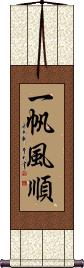
一帆風順 is just what you think it means. It suggests that you are on a trouble-free voyage through life, or literally on a sailing ship or sailboat. It is often used in China as a wish for good luck on a voyage or as you set out on a new quest or career in your life. Some may use this in place of “bon voyage.”
The literal meaning is “Once you raise your sail, you will get the wind you need, and it will take you where you want to go.” Another way to translate it is “Your sail and the wind follow your will.”
This is a great gift for a mariner, sailor, adventurer, or someone starting a new career.
Note: Can be understood in Korean Hanja but is rarely used.
See Also: Bon Voyage | Adventure
Traveler / To Live Abroad
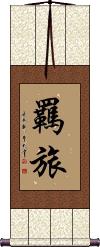
羈旅 is a Chinese and Japanese title for traveler/traveller, to live abroad, to be traveling, or just travel.
I Climbed the Great Wall

登长城 means to ascend or to climb the Great Wall of China.
登長城 is the poetic and native way to express this feat.
登 means “to ascend” and is a classical verb used in inscriptions, poems, and calligraphy.
长城 is the title of the Great Wall.
This three-character phrase is concise and implies achievement rather than casual travel.
A Bright Future
Incredible 10,000-Mile Flight of the Peng
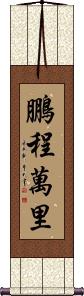
鵬程萬里 is an ancient Chinese proverb used in modern times to wish someone a long and successful career.
It's really about the 10,000 Flight of the Peng (Peng, also known as Roc is a mythical fish that can turn into a bird and take flight).
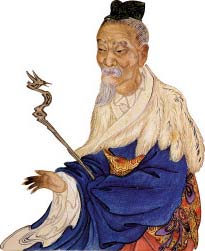
莊子
Zhuangzi or Chuang Tzu
Breaking down each character:
1. Peng or Roc (a kind of bird).
2. Journey (in this case, a flight).
3. 10,000 (Ten Thousand).
4. Li is a unit of distance often referred to as a “Chinese Mile,” though the real distance is about half a kilometer.
Direct Translation: “Peng's Journey [of] 10,000 Li.”
Literal meaning: “The 10,000-Li Flying Range Of The Roc.”
Perceived meaning: “To have a bright future” or “To go far.”
This proverb/idiom comes from the book of Zhuangzi or Chuang Tzu. It tells the tale of a huge fish that could turn into a gigantic bird. This bird was called a “peng” and was many miles long. This legendary size allowed the Peng to fly from the Northern Sea to the Southern Sea in a single bound.
Wishing someone “a Peng's Journey of 10,000 Li” will imply that they can travel far without stopping and will have great success, a long career, and a prosperous future.
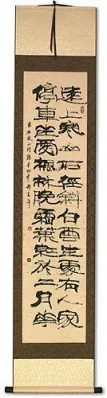
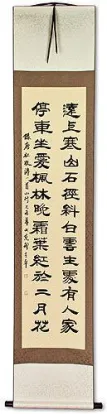
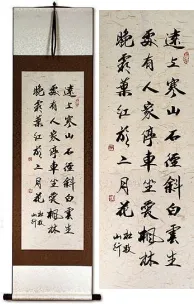
Mountain Travels Poem by Dumu

This poem was written almost 1200 years ago during the Tang dynasty.
It depicts traveling up a place known as Cold Mountain, where some hearty people have built their homes. The traveler is overwhelmed by the beauty of the turning leaves of the maple forest that surrounds him just as night overtakes the day, and darkness prevails. His heart implores him to stop, and take in all of the beauty around him.
First, before you get to the full translation, I must tell you that Chinese poetry is a lot different than what we have in the west. Chinese words simply don't rhyme in the same way that English or other western languages do. Chinese poetry depends on rhythm and a certain beat of repeated numbers of characters.
I have done my best to translate this poem keeping a certain feel of the original poet. But some of the original beauty of the poem in its original Chinese will be lost in translation.
Far away on Cold Mountain, a stone path leads upwards.
Among white clouds, people's homes reside.
Stopping my carriage I must, as to admire the maple forest at nights fall.
In awe of autumn leaves showing more red than even flowers of early spring.
Hopefully, this poem will remind you to stop, and “take it all in” as you travel through life.
The poet's name is “Du Mu” in Chinese that is: 
 .
.
The title of the poem, “Mountain Travels” is: 

You can have the title, poet's name, and even “Tang Dynasty” written as an inscription on your custom wall scroll if you like.
More about the poet:
Dumu lived from 803-852 AD and was a leading Chinese poet during the later part of the Tang dynasty.
He was born in Chang'an, a city in central China and the former capital of the ancient Chinese empire in 221-206 BC. In present-day China, his birthplace is currently known as Xi'an, the home of the Terracotta Soldiers.
He was awarded his Jinshi degree (an exam administered by the emperor's court which leads to becoming an official of the court) at the age of 25 and went on to hold many official positions over the years. However, he never achieved a high rank, apparently because of some disputes between various factions, and his family's criticism of the government. His last post in the court was his appointment to the office of Secretariat Drafter.
During his life, he wrote scores of narrative poems, as well as a commentary on the Art of War and many letters of advice to high officials.
His poems were often very realistic and often depicted everyday life. He wrote poems about everything, from drinking beer in a tavern to weepy poems about lost love.
The thing that strikes you most is the fact even after 1200 years, not much has changed about the beauty of nature, toils, and troubles of love and beer drinking.
Better Late Than Never
It's Never Too Late Too Mend
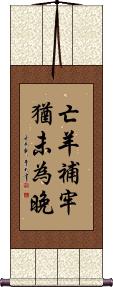
Long ago in what is now China, there were many kingdoms throughout the land. This time period is known as “The Warring States Period” by historians because these kingdoms often did not get along with each other.
Sometime around 279 B.C. the Kingdom of Chu was a large but not particularly powerful kingdom. Part of the reason it lacked power was the fact that the King was surrounded by “yes men” who told him only what he wanted to hear. Many of the King's court officials were corrupt and incompetent which did not help the situation.
The King was not blameless himself, as he started spending much of his time being entertained by his many concubines.
One of the King's ministers, Zhuang Xin, saw problems on the horizon for the Kingdom, and warned the King, “Your Majesty, you are surrounded by people who tell you what you want to hear. They tell you things to make you happy and cause you to ignore important state affairs. If this is allowed to continue, the Kingdom of Chu will surely perish, and fall into ruins.”
This enraged the King who scolded Zhuang Xin for insulting the country and accused him of trying to create resentment among the people. Zhuang Xin explained, “I dare not curse the Kingdom of Chu but I feel that we face great danger in the future because of the current situation.” The King was simply not impressed with Zhuang Xin's words.
Seeing the King's displeasure with him and the King's fondness for his court of corrupt officials, Zhuang Xin asked permission from the King that he may take leave of the Kingdom of Chu, and travel to the State of Zhao to live. The King agreed, and Zhuang Xin left the Kingdom of Chu, perhaps forever.
Five months later, troops from the neighboring Kingdom of Qin invaded Chu, taking a huge tract of land. The King of Chu went into exile, and it appeared that soon, the Kingdom of Chu would no longer exist.
The King of Chu remembered the words of Zhuang Xin and sent some of his men to find him. Immediately, Zhuang Xin returned to meet the King. The first question asked by the King was “What can I do now?”
Zhuang Xin told the King this story:
A shepherd woke one morning to find a sheep missing. Looking at the pen saw a hole in the fence where a wolf had come through to steal one of his sheep. His friends told him that he had best fix the hole at once. But the Shepherd thought since the sheep is already gone, there is no use fixing the hole.
The next morning, another sheep was missing. And the Shepherd realized that he must mend the fence at once. Zhuang Xin then went on to make suggestions about what could be done to reclaim the land lost to the Kingdom of Qin, and reclaim the former glory and integrity of the Kingdom of Chu.
The Chinese idiom shown above came from this reply from Zhuang Xin to the King of Chu almost 2,300 years ago.
It translates roughly into English as...
“Even if you have lost some sheep, it's never too late to mend the fence.”
This proverb, 亡羊补牢犹未为晚, is often used in modern China when suggesting in a hopeful way that someone change their ways, or fix something in their life. It might be used to suggest fixing a marriage, quitting smoking, or getting back on track after taking an unfortunate path in life among other things one might fix in their life.
I suppose in the same way that we might say, “Today is the first day of the rest of your life” in our western cultures to suggest that you can always start anew.
Note: This does have Korean pronunciation but is not a well-known proverb in Korean (only Koreans familiar with ancient Chinese history would know it). Best if your audience is Chinese.
This in-stock artwork might be what you are looking for, and ships right away...
Gallery Price: $160.00
Your Price: $88.77

Gallery Price: $52.00
Your Price: $28.88
These search terms might be related to Travel:
A Journey of 1000 Miles Begins With a Single Step
A Journey of 1000 Miles Feels Like One
Accept the Situation and Move On
Accept Your Mistake and Move On
Bon Voyage
Go Kan Ryu
Go With the Flow
Go-Dan / 5th Degree Black Belt
It is the Journey, Not the Destination
Journey / Travel
Journey of Life
Journey to the West
Life is a Journey
Move on / Change Way of Thinking
Pleasant Journey
Release / Let Go
The Destination is Nothing Without the Journey
The Game of Weiqi / Weichi / Go
The following table may be helpful for those studying Chinese or Japanese...
| Title | Characters | Romaji (Romanized Japanese) | Various forms of Romanized Chinese | |
| Journey Travel | 旅行 | ryokou / ryoko | lǚ xíng / lv3 xing2 / lv xing / lvxing | lü hsing / lühsing |
| Journey Travel | 旅 | ryo / tabi | lǚ / lu:3 / lu: | lü |
| Adventure | 探險 探险 / 探険 | tanken | tàn xiǎn / tan4 xian3 / tan xian / tanxian | t`an hsien / tanhsien / tan hsien |
| Better to Travel 10,000 Miles than Read 10,000 Books | 行萬里路勝讀萬捲書 行万里路胜读万卷书 | xíng wàn lǐ lù shèng dú wàn juǎn shū xing2 wan4 li3 lu4 sheng4 du2 wan4 juan3 shu1 xing wan li lu sheng du wan juan shu | hsing wan li lu sheng tu wan chüan shu | |
| Read 10,000 Books, Travel 10,000 Miles | 讀萬卷書行萬里路 读万卷书行万里路 | dú wàn juǎn shū, xíng wàn lǐ lù du2 wan4 juan3 shu1 xing2 wan4 li3 lu4 du wan juan shu xing wan li lu duwanjuanshuxingwanlilu | tu wan chüan shu hsing wan li lu | |
| Adventure | 冒険 | bou ken / bo ken | ||
| Adventure | 冒險 冒险 | mào xiǎn / mao4 xian3 / mao xian / maoxian | mao hsien / maohsien | |
| Smooth Sailing | 一帆風順 一帆风顺 | yī fán fēng shùn yi1 fan2 feng1 shun4 yi fan feng shun yifanfengshun | i fan feng shun ifanfengshun |
|
| Traveler To Live Abroad | 羈旅 羁旅 | kiryo | jī lǚ / ji1 lv3 / ji lv / jilv | chi lü / chilü |
| I Climbed the Great Wall | 登長城 登长城 | dēng cháng chéng deng1 chang2 cheng2 deng chang cheng dengchangcheng | teng ch`ang ch`eng tengchangcheng teng chang cheng |
|
| A Bright Future | 鵬程萬里 鹏程万里 | péng chéng wàn lǐ peng2 cheng2 wan4 li3 peng cheng wan li pengchengwanli | p`eng ch`eng wan li pengchengwanli peng cheng wan li |
|
| Mountain Travels Poem by Dumu | 遠上寒山石徑斜白雲生處有人家停車坐愛楓林晚霜葉紅於二月花 远上寒山石径斜白云生处有人家停车坐爱枫林晚霜叶红于二月花 | yuǎn shàng hán shān shí jìng xiá bái yún shēng chù yǒu rén jiā tíng chē zuò ài fēng lín wǎn shuàng yè hóng yú èr yuè huā yuan3 shang4 han2 shan1 shi2 jing4 xia2 bai2 yun2 sheng1 chu4 you3 ren2 jia1 ting2 che1 zuo4 ai4 feng1 lin2 wan3 shuang4 ye4 hong2 yu2 er4 yue4 hua1 yuan shang han shan shi jing xia bai yun sheng chu you ren jia ting che zuo ai feng lin wan shuang ye hong yu er yue hua | yüan shang han shan shih ching hsia pai yün sheng ch`u yu jen chia t`ing ch`e tso ai feng lin wan shuang yeh hung yü erh yüeh hua yüan shang han shan shih ching hsia pai yün sheng chu yu jen chia ting che tso ai feng lin wan shuang yeh hung yü erh yüeh hua |
|
| Better Late Than Never | 亡羊補牢猶未為晚 亡羊补牢犹未为晚 | wáng yáng bǔ láo yóu wèi wéi wǎn wang2 yang2 bu3 lao2 you2 wei4 wei2 wan3 wang yang bu lao you wei wei wan | wang yang pu lao yu wei wei wan wangyangpulaoyuweiweiwan |
|
| In some entries above you will see that characters have different versions above and below a line. In these cases, the characters above the line are Traditional Chinese, while the ones below are Simplified Chinese. | ||||

Successful Chinese Character and Japanese Kanji calligraphy searches within the last few hours...



