Many custom options...


And formats...



Qi in Chinese / Japanese...
Buy a Qi calligraphy wall scroll here!
Personalize your custom “Qi” project by clicking the button next to your favorite “Qi” title below...
Qi Gong / Chi Kung
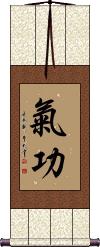
氣功 or Qigong is the title of a technique that is somewhere between medical practice, meditation, and in some cases, religion.
The definition is blurred depending on which school of Qigong you are following. In some cases, it is even incorporated with martial arts.
Some people (even Chinese people) mix this title with Tai Chi (Tai Qi) exercises.
Lately, in China, people will claim to practice Tai Chi rather than Qigong because the Qigong title was recently used as a cover for an illegal pseudo-religious movement in China with the initials F.G. or F.D. (I can not write those names here for fear of our website being banned in China).
You can learn those names and more here: Further info about Qigong
If you are wondering why I wrote “Qi Gong” and “Chi Kung” as the title of this calligraphy entry, I should teach you a little about the various ways in which Chinese can be Romanized. One form writes this as “Chi Kung” or “Chikung” (Taiwan). In the mainland and elsewhere, it is Romanized as “Qi Gong” or “Qigong.” The pronunciation is the same in Taiwan, mainland, and Singapore Mandarin. Neither Romanization is exactly like English. If you want to know how to say this with English rules, it would be something like “Chee Gong” (but the “gong” has a vowel sound like the “O” in “go”).
Romanization is a really confusing topic and has caused many Chinese words to be mispronounced in the west. One example is “Kung Pao Chicken,” which should actually be more like “Gong Bao” with the “O” sounding like “oh” for both characters. Neither the Romanization system in Taiwan nor the Mainland is perfect, in my opinion, and leads to many misunderstandings.
In modern Japan, you may see this written as 気功, but the original 氣功 is still recognized. If you need the Japanese version, please contact me.
Three Treasures of Chinese Medicine
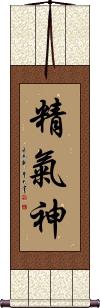
精, 氣, 神 are the characters jing, qi, and shen.
As a set, these three characters are known in English as the treasures of traditional Chinese medicine, the treasures of Qi Gong, or the three treasures of Taoism / Daoism.
Sometimes this set is titled 三寶 (sānbǎo) or “three treasures,” but here, we're writing each treasure out.
Here's how these characters are perceived in this context...
Jing: nutritive essence; refined; perfected; pure
Qi: vitality; energy; force; breath; vigor
Shen: spirit; soul; mind; being
To keep it simple, you can use “essence, vitality, and spirit” to define these.
Life Energy / Spiritual Energy
Chi Energy: Essence of Life / Energy Flow
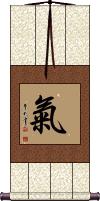
This 氣 energy flow is a fundamental concept of traditional Asian culture.
氣 is romanized as “Qi” or “Chi” in Chinese, “Gi” in Korean, and “Ki” in Japanese.
Chi is believed to be part of everything that exists, as in “life force” or “spiritual energy.” It is most often translated as “energy flow” or literally as “air” or “breath.” Some people will simply translate this as “spirit,” but you must consider the kind of spirit we're talking about. I think this is weighted more toward energy than spirit.
The character itself is a representation of steam (or breath) rising from rice. To clarify, the character for rice looks like this: 
Steam was apparently seen as visual evidence of the release of “life energy” when this concept was first developed. The Qi / Chi / Ki character is still used in compound words to mean steam or vapor.
The etymology of this character is a bit complicated. It's suggested that the first form of this character from bronze script (about 2500 years ago) looked like these samples: 

However, it was easy to confuse this with the character for the number three. So the rice radical was added by 221 B.C. (the exact time of this change is debated). This first version with the rice radical looks like this: 
The idea of Qi / Chi / Ki is really a philosophical concept. It's often used to refer to the “flow” of metaphysical energy that sustains living beings. Yet there is much debate that has continued for thousands of years as to whether Qi / Chi / Ki is pure energy or consists partially or fully of matter.
You can also see the character for Qi / Chi / Ki in common compound words such as Tai Chi / Tai Qi, Aikido, Reiki, and Qi Gong / Chi Kung.
In the modern Japanese Kanji, the rice radical has been changed into two strokes that form an X.
 The original and traditional Chinese form is still understood in Japanese, but we can also offer that modern Kanji form in our custom calligraphy. If you want this Japanese Kanji, please click on the character to the right instead of the “Select and Customize” button above.
More language notes: This is pronounced like “chee” in Mandarin Chinese, and like “key” in Japanese.
This is also the same way to write this in Korean Hanja where it is Romanized as “gi” and pronounced like “gee” but with a real G-sound, not a J-sound.
Though Vietnamese no longer use Chinese characters in their daily language, this character is still widely known in Vietnam.
See Also: Energy | Life Force | Vitality | Life | Birth | Soul
This in-stock artwork might be what you are looking for, and ships right away...

Gallery Price: $31.00
Your Price: $16.88
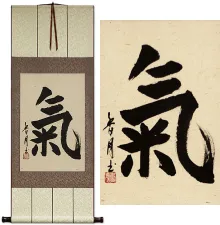
Gallery Price: $300.00
Your Price: $109.88
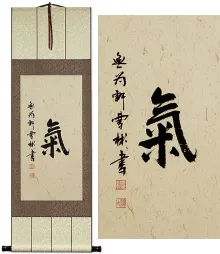
Gallery Price: $106.00
Your Price: $58.77
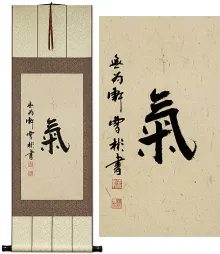
Gallery Price: $106.00
Your Price: $58.77

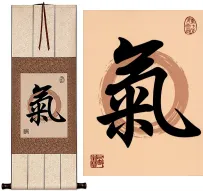
Gallery Price: $90.00
Your Price: $49.88
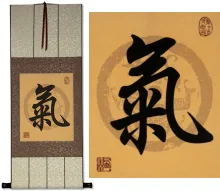
Gallery Price: $90.00
Your Price: $49.88
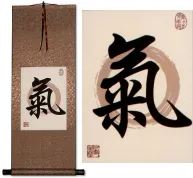
Gallery Price: $65.00
Your Price: $39.88
Not the results for qi that you were looking for?
Below are some entries from our dictionary that may match your qi search...
| Characters If shown, 2nd row is Simp. Chinese |
Pronunciation Romanization |
Simple Dictionary Definition |
七 see styles |
qī qi1 ch`i chi nano なの |
More info & calligraphy: Seven(numeric) seven (chi: qī); (female given name) Nano sapta, seven. |
棋 see styles |
qí qi2 ch`i chi go ご |
More info & calligraphy: Chessgo (board game of capturing territory) |
氣 气 see styles |
qì qi4 ch`i chi ki き |
More info & calligraphy: Life Energy / Spiritual Energy(out-dated kanji) (1) spirit; mind; heart; (2) nature; disposition; (3) motivation; intention; (4) mood; feelings; (5) ambience; atmosphere; mood energy |
齊 齐 see styles |
qí qi2 ch`i chi hitoshi ひとし |
More info & calligraphy: Uniform / Complete / Perfect / OrderQi (kingdom in China during the Spring and Autumn Period and the Period of the Warring States); Ch'i; (male given name) Hitoshi Even, level, equal, uniform; complete, perfect; equalize; tranquillize; alike; all; at the same time, altogether. |
七月 see styles |
qī yuè qi1 yue4 ch`i yüeh chi yüeh natsuki なつき |
More info & calligraphy: July(adverbial noun) July; (female given name) Natsuki |
乞灑 乞洒 see styles |
qǐ sǎ qi3 sa3 ch`i sa chi sa kisha |
More info & calligraphy: Ksaya / Omega / Finality |
企望 see styles |
qǐ wàng qi3 wang4 ch`i wang chi wang kibou / kibo きぼう |
More info & calligraphy: Looking Forward / Hoping(noun/participle) (obsolete) making a plan and anticipating its fruition |
企鵝 企鹅 see styles |
qǐ é qi3 e2 ch`i o chi o kiga きが |
More info & calligraphy: Penguin(obsolete) (See ペンギン) penguin |
勇氣 勇气 see styles |
yǒng qì yong3 qi4 yung ch`i yung chi |
More info & calligraphy: Bravery / Courage |
十七 see styles |
shí qī shi2 qi1 shih ch`i shih chi tona とな |
More info & calligraphy: 17 Seventeen17; seventeen; (surname) Tona |
古奇 see styles |
gǔ qí gu3 qi2 ku ch`i ku chi |
More info & calligraphy: Gooch |
啟發 启发 see styles |
qǐ fā qi3 fa1 ch`i fa chi fa |
More info & calligraphy: To inspire or enlighten |
啟示 启示 see styles |
qǐ shì qi3 shi4 ch`i shih chi shih |
More info & calligraphy: Inspire |
啟蒙 启蒙 see styles |
qǐ méng qi3 meng2 ch`i meng chi meng |
More info & calligraphy: Enlightenment |
啟迪 启迪 see styles |
qǐ dí qi3 di2 ch`i ti chi ti |
More info & calligraphy: Open the Minds of the Next Generation To Stimulate Thinking |
圍棋 围棋 see styles |
wéi qí wei2 qi2 wei ch`i wei chi |
More info & calligraphy: The Game of Weiqi / Weichi / Go |
奇瑞 see styles |
qí ruì qi2 rui4 ch`i jui chi jui kizui きずい |
More info & calligraphy: Cheryauspicious (good) omen an auspicious omen |
奇跡 奇迹 see styles |
qí jì qi2 ji4 ch`i chi chi chi kiseki きせき |
More info & calligraphy: Miracle(noun - becomes adjective with の) miracle; wonder; marvel; (female given name) Kiseki |
奇蹟 奇迹 see styles |
qí jì qi2 ji4 ch`i chi chi chi kiseki きせき |
More info & calligraphy: Miracle / Marvel(noun - becomes adjective with の) miracle; wonder; marvel |
奇遇 see styles |
qí yù qi2 yu4 ch`i yü chi yü kiguu / kigu きぐう |
More info & calligraphy: Fortuitous Meeting(adj-na,adj-no,n) unexpected meeting; coincidence |
好奇 see styles |
hào qí hao4 qi2 hao ch`i hao chi kouki / koki こうき |
More info & calligraphy: Curious / Inquisitiveinquisitiveness; (surname) Kōki |
川崎 see styles |
chuān qí chuan1 qi2 ch`uan ch`i chuan chi yamazaki やまざき |
More info & calligraphy: KawasakiKawasaki (city); (surname) Yamazaki |
枸杞 see styles |
gǒu qǐ gou3 qi3 kou ch`i kou chi kuko くこ |
More info & calligraphy: Wolfberry(kana only) Chinese matrimony vine (Lycium chinense); Chinese wolfberry; goji; (surname) Kuko a kind of tree |
氣力 气力 see styles |
qì lì qi4 li4 ch`i li chi li |
More info & calligraphy: Strength / Vigor / Energy |
氣功 气功 see styles |
qì gōng qi4 gong1 ch`i kung chi kung |
More info & calligraphy: Qi Gong / Chi Kung |
氣息 气息 see styles |
qì xī qi4 xi1 ch`i hsi chi hsi kisoku |
More info & calligraphy: Breath of Lifebreath |
氣魄 气魄 see styles |
qì pò qi4 po4 ch`i p`o chi po |
More info & calligraphy: Positive Attitude |
硬氣 硬气 see styles |
yìng qì ying4 qi4 ying ch`i ying chi |
More info & calligraphy: Strong Willed |
祈禱 祈祷 see styles |
qí dǎo qi2 dao3 ch`i tao chi tao kitō |
More info & calligraphy: Prayer / Praying祈念; 祈請 To pray, beg, implore, invite. |
空氣 空气 see styles |
kōng qì kong1 qi4 k`ung ch`i kung chi |
More info & calligraphy: Air / Atmosphere |
Click here for more qi results from our dictionary
The following table may be helpful for those studying Chinese or Japanese...
| Title | Characters | Romaji (Romanized Japanese) | Various forms of Romanized Chinese | |
| Qi Gong Chi Kung | 氣功 气功 | ki kou / kikou / ki ko | qì gōng / qi4 gong1 / qi gong / qigong | ch`i kung / chikung / chi kung |
| Three Treasures of Chinese Medicine | 精氣神 精气神 | jīng qì shén jing1 qi4 shen2 jing qi shen jingqishen | ching ch`i shen chingchishen ching chi shen |
|
| Life Energy Spiritual Energy | 氣 气 / 気 | ki | qì / qi4 / qi | ch`i / chi |
| In some entries above you will see that characters have different versions above and below a line. In these cases, the characters above the line are Traditional Chinese, while the ones below are Simplified Chinese. | ||||

Successful Chinese Character and Japanese Kanji calligraphy searches within the last few hours...



