I am shipping orders on Thursday this week. News and More Info
Buy a Second Chance calligraphy wall scroll here!
Personalize your custom “Second Chance” project by clicking the button next to your favorite “Second Chance” title below...
1. Fate / Opportunity / Chance
2. Serendipity / Chance Discovery
4. Opportunity
6. Opportunity Knocks Only Once
7. Serendipity
8. Yuan Fen
9. Opportunity Knocks Only Once
10. Serendipity
11. Failure is the Mother of Success
12. Don’t Panic
13. Serendipity / Happy Coincidence
14. Serendipity / Nice Coincidence
15. Serendipity / Lucky Coincidence
16. The More We Sweat in Training, The Less We Bleed in Battle
17. Let Us Try
The Buddhist idea of Fate
因緣 is the Buddhist concept of a chance meeting or an opportunity that presents itself by fate.
Sometimes this is used to describe a cosmic chain of events or cause and effect.
It also is used to describe predestined relationships between people - and sometimes married couples (although if you want one about marriage, try this: Fate / Destiny of Lovers.
因緣 can also be translated as origin, karma, destiny, affinity, connection, and relation. This all depends on context - seen alone on a wall scroll, this will be read with a “fate/chance” meaning by a Chinese person or a Korean person who can read Hanja.
The more complex definition of this word would be, “Direct causes and indirect conditions, which underlie the actions of all things.”
This concept is known as nidana in the original Sanskrit. Also sometimes presented as hetupratyaya (or “hetu and prataya”), which I believe is Pali.
Note: Japanese will tend to use this version of the second Kanji: ![]()
If you order this from the Japanese master calligrapher, expect that you’ll get this version. However, this word often carries a negative connotation in Japanese (bad things happen), as it is used that way in a certain Japanese idiom. Therefore, this may not be the best choice if Japanese is your target language.
See Also: Buddhism | Opportunity
偶然の発見 is a way to express serendipity in Japanese. This title is more about the discovery by chance, like the melting candy bar in a Bell radar/communications laboratory that led to the invention of the microwave oven.
The first two Kanji mean incidentally, by chance, randomly, unexpectedly, suddenly, accident, fortuity, or by coincidence.
In the middle is a possessive article that connects these words/ideas.
The last two Kanji mean discovery, detection, or finding.
緣份 specifically represents the fate or destiny that brings two people together.
This is like the chance meeting of two people that leads sometime later to marriage.
This could also be the chance meeting of two business people who become partners and build a huge and successful company.
This idea is often associated with a fateful meeting leading to good fortune.
Some will define this word as “Destiny brings you two together” or “Meant to be.”
Note: The second character can also be written without the left radical, as shown to the right. If you have a preference, please let use know in the special instructions for your project. There is no difference in meaning or pronunciation, just two (alternate) ways to write the same character.
See Also: Soulmates | Good Fortune
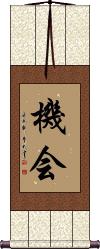
機会 is a common way to express “opportunity” in Japanese.
The first character means “chance,” and the second can be translated as “meeting.”
So in Japanese business, a “chance meeting” represents a real “opportunity.”
Note that this also means opportunity in Chinese, but it's more an oral or informal word in Mandarin. Also, the second Kanji is the same as the simplified version of the hui Chinese character.
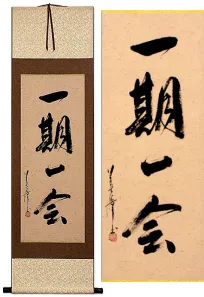
This Japanese title can be translated as “for this time only,” “chance meeting,” “one meeting, one opportunity,” “never again,” or “one chance in a lifetime.”
The characters literally mean “one time one meeting” - of course, the Kanji characters have meaning far beyond a direct translation like this.
Some might use this proverb to talk of an opportunity that presents itself just once in your life. It could also be a one-and-only chance meeting with your true soul mate. An expression of any event that might happen once in a lifetime.
This is primarily a Japanese title, however, there is also a Traditional Chinese (and old Korean) version of this proverb. Just the last character is different.
The traditional form was used in Japan before WWII and in Korea prior to 1900. This title is somewhat known in China.
If you want the older traditional form, just click on the character to the right.
緣分 or Yuan Fen is the fate or chance that brings people together.
This can also mean a predestined affinity or relationship. Basically this is about destiny.
Short Version
偶然 is a short way to write serendipity in Chinese, Japanese Kanji, and old Korean Hanja.
This can also be translated as incidentally, by chance, randomly, unexpectedly, suddenly, accident, fortuity, or by coincidence.
失败是成功之母 is a Chinese and Korean proverb that means “Every failure that you experience is a chance to learn from it and find success.”
Knowing what does not work is just as important as finding out what does work.
See Also: Experience is the Mother of Wisdom
失敗は成功の母 is a Japanese proverb that means exactly what you think.
Every failure that you experience is a chance to learn from it and find success.
Knowing what does not work is just as important as finding out what does work.
Note: This is the Japanese version of an ancient Chinese proverb.
Note: Because this selection contains some special Japanese Hiragana characters, it should be written by a Japanese calligrapher.
See Also: Experience is the Mother of Wisdom
If you need a strange homage to the Hitchhiker's Guide to the Galaxy, this might be it.
不要恐慌 says “Don't Panic” in Chinese. A Chinese person who is not familiar with this masterpiece of a book, will not see the humor but that will be your chance to suggest reading some Douglas Adams (which has been translated into Chinese).
幸せな偶然 is one of many ways to express serendipity in Japanese.
The first two characters mean happiness, good fortune, luck, or blessing.
In the middle is a Japanese Hiragana character connecting these words/ideas.
The last two Kanji mean incidentally, by chance, randomly, unexpectedly, suddenly, accident, fortuity, or by coincidence.
Note: Because this selection contains some special Japanese Hiragana characters, it should be written by a Japanese calligrapher.
素敵な偶然 is a common way to express serendipity in Japanese.
The first two characters mean nice, lovely, dreamy, beautiful, great, fantastic, superb, or cool.
In the middle is a Japanese Hiragana character connecting these words/ideas.
The last two Kanji mean incidentally, by chance, randomly, unexpectedly, suddenly, accident, fortuity, or by coincidence.
幸運な偶然 is one of many ways to express serendipity in Japanese.
The first two Kanji mean fortunate, lucky, fortune, or good luck.
In the middle is a Japanese Hiragana character connecting these words/ideas.
The last two Kanji mean incidentally, by chance, randomly, unexpectedly, suddenly, accident, fortuity, or by coincidence.
There is more than one way to translate the ancient Chinese military proverb, 平时多流汗战时少流血. Here are a few interpretations:
A drop of sweat spent in a drill is a drop of blood saved in war.
More practice will give one a better chance of success in real situations.
The more you sweat in training, the less you bleed in battle.
I heard this many times when I was a U.S. Marine but I had no idea at the time that it was actually an old Chinese proverb.
See Also: Blood Sweat and Tears
Essayons
嘗試 is a close match for the English phrase “let us try” or the French word “Essayons.”
Essayons the motto of Combat Engineers in the U.S. Army.
This word can also be translated as “to try” or “to attempt.”
Even if you're not a Combat Engineer, this word should inspire you to attempt to accomplish difficult things. If you don't try, you are certain to fail; if you do try, at least there is a chance of success.
The worst thing is not failure, the worst thing is not trying at all.
The invisible force that brings people together forever
緣 represents the fate that brings and bonds people together.
緣 is a complicated single character. It can mean a lot of different things depending on how you read it.
In Japanese, it can mean fate, destiny, a mysterious force that binds two people together, a relationship between two people, bond, link, connection, family ties, affinity, opportunity, or chance (to meet someone and start a relationship). It can also mean “someone to rely on,” relative, reminder, memento, or the female given name, Yori.
It's the same in Chinese, where it's defined as cause, reason, karma, fate, or predestined affinity.
In the Buddhist context, it's Pratyaya. This is the concept of indirect conditions, as opposed to direct causes. It's when something happens (meeting someone) by circumstance or a contributing environment. Instead of a direct cause or act, it is a conditioning cause without direct input or action by the involved people.
Occasionally, this character is used in a facetious way to say hem, seam, or edge of clothing. In this case, it's the seam that brings or holds the clothing together.
Note: Japanese will tend to use the variant of this Kanji shown to the right. If you want this version (and are ordering this from the Japanese master calligrapher), click on the Kanji at the right instead of the button above.
This in-stock artwork might be what you are looking for, and ships right away...
Gallery Price: $268.00
Your Price: $148.77
The following table may be helpful for those studying Chinese or Japanese...
| Title | Characters | Romaji (Romanized Japanese) | Various forms of Romanized Chinese | |
| Fate Opportunity Chance | 因緣 因缘 / 因縁 | in nen / innen | yīn yuán / yin1 yuan2 / yin yuan / yinyuan | yin yüan / yinyüan |
| Serendipity Chance Discovery | 偶然の発見 | guuzen no hakken guuzennohakken guzen no haken | ||
| Fate Chance Meeting | 緣份 / 緣分 缘份 / 缘分 | yuán fèn / yuan2 fen4 / yuan fen / yuanfen | yüan fen / yüanfen | |
| Opportunity | 機會 机会 | kikai | jī huì / ji1 hui4 / ji hui / jihui | chi hui / chihui |
| Once in a Lifetime | 一期一會 一期一会 | ichigo ichie ichigoichie | yī qī yī huì yi1 qi1 yi1 hui4 yi qi yi hui yiqiyihui | i ch`i i hui ichiihui i chi i hui |
| Opportunity Knocks Only Once | 機會隻敲一次門 机会只敲一次门 | jī huì zhǐ qiāo yī cì mén ji1 hui4 zhi3 qiao1 yi1 ci4 men2 ji hui zhi qiao yi ci men jihuizhiqiaoyicimen | chi hui chih ch`iao i tz`u men chihuichihchiaoitzumen chi hui chih chiao i tzu men |
|
| Serendipity | 偶然性 | ǒu rán xìng ou3 ran2 xing4 ou ran xing ouranxing | ou jan hsing oujanhsing |
|
| Yuan Fen | 緣分 缘分 | yuán fèn / yuan2 fen4 / yuan fen / yuanfen | yüan fen / yüanfen | |
| Opportunity Knocks Only Once | 機不可失時不再來 机不可失时不再来 | jī bù kě shī shí bù zài lái ji1 bu4 ke3 shi1 shi2 bu4 zai4 lai2 ji bu ke shi shi bu zai lai jibukeshishibuzailai | chi pu k`o shih shih pu tsai lai chipukoshihshihputsailai chi pu ko shih shih pu tsai lai |
|
| Serendipity | 偶然 | guu zen / guuzen / gu zen | ǒu rán / ou3 ran2 / ou ran / ouran | ou jan / oujan |
| Failure is the Mother of Success | 失敗是成功之母 失败是成功之母 | shī bài shì chéng gōng zhī mǔ shi1 bai4 shi4 cheng2 gong1 zhi1 mu3 shi bai shi cheng gong zhi mu shibaishichenggongzhimu | shih pai shih ch`eng kung chih mu shih pai shih cheng kung chih mu |
|
| Failure is the Mother of Success | 失敗は成功の母 | shippai wa seikou no haha shippaiwaseikounohaha shipai wa seiko no haha | ||
| Don’t Panic | 不要恐慌 | bú yào kǒng huāng bu2 yao4 kong3 huang1 bu yao kong huang buyaokonghuang | pu yao k`ung huang puyaokunghuang pu yao kung huang |
|
| Serendipity Happy Coincidence | 幸せな偶然 | shiawa se na guu zen shiawasenaguuzen shiawa se na gu zen | ||
| Serendipity Nice Coincidence | 素敵な偶然 | Su teki na guu zen Sutekinaguuzen Su teki na gu zen | ||
| Serendipity Lucky Coincidence | 幸運な偶然 | kou un na guu zen kouunnaguuzen ko un na gu zen | ||
| The More We Sweat in Training, The Less We Bleed in Battle | 平時多流汗戰時少流血 平时多流汗战时少流血 | píng shí duō liú hàn zhàn shí shǎo liú xuè ping2 shi2 duo1 liu2 han4 zhan4 shi2 shao3 liu2 xue4 ping shi duo liu han zhan shi shao liu xue | p`ing shih to liu shih shao liu hsüeh ping shih to liu shih shao liu hsüeh |
|
| Let Us Try | 嘗試 尝试 | cháng shì chang2 shi4 chang shi changshi | ch`ang shih changshih chang shih |
|
| The Mysterious Bond Between People | 緣 / 縁 缘 | en | yuán / yuan2 / yuan | yüan |
| In some entries above you will see that characters have different versions above and below a line. In these cases, the characters above the line are Traditional Chinese, while the ones below are Simplified Chinese. | ||||
Successful Chinese Character and Japanese Kanji calligraphy searches within the last few hours...

All of our calligraphy wall scrolls are handmade.
When the calligrapher finishes creating your artwork, it is taken to my art mounting workshop in Beijing where a wall scroll is made by hand from a combination of silk, rice paper, and wood.
After we create your wall scroll, it takes at least two weeks for air mail delivery from Beijing to you.
Allow a few weeks for delivery. Rush service speeds it up by a week or two for $10!
When you select your calligraphy, you'll be taken to another page where you can choose various custom options.
The wall scroll that Sandy is holding in this picture is a "large size"
single-character wall scroll.
We also offer custom wall scrolls in small, medium, and an even-larger jumbo size.
Professional calligraphers are getting to be hard to find these days.
Instead of drawing characters by hand, the new generation in China merely type roman letters into their computer keyboards and pick the character that they want from a list that pops up.
There is some fear that true Chinese calligraphy may become a lost art in the coming years. Many art institutes in China are now promoting calligraphy programs in hopes of keeping this unique form
of art alive.
Even with the teachings of a top-ranked calligrapher in China, my calligraphy will never be good enough to sell. I will leave that to the experts.
The same calligrapher who gave me those lessons also attracted a crowd of thousands and a TV crew as he created characters over 6-feet high. He happens to be ranked as one of the top 100 calligraphers in all of China. He is also one of very few that would actually attempt such a feat.
Check out my lists of Japanese Kanji Calligraphy Wall Scrolls and Old Korean Hanja Calligraphy Wall Scrolls.
Some people may refer to this entry as Second Chance Kanji, Second Chance Characters, Second Chance in Mandarin Chinese, Second Chance Characters, Second Chance in Chinese Writing, Second Chance in Japanese Writing, Second Chance in Asian Writing, Second Chance Ideograms, Chinese Second Chance symbols, Second Chance Hieroglyphics, Second Chance Glyphs, Second Chance in Chinese Letters, Second Chance Hanzi, Second Chance in Japanese Kanji, Second Chance Pictograms, Second Chance in the Chinese Written-Language, or Second Chance in the Japanese Written-Language.
1 people have searched for Second Chance in Chinese or Japanese in the past year.
Second Chance was last searched for by someone else on Dec 10th, 2025