Many custom options...


And formats...



Happiness and Joy in Chinese / Japanese...
Buy a Happiness and Joy calligraphy wall scroll here!
Personalize your custom “Happiness and Joy” project by clicking the button next to your favorite “Happiness and Joy” title below...
11. Doing good is the greatest source of happiness
12. Double Happiness
16. Happiness
17. Eternal Peace and Happiness
20. Happiness / Fortune / Lucky
21. A Life of Happiness and Prosperity
22. Double Happiness Guest Book
23. Be Happy
24. Happy Birthday
25. Happy / Laughter / Cheerful Bliss
26. Happy Marriage
27. A Life of Happiness and Prosperity
28. Serendipity / Happy Coincidence
29. Happy
31. 100 Years of Happy Marriage
32. Happy Buddha
33. Happy Birthday
34. Happy New Year
35. Happy Birthday
36. Happy Family
38. Happy Laughter
39. Better to be Happy than Rich
40. Optimism / Happy With Your Fate
41. Happy Family
42. Family Love / Domestic Bliss
43. Brahmavihara - The Four Immeasurables
44. You must endure a harsh winter to appreciate the warmth of springtime
45. Le
46. Radiance
47. Generosity
Happiness / Joyful / Joy
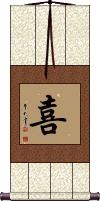
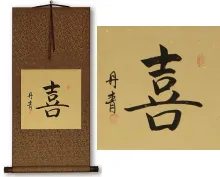
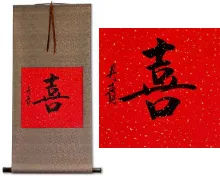
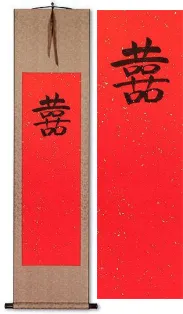
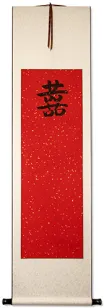
喜 is the Chinese, Japanese Kanji, and Korean Hanja for the kind of happiness known in the west as “joy.”
喜 can also be translated as rejoice, enjoyment, delighted, pleased, or “take pleasure in.” Sometimes it can mean “to be fond of” (in a certain context).
If you write two of these happiness/joy characters side by side, you create another character known in English as “double happiness,” which is a symbol associated with weddings and happy marriages.
There is another version of this character that you will find on our website with an additional radical on the left side (exactly same meaning, just an alternate form). The version of happiness shown here is the commonly written form in China, Japan and South Korea (banned in North Korea).
See Also: Contentment | Happiness | Joy
Happiness / Joy
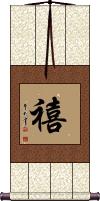
禧 is the type of happiness known in the west as “joy.”
The radical on the right side of this character is often seen alone (with the same meaning - and we do recommend that version because it's more universal).
Joyfulness / Happiness
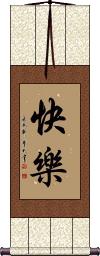
快樂 or joyfulness is an inner sense of peace and happiness.
You appreciate the gifts each day brings. Without joyfulness, when the fun stops, our happiness stops. Joy can carry us through hard times even when we are feeling very sad.
快樂 can also mean pleasure, enjoyment, delight, cheerfulness, or merry. In some ways, this is the essence that makes someone perceived as a charming person.
See Also: Happiness
School of Happiness
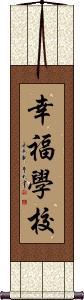
幸福學校 means “School of Happiness” or “Happiness School” in Chinese.
幸福 means happiness, happy, blessed, blessedness, joy, and/or well-being.
學校 means school or college.
Happiness in the Afterlife
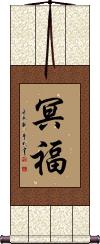
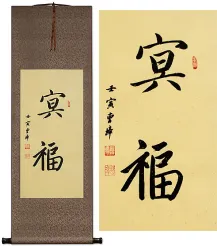
冥福 is an unusual Chinese, Japanese, and Korean term that means afterlife happiness, happiness in the next world, or the happiness of the dead.
Pursuit of Happiness
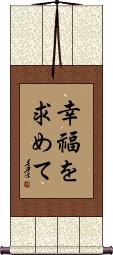
幸福を求めて is “Pursuit of Happiness” or “In Search of Happiness” in Japanese.
Here's how the characters break down:
幸福 (koufuku) happiness; blessedness; joy; well-being.
を (o) particle
求め (motome) to want; to seek; to pursue; to request
て (te) particle
Note: Because this selection contains some special Japanese Hiragana characters, it should be written by a Japanese calligrapher.
See Also: Follow Your Heart
Eternal Happiness
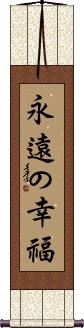
永遠の幸福 means “eternal happiness” in Japanese.
永遠 means eternal, eternity, perpetuity, forever, immortality, and permanence.
の is a possessive article which sort of makes this selection mean “happiness, of the eternal kind.”
幸福 means happiness, though this word can mean truly blessed, joy, happy, welfare, well-being, or fortunate.
Eternal Happiness
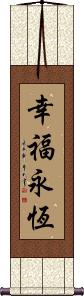
幸福永恆 is a short way to say eternal happiness in Chinese.
Breaking down the parts:
幸福 means happiness, happy, blessed, blessedness, joy, and/or well-being.
永恆 means eternal, everlasting, and/or forever.
Another way to write this is 永恆的幸福. It reverses the word order and adds a possessive article. I prefer the shorter version, which is slightly more natural in Chinese.
Love and Happiness
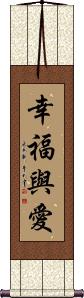
幸福與愛 is “happiness and love” in Chinese.
There is a suggestion of “good fortune” in the version of happiness used here.
Prosperity and Happiness
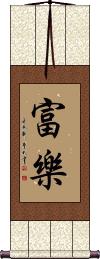
富樂 is the Chinese, Japanese Kanji, and old Korean Hanja for a title meaning prosperity and happiness.
If you have the desire to live in prosperity and happiness, this is for you.
Note: This title is often used in a Buddhist context.
School of Happiness
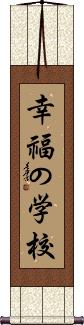
幸福の学校 means “School of Happiness” in Japanese.
This is not a common phrase in Japanese, but it will be understood.
Doing good is the greatest source of happiness
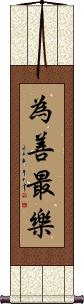
為善最樂 can mean “Doing good is the greatest source of happiness” or “doing good deeds brings the greatest joy.”
The origin is not known but is sometimes used in the context of Buddhism. However, this Chinese proverb or philosophy is a relatively mainstream idea of benevolence.
Double Happiness
(Happy wedding and marriage)
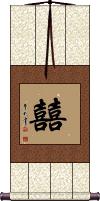
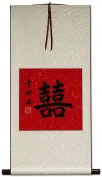
囍 is a common gift for Chinese couples getting married or newly married couples.
As we say in the west, “Two heads are better than one” Well, in the east, two “happinesses” are certainly better than one.
Some will suggest this is a symbol of two happinesses coming together. Others see it as a multiplication of happiness because of the union or marriage.
囍 is not really a character that is pronounced very often - it's almost exclusively used in written form. However, if pressed, most Chinese people will pronounce this “shuang xi” (double happy) although literally there are two “xi” characters combined in this calligraphy (but nobody will say “xi xi”).
 If you select this character, I strongly suggest the festive bright red paper for your calligraphy. Part of my suggestion comes from the fact that red is a good luck color in China, and this will add to the sentiment that you wish to convey with this scroll to the happy couple.
Pursuit of Happiness
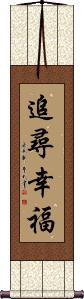
追尋幸福 is the best way to translate the English phrase “pursuit of happiness” into Chinese.
The first two characters mean “to pursue,” “to track down,” or “to search for.”
The last two mean happiness, happy, or being blessed.
See Also: Follow Your Heart
Seven Rules of Happiness
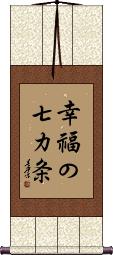
幸福の七カ条 is the title for the 7 rules of happiness in Japanese.
The rules themselves take up many space:
1. 成功や栄誉や勝ち負けを目的に、ことを行ってはいけない。
2. しないではいられないことをし続けなさい。
3. 他人との比較ではない、あくまで自分の楽しさを追及すべし。
4. 好きの力を信じる。
5. 才能と収入は別、努力は人を裏切ると心得よ。
6. 怠け者になりなさい。
7. 目に見えない世界を信じる。
...so this title is probably all you need.
Note: Because this selection contains some special Japanese Katakana characters, it should be written by a Japanese calligrapher.
Happiness / Contentment
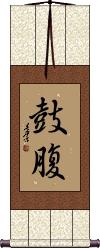
鼓腹 means happiness and contentment in Japanese Kanji.
The first Kanji represents your internal beat or drum.
The second Kanji represents your mind and body.
Together, it suggests that your internal rhythm or beat is regular, soothing, and at the proper tempo.
See Also: Salvation | Pleasure | Safety and Well-Being of the Family
Happiness
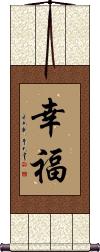
幸福 is a general state of happiness that can also be translated as truly blessed, welfare, well-being, or fortunate.
Eternal Peace and Happiness

永恆和平與幸福 means “Eternal Peace And Happiness” in Chinese.
Happiness / Contentment
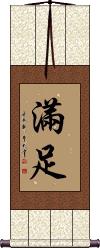
滿足 is the kind of happiness that involves being satisfied and content.
This can also suggest the actions of “to satisfy,” and “to meet the needs of.”
Other single-word definitions include satisfaction, contentment, sufficient, enough, adequate, full, or complete.
 In Japanese, the Kanji for this word is an alternate Chinese form. You can see and select this version at the right (recommended only if your audience is specifically Japanese).
See Also: Salvation | Contentment | Pleasure | Safety and Well-Being of the Family
Peace, Love, Happiness
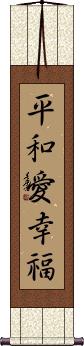
平和, 愛, 幸福 means “peace, love, happiness” in Japanese.
This is a word list, which is not the most natural kind of composition in Japanese (usually there is a subject, object, and verb - or a single word).
Peace, Love, Happiness
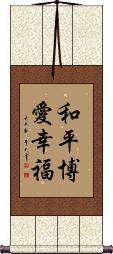
和平博愛幸福 is a word-list that means “peace, love, happiness,” in Chinese.
Word lists like this are not commonly-seen in China. Phrases with subject, verb, and object, or just single words are more natural for calligraphy artwork.
Happiness / Fortune / Lucky
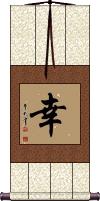
幸 can mean happiness, good fortune, good luck, and in the old days, good harvest or bounty.
Note: From Japanese, this character is sometimes romanized as “sachi,” and is often pronounced “kou” or sometimes “rei” when used in compound words with other Kanji.
A Life of Happiness and Prosperity
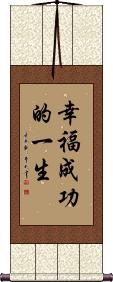
幸福成功的一生 means “A life of happiness and prosperity” or “A life of happiness and success.”
It's a very positive and inspirational wall scroll selection.
See Also: Prosperity
Double Happiness Guest Book
Customize a special Asian guest book for your wedding
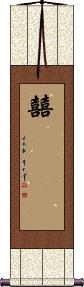
Start customizing a “Double Happiness Guest Book Wall Scroll” Here!
The paper panel length can be whatever you choose from 68cm to 135cm (27” to 53”).
If you don't mention what paper length you want in the special instructions tab (on the next page), we'll make it about 100cm (40”).
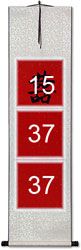
The medium-size scroll with a 33cm x 100cm (13” x 40”) paper panel can usually handle up to 89 signatures. That breaks down to 37 signatures per empty square and 15 signatures around the 囍 character. If you switch to a 135cm paper panel, add another 37 potential signatures.
We can splice two 135cm papers together, but that would be a crazy-long scroll. These are only estimates, your mileage may vary.
With silk panels, this will yield a wall scroll about 155cm (61”) long. That's enough for up to 89 signatures. Of course, that depends on if your guests just sign a brief salutation and name, or more verbose good wishes. Customer feedback is that 126 people can sign the 135cm long paper on a medium-sized scroll. If we go bigger than that, there will be a minor paper seam and an extra charge. Email me with your specifications if you need something special.
Most customers pick the festive red paper with gold flecks and white or ivory silk. Red is a good luck color in Chinese culture, thus the most popular choice. But, you can do any color combination that you want.
There is a long history of Chinese-character-use outside of mainland China. This Double Happiness character is also seen at weddings in Korea, Vietnam, Hong Kong, and Taiwan, as well as in Chinese communities in Thailand, Indonesia, and elsewhere. While Japan borrowed Chinese characters into their language, you won't see 囍 as often at Japanese weddings.
Be Happy
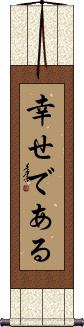
幸せである is a way to express the idea of “be happy” in Japanese.
Japanese grammar is far different than English, so the word order is the opposite of English. If you translated directly, you'd have something like “Happiness henceforth” or “Happiness hereafter.” The idea is to be happy from this moment on.
Note: Because this selection contains some special Japanese Hiragana characters, it should be written by a Japanese calligrapher.
Happy Birthday
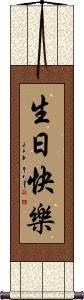
生日快樂 is how to write “Happy Birthday” in Chinese.
The first two characters mean “birthday,” and the second two characters mean “happiness,” or rather a wish for happiness.
Because a birthday only lasts one day per year, we strongly suggest that you find an appropriate and personal calligraphy gift that can be hung in the recipient's home year-round.
Happy / Laughter / Cheerful Bliss
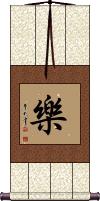
樂 is a single-character form of happiness or bliss that holds the ideas of laughing and having a good time.
This can also be translated as happy, glad, enjoyable, fun, and sometimes, music.
This a really good character if your audience is Chinese.
This is not a word seen alone very often in Korean.
 In Japanese, this character is written like the image shown to the right. If you order this from the Japanese master calligrapher, it will look like this instead of the character shown above.
Note: In Japanese, this has a meaning of comfort, ease, and enjoyment.
See Also: Joyfulness / Happiness
Happy Marriage
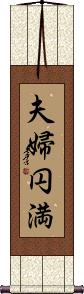
夫婦円満 is a Japanese title that means matrimonial happiness or happy marriage.
If you translate this, you get, “Husband-wife circle complete.”
A Life of Happiness and Prosperity
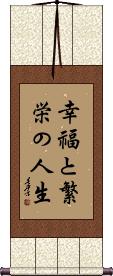
幸福と繁栄の人生 is a Japanese proverb that means “A life of happiness and prosperity” or “A life of happiness and success.”
Note: Because this selection contains some special Japanese Hiragana characters, it should be written by a Japanese calligrapher.
See Also: Prosperity
Serendipity / Happy Coincidence
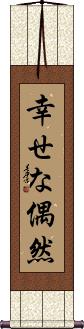
幸せな偶然 is one of many ways to express serendipity in Japanese.
The first two characters mean happiness, good fortune, luck, or blessing.
In the middle is a Japanese Hiragana character connecting these words/ideas.
The last two Kanji mean incidentally, by chance, randomly, unexpectedly, suddenly, accident, fortuity, or by coincidence.
Note: Because this selection contains some special Japanese Hiragana characters, it should be written by a Japanese calligrapher.
Happy
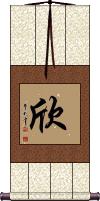
欣 is the type of happiness that you feel on the inside. It is the feeling of being released and delighted as well as being in a state of contentment. 欣 is more the internal happiness that perhaps only shows by the smile on your face. It can also be translated as “to take pleasure in” or “to rejoice.”
Note: 欣 is often used in compound words - especially in Korean Hanja.
As Japanese Kanji, this is so rare, that most Japanese people are not aware of its existence.
See Also: Happiness
Happy / Open Heart

In mordern times, 開心 means to feel happy, to rejoice, or to have a great time, but directly translates as open heart.
In the Buddhist context, beyond opening the heart, it can mean to develop the mind, to initiate into truth, or awaken the mind.
開 = Open.
心 = Heart/Mind.
Not commonly used in Japanese where it might be read as open-mindeness.
100 Years of Happy Marriage
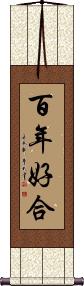
百年好合 is a wish or greeting, often heard at Chinese weddings, for a couple to have 100 good years together.
Some will translate this more naturally into English as: “May you live a long and happy life together.”
The character breakdown:
百 = 100
年 = Years
好 = Good (Happy)
合 = Together
Happy Buddha
Buddha of Joyful Light
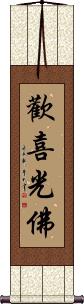
This title is Buddha of Joyful Light.
歡喜光佛 is Amitābha from Sanskrit but pronounced very differently in Chinese and Japanese.
Happy Birthday
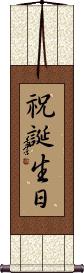
祝誕生日 is the shortest way to write “Happy Birthday” in Japanese.
The first Kanji means “wish” or “express good wishes,” and the last three characters mean “birthday.”
Because a birthday only lasts one day per year, we strongly suggest that you find an appropriate and personal calligraphy gift that can be hung in the recipient's home year-round.
Happy New Year
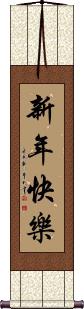
If you want to wish someone a happy new year, 新年快樂 is the way.
You can hang this up during Western New Years (Dec 31st - Jan 1st) and keep it up until after Chinese New Year which happens in either January or February of each year (it changes from year to year because China uses a lunar calendar).
Happy Birthday
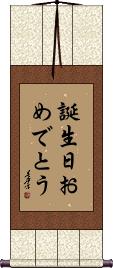
誕生日おめでとう is a verbose way to write “Happy Birthday” in Japanese.
The first part says “birthday” and the last 5 Kanji mean “congratulations.”
Note: Because this selection contains some special Japanese Hiragana characters, it should be written by a Japanese calligrapher.
Happy Family
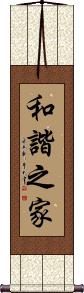
和諧之家 means “harmonious family” or “happy family” in Chinese.
The first two characters relay the idea of happiness and harmony.
The third character is a connecting or possessive article (connects harmony/happiness to family).
The last character means family but can also mean home or household.
Don't Worry, Be Happy
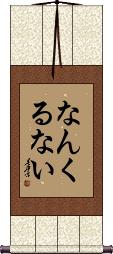
なんくるない or nankurunai is an Okinawan word, written in Japanese that means “Don't worry, be happy.”
沖縄/Okinawa and/or the 琉球/Ryūkyū Islands have a more laid-back “island style” approach to life. So the nankurunai idea is a perfect match for that lifestyle.
Note: Because this title is entirely Japanese Hiragana, it should be written by a Japanese calligrapher.
Happy Laughter
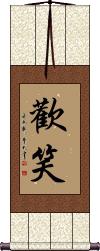
歡笑 translates as “happy laughter.”
The first character means happy or happiness.
The second character means to laugh, laughter or smile.
Better to be Happy than Rich
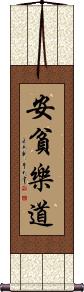
安貧樂道 means “It's better to be happy than rich” in Chinese.
Even if you are poor, you should still feel satisfied in your life...
...Satisfaction, happiness and the meaning of your life come from within yourself and not from money or riches of the world.
In Chinese, there are many four-character proverbs which express some very old philosophies.
Though there are only four characters on this scroll, in Chinese, the meanings often surpass the dictionary definition of each character.
In this case, you should not set your expectations too high for the money or riches you wish to have. One who sets their expectations too high is almost always disappointed. Instead, you should cherish what you have, seek to improve yourself from within, and not measure your worth by the size of your bank account.
Optimism / Happy With Your Fate
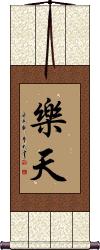
樂天 is about being optimistic and also making the best of whatever life throws at you.
This is hard to define. One dictionary defines this as “acceptance of fate and happy about it.” There is one English word equivalent, which is sanguinity or sanguinary.
You can also say that this means “Be happy with whatever Heaven provides,” or “Find happiness in whatever fate Heaven bestows upon you.” 樂天 suggests being an optimist in life.
Note: This is sometimes a given name in China.
Please note that Japanese tend to write the first character in a slightly-different form (as seen to the right). Let us know if you have a preference when you place your order.
Happy Family
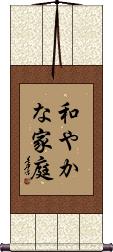
和やかな家庭 means “happy family” or “harmonious family” in Japanese.
The first three Kanji create a word that means mild, calm, gentle, quiet, or harmonious. After that is a connecting article. The last two Kanji mean family, home, or household.
Note: Because this selection contains some special Japanese Hiragana characters, it should be written by a Japanese calligrapher.
Family Love / Domestic Bliss
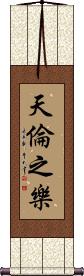
天倫之樂 means family love and joy, or domestic bliss.
The first two characters mean “the bonds of the family.”
The third character connects this to the fourth character which means happiness, joy, and cheerfulness.
Brahmavihara - The Four Immeasurables
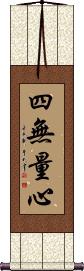
四無量心 is the cattāri brahmavihārā or catvāri apramāṇāni.
The four immeasurables, or infinite Buddha-states of mind. These four dhyānas include:
1. 慈無量心 boundless kindness, maitrī, or bestowing of joy or happiness.
2. 悲無量心 boundless pity, karuṇā, to save from suffering.
3. 喜無量心 boundless joy, muditā, on seeing others rescued from suffering.
4. 捨無量心 limitless indifference, upekṣā, i.e., rising above these emotions or giving up all things.
You must endure a harsh winter to appreciate the warmth of springtime
You must know hardship to appreciate happiness
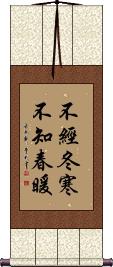
This literally translates as: Without having experienced the cold of winter, one cannot appreciate the warmth of spring.
Figuratively, this means: One cannot truly appreciate happiness without having gone through hardship.
There are many contrasts in life. One simply cannot fully know what joy is without having experienced misery, difficulty, and pain. How could you explain “light” if you did not have “darkness” to compare it to?
Embrace hardship, as it makes the good times seem even better.
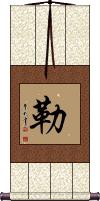
勒 is a Chinese surname that romanizes as Le or Lè and comes from ancient place names (Shu-Le) or ethnic groups like the Huns.
Use caution: There are other surnames in Asia that romanize as Le; here are a few:
Vietnamese (Lê): Most common usage, from Chinese 黎 (Lí), signifying a major royal family like the Lê Dynasty (1428–1788).
Chinese (樂 - Lè): Means "happiness" or "joy," from historical figures or noble lineages.
Korean: Can be a variant of Li or Lee, representing different Chinese characters (e.g., 黎, 呂).
Radiance
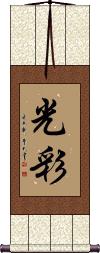
光彩 is the Chinese, Japanese Kanji, and old Korean Hanja for radiance.
Other meanings include luster, splendor/splendour, and brilliance.
光彩 is the radiance you see when a person's arrival brings happiness and joy to the room. Or the radiance on the face of a new bride etc.
If you delve into the dictionary, other forms of radiance will refer to isotopes emitting radiation. 光彩 is not related to radiation and is not the kind that causes cancer.
In Japanese, this can be several female given names such as Misa, Hikari, Hiiro, Teresa, or Arisa. And a more unisex given name of Kousai or Kosai.
Generosity
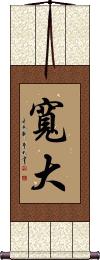
寬大 is a Chinese, Japanese, and Korean word that means Generosity.
Generosity is giving and sharing. You share freely, not with the idea of receiving something in return. You find ways to give others happiness and give just for the joy of giving. Generosity is one of the best ways to show love and friendship.
寬大 can also be translated as charitable, magnanimity, liberality, or in some contexts, broad-mindedness.
Note: There is a tiny deviation in the first character when written in Japanese. If you choose our Japanese master calligrapher, the little dot on the lower right of the first character will be omitted. With or without the dot, this can be read in Chinese, Japanese Kanji, and old Korean Hanja.
See Also: Benevolence | Lotus | Charity
This in-stock artwork might be what you are looking for, and ships right away...
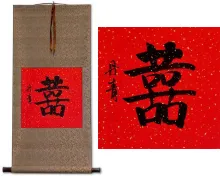

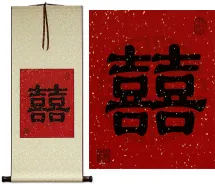
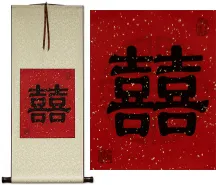
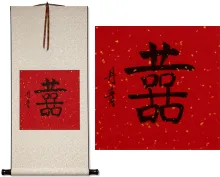
The following table may be helpful for those studying Chinese or Japanese...
| Title | Characters | Romaji (Romanized Japanese) | Various forms of Romanized Chinese | |
| Happiness Joyful Joy | 喜 | ki / yorokobi | xǐ / xi3 / xi | hsi |
| Happiness Joy | 禧 | xǐ / xi3 / xi | hsi | |
| Joyfulness Happiness | 快樂 快乐 | kai raku / kairaku | kuài lè / kuai4 le4 / kuai le / kuaile | k`uai le / kuaile / kuai le |
| School of Happiness | 幸福學校 幸福学校 | xìng fú xué xiào xing4 fu2 xue2 xiao4 xing fu xue xiao xingfuxuexiao | hsing fu hsüeh hsiao hsingfuhsüehhsiao |
|
| Happiness in the Afterlife | 冥福 | mei fuku / meifuku | míng fú / ming2 fu2 / ming fu / mingfu | |
| Pursuit of Happiness | 幸福を求めて | koufuku o motome te koufukuomotomete kofuku o motome te | ||
| Eternal Happiness | 永遠の幸福 | ei en no kou fuku eiennokoufuku ei en no ko fuku | ||
| Eternal Happiness | 幸福永恆 幸福永恒 | xìng fú yǒng héng xing4 fu2 yong3 heng2 xing fu yong heng xingfuyongheng | hsing fu yung heng hsingfuyungheng |
|
| Love and Happiness | 幸福與愛 幸福与爱 | xìng fú yǔ ài xing4 fu2 yu3 ai4 xing fu yu ai xingfuyuai | hsing fu yü ai hsingfuyüai |
|
| Prosperity and Happiness | 富樂 富乐 | furaku | fù lè / fu4 le4 / fu le / fule | |
| School of Happiness | 幸福の學校 幸福の学校 | koufuku no gakkou koufukunogakkou kofuku no gako | ||
| Doing good is the greatest source of happiness | 為善最樂 为善最乐 | wéi shàn zuì lè wei2 shan4 zui4 le4 wei shan zui le weishanzuile | wei shan tsui le weishantsuile |
|
| Double Happiness | 囍 喜喜 | xǐ / xi3 / xi | hsi | |
| Pursuit of Happiness | 追尋幸福 追寻幸福 | zhuī xún xìng fú zhui1 xun2 xing4 fu2 zhui xun xing fu zhuixunxingfu | chui hsün hsing fu chuihsünhsingfu |
|
| Seven Rules of Happiness | 幸福の七カ條 幸福の七カ条 | kou fuku no nana ka jou koufukunonanakajou ko fuku no nana ka jo | ||
| Happiness Contentment | 鼓腹 | ko fuku / kofuku | ||
| Happiness | 幸福 | koufuku / kofuku | xìng fú / xing4 fu2 / xing fu / xingfu | hsing fu / hsingfu |
| Eternal Peace and Happiness | 永恆和平與幸福 永恒和平与幸福 | yǒng héng hé píng yù xìng fú yong3 heng2 he2 ping2 yu4 xing4 fu2 yong heng he ping yu xing fu yonghenghepingyuxingfu | yung heng ho p`ing yü hsing fu yunghenghopingyühsingfu yung heng ho ping yü hsing fu |
|
| Happiness Contentment | 滿足 / 満足 满足 | man zoku / manzoku | mǎn zú / man3 zu2 / man zu / manzu | man tsu / mantsu |
| Peace, Love, Happiness | 平和, 愛, 幸福 | heiwa ai koufuku heiwaaikoufuku heiwa ai kofuku | ||
| Peace, Love, Happiness | 和平博愛幸福 和平博爱幸福 | hé píng bó ài xìng fú he2 ping2 bo2 ai4 xing4 fu2 he ping bo ai xing fu hepingboaixingfu | ho p`ing po ai hsing fu hopingpoaihsingfu ho ping po ai hsing fu |
|
| Happiness Fortune Lucky | 幸 | saki / sachi / rei / rē | xìng / xing4 / xing | hsing |
| A Life of Happiness and Prosperity | 幸福成功的一生 | xìng fú chéng gōng de yì shēng xing4 fu2 cheng2 gong1 de yi4 sheng1 xing fu cheng gong de yi sheng xingfuchenggongdeyisheng | hsing fu ch`eng kung te i sheng hsingfuchengkungteisheng hsing fu cheng kung te i sheng |
|
| Double Happiness Guest Book | 囍 喜喜 | xǐ / xi3 / xi | hsi | |
| Be Happy | 幸せである | Shiawa se de a ru Shiawasedearu | ||
| Happy Birthday | 生日快樂 生日快乐 | shēng rì kuài lè sheng1 ri4 kuai4 le4 sheng ri kuai le shengrikuaile | sheng jih k`uai le shengjihkuaile sheng jih kuai le |
|
| Happy Laughter Cheerful Bliss | 樂 / 楽 乐 | raku | lè / le4 / le | |
| Happy Marriage | 夫婦円満 | fuufuenman / fufuenman | ||
| A Life of Happiness and Prosperity | 幸福と繁栄の人生 | kou fuku to ha nei no jin sei koufukutohaneinojinsei ko fuku to ha nei no jin sei | ||
| Serendipity Happy Coincidence | 幸せな偶然 | shiawa se na guu zen shiawasenaguuzen shiawa se na gu zen | ||
| Happy | 欣 | kin | xīn / xin1 / xin | hsin |
| Happy Open Heart | 開心 开心 | kai shin / kaishin | kāi xīn / kai1 xin1 / kai xin / kaixin | k`ai hsin / kaihsin / kai hsin |
| 100 Years of Happy Marriage | 百年好合 | bǎi nián hǎo hé bai3 nian2 hao3 he2 bai nian hao he bainianhaohe | pai nien hao ho painienhaoho |
|
| Happy Buddha | 歡喜光佛 欢喜光佛 | kan gi kou butsu kangikoubutsu kan gi ko butsu | huān xǐ guāng fó huan1 xi3 guang1 fo2 huan xi guang fo huanxiguangfo | huan hsi kuang fo huanhsikuangfo |
| Happy Birthday | 祝誕生日 | shuku tan jou bi shukutanjoubi shuku tan jo bi | ||
| Happy New Year | 新年快樂 新年快乐 | xīn nián kuài lè xin1 nian2 kuai4 le4 xin nian kuai le xinniankuaile | hsin nien k`uai le hsinnienkuaile hsin nien kuai le |
|
| Happy Birthday | 誕生日おめでとう | tan jou bi o me de tou tanjoubiomedetou tan jo bi o me de to | ||
| Happy Family | 和諧之家 和谐之家 | hé xié zhī jiā he2 xie2 zhi1 jia1 he xie zhi jia hexiezhijia | ho hsieh chih chia hohsiehchihchia |
|
| Don't Worry, Be Happy | なんくるない | nan ku ru nai nankurunai | ||
| Happy Laughter | 歡笑 欢笑 | huān xiào huan1 xiao4 huan xiao huanxiao | huan hsiao huanhsiao |
|
| Better to be Happy than Rich | 安貧樂道 安贫乐道 | ān pín lè dào an1 pin2 le4 dao4 an pin le dao anpinledao | an p`in le tao anpinletao an pin le tao |
|
| Optimism Happy With Your Fate | 樂天 / 楽天 乐天 | raku ten / rakuten | lè tiān / le4 tian1 / le tian / letian | le t`ien / letien / le tien |
| Happy Family | 和やかな家庭 | nago ya ka na ka tei nagoyakanakatei | ||
| Family Love Domestic Bliss | 天倫之樂 天伦之乐 | tiān lún zhī lè tian1 lun2 zhi1 le4 tian lun zhi le tianlunzhile | t`ien lun chih le tienlunchihle tien lun chih le |
|
| Brahmavihara - The Four Immeasurables | 四無量心 四无量心 | shi mur you shin shimuryoushin shi mur yo shin | sì wú liàng xīn si4 wu2 liang4 xin1 si wu liang xin siwuliangxin | ssu wu liang hsin ssuwulianghsin |
| You must endure a harsh winter to appreciate the warmth of springtime | 不經冬寒不知春暖 不经冬寒不知春暖 | bù jīng dōng hán bù zhī chūn nuǎn bu4 jing1 dong1 han2 bu4 zhi1 chun1 nuan3 bu jing dong han bu zhi chun nuan | pu ching tung han pu chih ch`un nuan pu ching tung han pu chih chun nuan |
|
| Le | 勒 | lè / le4 / le | ||
| Radiance | 光彩 | kousai / kosai | guāng cǎi guang1 cai3 guang cai guangcai | kuang ts`ai kuangtsai kuang tsai |
| Generosity | 寬大 宽大 | kandai | kuān dà / kuan1 da4 / kuan da / kuanda | k`uan ta / kuanta / kuan ta |
| In some entries above you will see that characters have different versions above and below a line. In these cases, the characters above the line are Traditional Chinese, while the ones below are Simplified Chinese. | ||||

Successful Chinese Character and Japanese Kanji calligraphy searches within the last few hours...



