Many custom options...


And formats...



God First in Chinese / Japanese...
Buy a God First calligraphy wall scroll here!
Personalize your custom “God First” project by clicking the button next to your favorite “God First” title below...
2. Fear God
3. Trust in God / Belief in God
4. Trust in God / In God We Trust
5. Trust in God / Faith in God
6. God Bless You / May God Protect You
7. John 3:16
10. Safety and Well-Being of the Family
11. Grace from Heaven / Grace from God
12. Christian / Disciple of Christ
15. Under the Protection of the Dragon Saint
16. Amazing Grace
18. Nekogami
19. Goddess of Beauty / Beautiful Spirit
20. Sword Saint
God is Always With You
God is With Me Always
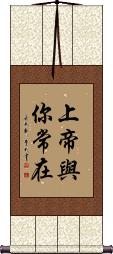
The direct translation of the Chinese characters, 上帝与你常在, is “God Together [with] You Always Exist.”
Keep in mind that Chinese grammar is sometimes very different from English. This makes perfect sense in Chinese.
Note: The title for God is the first two characters - the other words in the direct translation represent one character each.
Fear God
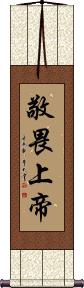
敬畏上帝 is probably the best way to translate the Christian English phrase “Fear God” into Chinese.
The first two characters mean to revere, be in awe of, or a general term of reverence. It can mean fear, but only in the context of respect or fear of authority.
Trust in God / Belief in God
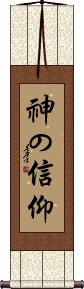
神の信仰 is the simplest way to express “Trust in God” in Japanese.
The first character means God, deity, divinity, or spirit (in this case, it will be read as God).
The second character is a particle that links the ideas.
The last two characters mean faith, belief, or creed in a religious context.
Trust in God / In God We Trust
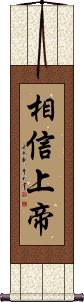
相信上帝 means exactly what the title suggests. The first two characters mean “trust” or “believe,” and the second two mean “God” (as in the God of Abraham and the God of Zion).
Thisis also how the American phrase “In God We Trust” as seen on U.S. Currency would be translated into Chinese. It would also be correct to say that this means “Believe in God,” though, in this arrangement/context, one would be more likely to interpret it as “trust.”
Trust in God / Faith in God
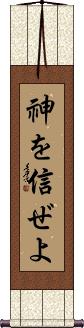
神を信ぜよ is a way to express “Trust in God” in Japanese.
The first character is “God.”
The second character is a particle that links the ideas here.
The last three characters are a word that means “to believe,” “to believe in,” “to place trust in,” “to confide in,” and “to have faith in.”
Basically, this is the Japanese phrase for “Have faith in God,” “Belief in God,” or “Trust in God.”
Note: Because this selection contains some special Japanese Hiragana characters, it should be written by a Japanese calligrapher.
God Bless You / May God Protect You
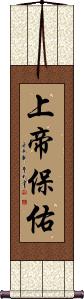
上帝保佑 is a blessing exchanged between Chinese Christians.
The first two characters mean God (The God of Zion). The second two characters express the idea of giving protection. Another way to translate this is “May God protect you.”
See Also: Guardian Angel
John 3:16 (first half)
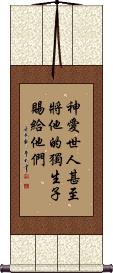
神愛世人甚至將他的獨生子賜給他們 is the first half of John 3:16 in Chinese.
It reads roughly, “For God so loved the world, that he gave his only begotten Son.”
This came directly from the Chinese Union Bible first printed in 1919.
Word of God / The Gospel
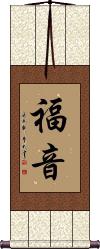
福音 is the Chinese, Korean and Japanese word for “Gospel” or “Word of God.”
福音 is a specifically Christian word in Asia (not used for any other religion).
The first character means blessing, good fortune, or good luck. This first character is a special character used throughout China to bring good tidings and fortune - especially during Chinese New Year. The second character means sound, noise, or news.
Together, these characters create a word that means “The Good News” or “The Sound of Good Fortune.”
When read by a Chinese or Japanese person, this word is always perceived as “The Christian Gospel,” “Word of God,” or even “The Voice of God.”
See Also: Christianity | Jesus Christ | God of Abraham
Grim Reaper / God of Death
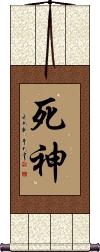
死神 is the title of the mythological figure (often called the Grim Reaper in western culture) in charge of taking the souls of those who die.
This title can be translated directly as “god of death” or “spirit of death.” The first character literally means “death,” and the second means “spirit” or “god.”
死神 is a very strange title for a calligraphy wall scroll. I'm not even sure if my calligraphers will write it, as it has some bad superstitious feelings attached to it.
Safety and Well-Being of the Family
Kanai Anzen
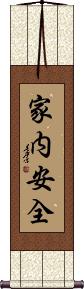
家內安全 is the Japanese way of saying “Family First.”
It's a Japanese proverb about the safety and well-being of your family and/or peace and prosperity in the household.
Some Japanese will hang an amulet in their home with these Kanji. The purpose is to keep your family safe from harm.
According to Shinto followers, hanging this in your home is seen as an invocation to God to always keep family members free from harm.
We were looking for a way to say “family first” in Japanese when this proverb came up in the conversation and research. While it doesn't say “family first,” it shows that the safety and well-being of your family is your first or most important priority. So, this proverb is the most natural way to express the idea that you put your family first.
See Also: Peace and Prosperity
Grace from Heaven / Grace from God
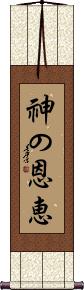
神の恩恵 means God's Grace in Japanese.
The first two characters act to create a word that means “divine,” “God's,” or “The Spirit's.”
The last two Kanji mean grace, favor/favour, blessing, or benefit.
Grace from Heaven / Grace from God
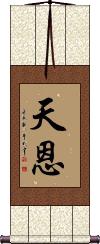
天恩 is the deepest way to say “Heaven's Grace” or “God's Grace” in Chinese.
The first character means Heaven or sky (referring, in this case, to the domain of God).
The second character means grace, blessings, benevolence, favor/favour, acts of kindness, merits, or beneficial influence.
This title can also be defined as:
Blessings of Heaven, Favor of the Emperor, Divination's luckiest day, or blessings of nature. Note: When you see “Emperor” above, remember that the Emperor, like the Pope, is theoretically chosen by God or seen as an emissary or conduit of God in ancient Asian culture. It would only be read that way in a certain context, such as “The Emperor, in his mercy, bestowed upon him Heaven's Grace, and the prisoner was set free.”
Note: Technically, this is a Japanese word too (pronounced "ten-on") but it’s rarely used in Japan anymore. Therefore, this title is best if your audience is Chinese.
Christian / Disciple of Christ
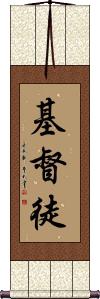
基督徒 is a very strong and direct word in Chinese for “Christian.”
The literal translation of the first two characters is “Christ.”
The last character means apprentice, follower, or disciple.
Altogether these three characters mean “Christ's Disciple” or “Christ's Apprentice.” 基督徒 is a pretty cool title to hang on your wall if you are a devout Christian.
Also used by Japanese Christians (but may be unfamiliar to non-Christian Japanese people).
See Also: Jesus Christ | God of Abraham
Disciple of Christianity
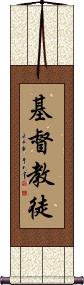
基督教徒 is the most verbose (longest) word for “Christian” in the Chinese and Japanese languages.
The literal translation of the first two characters is Christ.
The third Character means “Religion” or “Teaching.”
The last character means “apprentice” or “disciple.”
Altogether these three characters mean “Christ's Teaching Disciple” or “Christ's Religion Apprentice.”
Note: The last two characters are sometimes translated together as “follower (of a religion),” so you could also say it means “Follower of Christ.”
This four-character title makes it very clear what you are talking about in Chinese.
See Also: Jesus Christ | God of Abraham
Christianity / Christian
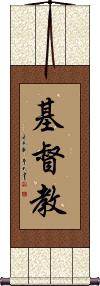
基督教 is the Chinese, Japanese and Korean word for “Christianity.”
Just as in English, this word is often used to mean “Protestant” but includes Catholics in the true definition.
It is the word used to refer to the whole “Christian religion” or “Christian Faith,” and therefore, it can be translated as “Christianity.” However, used as an adjective in regard to a person, it would translate as “Christian.” But more like saying, “His religion is Christianity,” rather than a noun form.
If you break it apart, the characters mean Base/Foundation Leading/Supervising Religion/Teaching. It makes more sense in Japanese, Chinese, and Korean. The first two characters together are translated as “Christ.” So you can also say this means “Christ's Religion” or “Christ's Teachings” when directly translated, or in reverse, “The Religion of Christ” or “The Teaching of Christ.”
Notes: The last character has a slight difference in one stroke - however, in calligraphic form, this will not be apparent. This entry can easily be read by any Korean person who knows Hanja characters (Chinese characters used in Korean).
See Also: Jesus Christ | God of Abraham
Under the Protection of the Dragon Saint
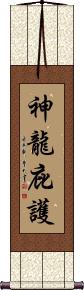
神龍庇護 is not the most common thing to say in Chinese, but it is grammatically correct and a cool title.
The first character means “supernatural or saintly.” The second is “dragon.” The last two mean protection. You could also translate this as something like “Protected by the Dragon God” or more closely “Holy Dragon.”
Amazing Grace
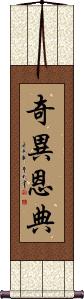
奇異恩典 is the title, “Amazing Grace” in Chinese.
The first two characters can also mean amazing, fantastic, exotic, astonishing, odd, strange, wonderful, extraordinary, uncommon, or rare.
The last two characters mean “grace,” as in “grace or favor of/from God.”
The LORD is my Shepherd
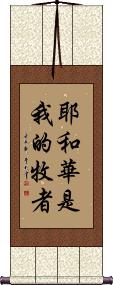
耶和華是我的牧者 is the first line from Psalms 23 straight out of the Chinese Union Bible.
This reads, “The LORD is my shepherd,” or “Jehovah is my shepherd.”
The character breakdown:
耶和華 = Jehovah (most English Bibles translate as LORD or God). This Chinese title is meant to sound a bit like the original Hebrew YHWH or Yahweh.
是 = is.
我的 = my.
牧者 = shepherd.
Nekogami
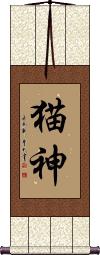
貓神 is the title Nekogami or “Cat God” in Japanese.
This can also be pronounced “neko shin” or “neko kami.”
猫神 is the modern Japanese version, before WWII, this would have been written 貓神 (just the first Kanji varies).
This also makes sense in Chinese, though the traditional version, 貓神, would be better for Chinese calligraphy.
Goddess of Beauty / Beautiful Spirit
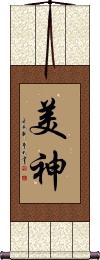
In Chinese, 美神 means Goddess of Beauty.
The first character means beauty or beautiful.
The second character means spirit (can also mean god, goddess, or soul).
Some will use this as a short way to say, “Beautiful Spirit.”
This has a similar meaning in Japanese but is used more often as a female given name in Japan. As a Japanese given name, it can be pronounced Mikami, Mikan, or Binasu.
Sword Saint
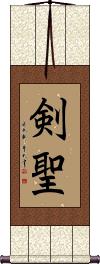
剣聖 can be translated as “Sword Saint,” “God of the Sword,” or “Saint of the Sword.” This is an ancient Japanese title bestowed on a master with the greatest of skills in swordsmanship.
Keep in mind that this is an antiquated term. It will only be understood in the context of martial arts. The pronunciation “kensei” also applies to other words like “constitutional government” and power (these words have different kanji and are completely unrelated).
Notes: This is sometimes Romanized as “kensei,” “ken sei,” and incorrectly as “Kensai.”
Chinese Note: This title is pronounceable in Chinese but seldom, if ever, used in Chinese. Also, the first character is an alternate character form for a sword, currently only used in Japan.
Art of War: 5 Points of Analysis
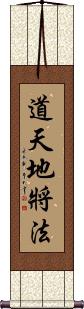
道天地將法 is a list of five key points to analyzing your situation from the first chapter of Sun Tzu's Art of War.
This reads like a 5-part military proverb. Sun Tzu says that to sharpen your skills, you must plan. To plan well, you must know your situation. Therefore, you must consider and discuss the following:
1. Philosophy and Politics: Make sure your way or your policy is agreeable among all of your troops (and the citizens of your kingdom as well). For when your soldiers believe in you and your way, they will follow you to their deaths without hesitation and will not question your orders.
2. Heaven/Sky: Consider climate / weather. This can also mean considering whether God is smiling upon you. In the modern military, this could be waiting for clear skies so that you can have air support for an amphibious landing.
3. Ground/Earth: Consider the terrain in which the battle will take place. This includes analyzing defensible positions, and exit routes, while using varying elevations to your advantage. When you plan an ambush, you must know your terrain and the best location from which to stage that ambush. This knowledge will also help you avoid being ambushed, as you will know where the likely places in which to expect an ambush from your enemy.
4. Leadership: This applies to you as the general and your lieutenants. A leader should be smart and be able to develop good strategies. Leaders should keep their word, and if they break a promise, they should punish themselves as harshly as they would punish subordinates. Leaders should be benevolent to their troops, with almost a fatherly love for them. Leaders must have the ability to make brave and fast decisions. Leaders must have steadfast principles.
5. [Military] Methods: This can also mean laws, rules, principles, models, or systems. You must have an efficient organization in place to manage both your troops and supplies. In the modern military, this would be a combination of how your unit is organized and your SOP (Standard Operating Procedure).
Notes: This is a simplistic translation and explanation. Much more is suggested in the actual text of the Art of War (Bing Fa). It would take a lot of study to master all of these aspects. In fact, these five characters can be compared to the modern military acronyms such as BAMCIS or SMEAC.
CJK notes: I have included the Japanese and Korean pronunciations but in Chinese, Korean and Japanese, this does not make a typical phrase (with subject, verb, and object) it is a list that only someone familiar with Sun Tzu’s writings would understand.
I've noticed you are searching for "god first". If you are interested, I can have your favorite verse from the Torah or Bible translated into Chinese and written on a wall scroll for you. Please contact me siting the verse or verses you want. Here is an example: Joshua 24:15.
If you are looking for a Jewish or Christian title, phrase, or word, I have a great selection here: Christian Words in Chinese
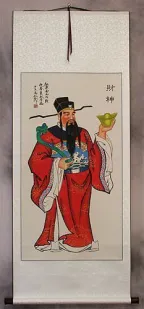
This in-stock artwork might be what you are looking for, and ships right away...
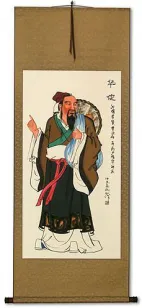
Gallery Price: $200.00
Your Price: $79.88
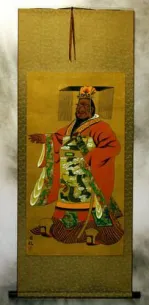
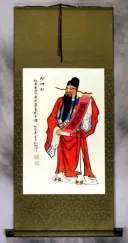
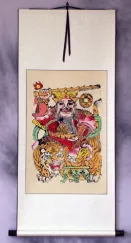
Gallery Price: $108.00
Your Price: $59.88
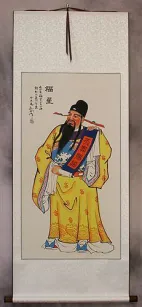
Gallery Price: $71.00
Your Price: $39.00
The following table may be helpful for those studying Chinese or Japanese...
| Title | Characters | Romaji (Romanized Japanese) | Various forms of Romanized Chinese | |
| God is Always With You | 上帝與你常在 上帝与你常在 | shàng dì yǔ nǐ cháng zài shang4 di4 yu3 ni3 chang2 zai4 shang di yu ni chang zai shangdiyunichangzai | shang ti yü ni ch`ang tsai shangtiyünichangtsai shang ti yü ni chang tsai |
|
| Fear God | 敬畏上帝 | jìng wèi shàng dì jing4 wei4 shang4 di4 jing wei shang di jingweishangdi | ching wei shang ti chingweishangti |
|
| Trust in God Belief in God | 神の信仰 | kami no shin kou kaminoshinkou kami no shin ko | ||
| Trust in God In God We Trust | 相信上帝 | xiāng xìn shàng dì xiang1 xin4 shang4 di4 xiang xin shang di xiangxinshangdi | hsiang hsin shang ti hsianghsinshangti |
|
| Trust in God Faith in God | 神を信ぜよ | kami wo shin ze yo kamiwoshinzeyo | ||
| God Bless You May God Protect You | 上帝保佑 | shàng dì bǎo yòu shang4 di4 bao3 you4 shang di bao you shangdibaoyou | shang ti pao yu shangtipaoyu |
|
| John 3:16 (first half) | 神愛世人甚至將他的獨生子賜給他們 神爱世人甚至将他的独生子赐给他们 | shén ài shì rén shèn zhì jiāng tā de dú shēng zǐ cì gè tā mén shen2 ai4 shi4 ren2 shen4 zhi4 jiang1 ta1 de du2 sheng1 zi3 ci4 gei3 ta1 men2 shen ai shi ren shen zhi jiang ta de du sheng zi ci gei ta men | shen ai shih jen shen chih chiang t`a te tu sheng tzu tz`u kei t`a men shen ai shih jen shen chih chiang ta te tu sheng tzu tzu kei ta men |
|
| Word of God The Gospel | 福音 | fukuin | fú yīn / fu2 yin1 / fu yin / fuyin | |
| Grim Reaper God of Death | 死神 | shinigami | sǐ shén / si3 shen2 / si shen / sishen | ssu shen / ssushen |
| Safety and Well-Being of the Family | 家內安全 家内安全 | ka nai an zen kanaianzen | ||
| Grace from Heaven Grace from God | 神の恩恵 | kami no on kei kaminoonkei | ||
| Grace from Heaven Grace from God | 天恩 | tiān ēn / tian1 en1 / tian en / tianen | t`ien en / tienen / tien en | |
| Christian Disciple of Christ | 基督徒 | kirisuto | jī dū tú ji1 du1 tu2 ji du tu jidutu | chi tu t`u chitutu chi tu tu |
| Disciple of Christianity | 基督教徒 | kirisutokyouto kirisutokyoto | jī dū jiào tú ji1 du1 jiao4 tu2 ji du jiao tu jidujiaotu | chi tu chiao t`u chituchiaotu chi tu chiao tu |
| Christianity Christian | 基督教 | kirisutokyou kirisutokyo | jī dū jiào ji1 du1 jiao4 ji du jiao jidujiao | chi tu chiao chituchiao |
| Under the Protection of the Dragon Saint | 神龍庇護 神龙庇护 | shén lóng bì hù shen2 long2 bi4 hu4 shen long bi hu shenlongbihu | shen lung pi hu shenlungpihu |
|
| Amazing Grace | 奇異恩典 | qí yì ēn diǎn qi2 yi4 en1 dian3 qi yi en dian qiyiendian | ch`i i en tien chiientien chi i en tien |
|
| The LORD is my Shepherd | 耶和華是我的牧者 耶和华是我的牧者 | yē hé huá shì wǒ de mù zhě ye1 he2 hua2 shi4 wo3 de mu4 zhe3 ye he hua shi wo de mu zhe yehehuashiwodemuzhe | yeh ho hua shih wo te mu che yehhohuashihwotemuche |
|
| Nekogami | 貓神 猫神 | neko gami / nekogami | māo shén / mao1 shen2 / mao shen / maoshen | |
| Goddess of Beauty Beautiful Spirit | 美神 | mikami | měi shén / mei3 shen2 / mei shen / meishen | |
| Sword Saint | 剣聖 / 剣聖 剣圣 | kensei | jiàn shèng jian4 sheng4 jian sheng jiansheng | chien sheng chiensheng |
| Art of War: 5 Points of Analysis | 道天地將法 道天地将法 | dou ten chi shou hou doutenchishouhou do ten chi sho ho | dào tiān dì jiàng fǎ dao4 tian1 di4 jiang4 fa3 dao tian di jiang fa daotiandijiangfa | tao t`ien ti chiang fa taotientichiangfa tao tien ti chiang fa |
| In some entries above you will see that characters have different versions above and below a line. In these cases, the characters above the line are Traditional Chinese, while the ones below are Simplified Chinese. | ||||

Successful Chinese Character and Japanese Kanji calligraphy searches within the last few hours...



