Many custom options...


And formats...



Won in Chinese / Japanese...
Buy a Won calligraphy wall scroll here!
Personalize your custom “Won” project by clicking the button next to your favorite “Won” title below...
1. Won
2. Opportunity Knocks Only Once
3. Zen Garden
4. Bodhicitta: Enlightened Mind
5. One Who Does Not Do Bad Things, Worries Not of Knocks at His Door
6. You May Learn from Victory, You Will Learn from Failure
9. Strong bones come from hard knocks
11. Phenomenon

ウォン is the name Won in Japanese Katakana.
Note: Because this title is entirely Japanese Katakana, it should be written by a Japanese calligrapher.

元 is the name Korean name Won in Chinese characters, also known as Korean Hanja.
It's possible your origin character is one of these: 温, 文, 袁, or 阮. Take a look at some old family records to be sure.
Opportunity Knocks Only Once
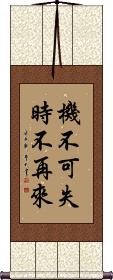
機不可失, 時不再來 is often translated as Opportunity Knocks Only Once in Chinese.
The more literal meaning is, “This chance is not to be lost, it won't come again.”
Zen Garden
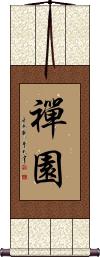
禪園 literally means “meditation garden.”
The first character happens to be known as Zen in the west (the pronunciation comes from Japanese) but this title is not often used in Japan (won't be recognized as a Japanese title).
The title “Zen Garden” was made up by westerners I'm afraid.
Bodhicitta: Enlightened Mind
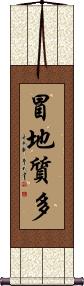
冒地質多 is a Chinese and Japanese way to write Bodhicitta.
冒地質多 is often translated as “the enlightened mind” or “enlightened heart.”
This title is strictly Buddhist and won't make sense to Chinese or Japanese people who do not have an expansive background in Buddhist terms, concepts, and scripture.
One Who Does Not Do Bad Things, Worries Not of Knocks at His Door
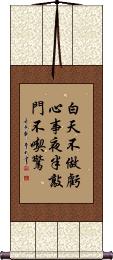
白天不做亏心事夜半敲门不吃惊 literally translates as: [If one does] not do bad things in the daytime, one need not be alarmed at knocks on the door in the middle of the night.
The meaning is something like, “A quiet conscience sleeps in thunder.” Basically, the message is, “don't commit crimes and you won't be jumpy every time the doorbell rings (so don't do anything wrong and your life will have fewer worries and you can sleep at night).”
You May Learn from Victory, You Will Learn from Failure
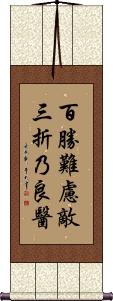
百胜难虑敌三折乃良医 is a Chinese proverb that literally translates as: [Even a general who has won a] hundred victories [may be] hard put to see through the enemy's [strategy], [but one who has] broken [his] arm three [times] [will] be a good doctor.
Figuratively, this means: One cannot always depend on past successes to guarantee future success but one can always learn from lessons drawn from failure.
See Also: Failure - Mother of Success | Experience - Mother of Success | Fall Down 7 Times Get Up 8 | Hard Knocks
Nothing / Nothingness
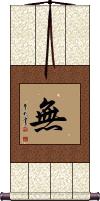
無 is the simple way to express “nothing.”
However, this single character leaves a bit of mystery as to what you might really mean if you hang it as a wall scroll. I'm not saying that's a bad thing; as you can decide what it means to you, and you won't be wrong if you stay within the general context.
More info: 無 is usually used as a suffix or prefix for Chinese and Japanese words (also old Korean). It can be compared to “un-” or “-less” in English. It can also mean “not to have,” no, none, not, “to lack,” or nothingness.
Beware of the Lawyers
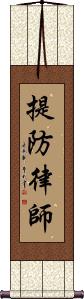
提防律師 is a kind of Chinese joke about lawyers.
The first two characters mean “guard yourself against (an attack)” or “beware.”
The last two characters can be translated as lawyer, attorney, or solicitor.
Separately, those characters mean law/regulation/control and master/expert/teacher. Here, you can see the attorney meaning is pretty clear in the individual characters.
Please note this is Chinese only (it won't make sense in Japanese, and the last two characters are sometimes translated together as “Buddhist Priest” in Japanese).
Strong bones come from hard knocks
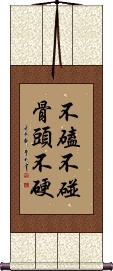
不磕不碰骨頭不硬 is a Chinese proverb that literally translates as: Without being knocked around a bit, [one's] bones won't become hard.
Figuratively, this means: One can't become strong without first being tempered by “hard knocks.”
While true for everyone, this sounds like the “Iron Body” form of Kung Fu, where practitioners' bodies are beaten (and often bone fractured) in order to become stronger.
For the rest of us, this is just about how we can be tempered and build character through the hardships in our lives.
This is not a common title for a wall scroll in China.
Crazy / Mad / Wild
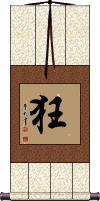
狂 is a single character that means “crazy” in Chinese, Japanese Kanji, and old Korean Hanja.
狂 means crazy, unrestrained, lunatic, insane, confused, deranged, wild, or mad.
This can also refer to an extreme enthusiast (like a football fan). But then, it can also refer to a person possessing a mental abnormality.
In some contexts, this can mean conceited (it probably won't be read that way on a wall scroll).
A warning: 狂 is an odd selection for a wall scroll. You should only order this if you plan to bewilder or confuse those who see it. It kind of says something about you, something that most native Asian people will not view in a good light.
Phenomenon
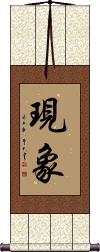
I must first say that 現象 is an odd thing to put on a wall scroll in Asian cultures. It won't make a lot of sense alone unless you have a special or personal meaning that you attach to it for yourself.
These two characters mean phenomenon in Chinese, Japanese, and Korean Hanja. They can also be translated as “a happening,” depending on context.
The sum of these characters is a little different than their individual meanings. But I will break it down anyway...
The first character means present, existing, actual, apparent, now, or current.
The second character alone means pattern after, imitate, image, shape, sign (of the times), form, appearance, to be like, to resemble, to take after, to seem, or elephant.
Indomitable / Unyielding
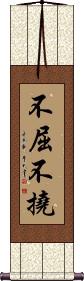
不屈不撓 means “Indomitable” or “Unyielding.”
不屈不撓 is a long word by Chinese standards. At least, it is often translated as a single word into English. It's actually a proverb in Chinese.
If you want to break it down, you can see that the first and third characters are the same. Both mean “not” (they work as a suffix to make a negative or opposite meaning to whatever character follows).
The second character means “bendable.”
The last means “scratched” or “bothered.”
So this really means “Won't be bent, can't be bothered.” I have also seen it written as “Will not crouch, will not submit.” This comes from the fact that the second character can mean “to crouch” and the last can mean “to submit” (as in “to give in” such as “submitting to the rule of someone else”). This may explain better why these four characters mean “indomitable.”
Notes:
Some will translate this as “indomitable spirit”; however, technically, there is no character to suggest the idea of “spirit” in this word.
Other translations include indefatigability, indomitableness, or unremitting tenacity.
The first two characters can be stand-alone words in Chinese.
In Japanese, this is considered two words (with very similar meanings). It's more common to see the word order flipped to 不撓不屈 in Japanese.
The same characters are used in old Korean Hanja. Just like in Japanese, the words are swapped to 不撓不屈 creating a word pronounced “불요불굴” in Korean.
See 不撓不屈
Double Happiness Guest Book
Customize a special Asian guest book for your wedding
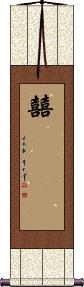
Start customizing a “Double Happiness Guest Book Wall Scroll” Here!
The paper panel length can be whatever you choose from 68cm to 135cm (27” to 53”).
If you don't mention what paper length you want in the special instructions tab (on the next page), we'll make it about 100cm (40”).
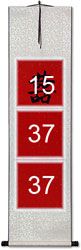
The medium-size scroll with a 33cm x 100cm (13” x 40”) paper panel can usually handle up to 89 signatures. That breaks down to 37 signatures per empty square and 15 signatures around the 囍 character. If you switch to a 135cm paper panel, add another 37 potential signatures.
We can splice two 135cm papers together, but that would be a crazy-long scroll. These are only estimates, your mileage may vary.
With silk panels, this will yield a wall scroll about 155cm (61”) long. That's enough for up to 89 signatures. Of course, that depends on if your guests just sign a brief salutation and name, or more verbose good wishes. Customer feedback is that 126 people can sign the 135cm long paper on a medium-sized scroll. If we go bigger than that, there will be a minor paper seam and an extra charge. Email me with your specifications if you need something special.
Most customers pick the festive red paper with gold flecks and white or ivory silk. Red is a good luck color in Chinese culture, thus the most popular choice. But, you can do any color combination that you want.
There is a long history of Chinese-character-use outside of mainland China. This Double Happiness character is also seen at weddings in Korea, Vietnam, Hong Kong, and Taiwan, as well as in Chinese communities in Thailand, Indonesia, and elsewhere. While Japan borrowed Chinese characters into their language, you won't see 囍 as often at Japanese weddings.
The following table may be helpful for those studying Chinese or Japanese...
| Title | Characters | Romaji (Romanized Japanese) | Various forms of Romanized Chinese | |
| Won | ウォン | won | ||
| Won | 元 | yuán / yuan2 / yuan | yüan | |
| Opportunity Knocks Only Once | 機不可失時不再來 机不可失时不再来 | jī bù kě shī shí bù zài lái ji1 bu4 ke3 shi1 shi2 bu4 zai4 lai2 ji bu ke shi shi bu zai lai jibukeshishibuzailai | chi pu k`o shih shih pu tsai lai chipukoshihshihputsailai chi pu ko shih shih pu tsai lai |
|
| Zen Garden | 禪園 禅园 | zen sono / zensono | chán yuán chan2 yuan2 chan yuan chanyuan | ch`an yüan chanyüan chan yüan |
| Bodhicitta: Enlightened Mind | 冒地質多 冒地质多 | boujiishitta bojishitta | mào dì zhì duō mao4 di4 zhi4 duo1 mao di zhi duo maodizhiduo | mao ti chih to maotichihto |
| One Who Does Not Do Bad Things, Worries Not of Knocks at His Door | 白天不做虧心事夜半敲門不吃驚 白天不做亏心事夜半敲门不吃惊 | bái tiān bú zuò kuī xīn shì yè bàn qiāo mén bù chī jīng bai2 tian1 bu2 zuo4 kui1 xin1 shi4 ye4 ban4 qiao1 men2 bu4 chi1 jing1 bai tian bu zuo kui xin shi ye ban qiao men bu chi jing | pai t`ien pu tso k`uei hsin shih yeh pan ch`iao men pu ch`ih ching pai tien pu tso kuei hsin shih yeh pan chiao men pu chih ching |
|
| You May Learn from Victory, You Will Learn from Failure | 百勝難慮敵三折乃良醫 百胜难虑敌三折乃良医 | bǎi shèng nán lǜ dí sān zhé nǎi liáng yī bai3 sheng4 nan2 lv4 di2 san1 zhe2 nai3 liang2 yi1 bai sheng nan lv di san zhe nai liang yi | pai sheng nan lü ti san che nai liang i | |
| Nothing Nothingness | 無 无 | mu | wú / wu2 / wu | |
| Beware of the Lawyers | 提防律師 提防律师 | xiǎo xīn lǜ shī xiao3 xin1 lv4 shi1 xiao xin lv shi xiaoxinlvshi | hsiao hsin lü shih hsiaohsinlüshih |
|
| Strong bones come from hard knocks | 不磕不碰骨頭不硬 不磕不碰骨头不硬 | bù kē bù pèng gǔ tóu bù yìng bu4 ke1 bu4 peng4 gu3 tou2 bu4 ying4 bu ke bu peng gu tou bu ying bukebupenggutoubuying | pu k`o pu p`eng ku t`ou pu ying pukopupengkutoupuying pu ko pu peng ku tou pu ying |
|
| Crazy Mad Wild | 狂 狂 | kyou / kyo | kuáng / kuang2 / kuang | k`uang / kuang |
| Phenomenon | 現象 现象 | genshou / gensho | xiàn xiàng xian4 xiang4 xian xiang xianxiang | hsien hsiang hsienhsiang |
| Indomitable Unyielding | 不屈不撓 不屈不挠 | fu kutsu fu tou fukutsufutou fu kutsu fu to | bù qū bù náo bu4 qu1 bu4 nao2 bu qu bu nao buqubunao | pu ch`ü pu nao puchüpunao pu chü pu nao |
| Double Happiness Guest Book | 囍 喜喜 | xǐ / xi3 / xi | hsi | |
| In some entries above you will see that characters have different versions above and below a line. In these cases, the characters above the line are Traditional Chinese, while the ones below are Simplified Chinese. | ||||

Successful Chinese Character and Japanese Kanji calligraphy searches within the last few hours...



