Many custom options...


And formats...



Sites in Chinese / Japanese...
Buy a Sites calligraphy wall scroll here!
Personalize your custom “Sites” project by clicking the button next to your favorite “Sites” title below...
Sites

賽茨 is the name Sites in Chinese (Mandarin).
Sites

サイトス is the name Sites in Japanese Katakana.
Note: Because this title is entirely Japanese Katakana, it should be written by a Japanese calligrapher.
Shikin Haramitsu Daikomyo
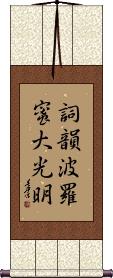
詞韻波羅蜜大光明 are the Japanese Kanji characters that romanize as “Shikin Haramitsu Daikōmyō.”
This is a complicated proverb. I'm actually going to forgo writing any translation information here. You can figure it out via Google search and at sites like Paramita and the Perfection of Wisdom or
Fecastel.Wordpress.com::Shikin Haramitsu Daikōmyō
When the sun rises it first shines on the highest mountain
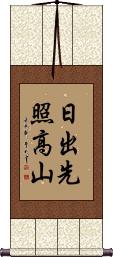
This old Buddhist phrase means, “When the sun rises it always shines first on the highest mountain,” or “When the sun appears, it first casts its light upon the highest mountain.”
This comes from the Avatamsaka Sutra and has been used as the name or portion of the name for temples in Japan and sites in China.
The Buddha's first round of teaching (Avatamsaka period) is likened to the time when the sun rises from the east horizon. When the sun first rises it illuminates the high mountains. In this analogy, the high mountains represent the great Bodhisattvas and/or those most ready to receive enlightenment and liberation.
This can be romanized from Japanese as “Nichi shutsu sen shō kō san,” “Nisshutsu saki teru takayama,” or “Hide temazu kōzan wo terasu yama.” The last one is probably the most common. Ask three Japanese people what they think the pronunciation is, and you will get three different opinions.
Not the results for Sites that you were looking for?
Below are some entries from our dictionary that may match your Sites search...
| Characters If shown, 2nd row is Simp. Chinese |
Pronunciation Romanization |
Simple Dictionary Definition |
六部 see styles |
rokube ろくべ |
(1) six copies; (2) (abbreviation) (See 六十六部) Buddhist pilgrim (carrying 66 copies of the Lotus Sutra to be left at sites across Japan); (surname) Rokube |
出職 see styles |
deshoku でしょく |
job that requires traveling to work sites (e.g. repairman, gardener) |
古跡 古迹 see styles |
gǔ jì gu3 ji4 ku chi koseki こせき |
places of historic interest; historical sites; CL:個|个[ge4] historic spot; historic remains; ruins; (surname) Koseki |
古蹟 古迹 see styles |
gǔ jì gu3 ji4 ku chi koseki こせき |
places of historic interest; historical sites; CL:個|个[ge4] historic spot; historic remains; ruins |
矢来 see styles |
yarai やらい |
rough fence of bamboo, logs, etc. constructed at battle sites or execution grounds; (place-name, surname) Yarai |
石剣 see styles |
sekken せっけん |
sword-shaped stoneware found in archeological sites in eastern Japan dating to the end of the Jomon period |
網模 网模 see styles |
wǎng mó wang3 mo2 wang mo |
model for online fashion sites etc |
覽古 览古 see styles |
lǎn gǔ lan3 gu3 lan ku |
to visit historic sites |
足跡 足迹 see styles |
zú jì zu2 ji4 tsu chi sokuseki そくせき ashiato あしあと |
footprint; track; spoor (1) footprints; (2) (computer terminology) record of page visitors (e.g. in social networking sites) |
鞘堂 see styles |
sayadou / sayado さやどう |
{archit} (See 覆屋) outer roofed structure for protecting cultural assets and historic sites; (place-name) Sayadou |
五毛黨 五毛党 see styles |
wǔ máo dǎng wu3 mao2 dang3 wu mao tang |
fifty cents party (person supposed to relay government propaganda on Internet sites) |
古窯址 see styles |
koyoushi / koyoshi こようし |
ruins of old kilns; old kiln sites |
古窯趾 see styles |
koyoushi / koyoshi こようし |
ruins of old kilns; old kiln sites |
足あと see styles |
ashiato あしあと |
(1) footprints; (2) (computer terminology) record of page visitors (e.g. in social networking sites) |
ボイド管 see styles |
boidokan ボイドかん |
cardboard tube for pouring concrete into on building sites |
六十六部 see styles |
rokujuurokubu / rokujurokubu ろくじゅうろくぶ |
Buddhist pilgrim (carrying 66 copies of the Lotus Sutra to be left at sites across Japan) |
名勝古跡 名胜古迹 see styles |
míng shèng gǔ jì ming2 sheng4 gu3 ji4 ming sheng ku chi |
historical sites and scenic spots |
名所古跡 see styles |
meishokoseki / meshokoseki めいしょこせき |
(yoji) scenic sites and historic places; places of natural beauty and historic interest |
百座講會 百座讲会 see styles |
bǎi zuò jiǎng huì bai3 zuo4 jiang3 hui4 pai tso chiang hui hyakuza kōe |
hundred sites lecture |
百座道場 百座道场 see styles |
bǎi zuò dào chǎng bai3 zuo4 dao4 chang3 pai tso tao ch`ang pai tso tao chang hyakuza dōjō |
one hundred lecture sites |
紅色旅遊 红色旅游 see styles |
hóng sè lǚ yóu hong2 se4 lu:3 you2 hung se lü yu |
red tourism, focused on sites in China associated with the Communist Revolution |
ランキング see styles |
rankingu ランキング |
(1) ranking; (2) toplist (e.g. of WWW sites) |
ティカル遺跡 see styles |
tikaruiseki ティカルいせき |
(place-name) Tikal sites |
Variations: |
wakuotsu; wakotsu わくおつ; わこつ |
(expression) (net-sl) (kana only) (from 枠取り (live streaming) and 乙 (お疲れ様); usu. on live streaming sites) (See うぽつ,枠・6,乙・4) thanks for streaming |
Variations: |
fukudou(覆堂); ooidou / fukudo(覆堂); ooido ふくどう(覆堂); おおいどう |
{archit} (See 覆屋) outer roofed structure for protecting cultural assets and historic sites |
Variations: |
ooiya おおいや |
{archit} outer roofed structure for protecting cultural assets and historic sites |
Variations: |
sayadou / sayado さやどう |
{archit} (See 覆屋) outer roofed structure for protecting cultural assets and historic sites |
キウス周堤墓群 see styles |
kiusushuuteibogun / kiusushutebogun キウスしゅうていぼぐん |
(place-name) Kiusu Shuuteibogun (cluster of grave-sites in Hokkaido) |
Variations: |
koyoushi / koyoshi こようし |
ruins of old kilns; old kiln sites |
鐃旬ワ申鐃宿器申 see styles |
鐃旬wa申鐃宿wa申鐃緒申 鐃旬ワ申鐃宿わ申鐃緒申 |
cardboard tube for pouring concrete into on building sites |
Click here for more Sites results from our dictionary
The following table may be helpful for those studying Chinese or Japanese...
| Title | Characters | Romaji (Romanized Japanese) | Various forms of Romanized Chinese | |
| Sites | 賽茨 赛茨 | sài cí / sai4 ci2 / sai ci / saici | sai tz`u / saitzu / sai tzu | |
| Sites | サイトス | saitosu | ||
| Shikin Haramitsu Daikomyo | 詞韻波羅蜜大光明 词韵波罗蜜大光明 | shi kin ha ra mitsu dai kou myo shikinharamitsudaikoumyo shi kin ha ra mitsu dai ko myo | ||
| When the sun rises it first shines on the highest mountain | 日出先照高山 | hiide temazu kousan wo terasu yama hide temazu kosan wo terasu yama | rì chū xiān zhào gāo shān ri4 chu1 xian1 zhao4 gao1 shan1 ri chu xian zhao gao shan richuxianzhaogaoshan | jih ch`u hsien chao kao shan jihchuhsienchaokaoshan jih chu hsien chao kao shan |
| In some entries above you will see that characters have different versions above and below a line. In these cases, the characters above the line are Traditional Chinese, while the ones below are Simplified Chinese. | ||||

Successful Chinese Character and Japanese Kanji calligraphy searches within the last few hours...



