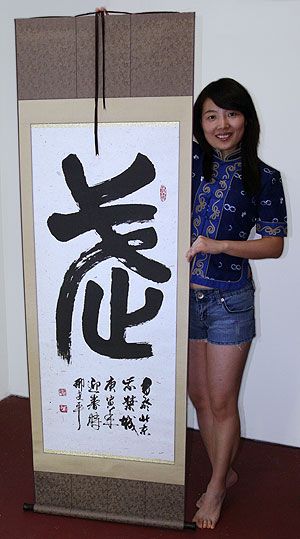
Many custom options


And formats


Not what you want?
Try other similar-meaning words, fewer words, or just one word.
Romans 8:28 in Chinese & Japanese Calligraphy
Compare the meanings and pronunciations of the entries related to Romans 8:28 below. Choose “Customize & Buy” next to your preferred entry to personalize your calligraphy wall scroll.
Romans 8:28

This is Romans 8:28 in Japanese, from the 1954–55 Japanese Kōgo-yaku (口語訳).
In English, the King James Version reads, “And we know that all things work together for good to them that love God, to them who are the called according to his purpose.”
Note: Because this selection contains some special Japanese Hiragana characters, it should be written by a Japanese calligrapher.
Romans 8:28

This is Romans 8:28 in Chinese, from the Chinese Union Version (和合本).
In English, the King James Version reads, “And we know that all things work together for good to them that love God, to them who are the called according to his purpose.”
Romans

羅馬斯 is the name Romans in Chinese (Mandarin).
Romans

ロマンズ is the name Romans in Japanese Katakana.
Note: Because this title is entirely Japanese Katakana, it should be written by a Japanese calligrapher.
Romans 8:18

This is Romans 8:18 in Japanese, from the 1954–55 Japanese Kōgo-yaku (口語訳).
In English, the King James Version reads, “For I reckon that the sufferings of this present time are not worthy to be compared with the glory which shall be revealed in us.”
Note: Because this selection contains some special Japanese Hiragana characters, it should be written by a Japanese calligrapher.
Romans 8:18

This is Romans 8:18 in Chinese, from the Chinese Union Version (和合本).
In English, the King James Version reads, “For I reckon that the sufferings of this present time are not worthy to be compared with the glory which shall be revealed in us.”
Not the results for Romans 8:28 that you were looking for?
Below are some entries from our dictionary that may match your Romans 8:28 search:
| Characters If shown, 2nd row is Simp. Chinese |
Pronunciation Romanization |
Simple Dictionary Definition |
隨俗 随俗 see styles |
suí sú sui2 su2 sui su |
according to custom; to do as local custom requires; do as the Romans do |
羅馬書 罗马书 see styles |
luó mǎ shū luo2 ma3 shu1 lo ma shu |
Epistle of St Paul to the Romans |
入境問俗 入境问俗 see styles |
rù jìng wèn sú ru4 jing4 wen4 su2 ju ching wen su |
When you enter a country, enquire about the local customs (idiom); do as the natives do; When in Rome, do as the Romans do |
入境隨俗 入境随俗 see styles |
rù jìng suí sú ru4 jing4 sui2 su2 ju ching sui su |
lit. when you enter a country, follow the local customs (idiom); fig. when in Rome, do as the Romans do |
入鄉隨俗 入乡随俗 see styles |
rù xiāng suí sú ru4 xiang1 sui2 su2 ju hsiang sui su |
When you enter a village, follow the local customs (idiom); do as the natives do; When in Rome, do as the Romans do |
走鄉隨鄉 走乡随乡 see styles |
zǒu xiāng suí xiāng zou3 xiang1 sui2 xiang1 tsou hsiang sui hsiang |
(proverb) to follow local customs; When in Rome, do as the Romans do. |
ローマ人への手紙 see styles |
roomabitohenotegami; roomajinhenotegami ローマびとへのてがみ; ローマじんへのてがみ |
(exp,n) {Christn} Epistle to the Romans (book of the Bible) |
ロマンシュリゼール see styles |
romanshurizeeru ロマンシュリゼール |
(place-name) Romans-sur-Isere |
郷に入らば郷に従え see styles |
gouniirabagounishitagae / gonirabagonishitagae ごうにいらばごうにしたがえ |
(expression) (proverb) (See 郷に入っては郷に従え) When in Rome, do as the Romans do |
郷に入れば郷に従え see styles |
gouniirebagounishitagae / gonirebagonishitagae ごうにいればごうにしたがえ |
(expression) (proverb) (See 郷に入っては郷に従え) when in Rome, do as the Romans do |
ローマの信徒への手紙 see styles |
roomanoshintohenotegami ローマのしんとへのてがみ |
Epistle to the Romans (book of the Bible) |
到什麼山上,唱什麼歌 到什么山上,唱什么歌 |
dào shén me shān shàng , chàng shén me gē dao4 shen2 me5 shan1 shang4 , chang4 shen2 me5 ge1 tao shen me shan shang , ch`ang shen me ko tao shen me shan shang , chang shen me ko |
lit. whatever mountain one is on, one should sing its songs (idiom); fig. when in Rome, do as the Romans do |
郷に入っては郷に従え see styles |
gouniittehagounishitagae / gonittehagonishitagae ごうにいってはごうにしたがえ |
(expression) (proverb) when in Rome, do as the Romans do |
The following table may be helpful for those studying Chinese or Japanese:
| Title | Characters | Romaji (Romanized Japanese) | Various forms of Romanized Chinese | |
| Romans 8:28 | 神は、神を愛する者たち、すなわち、ご計画に従って召された者たちと共に働いて、万事を益となるようにして下さることを、わたしたちは知っている。 | Kami wa, Kami o ai suru monotachi, sunawachi, gokeikaku ni shitagatte mesareta monotachi to tomo ni hataraite, banji o eki to naru yō ni shite kudasaru koto o, watashitachi wa shitte iru. | ||
| Romans 8:28 | 我們曉得萬事都互相效力叫愛神的人得益處就是按他旨意被召的人 我们晓得万事都互相效力叫爱神的人得益处就是按他旨意被召的人 | wǒ men xiǎo de wàn shì dōu hù xiāng xiào lì jiào ài shén de rén dé yì chù jiù shì àn tā zhǐ yì bèi zhào de rén wo3 men xiao3 de wan4 shi4 dou1 hu4 xiang1 xiao4 li4 jiao4 ai4 shen2 de ren2 de2 yi4 chu4 jiu4 shi4 an4 ta1 zhi3 yi4 bei4 zhao4 de ren2 wo men xiao de wan shi dou hu xiang xiao li jiao ai shen de ren de yi chu jiu shi an ta zhi yi bei zhao de ren | wo men hsiao te wan shih tou hu hsiang hsiao li chiao ai shen te jen te i ch`u chiu shih an t`a chih i pei chao te jen wo men hsiao te wan shih tou hu hsiang hsiao li chiao ai shen te jen te i chu chiu shih an ta chih i pei chao te jen |
|
| Romans | 羅馬斯 罗马斯 | luó mǎ sī luo2 ma3 si1 luo ma si luomasi | lo ma ssu lomassu |
|
| Romans | ロマンズ | romanzu | ||
| Romans 8:18 | わたしは思う。今のこの時の苦しみは、やがてわたしたちに現されようとする栄光に比べると、言うに足りない。 | Watashi wa omou. Ima no kono toki no kurushimi wa, yagate watashitachi ni arawasareyō to suru eikō ni kuraberu to, iu ni tarinai. Watashi wa omo. Ima no kono toki no kurushimi wa, yagate watashitachi ni arawasareyō to suru eikō ni kuraberu to, iu ni tarinai. | ||
| Romans 8:18 | 我想現在的苦楚若比起將來要顯於我們的榮耀就不足介意了 我想现在的苦楚若比起将来要显于我们的荣耀就不足介意了 | wǒ xiǎng xiàn zài de kǔ chǔ ruò bǐ qǐ jiāng lái yào xiǎn yú wǒ men de róng yào jiù bù zú jiè yì le wo3 xiang3 xian4 zai4 de ku3 chu3 ruo4 bi3 qi3 jiang1 lai2 yao4 xian3 yu2 wo3 men de rong2 yao4 jiu4 bu4 zu2 jie4 yi4 le wo xiang xian zai de ku chu ruo bi qi jiang lai yao xian yu wo men de rong yao jiu bu zu jie yi le | wo hsiang hsien tsai te k`u ch`u jo pi ch`i chiang lai yao hsien yü wo men te jung yao chiu pu tsu chieh i le wo hsiang hsien tsai te ku chu jo pi chi chiang lai yao hsien yü wo men te jung yao chiu pu tsu chieh i le |
|
| In some entries above you will see that characters have different versions above and below a line. In these cases, the characters above the line are Traditional Chinese, while the ones below are Simplified Chinese. | ||||

Successful Chinese Character and Japanese Kanji calligraphy searches within the last few hours...