Many custom options


And formats


Proverbs 3:5 in Chinese & Japanese Calligraphy
Compare the meanings and pronunciations of the entries related to Proverbs 3:5 below. Choose “Customize & Buy” next to your preferred entry to personalize your calligraphy wall scroll.
See also: Old Chinese Proverbs, Philosophies and Idioms
1. Proverbs 3:5
6. Love the Flower, Love the Pot also
7. To cut and polish each other
Proverbs 3:5

心をつくして主に信頼せよ自分の知識にたよってはならない is Proverbs 3:5 in Japanese, from the 1954–55 Japanese Kōgo-yaku (口語訳).
In English, the King James Version reads, “Trust in the LORD with all thine heart; and lean not unto thine own understanding.”
Note: Because this selection contains some special Japanese Hiragana characters, it should be written by a Japanese calligrapher.
Proverbs 3:5

你要專心仰賴耶和華不可倚靠自己的聰明 is Proverbs 3:5 in Chinese, from the Chinese Union Version (和合本).
In English, the King James Version reads, “Trust in the LORD with all thine heart; and lean not unto thine own understanding.”
Proverbs 3:5-6

This is Proverbs 3:5-6 in Japanese, from the 1954–55 Japanese Kōgo-yaku (口語訳).
In English, the King James Version reads, “Trust in the LORD with all thine heart; and lean not unto thine own understanding. In all thy ways acknowledge him, and he shall direct thy paths.”
Note: Because this selection contains some special Japanese Hiragana characters, it should be written by a Japanese calligrapher.
Proverbs 3:5-6

This is Proverbs 3:5-6 in Chinese, from the Chinese Union Version (和合本).
In English, the King James Version reads, “Trust in the LORD with all thine heart; and lean not unto thine own understanding. In all thy ways acknowledge him, and he shall direct thy paths.”
Proverbs 27:17

鉄は鉄をとぐそのように人はその友の顔をとぐ is Proverbs 27:17 in Japanese, from the 1954–55 Japanese Kōgo-yaku (口語訳).
In English, the King James Version reads, “Iron sharpeneth iron; so a man sharpeneth the countenance of his friend.”
Note: Because this selection contains some special Japanese Hiragana characters, it should be written by a Japanese calligrapher.
Proverbs 27:17

鐵磨鐵磨出刃來朋友相感也是如此 is Proverbs 27:17 in Chinese, from the Chinese Union Version (和合本).
In English, the King James Version reads, “Iron sharpeneth iron; so a man sharpeneth the countenance of his friend.”
Love Loyalty Respect
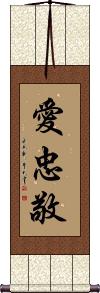
愛忠敬 is a Chinese word list that means love, loyalty, and respect.
愛忠敬 is the shortest way to express these words/ideas. Word lists are not as natural in Chinese as they are in English - phrases or proverbs are more common.
Failure in Not an Option
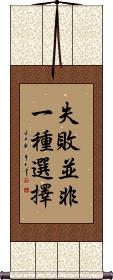
失敗並非一種選擇 is probably the best way to say, “Failure is not an option,” in Chinese.
Just don't forget that some ancient Chinese proverbs suggest that failure is a learning opportunity that leads to success or innovation. So don't plan to fail but failure is only a waste if nothing is learned from the failure.
See Also: Failure is a Stepping Stone to Success | Failure is the Mother of Success
Love the Flower, Love the Pot also
Love Me, Love My Dog
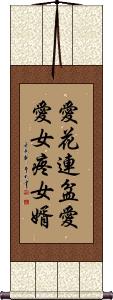
This proverb, 爱花连盆爱爱女疼女婿, literally translates as “If one loves a flower, [one will] love its pot; [if one really] loves [one's] daughter, [one will also] love [one's] son-in-law.”
Figuratively, is similar to the English proverbs:
Love me, love my dog.
Love for a person extends even to the crows on his roof.
To cut and polish each other

相切相磋 means, “to cut and polish each other” or “mutual cutting and polishing.”
This is an original Chinese phrase (also known in Japan), though it matches the idea of “Iron sharpens iron; so one person sharpens another.” (Proverbs 27:17).
This was derived at some point from the Chinese phrase, 切磋琢磨, which means “cutting, filing, carving, polishing.”
Sun Tzu - Art of War
military strategy, tactics, and procedure
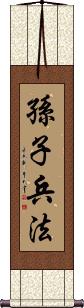
孫子兵法 is the full title of the most famous book of military proverbs about warfare.
The English title is “Sun Tzu's The Art of War.”
The last two characters have come to be known in the west as “The Art of War,” but a better translation would be “military strategy and tactics,” “military skills” or “army procedures.”
Note: Sometimes the author's name is Romanized as “Sun Zi” or “Sunzi.”
It's written the same in Chinese, Japanese Kanji, and Korean Hanja.
See Also: Military Veteran / Retired Soldier | Warrior
Better to be Happy than Rich
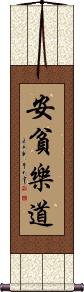
安貧樂道 means “It's better to be happy than rich” in Chinese.
Even if you are poor, you should still feel satisfied in your life...
...Satisfaction, happiness and the meaning of your life come from within yourself and not from money or riches of the world.
In Chinese, there are many four-character proverbs which express some very old philosophies.
Though there are only four characters on this scroll, in Chinese, the meanings often surpass the dictionary definition of each character.
In this case, you should not set your expectations too high for the money or riches you wish to have. One who sets their expectations too high is almost always disappointed. Instead, you should cherish what you have, seek to improve yourself from within, and not measure your worth by the size of your bank account.
An Open Book Benefits Your Mind
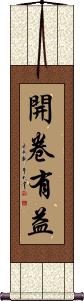
There are several ways to translate this ancient proverb. Translated literally and directly, it says, “Open roll has/yields benefit.”
To understand that, you must know a few things...
First, Chinese characters and language have deeper meanings that often are not spoken but are understood - especially with ancient texts like this. Example: It's understood that the “benefit” referred to in this proverb is to the reader's mind. Just the last character expresses that whole idea.
Second, Chinese proverbs are supposed to make you think and leave a bit of mystery to figure out.
Third, for this proverb, it should be noted that roll = book. When this proverb came about (about two thousand years ago), books were rolls of bamboo slips strung together. The first bound books like the ones we use today did not come about until about a thousand years after this proverb when they invented paper in China.
開卷有益 is a great gift for a bookworm who loves to read and increase their knowledge. Or for any friend that is or wants to be well-read.
Some other translations of this phrase:
Opening a book is profitable
The benefits of education.
The following table may be helpful for those studying Chinese or Japanese:
| Title | Characters | Romaji (Romanized Japanese) | Various forms of Romanized Chinese | |
| Proverbs 3:5 | 心をつくして主に信頼せよ、自分の知識にたよってはならない | Kokoro o tsukushite Shu ni shinrai seyo, jibun no chishiki ni tayotte wa naranai. | ||
| Proverbs 3:5 | 你要專心仰賴耶和華不可倚靠自己的聰明 你要专心仰赖耶和华不可倚靠自己的聪明 | nǐ yào zhuān xīn yǎng lài yē hé huá bù kě yǐ kào zì jǐ de cōng míng ni3 yao4 zhuan1 xin1 yang3 lai4 ye1 he2 hua2 bu4 ke3 yi3 kao4 zi4 ji3 de cong1 ming2 ni yao zhuan xin yang lai ye he hua bu ke yi kao zi ji de cong ming | ni yao chuan hsin yang lai yeh ho hua pu k`o i k`ao tzu chi te ts`ung ming ni yao chuan hsin yang lai yeh ho hua pu ko i kao tzu chi te tsung ming |
|
| Proverbs 3:5-6 | 心をつくして主に信頼せよ、自分の知識にたよってはならない。すべての道で主を認めよ、そうすれば、主はあなたの道をまっすぐにされる。 | Kokoro o tsukushite Shu ni shinrai seyo, jibun no chishiki ni tayotte wa naranai. Subete no michi de Shu o mitomeyo, sō sureba, Shu wa anata no michi o massugu ni sareru. Kokoro o tsukushite Shu ni shinrai seyo, jibun no chishiki ni tayotte wa naranai. Subete no michi de Shu o mitomeyo, sō sureba, Shu wa anata no michi o masugu ni sareru. | ||
| Proverbs 3:5-6 | 你要專心仰賴耶和華不可倚靠自己的聰明在你一切所行的事上都要認定他他必指引你的路 你要专心仰赖耶和华不可倚靠自己的聪明在你一切所行的事上都要认定他他必指引你的路 | nǐ yào zhuān xīn yǎng lài yē hé huá bù kě yǐ kào zì jǐ de cōng míng zài nǐ yí qiè suǒ xíng de shì shàng dōu yào rèn dìng tā tā bì zhǐ yǐn nǐ de lù ni3 yao4 zhuan1 xin1 yang3 lai4 ye1 he2 hua2 bu4 ke3 yi3 kao4 zi4 ji3 de cong1 ming2 zai4 ni3 yi2 qie4 suo3 xing2 de shi4 shang4 dou1 yao4 ren4 ding4 ta1 ta1 bi4 zhi3 yin3 ni3 de lu4 ni yao zhuan xin yang lai ye he hua bu ke yi kao zi ji de cong ming zai ni yi qie suo xing de shi shang dou yao ren ding ta ta bi zhi yin ni de lu | ni yao chuan hsin yang lai yeh ho hua pu k`o i k`ao tzu chi te ts`ung ming tsai ni i ch`ieh so hsing te shih shang tou yao jen ting t`a t`a pi chih yin ni te lu ni yao chuan hsin yang lai yeh ho hua pu ko i kao tzu chi te tsung ming tsai ni i chieh so hsing te shih shang tou yao jen ting ta ta pi chih yin ni te lu |
|
| Proverbs 27:17 | 鉄は鉄をとぐ、そのように人はその友の顔をとぐ | Tetsu wa tetsu o togu, sono yō ni hito wa sono tomo no kao o togu. | ||
| Proverbs 27:17 | 鐵磨鐵磨出刃來朋友相感也是如此 铁磨铁磨出刃来朋友相感也是如此 | tiě mó tiě mó chū rèn lái péng yǒu xiāng gǎn yě shì rú cǐ tie3 mo2 tie3 mo2 chu1 ren4 lai2 peng2 you3 xiang1 gan3 ye3 shi4 ru2 ci3 tie mo tie mo chu ren lai peng you xiang gan ye shi ru ci | t`ieh mo t`ieh mo ch`u jen lai p`eng yu hsiang kan yeh shih ju tz`u tieh mo tieh mo chu jen lai peng yu hsiang kan yeh shih ju tzu |
|
| Love Loyalty Respect | 愛忠敬 | ài zhōng jìng ai4 zhong1 jing4 ai zhong jing aizhongjing | ai chung ching aichungching |
|
| Failure in Not an Option | 失敗並非一種選擇 失败并非一种选择 | shī bài bìng fēi yì zhǒng xuǎn zé shi1 bai4 bing4 fei1 yi4 zhong3 xuan3 ze2 shi bai bing fei yi zhong xuan ze | shih pai ping fei i chung hsüan tse | |
| Love the Flower, Love the Pot also | 愛花連盆愛愛女疼女婿 爱花连盆爱爱女疼女婿 | ài huā lián pén ài ài nǚ téng nǚ xù ai4 hua1 lian2 pen2 ai4 ai4 nv3 teng2 nv3 xu4 ai hua lian pen ai ai nv teng nv xu | ai hua lien p`en ai ai nü t`eng nü hsü ai hua lien pen ai ai nü teng nü hsü |
|
| To cut and polish each other | 相切相磋 | sousetsu sousa sousetsusousa sosetsu sosa | xiāng qiē xiāng cuō xiang1 qie1 xiang1 cuo1 xiang qie xiang cuo xiangqiexiangcuo | hsiang ch`ieh hsiang ts`o hsiangchiehhsiangtso hsiang chieh hsiang tso |
| Sun Tzu - Art of War | 孫子兵法 孙子兵法 | son shi hyou hou sonshihyouhou son shi hyo ho | sūn zǐ bīng fǎ sun1 zi3 bing1 fa3 sun zi bing fa sunzibingfa | sun tzu ping fa suntzupingfa |
| Better to be Happy than Rich | 安貧樂道 安贫乐道 | ān pín lè dào an1 pin2 le4 dao4 an pin le dao anpinledao | an p`in le tao anpinletao an pin le tao |
|
| An Open Book Benefits Your Mind | 開卷有益 开卷有益 | kāi juàn yǒu yì kai1 juan4 you3 yi4 kai juan you yi kaijuanyouyi | k`ai chüan yu i kaichüanyui kai chüan yu i |
|
| In some entries above you will see that characters have different versions above and below a line. In these cases, the characters above the line are Traditional Chinese, while the ones below are Simplified Chinese. | ||||

Successful Chinese Character and Japanese Kanji calligraphy searches within the last few hours...