Many custom options...


And formats...



Lunar New Year in Chinese / Japanese...
Buy a Lunar New Year calligraphy wall scroll here!
Personalize your custom “Lunar New Year” project by clicking the button next to your favorite “Lunar New Year” title below...
Happy New Year
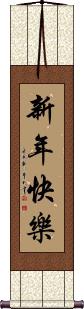
If you want to wish someone a happy new year, 新年快樂 is the way.
You can hang this up during Western New Years (Dec 31st - Jan 1st) and keep it up until after Chinese New Year which happens in either January or February of each year (it changes from year to year because China uses a lunar calendar).
Broken Mirror Rejoined
Used in modern times for divorced couples that come back together
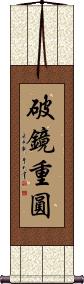
破鏡重圓 is about a husband and wife who were separated and reunited.
About 1500 years ago in China, there lived a beautiful princess named Le Chang. She and her husband Xu De Yan loved each other very much. But when the army of the Sui Dynasty was about to attack their kingdom, disposed of all of their worldly possessions and prepared to flee into exile.
They knew that in the chaos, they might lose track of each other, so the one possession they kept was a bronze mirror which is a symbol of unity for a husband and wife. They broke the mirror into two pieces, and each of them kept half of the mirror. They decided that if separated, they would try to meet at the fair during the 15th day of the first lunar month (which is the lantern festival). Unfortunately, the occupation was brutal, and the princess was forced to become the mistress of the new commissioner of the territory, Yang Su.
At the Lantern Festival the next year, the husband came to the fair to search for his wife. He carried with him his half of the mirror. As he walked through the fair, he saw the other half of the mirror for sale at a junk market by a servant of the commissioner. The husband recognized his wife's half of the mirror immediately, and tears rolled down his face as he was told by the servant about the bitter and loveless life that the princess had endured.
As his tears dripped onto the mirror, the husband scratched a poem into his wife's half of the mirror:
You left me with the severed mirror,
The mirror has returned, but absent are you,
As I gaze in the mirror, I seek your face,
I see the moon, but as for you, I see not a trace.
The servant brought the inscribed half of the mirror back to the princess. For many days, the princess could not stop crying when she found that her husband was alive and still loved her.
Commissioner Yang Su, becoming aware of this saga, realized that he could never obtain the princess's love. He sent for the husband and allowed them to reunite.
This proverb, 破鏡重圓, is now used to describe a couple who has been torn apart for some reason (usually divorce) but have come back together (or remarried).
It seems to be more common these days in America for divorced couples to reconcile and get married to each other again. This will be a great gift if you know someone who is about to remarry their ex.
This in-stock artwork might be what you are looking for, and ships right away...
Gallery Price: $240.00
Your Price: $148.88
Gallery Price: $72.00
Your Price: $39.88
Gallery Price: $72.00
Your Price: $39.88
Gallery Price: $72.00
Your Price: $39.88


Gallery Price: $61.00
Your Price: $33.88

Gallery Price: $61.00
Your Price: $33.88

Gallery Price: $61.00
Your Price: $33.88
Gallery Price: $126.00
Your Price: $69.88
Gallery Price: $200.00
Your Price: $88.88
Gallery Price: $304.00
Your Price: $168.88

Gallery Price: $240.00
Your Price: $148.88
Not the results for Lunar New Year that you were looking for?
Below are some entries from our dictionary that may match your Lunar New Year search...
| Characters If shown, 2nd row is Simp. Chinese |
Pronunciation Romanization |
Simple Dictionary Definition |
五福臨門 五福临门 see styles |
wǔ fú lín mén wu3 fu2 lin2 men2 wu fu lin men |
More info & calligraphy: Blessings on this Home |
年年有餘 年年有余 see styles |
nián nián yǒu yú nian2 nian2 you3 yu2 nien nien yu yü |
More info & calligraphy: Year-In Year-Out Have Abundance |
朔 see styles |
shuò shuo4 shuo hajime はじめ |
beginning; first day of lunar month; north (1) {astron} new moon; (2) first day of the lunar month; (3) (hist) next year's calendar and decrees (in ancient China; distributed by the Emperor at year's end); (given name) Hajime |
三元 see styles |
sān yuán san1 yuan2 san yüan miyuki みゆき |
(old) first place in civil service examinations at three levels: provincial 解元[jie4 yuan2], metropolitan 會元|会元[hui4 yuan2] and palace 狀元|状元[zhuang4 yuan2] (1) (See 上元,中元・1,下元) 15th day of the 1st, 7th and 10th lunar months; (2) heaven, earth and man; (3) January 1; New Year's Day; (can act as adjective) (4) {chem} ternary; (female given name) Miyuki |
團年 团年 see styles |
tuán nián tuan2 nian2 t`uan nien tuan nien |
(of a family) to come together at lunar New Year's Eve; family reunion at New Year's |
守歲 守岁 see styles |
shǒu suì shou3 sui4 shou sui |
to see in the New Year; to stay up all night on lunar New Year's Eve |
年夜 see styles |
nián yè nian2 ye4 nien yeh |
lunar New Year's Eve |
新春 see styles |
xīn chūn xin1 chun1 hsin ch`un hsin chun niiharu / niharu にいはる |
the beginning of Spring; the 10 or 20 days following the lunar New Year's Day New Year; (surname) Niiharu |
春節 春节 see styles |
chūn jié chun1 jie2 ch`un chieh chun chieh shunsetsu しゅんせつ |
Spring Festival (Chinese New Year) Lunar New Year; Chinese New Year; Spring Festival |
正月 see styles |
zhēng yuè zheng1 yue4 cheng yüeh mutsuki むつき |
first month of the lunar year (1) New Year (esp. first three days); (2) first month of the year; January; (surname) Mutsuki the first month of the year |
正朔 see styles |
zhēng shuò zheng1 shuo4 cheng shuo seisaku / sesaku せいさく |
first day of the first lunar month; (old) calendar promulgated by the first emperor of a dynasty beginning of the month or the year; New Year's Day; the calendar; (given name) Seisaku |
開春 开春 see styles |
kāi chūn kai1 chun1 k`ai ch`un kai chun |
beginning of spring; the lunar New Year |
除夕 see styles |
chú xī chu2 xi1 ch`u hsi chu hsi joseki じょせき |
lunar New Year's Eve New Year's Eve |
八寶飯 八宝饭 see styles |
bā bǎo fàn ba1 bao3 fan4 pa pao fan |
Eight Treasures Rice, Chinese rice pudding dessert usually made with eight types of candied fruits, nuts, seeds etc, popular during the Lunar New Year |
年三十 see styles |
nián sān shí nian2 san1 shi2 nien san shih |
last day of the lunar year; Chinese New Year's Eve |
年夜飯 年夜饭 see styles |
nián yè fàn nian2 ye4 fan4 nien yeh fan |
reunion dinner on Lunar New Year's Eve (Chinese New Year tradition) |
旧正月 see styles |
kyuushougatsu / kyushogatsu きゅうしょうがつ |
lunar New Year (esp. the Chinese New Year) |
舊曆年 旧历年 see styles |
jiù lì nián jiu4 li4 nian2 chiu li nien |
lunar New Year |
大年三十 see styles |
dà nián sān shí da4 nian2 san1 shi2 ta nien san shih |
last day of the lunar year; Chinese New Year's Eve |
大年初一 see styles |
dà nián chū yī da4 nian2 chu1 yi1 ta nien ch`u i ta nien chu i |
Lunar New Year's Day |
弓場始め see styles |
yubahajime ゆばはじめ |
(1) ceremony on the fifth day of the 10th lunar month in which the emperor would watch prize archery (Heian and Kamakura periods); (2) first firing of the bow (after the New Year or the reconstruction of the archery range (in military families)) |
正月初一 see styles |
zhēng yuè chū yī zheng1 yue4 chu1 yi1 cheng yüeh ch`u i cheng yüeh chu i |
New Year's Day in the lunar calendar |
農曆新年 农历新年 see styles |
nóng lì xīn nián nong2 li4 xin1 nian2 nung li hsin nien |
Chinese New Year; Lunar New Year |
Variations: |
juurukunichii; juurukunichii; juurukunichii / jurukunichi; jurukunichi; jurukunichi じゅうるくにちい; ジュウルクニチー; ジュールクニチー |
Jūrukunichī; New Year's Day of the Dead; Okinawan festival celebrated on the 16th day of the first month in the lunar calendar |
The following table may be helpful for those studying Chinese or Japanese...
| Title | Characters | Romaji (Romanized Japanese) | Various forms of Romanized Chinese | |
| Happy New Year | 新年快樂 新年快乐 | xīn nián kuài lè xin1 nian2 kuai4 le4 xin nian kuai le xinniankuaile | hsin nien k`uai le hsinnienkuaile hsin nien kuai le |
|
| Broken Mirror Rejoined | 破鏡重圓 破镜重圆 | pò jìng chóng yuán po4 jing4 chong2 yuan2 po jing chong yuan pojingchongyuan | p`o ching ch`ung yüan pochingchungyüan po ching chung yüan |
|
| In some entries above you will see that characters have different versions above and below a line. In these cases, the characters above the line are Traditional Chinese, while the ones below are Simplified Chinese. | ||||

Successful Chinese Character and Japanese Kanji calligraphy searches within the last few hours...



