Many custom options...


And formats...



Lotus Flower in Chinese / Japanese...
Buy a Lotus Flower calligraphy wall scroll here!
Personalize your custom “Lotus Flower” project by clicking the button next to your favorite “Lotus Flower” title below...
White Lotus
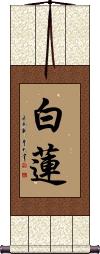
白蓮 is the title for the white lotus (flower) or a short name for the White Lotus society.
The white lotus represents purity or a pure heart and is often associated with Buddhism.
Notes: This can be the Japanese given name Byakuren. In the Buddhist context, the white lotus represented by these characters is originally puṇḍarīka in Sanskrit.
Namu Myoho Renge Kyo / Homage to Lotus Sutra
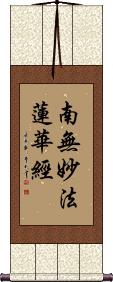
南無妙法蓮華經 is sometimes translated as the “Devotion to the Law of the Lotus Flower Scripture.”
This is a meditation chant and homage to the Lotus Sutra, used by Nichiren Buddhists in Japan.
This is also a chant used in China by certain sects of Buddhism that celebrate the deity Guanyin.
Also romanized as “Nam Myōhō Renge Kyō” or without accents as “Nam Myoho Renge Kyo.”


Original
Traditional
Version
The last character was originally written as seen on the left. Sometimes, you will see it written in the Japanese variant form as shown on the right. If you want this Japanese variant, click on the "Modern Japanese Variant" text instead of the button up by the main title of this entry.
This in-stock artwork might be what you are looking for, and ships right away...



Not the results for Lotus Flower that you were looking for?
Below are some entries from our dictionary that may match your Lotus Flower search...
| Characters If shown, 2nd row is Simp. Chinese |
Pronunciation Romanization |
Simple Dictionary Definition |
花 see styles |
huā hua1 hua ririka りりか |
More info & calligraphy: Flower(1) flower; blossom; bloom; petal; (2) cherry blossom; (3) beauty; (4) blooming (esp. of cherry blossoms); (5) ikebana; (6) (abbreviation) Japanese playing cards; (7) (the) best; (female given name) Ririka 華 puṣpa, a flower, flowers; especially the lotus, and celestial flowers. 花座 The lotus throne on which buddhas and bodhisattvas sit. |
華 华 see styles |
huá hua2 hua ririka りりか |
More info & calligraphy: Flowers / Blooming / Splendid / China(1) flashiness; showiness; brilliance; splendor; (2) bloom; flowers; (3) (abbreviation) (See 中華民国・1) Republic of China; (female given name) Ririka kusuma; puṣpa; padma; a flower, blossom; flowery; especially the lotus; also 花, which also means pleasure, vice; to spend, waste, profligate. 華 also means splendour, glory, ornate; to decorate; China. |
白蓮 白莲 see styles |
bái lián bai2 lian2 pai lien byakuren びゃくれん |
More info & calligraphy: White Lotus(1) white lotus; (2) purity; pure heart; (given name) Byakuren (白蓮華); 分陀利 puṇḍarīka, the white lotus. |
觀世音 观世音 see styles |
guān shì yīn guan1 shi4 yin1 kuan shih yin Kanzeon かんぜおん |
More info & calligraphy: Guan Shi Yin: Protector Of Life(out-dated kanji) Avalokiteshvara (Bodhisattva); Avalokitesvara; Kannon; Kwannon; Guanyin; Buddhist deity of compassion Regarder of the world's sounds, or cries, the so-called Goddess of Mercy; also known as 觀音; 觀世音善薩; 觀自在 (觀世自在); 觀尹; 光世音 (the last being the older form). Avalokiteśvara, v. 阿 8. Originally represented as a male, the images are now generally those of a female figure. The meaning of the term is in doubt; it is intp. as above, but the term 觀自在 (觀世自在) accords with the idea of Sovereign Regarder and is not associated with sounds or cries. Guanyin is one of the triad of Amida, is represented on his left, and is also represented as crowned with Amida; but there are as many as thirty-three different forms of Guanyin, sometimes with a bird, a vase, a willow wand, a pearl, a 'thousand' eyes and hands, etc., and, when as bestower of children, carrying a child. The island of Putuo (Potala) is the chief centre of Guanyin worship, where she is the protector of all in distress, especially of those who go to sea. There are many sūtras, etc., devoted to the cult, but its provenance and the date of its introduction to China are still in doubt. Chapter 25 of the Lotus Sūtra is devoted to Guanyin, and is the principal scripture of the cult; its date is uncertain. Guanyin is sometimes confounded with Amitābha and Maitreya. She is said to be the daughter of king Śubhavyūha 妙莊王, who had her killed by 'stifling because the sword of the executioner broke without hurting her. Her spirit went to hell; but hell changed into paradise. Yama sent her back to life to save his hell, when she was miraculously transported on a Lotus flower to the island of Poo-too'. Eitel. |
一蓮 一莲 see styles |
yī lián yi1 lian2 i lien ichiren いちれん |
(given name) Ichiren The Lotus-flower of the Pure-land of Amitābha, idem 蓮臺. |
下品 see styles |
xià pǐn xia4 pin3 hsia p`in hsia pin shimoshina しもしな |
(noun or adjectival noun) vulgar; indecent; coarse; crude; (place-name) Shimoshina The three lowest of the nine classes born in the Amitābha Pure Land, v. 無量壽經. These three lowest grades are (1) 下品上生 The highest of the three lowest classes who enter the Pure Land of Amitābha, i.e. those who have committed all sins except dishonouring the sūtras. If at the end of life the sinner clasps hands and says "Namo Amitābha", such a one will be born in His precious lake. (2) 下品中生 The middle class consists of those who have broken all the commandments, even stolen from monks and abused the law. If at death such a one hears of the great power of Amitābha, and assents with but a thought, he will be received into paradise. (3) 下品下生 The lowest class, because of their sins, should have fallen into the lowest gati, but by invoking the name of Amitābha, they can escape countless ages of reincarnation and suffering and on dying will behold a lotus flower like the sun, and, by the response of a single thought, will enter the Pure Land of Amitābha. |
十宗 see styles |
shí zōng shi2 zong1 shih tsung jūshū |
The ten schools of Chinese Buddhism: I. The (1) 律宗 Vinaya-discipline, or 南山|; (2) 倶舍 Kośa, Abhidharma, or Reality (Sarvāstivādin) 有宗; (3) 成實宗 Satyasiddhi sect founded on this śāstra by Harivarman; (4) 三論宗 Mādhyamika or 性空宗; (5) 法華宗 Lotus, "Law-flower" or Tiantai 天台宗; (6) 華嚴Huayan or法性 or賢首宗; ( 7) 法相宗 Dharmalakṣana or 慈恩宗 founded on the唯識論 (8) 心宗 Ch'an or Zen, mind-only or intuitive, v. 禪宗 ; (9) 眞言宗 (Jap. Shingon) or esoteric 密宗 ; (10) 蓮宗 Amitābha-lotus or Pure Land (Jap. Jōdo) 淨士宗. The 2nd, 3rd, 4th, and 9th are found in Japan rather than in China, where they have ceased to be of importance. II. The Hua-yen has also ten divisions into ten schools of thought: (1) 我法倶有 the reality of self (or soul) and things, e.g. mind and matter; (2) 法有我無 the reality of things but not of soul; (3) 法無去來 things have neither creation nor destruction; (4) 現通假實 present things are both apparent and real; (5) 俗妄眞實 common or phenomenal ideas are wrong, fundamental reality is the only truth; (6) things are merely names; (7) all things are unreal 空; (8) the bhūtatathatā is not unreal; (9) phenomena and their perception are to be got rid of; (10) the perfect, all-inclusive, and complete teaching of the One Vehicle. III. There are two old Japanese divisions: 大乘律宗, 倶舎宗 , 成實 宗 , 法和宗 , 三論宗 , 天台宗 , 華嚴宗 , 眞言宗 , 小乘律宗 , and 淨土宗 ; the second list adds 禪宗 and omits 大乘律宗. They are the Ritsu, Kusha, Jōjitsu, Hossō, Sanron, Tendai, Kegon, Shingon, (Hīnayāna) Ritsu, and Jōdo; the addition being Zen. |
含華 含华 see styles |
hán huā han2 hua1 han hua gange |
In the closed lotus flower, i.e. those who await the opening of the flower for rebirth in Paradise. |
四果 see styles |
sì guǒ si4 guo3 ssu kuo shika |
The four phala, i. e. fruitions, or rewards — srota-āpanna-phala, sakradāgāmi-phala, anāgāmiphala, arhat-phala, i. e. four grades of saintship; see 須陀洹; 斯陀含, 阿那含, and 阿離漢. The four titles are also applied to four grades of śramaṇas— yellow and blue flower śramaṇas, lotus śramaṇas, meek śramaṇas, and ultra-meek śramaṇas. |
天華 天华 see styles |
tiān huā tian1 hua1 t`ien hua tien hua yuki ゆき |
(Buddhist term) flowers that bloom in the heavens; paper flowers scattered before the Buddha's image; snow; (female given name) Yuki Deva, or divine, flowers, stated in the Lotus Sutra as of four kinds, mandāras, mahāmandāras, mañjūṣakas, and mahāmañjūṣakas, the first two white, the last two red. |
法華 法华 see styles |
fǎ huā fa3 hua1 fa hua myouka / myoka みょうか |
(1) (abbreviation) (See 法華宗) Nichiren sect; Tendai sect; (2) (abbreviation) (See 法華経) Lotus Sutra; (female given name) Myōka The Dharma-flower, i.e. the Lotus Sutra, the法華經 or 妙法蓮華經 q.v. Saddharmapuṇḍarīka Sutra; also the法華宗 Lotus sect, i.e. that of Tiantai, which had this sutra for its basis. There are many treatises with this as part of the title. 法華法, 法華會, 法華講 ceremonials, meetings, or explications connected with this sutra. |
紅蓮 红莲 see styles |
hóng lián hong2 lian2 hung lien koren これん |
red lotus (1) bright red; (2) crimson lotus flower; (female given name) Koren |
芬陀 see styles |
fēn tuó fen1 tuo2 fen t`o fen to funda |
white lotus flower |
花筥 see styles |
huā jǔ hua1 ju3 hua chü keko |
花籠; 花皿 Flower baskets for scattering lotus flowers, or leaves and flowers in general. |
蓮花 莲花 see styles |
lián huā lian2 hua1 lien hua renfa れんふぁ |
lotus flower (Nelumbo nucifera Gaertn, among others); water-lily (1) (kana only) lotus flower; (2) (abbreviation) (kana only) Chinese milk vetch (Astragalus sinicus); (3) (abbreviation) china spoon; (4) lotus-shaped pedestal for a gravestone; (female given name) Renfa lotus flower |
蓮華 莲华 see styles |
lián huá lian2 hua2 lien hua renge れんげ |
(1) (kana only) lotus flower; (2) (abbreviation) (kana only) Chinese milk vetch (Astragalus sinicus); (3) (abbreviation) china spoon; (4) lotus-shaped pedestal for a gravestone; (f,p) Renge or 蓮花 The lotus flower. |
優鉢羅 优钵罗 see styles |
yōu bō luó you1 bo1 luo2 yu po lo uhatsura |
utpala, the blue lotus, to the shape of whose leaves the Buddha's eyes are likened; also applied to other water lilies. Name of a dragon king; also of one of the cold hells, and one of the hot hells. Also 優鉢剌; 鄔鉢羅; 漚鉢羅. |
分陀利 see styles |
fēn tuó lì fen1 tuo2 li4 fen t`o li fen to li fundari |
lotus flower |
合蓮華 合莲华 see styles |
hé lián huá he2 lian2 hua2 ho lien hua gō renge |
A closed lotus-flower. |
大寶華 大宝华 see styles |
dà bǎo huā da4 bao3 hua1 ta pao hua daihō ke |
The great precious flower, a lotus made of pearls. |
水の花 see styles |
mizunohana みずのはな |
(1) algal bloom; water bloom; (2) lotus flower; (3) (archaism) (feminine speech) Japanese sea perch; Japanese sea bass |
水の華 see styles |
mizunohana みずのはな |
(1) algal bloom; water bloom; (2) lotus flower; (3) (archaism) (feminine speech) Japanese sea perch; Japanese sea bass |
淨華衆 淨华众 see styles |
jìng huā zhòng jing4 hua1 zhong4 ching hua chung jōke shu |
The pure flower multitude, i.e. those who are born into the Pure Land by means of a lotus flower. ' |
白蓮花 白莲花 see styles |
bái lián huā bai2 lian2 hua1 pai lien hua byaku renge |
white lotus flower |
赤蓮華 赤莲华 see styles |
chì lián huá chi4 lian2 hua2 ch`ih lien hua chih lien hua shaku renge |
a red lotus flower |
靑蓮華 see styles |
qīng lián huá qing1 lian2 hua2 ch`ing lien hua ching lien hua |
blue lotus flower |
八寒地獄 八寒地狱 see styles |
bā hán dì yù ba1 han2 di4 yu4 pa han ti yü hakkan jigoku |
Also written 八寒冰地獄. The eight cold narakas, or hells: (1) 頞浮陀 arbuda, tumours, blains; (2) 泥羅浮陀 nirarbuda, enlarged tumors; 疱裂bursting blains; (3) 阿叱叱 aṭaṭa, chattering (teeth); (4) 阿波波 hahava, or ababa, the only sound possible to frozen tongues; (5) 嘔侯侯ahaha, or hahava, ditto to frozen throats; (6) 優鉢羅 utpala, blue lotus flower, the flesh being covered with sores resembling it; (7) 波頭摩padma, red lotus flower, ditto; (8) 分陀利puṇḍarīka, the great lotus, ditto. v. 地獄 and大地獄. |
出水芙蓉 see styles |
chū shuǐ fú róng chu1 shui3 fu2 rong2 ch`u shui fu jung chu shui fu jung |
as a lotus flower breaking the surface (idiom); surpassingly beautiful (of young lady's face or old gentleman's calligraphy) |
分荼利華 分荼利华 see styles |
fēn tú lì huā fen1 tu2 li4 hua1 fen t`u li hua fen tu li hua fundarika |
white lotus flower |
分荼利迦 see styles |
fēn tú lì jiā fen1 tu2 li4 jia1 fen t`u li chia fen tu li chia fundarika |
white lotus flower |
Click here for more Lotus Flower results from our dictionary
The following table may be helpful for those studying Chinese or Japanese...
| Title | Characters | Romaji (Romanized Japanese) | Various forms of Romanized Chinese | |
| White Lotus | 白蓮 白莲 | byakuren | bái lián / bai2 lian2 / bai lian / bailian | pai lien / pailien |
| Namu Myoho Renge Kyo Homage to Lotus Sutra | 南無妙法蓮華經 / 南無妙法蓮華経 南无妙法莲华经 | na mu myou hou ren ge kyou namumyouhourengekyou na mu myo ho ren ge kyo | nán wú miào fǎ lián huá jīng nan2 wu2 miao4 fa3 lian2 hua2 jing1 nan wu miao fa lian hua jing nanwumiaofalianhuajing | nan wu miao fa lien hua ching nanwumiaofalienhuaching |
| In some entries above you will see that characters have different versions above and below a line. In these cases, the characters above the line are Traditional Chinese, while the ones below are Simplified Chinese. | ||||

Successful Chinese Character and Japanese Kanji calligraphy searches within the last few hours...



