Many custom options...


And formats...



Guess in Chinese / Japanese...
Buy a Guess calligraphy wall scroll here!
Personalize your custom “Guess” project by clicking the button next to your favorite “Guess” title below...
1. Guess
2. Lava / Magma
3. Zero
4. Gold / Metal
5. Eight
6. Five
7. Ten
8. Nine
9. Three
10. Loyalty / Faithful / Devoted
12. Enthusiasm / Passion for a Cause
14. Gay Pride
15. Boxing
16. Longevity / Long Life Wishes
17. Independent Spirit / Independent Heart
18. Shit Happens
19. Kung Fu San Soo / San Shou
20. Cooperation
Guess

ゲス is the name Guess in Japanese Katakana.
Note: Because this title is entirely Japanese Katakana, it should be written by a Japanese calligrapher.
Guess

蓋斯 is the name Guess in Chinese (Mandarin).
Lava / Magma
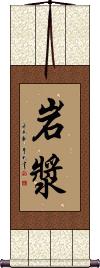
岩漿 are the Chinese characters and Japanese Kanji for lava or magma.
I guess if you like volcanoes and eruptions, this could be the title for you.
Zero
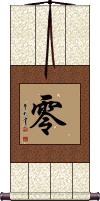
零 is the number zero in Chinese, Japanese Kanji, and old Korean Hanja.
零 is a strange selection for a wall scroll, so it's here mostly for reference. I guess it's OK if zero is important to you.
Note: In modern Japan and China, they will often just write a circle to represent zero in lieu of this character.
Gold / Metal
(One of the five elements)
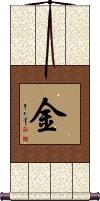
金 is the symbol for metal (often means gold or money) in Chinese, Korean and Japanese.
In an interesting twist, in Japanese, this Kanji can also mean “Friday.” I guess Friday is “the golden day” in Japan.
Gold / Metal is one of the five elements that ancient Chinese believed all things were composed of. These elements are also part of the cycle of Chinese astrology. Every person has both an animal sign, and one of the five elements according to the date of their birth. See also Five Elements and Chinese 12 Animals / Zodiac.
Eight
The number eight
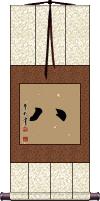
八 is the number eight in Chinese, Japanese Kanji, and old Korean Hanja.
八 is a strange selection for a wall scroll, so it's here mostly for reference. I guess it's OK if the number eight is important to you.
Because this character is rather simple (just two strokes), 捌 instead of 八 is an anti-fraud way to write eight on bank documents.
Five
The number five
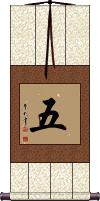
五 is the number five in Chinese, Japanese Kanji, and old Korean Hanja.
This is a strange selection for a wall scroll, so it's here mostly for reference. I guess it's OK if the number five is important to you.
 Because this character is rather simple (just four strokes), there is an anti-fraud way to write three on bank documents. These variants are shown to the right. This version can also refer to a squad of five soldiers, or in Korean, refer to rank.
Ten
The number ten
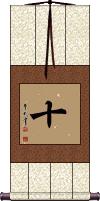
十 is the number ten in Chinese, Japanese Kanji, and old Korean Hanja.
This is a strange selection for a wall scroll, so it's here mostly for reference. I guess it's OK if the number ten is important to you.
 Because this character is rather simple (just two strokes), there is an anti-fraud way to write ten on bank documents. This variant is shown to the right.
Nine
The number nine
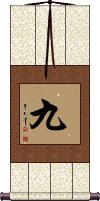
九 is the number nine in Chinese, Japanese Kanji, and old Korean Hanja.
九 is a strange selection for a wall scroll, so it's here mostly for reference. I guess it's OK if the number nine is important to you.
 Because this character is rather simple (just two strokes), there is an anti-fraud way to write nine on bank documents. This version is shown to the right.
Three
The number three
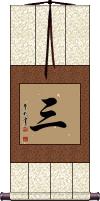
三 is the number three in Chinese, Japanese Kanji, and old Korean Hanja.
This is a strange selection for a wall scroll, so it's here mostly for reference. I guess it's OK if the number three is important to you.

 Because this character is rather simple (just three lines), there is an anti-fraud way to write three on bank documents. These variants are shown to the right.
Loyalty / Faithful / Devoted
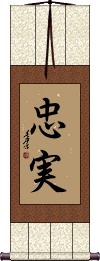
忠実 is a Japanese way to write “Loyalty” - it also contains the ideas of being faithful, devoted, true, and obedient.
The second character is a modified form only used in the Japanese lexicon; however, Chinese speakers can easily guess the meaning.
This is also a virtue of the Samurai Warrior
See our page with just Code of the Samurai / Bushido here
Imagine / Imagination
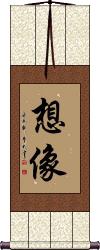
想像 is the shortest word for imagine, visualize, or imagination.
It can also mean “to guess,” (which is why I favor the 3-character version of imagination (just a third character is added to the end, which clarifies it).
Enthusiasm / Passion for a Cause
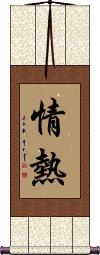
情熱 is the Japanese word that means enthusiasm or “passion for a cause.”
In some contexts, this could mean being extremely fond of something or having a fondness for a cause or person.
Can also be translated as passion, zeal, ardor/ardour, or fervor.
Note: This word (or character order) is not natural in Chinese. However, a typical Chinese person can guess this is a Japanese or Korean word and understand the intended meaning. This selection is best if your audience is Japanese or old-school Korean.
See Also: Persistence | Devotion | Tenacity | Commitment | Motivation
San Soo / San Shou
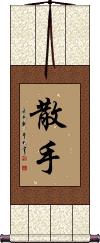
散手 is a martial arts title sometimes spelled in English as “San Soo” or “San Shou.”
The Mandarin version romanizes as “San Shou.” Mandarin Chinese is the most common dialect in China (literally 99% of Chinese people speak standard Mandarin along with their local dialect).
There is another martial arts style that spells this “San Soo.” I guess this was supposed to approximate Cantonese pronunciation for which the scholarly romanization is generally agreed to be “Saan Sau.”
Gay Pride
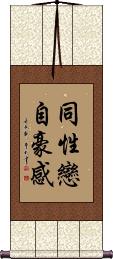
同性戀自豪感 or “Gay Pride” is a new idea in China. It's so new, that we may have just started the movement by translating this phrase.
If they ever do start having gay pride parades in China, my best guess is that these 6 characters will constitute the term they use to title the parade/movement.
Who knows, maybe in 10 years they will have a pride parade march straight past Tian'anmen Square on Chang An Street (the main drag in Beijing).
Boxing
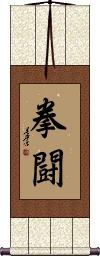
拳闘 is the term used in Japanese Kanji to refer to the original Olympic sport of combat and fighting.
This can also be translated as prizefighting.
The first Kanji means fist. The second means fight. So when literally translated, this means “fistfight” (though understood in Japanese as a more refined sport, versus street fighting).
Note: A completely different second character is used in the Chinese word for boxing but a Chinese person would still be able to guess the meaning of these Kanji.
Longevity / Long Life Wishes
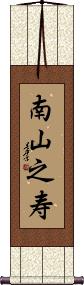
南山之壽 is a wish for long life for someone. The first part of this Japanese phrase is “Nan Zan,” which means “south mountain.” This mountain is one of the good wishes, good fortune, and prosperity. The title is often used as a salutation of good wishes.
The third Kanji is just a connector, and the last Kanji means long life or longevity.
I guess you could translate this phrase as “May your life be as long as Nan Zan is tall.”
Independent Spirit / Independent Heart
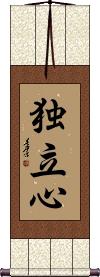
獨立心 means independent spirit or independent heart in Japanese.
The first two characters mean independent or independence. The third character means spirit, heart, or mind.
獨立心 is a Japanese term, although Chinese people could guess the meaning (the characters make sense individually in Chinese but are not often used this way). Also, the first character would be written 獨 in Traditional Chinese versus 独 which is the Simplified Chinese and modern Japanese version.
Shit Happens
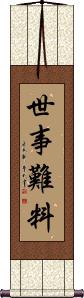
世事難料 is a polite Chinese version of “shit happens.” This phrase suggests that things happen (for no reason, and for which we have no control).
The first two characters mean the affairs of life, things of the world, worldly affairs, or ways of the world.
The third character means disaster, distress, problem, difficulty, difficult, hardships, troubles, or defect.
The last character in this context means: to expect, to anticipate, or to guess.
If you put this back together, you have something like, “In life, troubles [should be] expected.”
Kung Fu San Soo / San Shou
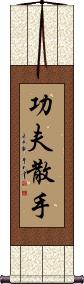
功夫散手 is a martial arts title.
Oddly, there are multiple ways two spell/romanize this in English, but in Chinese, it's written exactly the same.
Technically, the Mandarin romanizes as “gong fu san shou,” for which you'll sometimes see it written “kung fu san shou” (k'ung is an old romanization for a word that sounds like gong with a vowel sound like “oh”).
There is another martial arts style that spells this “Kung Fu San Soo.” I guess this was supposed to approximate Cantonese pronunciation for which the scholarly romanization is generally agreed to be “gung fu saan sau.”
Cooperation
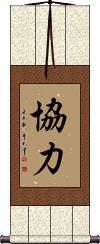
協力 is a Japanese word that means cooperation.
If you look at the second character, which means “strength” or “power,” and then you look at the first character, you will see that the first character seems to represent multiple “strengths” together. Thus, you can visually see the meaning of this word as “stronger when working together.” The combination of characters that form this word is commonly seen in Japanese Kanji and Korean Hanja but not used in China (however, a Chinese person could probably guess the meaning, and it can be pronounced in Chinese).
It is implied that you are cooperating to create some project or product.
This can also be translated as “joint effort.”
See Also: Partnership
Kowtow - The deepest bow
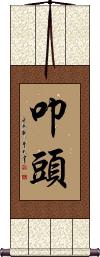
叩頭 is the term that seems to be known worldwide as kowtow.
In Japanese and Chinese, it simply means a deep bow, especially one so low that one's head touches the ground in submission. However, in western culture, it has sometimes come to mean “giving in” or “surrendering to someone else's will.” Sometimes even said of a person who stoops to flattery at the expense of their dignity.
I don't know if you would really want this on a wall scroll, but enough people have searched for this term on our website that I guess it was time to add it. It just feels strange to see such a word on a wall scroll, so please order with caution. 叩頭 is antiquated in both Japanese and Chinese. The act is seldom done anymore and is seen as an ancient ritual.
Martial Arts Master
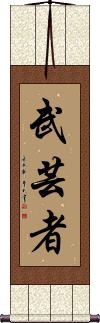
武芸者 is the Japanese Kanji title for “Martial Arts Master.” It suggests that you have reached at least the level of black belt and are probably to the level where you are ready to become an instructor.
Please consider carefully where you stand before ordering this phrase on a wall scroll. If you are not a master, this will make you look a bit foolish.
If you want to get this as a gift for your master at the dojo. Try to discreetly make sure this term is used in your school. Different schools and styles of Japanese martial arts use different terms. You may notice in the Romaji that the last two characters romanize as “geisha” which means “person skilled in arts” (what a geisha girl really is). The title here has the character for “martial,” “warrior,” and/or “military” in front of it. Therefore the literal translation is “martial art person.”
These Kanji are valid Chinese characters and Korean Hanja, but this title does not really make sense in Chinese and is not often used in Korean, though a Chinese or Korean would be able to guess the meaning by looking at the first and last characters.
Crisis equals Danger plus Opportunity?
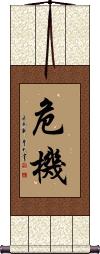
危機 means crisis in Chinese and Japanese.
Separately, the first character here does mean “danger” or “to endanger,” and the second character can mean “opportunity.”
However, I want to debunk a myth that was propagated by some westerners who did not have a clear understanding of Asian languages...
While often, Chinese/Japanese/Korean compound words (words of two or more characters) are the sum of their parts, this is not always the case. The compound is often understood with a completely different meaning than the two characters individually.
Many have said that the Chinese/Japanese/Korean word for Crisis is made up of the characters for “danger” and “opportunity.” 危機 is true when phrased this way.
However, it's not absolutely correct to say that “danger + opportunity = crisis” in Asian cultures.
English example:
If I tell you that...
Bovine creature + Guy behind the plate in baseball = Locomotive train protection

...you would think I was mad. But consider that “cow + catcher = cowcatcher,” which is the device that used to be found on steam engines to protect them if they hit an animal on the tracks. When we hear the word “cowcatcher,” we don't separate the words into their individual meanings (necessarily).
The same is true with the word for crisis in Chinese/Japanese/Korean. While you can separate the characters, few Asian people would automatically do so in their minds.
The final answer:
It is a half-truth to say, “danger plus opportunity equals crisis” in Chinese/Japanese/Korean. Use this statement and concept with caution.
Also, the second character can mean “secret” or “machine,” depending on context so I guess you have to say “a dangerous machine = crisis” or “danger + a secret = crisis.” Both of these are only slightly more ridiculous than the first premise.
PS: 危機 is probably not a great word for a scroll unless you have a special use for it.
The following table may be helpful for those studying Chinese or Japanese...
| Title | Characters | Romaji (Romanized Japanese) | Various forms of Romanized Chinese | |
| Guess | ゲス | gesu | ||
| Guess | 蓋斯 盖斯 | gài sī / gai4 si1 / gai si / gaisi | kai ssu / kaissu | |
| Lava Magma | 岩漿 岩浆 | ganshou / gansho | yán jiāng yan2 jiang1 yan jiang yanjiang | yen chiang yenchiang |
| Zero | 零 零 / 〇 | rei / zero | líng / ling2 / ling | |
| Gold Metal | 金 | kin | jīn / jin1 / jin | chin |
| Eight | 八 | hachi | bā / ba1 / ba | pa |
| Five | 五 / 伍 五 | go | wǔ / wu3 / wu | |
| Ten | 十 / 拾 十 | juu / ju | shí / shi2 / shi | shih |
| Nine | 九 / 玖 | kyuu / kyu | jiǔ / jiu3 / jiu | chiu |
| Three | 三 / 參 三 / 参 | san | sān / san1 / san | |
| Loyalty Faithful Devoted | 忠實 忠実 | chuujitsu / chuugi chujitsu / chugi | ||
| Imagine Imagination | 想像 | souzou / sozo | xiǎng xiàng xiang3 xiang4 xiang xiang xiangxiang | hsiang hsiang hsianghsiang |
| Enthusiasm Passion for a Cause | 情熱 情热 | jou netsu / jounetsu / jo netsu | qíng rè / qing2 re4 / qing re / qingre | ch`ing je / chingje / ching je |
| San Soo San Shou | 散手 | sǎn shǒu / san3 shou3 / san shou / sanshou | ||
| Gay Pride | 同性戀自豪感 同性恋自豪感 | tóng xìng liàn zì háo gǎn tong2 xing4 lian4 zi4 hao2 gan3 tong xing lian zi hao gan tongxinglianzihaogan | t`ung hsing lien tzu hao kan tunghsinglientzuhaokan tung hsing lien tzu hao kan |
|
| Boxing | 拳闘 拳斗 | ken tou / kentou / ken to | ||
| Longevity Long Life Wishes | 南山之壽 南山之寿 | nan zan no jyu nanzannojyu | ||
| Independent Spirit Independent Heart | 獨立心 独立心 | dokuritsushin | ||
| Shit Happens | 世事難料 世事难料 | shì shì nán liào shi4 shi4 nan2 liao4 shi shi nan liao shishinanliao | shih shih nan liao shihshihnanliao |
|
| Kung Fu San Soo San Shou | 功夫散手 | gōng fu sǎn shǒu gong1 fu san3 shou3 gong fu san shou gongfusanshou | kung fu san shou kungfusanshou |
|
| Cooperation | 協力 协力 | kyouryoku / kyoryoku | xié lì / xie2 li4 / xie li / xieli | hsieh li / hsiehli |
| Kowtow - The deepest bow | 叩頭 叩头 | koutou / koto | kòu tóu / kou4 tou2 / kou tou / koutou | k`ou t`ou / koutou / kou tou |
| Martial Arts Master | 武芸者 | bugeisha | wǔ yún zhě wu3 yun2 zhe3 wu yun zhe wuyunzhe | wu yün che wuyünche |
| Crisis equals Danger plus Opportunity? | 危機 危机 | kiki | wēi jī / wei1 ji1 / wei ji / weiji | wei chi / weichi |
| In some entries above you will see that characters have different versions above and below a line. In these cases, the characters above the line are Traditional Chinese, while the ones below are Simplified Chinese. | ||||

Successful Chinese Character and Japanese Kanji calligraphy searches within the last few hours...



