Many custom options


And formats



Favors in Chinese / Japanese
Buy a Favors calligraphy wall scroll here!
Personalize your custom “Favors” project by clicking the button next to your favorite “Favors” title below.
Favors

費弗斯 is the name Favors in Chinese (Mandarin).
Favors

フェイバーズ is the name Favors in Japanese Katakana.
Note: Because this title is entirely Japanese Katakana, it should be written by a Japanese calligrapher.
Fortune Favors the Bold
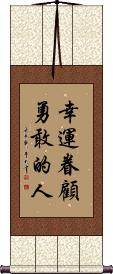
幸运眷顾勇敢的人 can mean “Fortune favors the brave/bold/courageous” in Chinese.
Fortune Favors The Brave
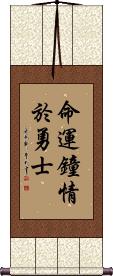
命運鐘情於勇士 means “Fortune favors the brave” in Chinese.
This is not the only way to express the idea of fortune favoring the bold or brave.
It's not originally a Chinese phrase, so it's been translated into Chinese in various ways.
Fortune favors the brave
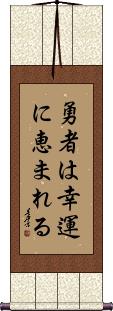
勇者は幸運に恵まれる is a Japanese proverb that suggests that in history, the brave or courageous tend to be the ones who win.
Note: Because this selection contains some special Japanese Hiragana characters, it should be written by a Japanese calligrapher.
Guanxi
The Chinese Concept of Relationship and Exchange of Favors
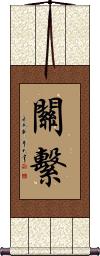
The dictionary definition is:
Relations/relationship, to concern, to affect, to have to do with, or connection.
But there's more to it...
In China, the relationship that you have with certain people can open doors for you. Having guanxi with someone also means they would never defraud you but are honor-bound to treat you fairly (of course, this goes both ways). Sometimes it is suggested that guanxi is the exchange of favors. 關繫 / 関繫 / 關係 is more about having a relationship that allows you to ask for and expect favors without shame.
There is no concept in western culture that exactly matches guanxi, but perhaps having a social or professional network is similar.
Note that there are some variations common within Chinese, Japanese Kanji, and Korean Hanja for this word... Japanese tend to use a Chinese alternate form as shown to the right for
the first character.
 There's also another alternate form of that first character (currently used as the official Simplified form in mainland China) which looks like the character shown to the right. It's basically the central radical of the alternate version shown above but without the “door radical” around it. In more free-flowing calligraphy styles, this version would be the likely choice for a calligrapher.
 In Modern Japanese, they use the character shown to the right.
They also tend to use this same form in Korean Hanja (I've only checked this word in my Korean dictionary, but it has not been confirmed by a translator's review).
 If that was not confusing enough, there is another alternate form of that second character. See right.
An Asian calligrapher of any nationality may use these forms at their discretion. However, They would tend to stick to the most common form used in their respective languages.
If you have any preference on any of these issues, please give us a special note with your order, and we'll make sure it's done the way you want.
Confucius: Golden Rule / Ethic of Reciprocity
Do not do to others what you do not want done to yourself
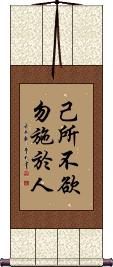
Some may think of this as a “Christian trait,” but actually, it transcends many religions.
This Chinese teaching dates back to about 2,500 years ago in China. Confucius had always taught the belief in being benevolent (ren), but this idea was hard to grasp for some of his students, as benevolence could be kind-heartedness or an essence of humanity itself.
When answering Zhong Gong's question as to what “ren” actually meant, Confucius said:
己所不欲勿施于人 or “When you go out, you should behave as if you were in the presence of a distinguished guest; when people do favors for you, act as if a great sacrifice was made for you. Whatever you wouldn't like done to you, do not do that thing to others. Don't complain at work or home.”
Hearing this, Zhong Gong said humbly, “Although I am not clever, I will do what you say.”
From this encounter, the Chinese version of the “Golden Rule” or “Ethic of Reciprocity” came to be.
The characters you see above express, “Do not do to others whatever you do not want to be done to yourself.”
See Also: Tea | Benevolence
These search terms might be related to Favors:
Not the results for Favors that you were looking for?
Below are some entries from our dictionary that may match your Favors search:
| Characters If shown, 2nd row is Simp. Chinese |
Pronunciation Romanization |
Simple Dictionary Definition |
フェイバーズ see styles |
feibaazu / febazu フェイバーズ |
More info & calligraphy: Favors |
余瀝 see styles |
yoreki よれき |
lingering raindrops; remaining portion of a drink; favors; favours |
博取 see styles |
bó qǔ bo2 qu3 po ch`ü po chü |
to win (favors, confidence etc) |
國恩 国恩 see styles |
guó ēn guo2 en1 kuo en kokuon |
favors received from the state |
將接 将接 see styles |
jiàng jiē jiang4 jie1 chiang chieh sōshō |
favors and guards (?) |
少恩 see styles |
shouon / shoon しょうおん |
small favors; small favours |
恩賜 恩赐 see styles |
ēn cì en1 ci4 en tz`u en tzu onshi おんし |
to bestow (favors, charity etc) Imperial gift |
惠潤 惠润 see styles |
huì rùn hui4 run4 hui jun ejun |
to bestow favors |
旧恩 see styles |
kyuuon / kyuon きゅうおん |
old favors; old favours |
潤う see styles |
uruou / uruo うるおう |
(v5u,vi) (1) to be moist; to be damp; to get wet; to be watered; (2) to profit by; to receive benefits; to receive favors (favours); (3) to become rich; to become at ease financially |
盼睞 盼睐 see styles |
pàn lài pan4 lai4 p`an lai pan lai |
your favors; your consideration |
蔭間 see styles |
kagema かげま |
(1) (archaism) homosexual prostitute who sold favors at banquets, etc. (late Edo); (2) (archaism) actor-in-training in kabuki; (surname) Kagema |
陰間 阴间 see styles |
yīn jiān yin1 jian1 yin chien kagema かげま |
the nether world; Hades; (neologism) (slang) disturbing; unsettling; awful; detestable (1) (archaism) homosexual prostitute who sold favors at banquets, etc. (late Edo); (2) (archaism) actor-in-training in kabuki |
霑う see styles |
uruou / uruo うるおう |
(v5u,vi) (1) to be moist; to be damp; to get wet; to be watered; (2) to profit by; to receive benefits; to receive favors (favours); (3) to become rich; to become at ease financially |
愛用者 see styles |
aiyousha / aiyosha あいようしゃ |
regular user; person who favors (favours) (something) |
求報恩 求报恩 see styles |
qiú bào ēn qiu2 bao4 en1 ch`iu pao en chiu pao en gu hōon |
looking for repayment [of favors] |
潛規則 潜规则 see styles |
qián guī zé qian2 gui1 ze2 ch`ien kuei tse chien kuei tse |
unspoken rules (usually ones that codify improper behaviors such as leveraging guanxi to get favorable treatment, or coercing employees for sexual favors) |
祈願所 see styles |
kiganjo きがんじょ |
temple; shrine (esp. one at which worshippers pray for favors); prayer hall |
不求收獲 不求收获 see styles |
bù qiú shōu huò bu4 qiu2 shou1 huo4 pu ch`iu shou huo pu chiu shou huo |
not expecting any reward; not asking for favors |
不識抬舉 不识抬举 see styles |
bù shí tái jǔ bu4 shi2 tai2 ju3 pu shih t`ai chü pu shih tai chü |
fail to appreciate sb's kindness; not know how to appreciate favors |
孑孑為義 孑孑为义 see styles |
jié jié wéi yì jie2 jie2 wei2 yi4 chieh chieh wei i |
petty favors |
忘恩負義 忘恩负义 see styles |
wàng ēn fù yì wang4 en1 fu4 yi4 wang en fu i |
to forget favors and violate justice (idiom); ingratitude to a friend; to kick a benefactor in the teeth |
援助交際 援助交际 see styles |
yuán zhù jiāo jì yuan2 zhu4 jiao1 ji4 yüan chu chiao chi enjokousai / enjokosai えんじょこうさい |
Enjo-kōsai or "compensated dating", a practice which originated in Japan where older men give money or luxury gifts to women for their companionship and sexual favors (n,vs,vi) (See 援交) paid dating (esp. with an underage girl; oft. involving selling of sex); compensated dating |
傻人有傻福 see styles |
shǎ rén yǒu shǎ fú sha3 ren2 you3 sha3 fu2 sha jen yu sha fu |
fortune favors fools (idiom); fool's luck |
Variations: |
kagema かげま |
(1) (archaism) homosexual prostitute who sold his favors at banquets (Edo period); (2) (archaism) (kabuki) actor-in-training |
Variations: |
uruou / uruo うるおう |
(v5u,vi) (1) to be moist; to be damp; to get wet; to be watered; (v5u,vi) (2) to profit by; to receive benefits; to receive favors (favours); (v5u,vi) (3) to become rich; to become at ease financially |
常在河邊走,哪有不濕鞋 常在河边走,哪有不湿鞋 |
cháng zài hé biān zǒu , nǎ yǒu bù shī xié chang2 zai4 he2 bian1 zou3 , na3 you3 bu4 shi1 xie2 ch`ang tsai ho pien tsou , na yu pu shih hsieh chang tsai ho pien tsou , na yu pu shih hsieh |
a person who regularly walks by the river cannot avoid getting their shoes wet (proverb); (fig.) it comes with the territory (e.g. a person with the power to grant favors will inevitably succumb to temptation and take a bribe) |
The following table may be helpful for those studying Chinese or Japanese:
| Title | Characters | Romaji (Romanized Japanese) | Various forms of Romanized Chinese | |
| Favors | 費弗斯 费弗斯 | fèi fú sī fei4 fu2 si1 fei fu si feifusi | fei fu ssu feifussu |
|
| Favors | フェイバーズ | feibaazu / feibazu | ||
| Fortune Favors the Bold | 幸運眷顧勇敢的人 幸运眷顾勇敢的人 | xìng yùn juàn gù yǒng gǎn de rén xing4 yun4 juan4 gu4 yong3 gan3 de ren2 xing yun juan gu yong gan de ren | hsing yün chüan ku yung kan te jen | |
| Fortune Favors The Brave | 命運鐘情於勇士 命运钟情于勇士 | mìng yùn zhōng qíng yú yǒng shì ming4 yun4 zhong1 qing2 yu2 yong3 shi4 ming yun zhong qing yu yong shi | ming yün chung ch`ing yü yung shih ming yün chung ching yü yung shih |
|
| Fortune favors the brave | 勇者は幸運に恵まれる | yuusha ha kouun ni megumareru yusha ha koun ni megumareru | ||
| Guanxi | 關繫 / 関繫 / 關係 关系 / 関係 | kankei | guān xì / guan1 xi4 / guan xi / guanxi | kuan hsi / kuanhsi |
| Confucius: Golden Rule Ethic of Reciprocity | 己所不欲勿施於人 己所不欲勿施于人 | jǐ suǒ bú yù wù shī yú rén ji3 suo3 bu2 yu4, wu4 shi1 yu2 ren2 ji suo bu yu, wu shi yu ren jisuobuyu,wushiyuren | chi so pu yü, wu shih yü jen chisopuyü,wushihyüjen |
|
| In some entries above you will see that characters have different versions above and below a line. In these cases, the characters above the line are Traditional Chinese, while the ones below are Simplified Chinese. | ||||

Successful Chinese Character and Japanese Kanji calligraphy searches within the last few hours...



