Many custom options...


And formats...



Counts in Chinese / Japanese...
Buy a Counts calligraphy wall scroll here!
Personalize your custom “Counts” project by clicking the button next to your favorite “Counts” title below...
Counts

康茨 is the name Counts in Chinese (Mandarin).
Counts

カウンツ is the name Counts in Japanese Katakana.
Note: Because this title is entirely Japanese Katakana, it should be written by a Japanese calligrapher.
Time is Gold
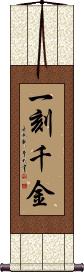
一刻千金 is a Chinese and Japanese proverb that can be translated as “time is gold,” “every minute counts,” “every moment is precious,” “time is money,” or “precious time.”
Not the results for Counts that you were looking for?
Below are some entries from our dictionary that may match your Counts search...
| Characters If shown, 2nd row is Simp. Chinese |
Pronunciation Romanization |
Simple Dictionary Definition |
カウンツ see styles |
kauntsu カウンツ |
More info & calligraphy: Counts |
大 see styles |
dài dai4 tai yutaka ゆたか |
see 大夫[dai4 fu5] (pref,adj-na,n) (1) large; big; great; huge; vast; major; important; serious; severe; (prefix) (2) great; prominent; eminent; distinguished; (suffix) (3) -sized; as big as; the size of; (suffix noun) (4) (abbreviation) (See 大学・1) university; (5) large (e.g. serving size); large option; (6) (abbreviation) (See 大の月) long month (i.e. having 31 days); (given name) Yutaka Maha. 摩訶; 麼賀. Great, large, big; all pervading, all-embracing; numerous 多; surpassing ; mysterious 妙; beyond comprehension 不可思議; omnipresent 體無不在. The elements, or essential things, i.e. (a) 三大 The three all-pervasive qualities of the 眞如 q.v. : its 體, 相 , 用 substance, form, and functions, v. 起信論 . (b) 四大 The four tanmātra or elements, earth, water, fire, air (or wind) of the 倶舍論. (c)五大 The five, i.e. the last four and space 空, v. 大日經. (d) 六大 The six elements, earth, water, fire, wind, space (or ether), mind 識. Hīnayāna, emphasizing impersonality 人空, considers these six as the elements of all sentient beings; Mahāyāna, emphasizing the unreality of all things 法空, counts them as elements, but fluid in a flowing stream of life, with mind 識 dominant; the esoteric sect emphasizing nonproduction, or non-creation, regards them as universal and as the Absolute in differentiation. (e) 七大 The 楞嚴經 adds 見 perception, to the six above named to cover the perceptions of the six organs 根. |
二教 see styles |
èr jiào er4 jiao4 erh chiao nikyō |
Dual division of the Buddha's teaching. There are various definitions: (1) Tiantai has (a) 顯教 exoteric or public teaching to the visible audience, and (b) 密教 at the same time esoteric teaching to an audience invisible to the other assembly. (2) The 眞言 Shingon School by "exoteric" means all the Buddha's preaching, save that of the 大日經 which it counts esoteric. (3) (a) 漸教 and (b) 頓教 graduated and immediate teaching, terms with various uses, e.g. salvation by works Hīnayāna, and by faith, Mahāyāna, etc.; they are applied to the Buddha's method, to the receptivity of hearers and to the teaching itself. (4) Tiantai has (a) 界内教 and (b) 界外教 teachings relating to the 三界 or realms of mortality and teachings relating to immortal realms. (5) (a) 半字教 and (b) 滿字教 Terms used in the Nirvāṇa sūtra, meaning incomplete word, or letter, teaching and complete word teaching, i.e. partial and complete, likened to Hīnayāna and Mahāyāna. (6) (a) 捃收教 and (b) 扶律談常教 of the Nirvāṇa sūtra, (a) completing those who failed to hear the Lotus; (b) "supporting the law, while discoursing on immortality," i.e. that the keeping of the law is also necessary to salvation. (7) Tiantai's division of (a) 偏教 and (b) 圓教 the partial teaching of the 藏, 通, and schools as contrasted with the perfect teaching of the 圓 school. (8) Tiantai's division of (a) 構教 and (6) 實教 temporary and permanent, similar to the last two. (9) (a) 世間教 The ordinary teaching of a moral life here; (b) 出世間教 the teaching of Buddha-truth of other-worldly happiness in escape from mortality. (10) (a) 了義教 the Mahāyāna perfect or complete teaching, and (b) 不了義教 Hīnayāna incompleteness. (11) The Huayan division of (a) 屈曲教 indirect or uneven teaching as in the Lotus and Nirvāṇa sūtras, and (b) 平道教 direct or levelled up teaching as in the Huayan sūtra. (12) The Huayan division of (a) 化教 all the Buddha's teaching for conversion and general instruction, and (b) 制教 his rules and commandments for the control and development of his order. |
文殊 see styles |
wén shū wen2 shu1 wen shu monju もんじゅ |
Manjushri, the Bodhisattva of keen awareness (Buddhist term) Manjushri; Manjusri; Bodhisattva that represents transcendent wisdom; (p,s,f) Monju (文殊師利) Mañjuśrī 滿殊尸利 -later 曼殊室利. 文殊 is also used for Mañjunātha, Mañjudeva, Mañjughoṣa, Mañjuṣvara, et al. T., hjamdpal; J., Monju. Origin unknown; presumably, like most Buddhas and bodhisattvas, an idealization of a particular quality, in his case of Wisdom. Mañju is beautiful, Śrī; good fortune, virtue, majesty, lord, an epithet of a god. Six definitions are obtained from various scriptures: 妙首 (or 頭 ) wonderful or beautiful) head; 普首 universal head; 濡首 glossy head (probably a transliteration); 敬首 revered head; 妙德 wonderful virtue (or power); 妙吉祥 wonderfully auspicious; the last is a later translation in the 西域記. As guardian of wisdom 智慧 he is often placed on Śākyamuni's left, with 普顯 on the right as guardian of law 理, the latter holding the Law, the former the wisdom or exposition of it; formerly they held the reverse positions. He is often represented with five curls or waves to his hair indicating the 五智 q. v. or the five peaks; his hand holds the sword of wisdom and he sits on a lion emblematic of its stern majesty: but he has other forms. He is represented as a youth, i. e. eternal youth. His present abode is given as east of the universe, known as 淸涼山 clear and cool mountain, or a region 寶住 precious abode, or Abode of Treasures, or 寶氏 from which he derives one of his titles, 寶相如來. One of his dhāraṇīs prophesies China as his post-nirvāṇa realm. In past incarnations he is described as being the parent of many Buddhas and as having assisted the Buddha into existence; his title was 龍種上佛 the supreme Buddha of the nāgas, also 大身佛 or 神仙佛; now his title is 歡喜藏摩尼寶精佛 The spiritual Buddha who joyfully cares for the jewel: and his future title is to be 普現佛 Buddha universally revealed. In the 序品 Introductory Chapter of the Lotus Sutra he is also described as the ninth predecessor or Buddha-ancestor of Śākyamuni. He is looked on as the chief of the Bodhisattvas and represents them, as the chief disciple of the Buddha, or as his son 法王子. Hīnayāna counts Śāriputra as the wisest of the disciples, Mahāyāna gives Mañjuśrī the chief place, hence he is also styled 覺母 mother, or begetter of understanding. He is shown riding on either a lion or a peacock, or sitting on a white lotus; often he holds a book, emblem of wisdom, or a blue lotus; in certain rooms of a monastery he is shown as a monk; and he appears in military array as defender of the faith. His signs, magic words, and so on, are found in various sutras. His most famous centre in China is Wu-tai shan in Shansi. where he is the object of pilgrimages, especially of Mongols. The legends about him are many. He takes the place in Buddhism of Viśvakarman as Vulcan, or architect, of the universe. He is one of the eight Dhyāni-bodhisattvas, and sometimes has the image of Akṣobhya in his crown. He was mentioned in China as early as the fourth century and in the Lotus Sutra he frequently appears, especially as the converter of the daughter of the Dragon-king of the Ocean. He has five messengers 五使者 and eight youths 八童子 attending on him. His hall in the Garbhadhātu maṇḍala is the seventh, in which his group numbers twenty-five. His position is northeast. There are numerous sutras and other works with his name as title, e. g. 文殊師利問菩提經 Gayaśīrṣa sūtra, tr. by Kumārajīva 384-417: and its 論 or .Tīkā of Vasubandhu, tr. by Bodhiruci 535. see list in B. N. |
鹿苑 see styles |
lù yuàn lu4 yuan4 lu yüan shikazono しかぞの |
(surname) Shikazono 鹿野園 Mṛgadāva, known also as 仙人園, etc., the park, abode, or retreat of wise men, whose resort it formed; 'a famous park north-east of Vārāṇasī, a favourite resort of Śākyamuni. The modern Sārnāth (Śāraṅganātha) near Benares.' M. W. Here he is reputed to have preached his first sermon and converted his first five disciples. Tiantai also counts it as the scene of the second period of his teaching, when during twelve years he delivered the Āgama sūtras. |
キリ番 see styles |
kiriban キリばん |
good turning point number (10000, 12345 etc., often referring to web site visit counts) |
了義經 了义经 see styles |
liǎo yì jīng liao3 yi4 jing1 liao i ching ryōgi kyō |
The sūtras containing it. Mahāyāna counts all Hīnayāna sutras as 不了義經; Mahāyāna sūtras are divided into both kinds according to different schools. |
切り番 see styles |
kiriban きりばん |
good turning point number (10000, 12345 etc., often referring to web site visit counts) |
此処ぞ see styles |
kokozo ここぞ |
(adv-to,adj-no) (kana only) (often used as ここぞというとき or ここぞとばかり) at the critical moment; when it counts |
気は心 see styles |
kihakokoro きはこころ |
(expression) it's the thought that counts |
人微言輕 人微言轻 see styles |
rén wēi yán qīng ren2 wei1 yan2 qing1 jen wei yen ch`ing jen wei yen ching |
(idiom) what lowly people think counts for little |
分秒必爭 分秒必争 see styles |
fēn miǎo bì zhēng fen1 miao3 bi4 zheng1 fen miao pi cheng |
seize every minute and second (idiom); not a minute to lose; every moment counts |
みなし道路 see styles |
minashidouro / minashidoro みなしどうろ |
{law} (See 接道義務) road that is narrower than 4 meters but still counts as a valid connecting road for determining if construction is allowed on a plot adjacent to the road |
禮輕人意重 礼轻人意重 see styles |
lǐ qīng rén yì zhòng li3 qing1 ren2 yi4 zhong4 li ch`ing jen i chung li ching jen i chung |
slight present but weighty meaning (idiom); It's not the present the counts, it's the thought behind it. |
禮輕情意重 礼轻情意重 see styles |
lǐ qīng qíng yì zhòng li3 qing1 qing2 yi4 zhong4 li ch`ing ch`ing i chung li ching ching i chung |
goose feather sent from afar, a trifling present with a weighty thought behind it (idiom); It's not the gift that counts, but the thought behind it. |
Variations: |
kiriban; kiriban きりばん; キリバン |
(net-sl) (abbr. of 切りのいい番号) satisfying number (e.g. 10000, 12345, 33333; in view counts, odometer readings, video game scores, etc.) |
Variations: |
nikoudouro / nikodoro にこうどうろ |
{law} (See 接道義務) road that is narrower than 4 meters but still counts as a valid connecting road for determining if construction is allowed on a plot adjacent to the road |
千里送鵝毛,禮輕人意重 千里送鹅毛,礼轻人意重 |
qiān lǐ sòng é máo , lǐ qīng rén yì zhòng qian1 li3 song4 e2 mao2 , li3 qing1 ren2 yi4 zhong4 ch`ien li sung o mao , li ch`ing jen i chung chien li sung o mao , li ching jen i chung |
goose feather sent from afar, a slight present but weighty meaning (idiom); It's not the present the counts, it's the thought behind it. |
千里送鵝毛,禮輕情意重 千里送鹅毛,礼轻情意重 |
qiān lǐ sòng é máo , lǐ qīng qíng yì zhòng qian1 li3 song4 e2 mao2 , li3 qing1 qing2 yi4 zhong4 ch`ien li sung o mao , li ch`ing ch`ing i chung chien li sung o mao , li ching ching i chung |
goose feather sent from afar, a trifling present with a weighty thought behind it (idiom); It's not the gift that counts, but the thought behind it. |
禮輕人意重,千里送鵝毛 礼轻人意重,千里送鹅毛 |
lǐ qīng rén yì zhòng , qiān lǐ sòng é máo li3 qing1 ren2 yi4 zhong4 , qian1 li3 song4 e2 mao2 li ch`ing jen i chung , ch`ien li sung o mao li ching jen i chung , chien li sung o mao |
goose feather sent from afar, a slight present but weighty meaning (idiom); It's not the present the counts, it's the thought behind it. |
Variations: |
kokorozashihamatsunohanitsutsume こころざしはまつのはにつつめ |
(expression) (proverb) for gifts, it's the thought that counts |
The following table may be helpful for those studying Chinese or Japanese...
| Title | Characters | Romaji (Romanized Japanese) | Various forms of Romanized Chinese | |
| Counts | 康茨 | kāng cí / kang1 ci2 / kang ci / kangci | k`ang tz`u / kangtzu / kang tzu | |
| Counts | カウンツ | kauntsu | ||
| Time is Gold | 一刻千金 | ikko ku sen kin ikkokusenkin iko ku sen kin | yī kè qiān jīn yi1 ke4 qian1 jin1 yi ke qian jin yikeqianjin | i k`o ch`ien chin ikochienchin i ko chien chin |

Successful Chinese Character and Japanese Kanji calligraphy searches within the last few hours...



