Many custom options


And formats



Click in Chinese / Japanese
Buy a Click calligraphy wall scroll here!
Personalize your custom “Click” project by clicking the button next to your favorite “Click” title below.
1. Click
2. Hyo-Jung
4. Jung Sim Do
5. Martial Arts
6. Mi Guk Kwan
11. Doctor
12. Respect
16. Honor
17. Justice / Rectitude / Right Decision
18. Turtle
19. Reiki
Click

克里克 is the name Click in Chinese (Mandarin).
Click

クリック is the name Click in Japanese Katakana.
Note: Because this title is entirely Japanese Katakana, it should be written by a Japanese calligrapher.
Hyo-Jung
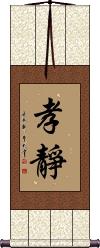
孝靜 or 효정 is the Korean given name Hyo-Jung or Hyojung.
If you want this name written in Hangul, click the Hangul characters next to the Korean flag above (instead of the big button).
Chung Do Kwan
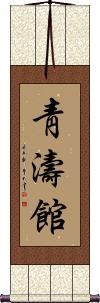
靑濤館 is the Korean martial arts style, Chung Do Kwan, meaning “Blue Wave School.”
If you want this in modern Korean Hangul characters, click on the Hangul next to the Korean flag above instead of the button above.
Also Romanized as “Cheong Do Gwan” or “Ch'ŏng Do Kwan.”
Jung Sim Do
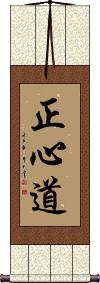
This is the Korean martial arts title Jung Sim Do.
The official romanization should be Jeong Sim Do (thought in Korean, the J is almost a “Ch” sound) and other will romanize as Jung Shin Do.
The meaning is straight/right heart way.
If you want this written in Hangul (정심도) in stead of Hanja (正心道), please click on the Hangul characters next to the Korean flag above.
Martial Arts
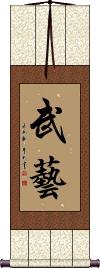
武藝 is a Korean Hanja title that means “martial arts” or “military skill.”
武藝 is also a Chinese word, but is used more often in the context of Korean martial arts.
In Korean, this is romanized as either “mu ye” or “moo ye.”
If you want to order this in modern Korean Hangul, just click the Hangul characters in the pronunciation box next to the Korean flag above.
Mi Guk Kwan
American School
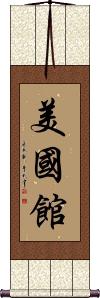
美國館 is a Korean Hanja title, which roughly means “U.S. School.”
The first two characters mean “USA” (literally: Beautiful Kingdom/Country).
The last character means “school,” “building,” and “schoolroom” in this context.
This “Mi Guk Kwan” title is used to mean “The American School of Tang Soo Do.”
If you want this in modern Korean Hangul, just click the Hangul characters in the pronunciation box next to the Korean flag above.
Concentration
Chung shin tong il
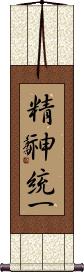
精神統一 means concentration of mind or mental concentration in old Korean Hanja and Japanese.
This concentration title is one of the 8 Key Concepts of Tang Soo Do.
You'll often see this romanized from Korean as “Chung Shin Tong Il.”
If you want to order the modern Korean Hangul version, click on the Hangul characters in the pronunciation box. Otherwise, this title is valid Korean Hanja (from the 1600 years that Korea used Chinese characters).
Songahm Taekwondo
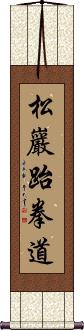
松巖跆拳道 is the title Songahm Taekwondo.
If you want this written in Korean Hangul instead of Hanja, click on the Hangul characters below the Korean flag above.
Note, Songahm is usually written in Hanja as 松巖. However, in Traditional Chinese, it would be 鬆巖, and in modern Japanese, it can be 松岩 (but not known in this context - I think it's a small train station and place in Japan).
Technically, all of these can also be Korean Hanja so that you might see these variations in use. If you need a version other than 松巖, just let me know when you order.
Haidong Gumdo
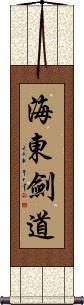
海東劍道 is the Korean martial arts style that means Eastern Sea Sword Way.
The character meanings break down this way:
海 = Sea
東 = East/Eastern
劍 = Sword
道 = Way/Path/Style/Method
This can sometimes be romanized as “Hae Dong Kum Do,” “Haidong Kendo,” “Hae Dong Geom Do,” “Haedong Geomdo,” or “Haedong Kumdo.”
If you want this written in modern Korean Hangul (해동검도) instead of Hanja (Chinese), click on the Hangul characters next to the Korean flag above, instead of the regular button.
Family / Household
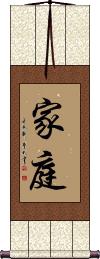
家庭/傢庭 is a common way to express family, household, or home in Chinese, Japanese Kanji, and old Korean Hanja.
However, for a wall scroll, we recommend the single-character form (which is just the first character of this two-character word). If you want that, just click here: Family Single-Character
The first character means “family” or “home.” The second means “courtyard” or “garden.” When combined, the meaning is a bit different, as it becomes “household” or “family.” The home and/or property traditionally has a strong relationship with family in Asia. Some Chinese, Korean, and Japanese families have lived in the same house for 7 or more generations!
Doctor
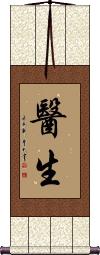
醫生 is the title used to refer to medical doctors or physicians in China.
Note: Sometimes, this same term is used in Korean, but not common.
The meaning is close to “healer [of] life” as the first character, 醫, can mean medicine, the healing art, healing, curing, medical, to cure, or to treat. The second character, 生, means birth or life.

 In Japan, they use a simplified version of the first character (医生 is also used as the Simplified Chinese version of Doctor). If you want this version, please click the characters to the right instead of the button above.
Respect
Politeness, Gratitude and Propriety
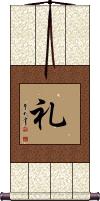
礼 is one of the five tenets of Confucius.
Beyond respect, 礼 can also be translated as propriety, good manners, politeness, rite, worship, or an expression of gratitude.
We show respect by speaking and acting with courtesy. We treat others with dignity and honor the rules of our family, school, and nation. Respect yourself, and others will respect you.
 Please note that Japanese use this simplified 礼 version of the original 禮 character for respect. 礼 also happens to be the same simplification used in mainland China. While 禮 is the traditional and original version, 礼 has been used as a shorthand version for many centuries. Click on the big 禮 character to the right if you want the Traditional Chinese and older Japanese versions.
This is also a virtue of the Samurai Warrior
See our page with just Code of the Samurai / Bushido here
See Also: Confucius
Fight / Beat Someone
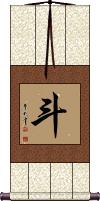
斗 is how to express the act of fighting in Chinese.
Generally, this means fighting against someone or some force whether physically or metaphorically.
Note: There is more than one way to write this character. You will notice variations on the next page after you click “Select and Customize.” If you have a preference, please let us know when you place your order.
Please note that there is a secondary pronunciation and meaning of this character. It can also mean “measuring cup” or in Japanese “sake dipper” or even “The Big Dipper.” In Japanese and Korean, this does not have the fighting meaning associated with it. You should, therefore, select this character only if your audience is Chinese, or you are a big fan of sake dippers or The Big Dipper (as that is how it will be read by Japanese and Korean people).
Zen / Chan / Meditation
...as in Zen Buddhism
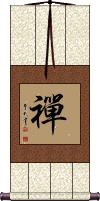
First, let's correct something: The Japanese romanization for this character, “Zen” has penetrated the English language. In English, it's almost always incorrectly used for phrases like “That's so zen.” Nobody says, “That's so meditation” - right? As the title of a sect, this would be like saying, “That's so Baptist!”
禪 by itself just means “meditation.” In that context, it should not be confined to use by any one religion or sect.
Regardless of the dictionary definition, more often than not, this character is associated with Buddhism. And here is one of the main reasons:
Zen is used as the title of a branch of Mahayana Buddhism, which strongly emphasizes meditation practice.
However, it should be noted that Buddhism came from India, and “Chan Buddhism” evolved and developed in medieval China. The Chinese character “Chan” was eventually pronounced as “Zen” in Japanese. Chan Buddhists in China have much in common with Zen Buddhists in Japan.
More about the history of Zen Buddhism here.
Please also note that the Japanese Kanji character for Zen has evolved a little in Japan, and the two boxes (kou) that you see at the top of the right side of the character have been replaced by three dots with tails.
 The original character would still be generally understood and recognized in Japanese (it's considered an ancient version in Japan) but if you want the specifically modern Japanese version, please click on the zen Kanji to the right. Technically, there is no difference between the Tensho and Reisho versions of Zen since they are ancient character styles that existed long before Japan had a written language.
 There is also an alternate/shorthand/simplified Chinese version, which has two dots or tails above the right-side radical. This version is also popular for calligraphy in China. If you want this version, just click the character to the right.
Further notes: Zen is just one of seven sects of Buddhism practiced in Japan. The others are 律 Ritsu (or Risshū), 法相 Hossō, 論 Sanron 華嚴 Kegon, 天台 Tendai, and 眞言 Shingon.
Korean CKD Virtues
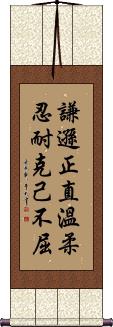
谦逊正直温柔忍耐克己不屈 are the virtues used by Choi Kwang Do Martial Arts.
| English | Hanja | Hangul | Pronunciation |
| 1. Humility (Humble / Modesty) | 謙遜 | 겸손 | gyeom son |
| 2. Honesty (Integrity) | 正直 | 정직 | jeong jig |
| 3. Gentleness | 溫柔 | 온유 | on yu |
| 4. Perseverance (To Endure) | 忍耐 | 인내 | in nae |
| 5. Self-Control (Self-Restraint) | 克己 | 극기 | geug gi |
| 6. Unbreakable Spirit (Unyielding / Unbending) | 不屈 | 불굴 | bur gur |
The characters shown here are in the ancient Korean Hanja form of writing. If you wish for a Korean Hangul form of these tenets, we can arrange that with our Master Calligrapher Xing An-Ping (click on the Hangul next to the South Korean flag above to order this in Hangul).
Honor
(Modern Japanese version)
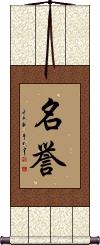
名譽 is a version of honor that is about having or earning the respect of others and about your reputation.
It is the status of being worthy of honor (not to be confused with doing honorable things or specific actions - see our other “honor” listing for that).
 Both modern Japanese and modern mainland Chinese use the same simplified version of the second character of honor. You can make a special request for the traditional second character as shown to the right (just click on that character to the right of you want to order that version). Before WWII, both Japan and China used the traditional form but modern Japanese and Chinese use this simplified form. Koreans still use the traditional form when they are not writing in their modern Hangul glyphs.
This is also a virtue of the Samurai Warrior
See our page with just Code of the Samurai / Bushido here
Justice / Rectitude / Right Decision
Also means: honor loyalty morality righteousness
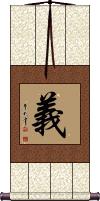
義 is about doing the right thing or making the right decision, not because it's easy but because it's ethically and morally correct.
No matter the outcome or result, one does not lose face if tempering proper justice.
義 can also be defined as righteousness, justice, morality, honor, or “right conduct.” In a more expanded definition, it can mean loyalty to friends, loyalty to the public good, or patriotism. This idea of loyalty and friendship comes from the fact that you will treat those you are loyal to with morality and justice.
義 is also one of the five tenets of Confucius's doctrine.
 There's also an alternate version of this character sometimes seen in Bushido or Korean Taekwondo tenets. It's just the addition of a radical on the left side of the character. If you want this version, click on the image to the right instead of the button above.
This is also a virtue of the Samurai Warrior
See our page with just Code of the Samurai / Bushido here
See Also: Judge | Unselfish: Perfectly Impartial | Ten
Turtle
...also means tortoise
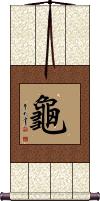
龜 is the generic term for turtle in Chinese and old Korean Hanja. It's like saying “turtle” (or “tortoise”) without being specific about the species of turtle.
Please note that there are many special characters in Chinese and a few in Japanese that denote specific species of turtle and do not include this character. We can't possibly cover all of these species, but if you want a certain one, such as “loggerhead” or a “leatherback,” just contact me, and I'll do my best to research your special species.
If you noticed, I said species names that do not include this character. This is because, in much the same way we can do it in English by just saying, “loggerhead” instead of “loggerhead turtle,” the same can be done in Chinese and Japanese.
 This may be hard to believe, but the image shown to the right is an alternate version of this character, which is currently used in Japan. This was originally an alternate form in ancient China for turtle - but it's so obscure now that most Chinese people would just think this is the Japanese version of turtle (I did many research on this). The version shown in the upper left is traditional Chinese (also used in Korea 100+ years ago). It will generally not be recognized by the new generation of Japanese people. If your audience is Japanese, please click on the Kanji image shown to the right to have the calligrapher write that version (instead of clicking the button above).
Note: In Japanese, this Kanji is also a representation of long life. This is related to the fact that a tortoise can live for hundreds of years.
Reiki
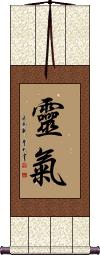
靈氣 is the title of a healing practice now found globally but with origins in Japan.
Special note: Outside of the context of the healing practice of Reiki, this means “aura” or “spiritual essence that surrounds all living things.” A Japanese person unfamiliar with the practice will take the “aura” meaning.
Reiki is a technique for stress reduction and relaxation that also heals. It can be compared to massage but is based on the idea that an unseen “life force energy” flows through us and is what causes us to be alive. If your life force energy is low, you'll be more likely to get sick or feel stressed. If your life force energy is abundant and flowing well, you become more capable of being happy and healthy.
There is many information available if you want to Google this term - my job is to offer the calligraphy while you can decide if it is right for you.


Note: We are showing the ancient (traditional) form of the Reiki Kanji. I have seen Reiki written with the slightly simplified version and this more classic form. If you want the form of Reiki with the two strokes in the shape of an X on the second character and the modern first character, simply click on the Kanji characters to the right.
Note: 靈氣 is also a Chinese word, but in Chinese, these characters create a word that refers to a smart person or someone with high aspirations. It is not read as a healing method in Chinese.
In Korean Hanja, this can be read as a “mysterious atmosphere” by a Korean who is not familiar with the practice of Reiki (still has a cool meaning in Korean).
Life Energy / Spiritual Energy
Chi Energy: Essence of Life / Energy Flow
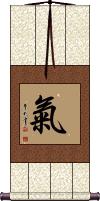
This 氣 energy flow is a fundamental concept of traditional Asian culture.
氣 is romanized as “Qi” or “Chi” in Chinese, “Gi” in Korean, and “Ki” in Japanese.
Chi is believed to be part of everything that exists, as in “life force” or “spiritual energy.” It is most often translated as “energy flow” or literally as “air” or “breath.” Some people will simply translate this as “spirit,” but you must consider the type of spirit we're talking about. I think this is weighted more toward energy than spirit.
The character itself is a representation of steam (or breath) rising from rice. To clarify, the character for rice looks like this: 
Steam was apparently seen as visual evidence of the release of “life energy” when this concept was first developed. The Qi / Chi / Ki character is still used in compound words to mean steam or vapor.
The etymology of this character is a bit complicated. It's suggested that the first form of this character from bronze script (about 2500 years ago) looked like these samples: 

However, it was easy to confuse this with the character for the number three. So the rice radical was added by 221 B.C. (the exact time of this change is debated). This first version with the rice radical looks like this: 
The idea of Qi / Chi / Ki is really a philosophical concept. It's often used to refer to the “flow” of metaphysical energy that sustains living beings. Yet there is much debate that has continued for thousands of years as to whether Qi / Chi / Ki is pure energy or consists partially or fully of matter.
You can also see the character for Qi / Chi / Ki in common compound words such as Tai Chi / Tai Qi, Aikido, Reiki, and Qi Gong / Chi Kung.
In the modern Japanese Kanji, the rice radical has been changed into two strokes that form an X.
The original and traditional Chinese form is still understood in Japanese, but we can also offer that modern Kanji form in our custom calligraphy. If you want this Japanese Kanji, please click on the character to the right instead of the “Select and Customize” button above.
More language notes: This is pronounced like “chee” in Mandarin Chinese, and like “key” in Japanese.
This is also the same way to write this in Korean Hanja where it is Romanized as “gi” and pronounced like “gee” but with a real G-sound, not a J-sound.
Though Vietnamese no longer use Chinese characters in their daily language, this character is still widely known in Vietnam.
See Also: Supernatural Energy | Life Force | Vitality | Eternal Wheel of Life | Birth Old-Age Sickness Death | Wolf Spirit / Soul of a Wolf
This in-stock artwork might be what you are looking for, and ships right away...


The following table may be helpful for those studying Chinese or Japanese:
| Title | Characters | Romaji (Romanized Japanese) | Various forms of Romanized Chinese | |
| Click | 克里克 | kè lǐ kè ke4 li3 ke4 ke li ke kelike | k`o li k`o koliko ko li ko |
|
| Click | クリック | kurikku / kuriku | ||
| Hyo-Jung | 孝靜 | xiào jìng xiao4 jing4 xiao jing xiaojing | hsiao ching hsiaoching |
|
| Chung Do Kwan | 靑濤館 | qīng tāo quǎn qing1 tao1 quan3 qing tao quan qingtaoquan | ch`ing t`ao ch`üan chingtaochüan ching tao chüan |
|
| Jung Sim Do | 正心道 | zhèng xīn dào zheng4 xin1 dao4 zheng xin dao zhengxindao | cheng hsin tao chenghsintao |
|
| Martial Arts | 武藝 武艺 | wǔ yì / wu3 yi4 / wu yi / wuyi | wu i / wui | |
| Mi Guk Kwan | 美國館 美国馆 | měi guó guǎn mei3 guo2 guan3 mei guo guan meiguoguan | mei kuo kuan meikuokuan |
|
| Concentration | 精神統一 | seishintouitsu seishintoitsu | ||
| Songahm Taekwondo | 松巖跆拳道 | sōng yán tái quán dào song1 yan2 tai2 quan2 dao4 song yan tai quan dao songyantaiquandao | sung yen t`ai ch`üan tao sungyentaichüantao sung yen tai chüan tao |
|
| Haidong Gumdo | 海東劍道 海东剑道 | hǎi dǒng jiàn dào hai3 dong3 jian4 dao4 hai dong jian dao haidongjiandao | hai tung chien tao haitungchientao |
|
| Family Household | 家庭 / 傢庭 家庭 | ka tei / katei | jiā tíng / jia1 ting2 / jia ting / jiating | chia t`ing / chiating / chia ting |
| Doctor | 醫生 医生 | yī shēng / yi1 sheng1 / yi sheng / yisheng | i sheng / isheng | |
| Respect | 禮 礼 | rei | lǐ / li3 / li | |
| Fight Beat Someone | 斗 | dòu / dou4 / dou | tou | |
| Zen Chan Meditation | 禪 禅 | zen | chán / chan2 / chan | ch`an / chan |
| Korean CKD Virtues | 謙遜正直溫柔忍耐克己不屈 谦逊正直温柔忍耐克己不屈 | qiān xùn zhèng zhí wēn róu rěn nài kè jǐ bù qū qian1 xun4 zheng4 zhi2 wen1 rou2 ren3 nai4 ke4 ji3 bu4 qu1 qian xun zheng zhi wen rou ren nai ke ji bu qu | ch`ien hsün cheng chih wen jou jen nai k`o chi pu ch`ü chien hsün cheng chih wen jou jen nai ko chi pu chü |
|
| Honor | 名譽 名誉 | meiyo | míng yù / ming2 yu4 / ming yu / mingyu | ming yü / mingyü |
| Justice Rectitude Right Decision | 義 义 | gi | yì / yi4 / yi | i |
| Turtle | 龜 龟 / 亀 | kame | guī / gui1 / gui | kuei |
| Reiki | 靈氣 灵气 霊気 | reiki | líng qì / ling2 qi4 / ling qi / lingqi | ling ch`i / lingchi / ling chi |
| Life Energy Spiritual Energy | 氣 气 / 気 | ki | qì / qi4 / qi | ch`i / chi |
| In some entries above you will see that characters have different versions above and below a line. In these cases, the characters above the line are Traditional Chinese, while the ones below are Simplified Chinese. | ||||

Successful Chinese Character and Japanese Kanji calligraphy searches within the last few hours...



