Many custom options...


And formats...



Cave in Chinese / Japanese...
Buy a Cave calligraphy wall scroll here!
Personalize your custom “Cave” project by clicking the button next to your favorite “Cave” title below...
Cave

凱夫 is the name Cave in Chinese (Mandarin).
Cave

ケイブ is the name Cave in Japanese Katakana.
Note: Because this title is entirely Japanese Katakana, it should be written by a Japanese calligrapher.
Facing the Wall Nine Years
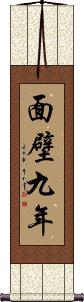
面壁九年 is a Buddhist term that means “facing a wall for nine years.”
This refers to the Bodhidharma who stared at a wall in meditation at the Shaolin Temple (or in a cave) for nine years until reaching full enlightenment.
How can you catch tiger cubs without entering the lair of the tiger?
Nothing ventured, nothing gained
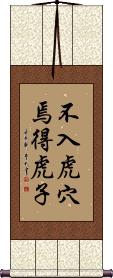
While perhaps no longer politically correct, this Chinese proverb is a reminder that you must take risks if you want rewards.
不入虎穴焉得虎子 is similar to the English proverb, “Nothing ventured, nothing gained.”
The literal word order of the Chinese is, “If (you) don't enter the tiger's lair/cave, how can (you) get/obtain tiger cubs?.”
Frightful Demon / Asura
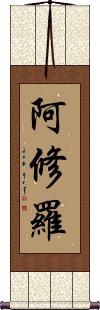
This demon title comes from the ancient Sanskrit word Asura.
阿修羅 is often used in Buddhism when describing various demons. Sometimes defined as “Fighting and battling a giant demon.”
In the context of Buddhism: This title originally meant a spirit, spirits, or even the gods (perhaps before 1700 years ago). It now generally indicates titanic demons, enemies of the gods, with whom, especially Indra, they wage constant war. They are defined as “not devas,” “ugly,” and “without wine.” There are four classes of asuras, separated according to their manner of rebirth. They can be egg-born, womb-born, transformation-born, and spawn- or water-born. Their abode is in the ocean, north of Sumeru but certain of the weaker dwell in a western mountain cave. They have realms, rulers, and palaces, as have the devas.
In terms of power, Asuras rank above humans but below most other deities. They live near the coastal foot of Mount Sumeru (on the northern side). Their domain is partially or wholly in the ocean.
Not the results for Cave that you were looking for?
Below are some entries from our dictionary that may match your Cave search...
| Characters If shown, 2nd row is Simp. Chinese |
Pronunciation Romanization |
Simple Dictionary Definition |
眼 see styles |
yǎn yan3 yen mesaki めさき |
More info & calligraphy: Eyeballs / Eyes(1) eye; eyeball; (2) (archaism) pupil and (dark) iris of the eye; (3) (archaism) insight; perceptivity; power of observation; (4) (archaism) look; field of vision; (5) (archaism) core; center; centre; essence; (surname) Mesaki cakṣuh, the eye. |
阿修羅 阿修罗 see styles |
ā xiū luó a1 xiu1 luo2 a hsiu lo ashura あしゅら |
More info & calligraphy: Frightful Demon / Asura{Buddh} Asura; demigod; anti-god; titan; demigods that fight the Devas (gods) in Hindu mythology; (female given name) Ashura asura, 修羅 originally meaning a spirit, spirits, or even the gods, it generally indicates titanic demons, enemies of the gods, with whom, especially Indra, they wage constant war. They are defined as 'not devas', and 'ugly', and 'without wine'. Other forms are 阿須羅 (or 阿蘇羅, or 阿素羅); 阿修倫 (or羅須倫 or 阿修輪 or 羅須輪); 阿素洛; 阿差. Four classes are named according to their manner of rebirth-egg, born, womb-born, transformation-born, and spawn- or water-born. Their abode is in the ocean, north of Sumeru, but certain of the weaker dwell in a western mountain cave. They have realms, rulers, and palaces, as have the devas. The 阿修羅道 is one of the six gatis, or ways of reincarnation. The 修羅場 or 修羅巷 is the battlefield of the asuras against Indra. The 阿修羅琴 are their harps. |
堀 see styles |
kū ku1 k`u ku bori ぼり |
cave; hole (1) moat; fosse; (2) canal; ditch; (personal name) Bori |
孔 see styles |
kǒng kong3 k`ung kung tooru とおる |
hole; CL:個|个[ge4]; classifier for cave dwellings (n,n-suf) (1) hole; (2) deficit; shortage; missing person (in a team, meeting, etc.); (3) vacancy; opening; (4) flaw; (5) profitable place (or item, etc.) not well known by others; (6) upset victory (with a large payoff); (7) (slang) pit (of a theater); (8) (archaism) hiding place; (9) (archaism) underbelly (of society, etc.); (given name) Tooru A hole: surname of Confucius; great, very; a peacock. |
屇 see styles |
tián tian2 t`ien tien |
cave; hole |
岫 see styles |
xiù xiu4 hsiu shuu / shu しゅう |
cave; mountain peak (1) (archaism) cave; cavern; (2) (くき only) (archaism) peak; summit; (personal name) Shuu |
峇 see styles |
kè ke4 k`o ko |
cave; cavern; also pr. [ke1] |
廅 see styles |
hé he2 ho ō |
A cave. |
洞 see styles |
tóng tong2 t`ung tung horasaki ほらさき |
used in 洪洞[Hong2 tong2], a county in Shanxi hollow; cavity; hole; cave; (surname) Horasaki A hole, cave; to see through, know. |
碉 see styles |
diāo diao1 tiao |
rock cave (archaic) |
穴 see styles |
xué xue2 hsüeh ana あな |
cave; cavity; hole; acupuncture point; Taiwan pr. [xue4] (1) (colloquialism) ass; arse; buttocks; (2) (colloquialism) rear; end; (3) acupuncture point; (counter) (4) hole; notch; (n,n-suf) (1) hole; (2) deficit; shortage; missing person (in a team, meeting, etc.); (3) vacancy; opening; (4) flaw; (5) profitable place (or item, etc.) not well known by others; (6) upset victory (with a large payoff); (7) (slang) pit (of a theater); (8) (archaism) hiding place; (9) (archaism) underbelly (of society, etc.); (surname) Ana a hole |
窖 see styles |
jiào jiao4 chiao anagura あなぐら |
cellar; to store in a cellar cellar; cave; hole in the ground |
窞 see styles |
dàn dan4 tan |
pit; cave |
窟 see styles |
kū ku1 k`u ku iwaya いわや |
cave; hole (kana only) caves dug as tombs in and around Kamakura during the Kamakura and Muromachi periods; cavern; grotto; (surname) Iwaya gūha. A cave. |
窯 窑 see styles |
yáo yao2 yao kama かま |
kiln; oven; coal pit; cave dwelling; (coll.) brothel stove; furnace; kiln; (place-name) Kama |
陷 see styles |
xiàn xian4 hsien kan |
pitfall; trap; to get stuck; to sink; to cave in; to frame (false charge); to capture (a city in battle); to fall (to the enemy); defect to fall into |
人穴 see styles |
hitoana ひとあな |
volcanic cave traditionally said to be inhabited; (place-name) Hitoana |
仙窟 see styles |
senkutsu せんくつ |
enchanted cave |
六行 see styles |
liù xíng liu4 xing2 liu hsing rokugyō |
Among Buddhists the term means the practice of the 六度 six pāramitās; it is referred, among outsiders, to the six austerities of the six kinds of heretics: (1) 自餓 starvation; (2) 投淵 naked cave-dwelling (or, throwing oneself down precipices); (3) 赴火 self-immolation, or self-torturing by fire; (4) 自坐 sitting naked in public; (5) 寂默 dwelling in silence among graves; (6) 牛狗 living as animals. |
冒頂 冒顶 see styles |
mào dǐng mao4 ding3 mao ting |
(mining) roof fall; to have the roof cave in |
凹む see styles |
hekomu へこむ |
(v5m,vi) (1) to be dented; to be indented; to yield; to give; to sink; to collapse; to cave in; (v5m,vi) (2) to be beaten; to be overwhelmed; to yield; to give in; to give up; (v5m,vi) (3) (colloquialism) (See ヘコむ) to be disheartened; to feel down; to feel depressed; (v5m,vi) (4) to suffer a loss; to lose |
凹陷 see styles |
āo xiàn ao1 xian4 ao hsien |
to cave in; hollow; sunken; depressed |
土窟 see styles |
tǔ kū tu3 ku1 t`u k`u tu ku dokutsu |
dirt cave |
土窯 土窑 see styles |
tǔ yáo tu3 yao2 t`u yao tu yao dogama どがま |
earthen kiln; loess cave earthen kiln |
地洞 see styles |
dì dòng di4 dong4 ti tung |
tunnel; cave; burrow; dugout |
塌方 see styles |
tā fāng ta1 fang1 t`a fang ta fang |
to cave in; to collapse; to have a landslide |
塌陷 see styles |
tā xiàn ta1 xian4 t`a hsien ta hsien |
to subside; to sink; to cave in |
奥壁 see styles |
okuheki おくへき |
inner wall (e.g. cave); inner rockface (mountain valley, etc.) |
小乘 see styles |
xiǎo shèng xiao3 sheng4 hsiao sheng shōjō |
Hinayana, the Lesser Vehicle; Buddhism in India before the Mayahana sutras; also pr. [Xiao3 cheng2] Hīnayāna 希那衍. The small, or inferior wain, or vehicle; the form of Buddhism which developed after Śākyamuni's death to about the beginning of the Christian era, when Mahāyāna doctrines were introduced. It is the orthodox school and more in direct line with the Buddhist succession than Mahāyānism which developed on lines fundamentally different. The Buddha was a spiritual doctor, less interested in philosophy than in the remedy for human misery and perpetual transmigration. He "turned aside from idle metaphysical speculations; if he held views on such topics, he deemed them valueless for the purposes of salvation, which was his goal" (Keith). Metaphysical speculations arose after his death, and naturally developed into a variety of Hīnayāna schools before and after the separation of a distinct school of Mahāyāna. Hīnayāna remains the form in Ceylon, Burma, and Siam, hence is known as Southern Buddhism in contrast with Northern Buddhism or Mahāyāna, the form chiefly prevalent from Nepal to Japan. Another rough division is that of Pali and Sanskrit, Pali being the general literary language of the surviving form of Hīnayāna, Sanskrit of Mahāyāna. The term Hīnayāna is of Mahāyānist origination to emphasize the universalism and altruism of Mahāyāna over the narrower personal salvation of its rival. According to Mahāyāna teaching its own aim is universal Buddhahood, which means the utmost development of wisdom and the perfect transformation of all the living in the future state; it declares that Hīnayāna, aiming at arhatship and pratyekabuddhahood, seeks the destruction of body and mind and extinction in nirvāṇa. For arhatship the 四諦Four Noble Truths are the foundation teaching, for pratyekabuddhahood the 十二因緣 twelve-nidānas, and these two are therefore sometimes styled the two vehicles 二乘. Tiantai sometimes calls them the (Hīnayāna) Tripiṭaka school. Three of the eighteen Hīnayāna schools were transported to China: 倶舍 (Abhidharma) Kośa; 成實 Satya-siddhi; and the school of Harivarman, the律 Vinaya school. These are described by Mahāyānists as the Buddha's adaptable way of meeting the questions and capacity of his hearers, though his own mind is spoken of as always being in the absolute Mahāyāna all-embracing realm. Such is the Mahāyāna view of Hīnayāna, and if the Vaipulya sūtras and special scriptures of their school, which are repudiated by Hīnayāna, are apocryphal, of which there seems no doubt, then Mahāyāna in condemning Hīnayāna must find other support for its claim to orthodoxy. The sūtras on which it chiefly relies, as regards the Buddha, have no authenticity; while those of Hīnayāna cannot be accepted as his veritable teaching in the absence of fundamental research. Hīnayāna is said to have first been divided into minority and majority sections immediately after the death of Śākyamuni, when the sthāvira, or older disciples, remained in what is spoken of as "the cave", some place at Rājagṛha, to settle the future of the order, and the general body of disciples remained outside; these two are the first 上坐部 and 大衆部 q. v. The first doctrinal division is reported to have taken place under the leadership of the monk 大天 Mahādeva (q.v.) a hundred years after the Buddha's nirvāṇa and during the reign of Aśoka; his reign, however, has been placed later than this by historians. Mahādeva's sect became the Mahāsāṅghikā, the other the Sthāvira. In time the two are said to have divided into eighteen, which with the two originals are the so-called "twenty sects" of Hīnayāna. Another division of four sects, referred to by Yijing, is that of the 大衆部 (Arya) Mahāsaṅghanikāya, 上座部 Āryasthavirāḥ, 根本說一切有部 Mūlasarvāstivādaḥ, and 正量部 Saṃmatīyāḥ. There is still another division of five sects, 五部律. For the eighteen Hīnayāna sects see 小乘十八部. |
山洞 see styles |
shān dòng shan1 dong4 shan tung yamahora やまほら |
cavern; cave (place-name) Yamahora |
Click here for more Cave results from our dictionary
The following table may be helpful for those studying Chinese or Japanese...
| Title | Characters | Romaji (Romanized Japanese) | Various forms of Romanized Chinese | |
| Cave | 凱夫 凯夫 | kǎi fū / kai3 fu1 / kai fu / kaifu | k`ai fu / kaifu / kai fu | |
| Cave | ケイブ | keibu | ||
| Facing the Wall Nine Years | 面壁九年 | menpeki kyunen menpekikyunen | miàn bì jiǔ nián mian4 bi4 jiu3 nian2 mian bi jiu nian mianbijiunian | mien pi chiu nien mienpichiunien |
| How can you catch tiger cubs without entering the lair of the tiger? | 不入虎穴焉得虎子 | bú rù hǔ xué yān dé hǔ zǐ bu2 ru4 hu3 xue2 yan1 de2 hu3 zi3 bu ru hu xue yan de hu zi buruhuxueyandehuzi | pu ju hu hsüeh yen te hu tzu pujuhuhsüehyentehutzu |
|
| Frightful Demon Asura | 阿修羅 阿修罗 | ashura | ē xiū luó e1 xiu1 luo2 e xiu luo exiuluo | o hsiu lo ohsiulo |
| In some entries above you will see that characters have different versions above and below a line. In these cases, the characters above the line are Traditional Chinese, while the ones below are Simplified Chinese. | ||||

Successful Chinese Character and Japanese Kanji calligraphy searches within the last few hours...



