Many custom options


And formats


Not what you want?
Try other similar-meaning words, fewer words, or just one word.
1 Corinthians 13:4 in Chinese & Japanese Calligraphy
Compare the meanings and pronunciations of the entries related to 1 Corinthians 13:4 below. Choose “Customize & Buy” next to your preferred entry to personalize your calligraphy wall scroll.
1 Corinthians 13:4

愛は忍耐強い。愛は情け深い。ねたまない。愛は自慢せず、高ぶらない。is 1st Corinthians 13:4 in Japanese.
In English, this reads:
1st Corinthians 13:4 (KJV) Charity suffereth long, and is kind; charity envieth not; charity vaunteth not itself, is not puffed up...
1st Corinthians 13:4 (NIV) Love is patient, love is kind. It does not envy, it does not boast, it is not proud.
1st Corinthians 13:4 (Basic English) Love is never tired of waiting; love is kind; love has no envy; love has no high opinion of itself, love has no pride.
If you want a big “love” character written above the verse on your artwork, just make a note in the “special instructions” tab when you are customizing your artwork. There is no extra charge for that service on this special verse.
Note: Because this selection contains some special Japanese Hiragana characters, it should be written by a Japanese calligrapher.
1 Corinthians 13:4
All you need to know about LOVE
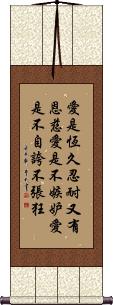
愛是恆久忍耐又有恩慈愛是不嫉妒愛是不自誇不張狂 is 1st Corinthians 13:4 in Chinese.
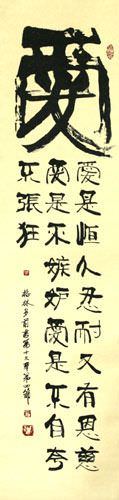
With large “love” character added.
In English, this reads:
1st Corinthians 13:4 (KJV) Charity suffereth long, and is kind; charity envieth not; charity vaunteth not itself, is not puffed up...
1st Corinthians 13:4 (NIV) Love is patient, love is kind. It does not envy, it does not boast, it is not proud.
1st Corinthians 13:4 (Basic English) Love is never tired of waiting; love is kind; love has no envy; love has no high opinion of itself, love has no pride.
The Chinese translation follows the love meaning, rather than the King James' use of “charity.” I was a little confused when writing this description with the significant differences between the NIV vs. KJV translations. After speaking to a Greek scholar about this, it would seem that the KJV has an almost errant translation with the use of “charity” in place of “love.”
We used the most popular Christian Chinese Bible, which is the Chinese Union Version (CUV). The CUV was first published in 1919. We use this so that the Chinese translation would be as accurate and standard as possible. Any Chinese Christian worth their salt will easily be able to identify this verse when they see these characters.
If you want a big “love” character written above the verse on your artwork, just make a note in the “special instructions” tab when you are customizing your artwork. There is no extra charge for that service on this special verse.
1 Corinthians 13:5

This is 1 Corinthians 13:5 in Japanese, from the 1954–55 Japanese Kōgo-yaku (口語訳).
In English, the King James Version reads, “Doth not behave itself unseemly, seeketh not her own, is not easily provoked, thinketh no evil;”
Note: Because this selection contains some special Japanese Hiragana characters, it should be written by a Japanese calligrapher.
1 Corinthians 13:8

This is 1 Corinthians 13:8 in Japanese, from the 1954–55 Japanese Kōgo-yaku (口語訳).
In English, the King James Version reads, “Charity never faileth: but whether there be prophecies, they shall fail; whether there be tongues, they shall cease; whether there be knowledge, it shall vanish away.”
Note: Because this selection contains some special Japanese Hiragana characters, it should be written by a Japanese calligrapher.
1 Corinthians 13:8

This is 1 Corinthians 13:8 in Chinese, from the Chinese Union Version (和合本).
In English, the King James Version reads, “Charity never faileth: but whether there be prophecies, they shall fail; whether there be tongues, they shall cease; whether there be knowledge, it shall vanish away.”
1 Corinthians 13:5
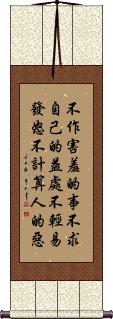
Here is 1 Corinthians 13:5 in Chinese.
The text with punctuation:
不作害羞的事。不求自己的益处。不轻易发怒。不计算人的恶。
Hand-painted calligraphy does not retain punctuation.
This translation is from the Chinese Union Bible.
You may know it from the KJV as:
Doth not behave itself unseemly, seeketh not her own, is not easily provoked, thinketh no evil.
1 Corinthians 13:4-8

愛是恆久忍耐又有恩慈愛是不嫉妒愛是不自誇不張狂不做害羞的事不求自己的益處不輕易發怒不計算人的惡不喜歡不義只喜歡真理凡事包容凡事相信凡事盼望凡事忍耐愛是永不止息先知講道之能終必歸於無有說方言之能終必停止知識也終必歸於無有 is 1 Corinthians 13:4-8 in Chinese, from the Chinese Union Version (和合本).
In English, the King James Version reads, “Charity suffereth long, and is kind; charity envieth not; charity vaunteth not itself, is not puffed up, Doth not behave itself unseemly, seeketh not her own, is not easily provoked, thinketh no evil; Rejoiceth not in iniquity, but rejoiceth in the truth; Beareth all things, believeth all things, hopeth all things, endureth all things. Charity never faileth: but whether there be prophecies, they shall fail; whether there be tongues, they shall cease; whether there be knowledge, it shall vanish away.”
1 Corinthians 13:4-8
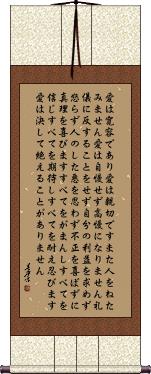
Here is 1st Corinthians 13:4-8 (just the first sentence of verse 8) in Japanese.
In the familiar NIV, this would read:
Love is patient, love is kind. It does not envy, it does not boast, it is not proud.
It does not dishonor others, it is not self-seeking, it is not easily angered, it keeps no record of wrongs.
Love does not delight in evil but rejoices with the truth.
It always protects, always trusts, always hopes, always perseveres.
Love never fails...
The Japanese text is from the 新改訳聖書 (Shinkaiyaku) or New Japanese Bible. Popular among most Protestant denominations in modern Japan.
Note: Because this selection contains some special Japanese Hiragana characters, it should be written by a Japanese calligrapher.
Faith Hope Love
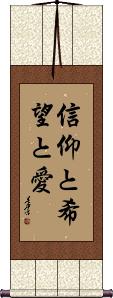
信仰と希望と愛 is a Japanese list of words (not really a phrase) meaning faith, hope, and love.
Some have associated this word list with Corinthians 13:13, though there are no specific religious connotations in this word list, and it's not directly from that Japanese Bible verse.
Note: Because this selection contains some special Japanese Hiragana characters, it should be written by a Japanese calligrapher.
The following table may be helpful for those studying Chinese or Japanese:
| Title | Characters | Romaji (Romanized Japanese) | Various forms of Romanized Chinese | |
| 1 Corinthians 13:4 | 愛は忍耐強い。愛は情け深い。ねたまない。愛は自慢せず、高ぶらない。 | ai ha nintai tsuyoi. ai ha nasakebukai. netama nai. ai ha jiman se zu, takabura nai. | ||
| 1 Corinthians 13:4 | 愛是恆久忍耐又有恩慈愛是不嫉妒愛是不自誇不張狂 爱是恒久忍耐又有恩慈爱是不嫉妒爱是不自夸不张狂 | ài shì héng jiǔ rěn nài yòu yǒu én cí ài shì bú jì dù ài shì bú zì kuā bù zhāng kuáng ai4 shi4 heng2 jiu3 ren3 nai4 you4 you3 en2 ci2 ai4 shi4 bu2 ji4 du4 ai4 shi4 bu2 zi4 kua1 bu4 zhang1 kuang2 ai shi heng jiu ren nai you you en ci ai shi bu ji du ai shi bu zi kua bu zhang kuang | ai shih heng chiu jen nai yu yu en tz`u ai shih pu chi tu ai shih pu tzu k`ua pu chang k`uang ai shih heng chiu jen nai yu yu en tzu ai shih pu chi tu ai shih pu tzu kua pu chang kuang |
|
| 1 Corinthians 13:5 | 不作法をしない、自分の利益を求めない、いらだたない、恨みをいだかない。 | Busahō o shinai, jibun no rieki o motomenai, iradatanai, urami o idakanai. | ||
| 1 Corinthians 13:8 | 愛はいつまでも絶えることがない。しかし、預言はすたれ、異言はやみ、知識はすたれるであろう。 | Ai wa itsu made mo taeru koto ga nai. Shikashi, yogen wa sutare, igen wa yami, chishiki wa sutareru de arō. | ||
| 1 Corinthians 13:8 | 愛是永不止息先知講道之能終必歸於無有說方言之能終必停止知識也終必歸於無有 爱是永不止息先知讲道之能终必归于无有说方言之能终必停止知识也终必归于无有 | ài shì yǒng bù zhǐ xī xiān zhī jiǎng dào zhī néng zhōng bì guī yú wú yǒu shuō fāng yán zhī néng zhōng bì tíng zhǐ zhī shí yě zhōng bì guī yú wú yǒu ai4 shi4 yong3 bu4 zhi3 xi1 xian1 zhi1 jiang3 dao4 zhi1 neng2 zhong1 bi4 gui1 yu2 wu2 you3 shuo1 fang1 yan2 zhi1 neng2 zhong1 bi4 ting2 zhi3 zhi1 shi2 ye3 zhong1 bi4 gui1 yu2 wu2 you3 ai shi yong bu zhi xi xian zhi jiang dao zhi neng zhong bi gui yu wu you shuo fang yan zhi neng zhong bi ting zhi zhi shi ye zhong bi gui yu wu you | ai shih yung pu chih hsi hsien chih chiang tao chih neng chung pi kuei yü wu yu shuo fang yen chih neng chung pi t`ing chih chih shih yeh chung pi kuei yü wu yu ai shih yung pu chih hsi hsien chih chiang tao chih neng chung pi kuei yü wu yu shuo fang yen chih neng chung pi ting chih chih shih yeh chung pi kuei yü wu yu |
|
| 1 Corinthians 13:5 | 不作害羞的事不求自己的益處不輕易發怒不計算人的惡 不作害羞的事不求自己的益处不轻易发怒不计算人的恶 | bù zuò hài xiū de shì bù qiú zì jǐ de yì chu bù qīng yì fā nù bù jì suàn rén de è bu4 zuo4 hai4 xiu1 de shi4 bu4 qiu2 zi4 ji3 de yi4 chu bu4 qing1 yi4 fa1 nu4 bu4 ji4 suan4 ren2 de e4 bu zuo hai xiu de shi bu qiu zi ji de yi chu bu qing yi fa nu bu ji suan ren de e | pu tso hai hsiu te shih pu ch`iu tzu chi te i ch`u pu ch`ing i fa nu pu chi suan jen te o pu tso hai hsiu te shih pu chiu tzu chi te i chu pu ching i fa nu pu chi suan jen te o |
|
| 1 Corinthians 13:4-8 | 愛是恆久忍耐又有恩慈愛是不嫉妒愛是不自誇不張狂不做害羞的事不求自己的益處不輕易發怒不計算人的惡不喜歡不義只喜歡真理凡事包容凡事相信凡事盼望凡事忍耐愛是永不止息先知講道之能終必歸於無有說方言之能終必停止知識也終必歸於無有 爱是恒久忍耐又有恩慈爱是不嫉妒爱是不自夸不张狂不做害羞的事不求自己的益处不轻易发怒不计算人的恶不喜欢不义只喜欢真理凡事包容凡事相信凡事盼望凡事忍耐爱是永不止息先知讲道之能终必归于无有说方言之能终必停止知识也终必归于无有 | ài shì héng jiǔ rěn nài yòu yǒu ēn cí ài shì bú jí dù ài shì bú zì kuā bù zhāng kuáng bú zuò hài xiū de shì bù qiú zì jǐ de yì chù bù qīng yì fā nù bú jì suàn rén de è bù xǐ huan bú yì zhǐ xǐ huan zhēn lǐ fán shì bāo róng fán shì xiāng xìn fán shì pàn wàng fán shì rěn nài ài shì yǒng bù zhǐ xī xiān zhī jiǎng dào zhī néng zhōng bì guī yú wú yǒu shuō fāng yán zhī néng zhōng bì tíng zhǐ zhī shí yě zhōng bì guī yú wú yǒu ai4 shi4 heng2 jiu3 ren3 nai4 you4 you3 en1 ci2 ai4 shi4 bu2 ji2 du4 ai4 shi4 bu2 zi4 kua1 bu4 zhang1 kuang2 bu2 zuo4 hai4 xiu1 de shi4 bu4 qiu2 zi4 ji3 de yi4 chu4 bu4 qing1 yi4 fa1 nu4 bu2 ji4 suan4 ren2 de e4 bu4 xi3 huan bu2 yi4 zhi3 xi3 huan zhen1 li3 fan2 shi4 bao1 rong2 fan2 shi4 xiang1 xin4 fan2 shi4 pan4 wang4 fan2 shi4 ren3 nai4 ai4 shi4 yong3 bu4 zhi3 xi1 xian1 zhi1 jiang3 dao4 zhi1 neng2 zhong1 bi4 gui1 yu2 wu2 you3 shuo1 fang1 yan2 zhi1 neng2 zhong1 bi4 ting2 zhi3 zhi1 shi2 ye3 zhong1 bi4 gui1 yu2 wu2 you3 ai shi heng jiu ren nai you you en ci ai shi bu ji du ai shi bu zi kua bu zhang kuang bu zuo hai xiu de shi bu qiu zi ji de yi chu bu qing yi fa nu bu ji suan ren de e bu xi huan bu yi zhi xi huan zhen li fan shi bao rong fan shi xiang xin fan shi pan wang fan shi ren nai ai shi yong bu zhi xi xian zhi jiang dao zhi neng zhong bi gui yu wu you shuo fang yan zhi neng zhong bi ting zhi zhi shi ye zhong bi gui yu wu you | ai shih heng chiu jen nai yu yu en tz`u ai shih pu chi tu ai shih pu tzu k`ua pu chang k`uang pu tso hai hsiu te shih pu ch`iu tzu chi te i ch`u pu ch`ing i fa nu pu chi suan jen te o pu hsi huan pu i chih hsi huan chen li fan shih pao jung fan shih hsiang hsin fan shih p`an wang fan shih jen nai ai shih yung pu chih hsi hsien chih chiang tao chih neng chung pi kuei yü wu yu shuo fang yen chih neng chung pi t`ing chih chih shih yeh chung pi kuei yü wu yu ai shih heng chiu jen nai yu yu en tzu ai shih pu chi tu ai shih pu tzu kua pu chang kuang pu tso hai hsiu te shih pu chiu tzu chi te i chu pu ching i fa nu pu chi suan jen te o pu hsi huan pu i chih hsi huan chen li fan shih pao jung fan shih hsiang hsin fan shih pan wang fan shih jen nai ai shih yung pu chih hsi hsien chih chiang tao chih neng chung pi kuei yü wu yu shuo fang yen chih neng chung pi ting chih chih shih yeh chung pi kuei yü wu yu |
|
| 1 Corinthians 13:4-8 | 愛は寛容であり愛は親切ですまた人をねたみません愛は自慢せず高慢になりません礼儀に反することをせず自分の利益を求めず怒らず人のした悪を思わず不正を喜ばずに真理を喜びますすべてをがまんしすべてを信じすべてを期待しすべてを耐え忍びます愛は決して絶えることがありません | ai wa kan youdeari ai wa shinsetsudesu mata hito o netamimasen ai wa jiman sezu kouman ni narimasen reigi ni hansuru koto o sezu jibun no rieki o motomezu okorazu hito no shita aku o omowazu fusei o yorokobazu ni shinri o yorokobimasu subete o gaman shi s ai wa kan yodeari ai wa shinsetsudesu mata hito o netamimasen ai wa jiman sezu koman ni narimasen reigi ni hansuru koto o sezu jibun no rieki o motomezu okorazu hito no shita aku o omowazu fusei o yorokobazu ni shinri o yorokobimasu subete o gaman shi s | ||
| Faith Hope Love | 信仰と希望と愛 | shinkou to kibou to ai shinkoutokiboutoai shinko to kibo to ai | ||
| In some entries above you will see that characters have different versions above and below a line. In these cases, the characters above the line are Traditional Chinese, while the ones below are Simplified Chinese. | ||||

Successful Chinese Character and Japanese Kanji calligraphy searches within the last few hours...