Many custom options...


And formats...



八 in Chinese / Japanese...
Buy an 八 calligraphy wall scroll here!
Personalize your custom “八” project by clicking the button next to your favorite “八” title below...
1. Eight
2. August
3. Ba Gua
6. Kazuya
7. Laiba
9. Bagua Fist
10. Bagua School
11. Ba Gua Zhang
12. Ba Ji Quan
13. Batangas
15. Hakko-Ryu
19. Fall Down Seven Times, Get Up Eight
20. Happu Fudo
Eight
The number eight
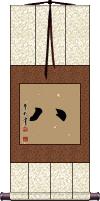
八 is the number eight in Chinese, Japanese Kanji, and old Korean Hanja.
八 is a strange selection for a wall scroll, so it's here mostly for reference. I guess it's OK if the number eight is important to you.
Because this character is rather simple (just two strokes), 捌 instead of 八 is an anti-fraud way to write eight on bank documents.
August
Eighth Month
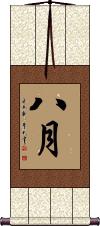
八月 is the month of August in Chinese, Japanese Kanji, and old Korean Hanja.
八月 literally means “eighth month” or “eighth moon.”
In Japanese, this can also be the female given name, Yatsuki, in much the same way August can be a female given name in English.
Ba Gua
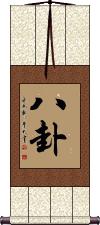
八卦 is the Chinese title for Bagua or Ba Gua.
Simply put, this represents the eight elements often seen around the yin-yang symbol.
Eight Immortals
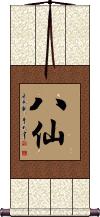
八仙 is the Chinese title for the Eight Immortals of Daoist / Taoist mythology.
In Japanese, this can be the given name Hassen.
Eighteen / 18
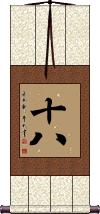
This means eighteen (18).
This can be pronounced seipai, toya, or jūhachi in Japanese. It can also be a Japanese personal name, Toya.
This would be the way to write the Buddhist Sanskrit word aṣṭādaśa (meaning 18) in Chinese, old Korean Hanja, and Japanese Kanji.
Kazuya
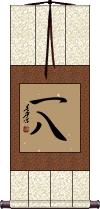
一八 is the female given name Kazuya.
This is the same name as used for Kazuya Mishima.
This is also a word that means wall iris, roof iris, Iris tectorum, or fleur-de-lis.
Laiba
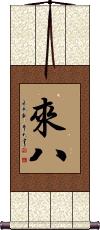
來八 is the name Laiba in Chinese (Mandarin).
Eight Black Horses
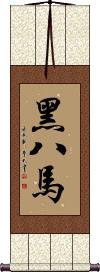
黑八馬 means “eight black horses” in Chinese.
This is an unusual title for calligraphy, but several people have searched for it, so we added it.
Eight horses are a sign of success in business in Chinese culture.
Bagua Fist

八卦拳 can be translated as “Bagua Fist.”
八卦 = Bagua or Eight Trigrams.
拳 = Fist.
Bagua School

八卦派 can be translated as “Bagua School.”
八卦 = Eight Trigrams (Bagua).
派 = Branch or faction, but in this context, translated as “School.”
Eight Trigrams; commonly used in internal arts terminology. Branch/faction; '-ha/-pai'.
Ba Gua Zhang
Martial arts style
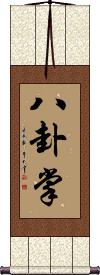
八卦掌 is the title Baguazhang, a form of Chinese boxing.
Literally translated, this means “Eight Trigrams Palm.”
You will also see this romanized as “Ba Gua Zhang,” “Bagua Zhang,” or “Pa Kua Chang” (same characters, just different spacing or romanization used in mainland China versus Taiwan).
八卦掌 is also known in Japan as hakkeshou or hakkesho.
Ba Ji Quan
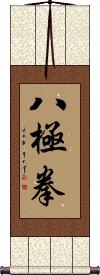
八極拳 is “Ba Ji Quan” or “Eight Extremes Fist.”
Some also translate this as “Eight Extremities Fist,” though I don't feel that's accurate.
八極拳 (Bājíquán) is a Chinese martial art that features explosive, short-range power and is famous for its elbow strikes. It originated in the Hebei Province in Northern China but spread to Taiwan and other places.
The full title is 開門八極拳 (Kāimén Bājíquán), which means Open-Door Bajiquan.
Other romanizations include: BaJiQuan, Pa Chi Ch`üan, or Pa Chi Chuan.
In Japan, this is known as Hakkyokuken.
Batangas
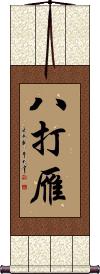
八打雁 is the name Batangas in Chinese (Mandarin).
Hachiman: God of War
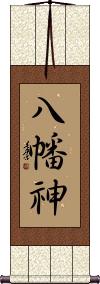
八幡神 is the Japanese God of War.
He is often known by the short name “Hachiman.” This version has the “God” title “jin” at the end, completing the idea of “God of War.”
Hakko-Ryu
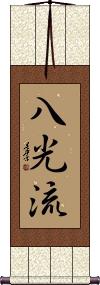
八光流 (Hakkō-Ryū) is a style of jujutsu associated with Daito-Ryu.
The title Hakko-Ryu comes from the Japanese phrase which translates as “The Style of the Eighth Light,” or more literally, “Eighth Light Style.”
The 光 character is associated with brightness or brilliance. It can be used to describe someone of great talent or potential. So the meaning goes far beyond just light.
Noble Eightfold Path
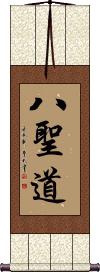
八聖道 is one of two titles for the Buddhist Noble Eightfold Path.
This version specifically has the “noble” idea in the middle character, which also means holy, sacred, wise and good, or upright.
The other title also romanizes as Hasshoudou or Hasshōdō in Japanese but is written 八正道.
The Noble Eightfold Path
Ashtangika Marga / Astangika-Marga / Atthangika Magga
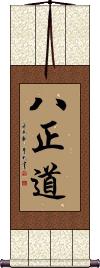
八正道 is a complex set of steps that Buddhists much take to cleanse karma, achieve enlightenment, eventually cease the cycle of rebirth and live in a state of Nirvana.
Note: This term is exclusively used by devout Buddhists. It is not a common term and remains an unknown concept to most Japanese and Chinese people. Sometimes written as 八聖道.
The Eighteen Arhats
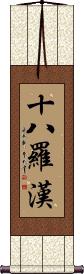
十八羅漢 is “The Eighteen Arhats” in Chinese.
Fall Down Seven Times, Get Up Eight
Always rising after a fall or repeated failures
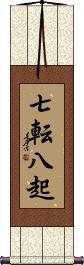
七転八起 is a Japanese proverb that relays the vicissitudes of life, with the meaning “seven times down eight times up.”
Some would more naturally translate it into English as “Always rising after a fall or repeated failures” or compare it to the English, “If at first, you don't succeed, try, try again.”
The first Kanji is literally “7.” The second means “fall down” (sometimes this Kanji means “turn around,” “revolve” or “turn over” but in this case, it holds the meaning of “fall”). The third is “8.” And the last is “get up,” “rouse,” or “rise.”
Basically, if you fail 7 times, you should recover from those events and be prepared to rise an 8th time. This also applies if it is the world or circumstances that knock you down seven times...
...just remember that you have the ability to bounce back from any kind of adversity.
Note: This can be pronounced in two ways. One is “shichi ten hakki” or “shichitenhakki.” The other is “nana korobi ya oki” also written, “nanakorobi-yaoki.”
Special Note: The second character is a Kanji that is not used in China. Therefore, please select a Japanese calligrapher for this title.
Happu Fudo
Unmoved by the Eight Winds

八風不動 is the short version, popularized in Japanese Zen Buddhism, of the original Chinese phrase 八風吹不動.
Literal meaning: “Unmoved by the Eight Winds”
The origin is Chinese, but it was later adopted into Japanese Zen. Here’s a little backstory:
The original famous anecdote is from Song Dynasty China, involving the poet-official 蘇東坡 (Su Dongpo / Su Shi, 1037–1101) and Zen master 佛印 (Foyin).
Su Dongpo wrote 八風吹不動,一屁打過江
“The Eight Winds cannot move me; Yet one fart blows me across the river.”
Foyin’s irreverent reply exposed Su Dongpo’s ego, which is kind of a classic Zen teaching story.
Unmoved by the Eight Winds

八風吹不動 is an ancient Buddhist phrase from about 1000 years ago.
Literal meaning: “The Eight Winds cannot move [me].”
The original famous anecdote is from Song Dynasty China, involving the poet-official 蘇東坡 (Su Dongpo / Su Shi, 1037–1101) and Zen master 佛印 (Foyin).
Su Dongpo wrote 八風吹不動,一屁打過江
“The Eight Winds cannot move me; Yet one fart blows me across the river.”
Foyin’s irreverent reply exposed Su Dongpo’s ego, which is kind of a classic Zen/Chan teaching story.
利 gain
衰 loss
毀 disgrace
譽 praise
稱 honor
譏 ridicule
苦 suffering
樂 pleasure
“The Eight Winds cannot move [him / the mind].”
“Unmoved by the Eight Winds.”
“The Eight Winds do not move me.”
“Not moved by the Eight Winds.”
“Unshaken by the Eight Winds.”
“Unaffected by the Eight Winds.”
“Unmoved by worldly forces.”
“Steadfast against the Eight Winds.”
“Remaining unmoved amid the Eight Winds.”
There is a shorter Japanese Zen version, 八風不動, which drops the middle character. Often romanized as happū fudō. The romanization of 八風吹不動 is arguably happū fukedomo ugokazu or happū sui fudō.
Return to Dwell in Gardens and Fields Poem

This is Tao Yuanming's poem, “Returning to Dwell in Gardens and Fields.”
少無適俗韻 性本愛丘山。
誤落塵網中 一去三十年。
羈鳥戀舊林 池魚思故淵。
開荒南野際 抱拙歸園田。
方宅十餘畝 草屋八九間。
榆柳蔭後簷 桃李羅堂前。
暖暖遠人村 依依墟裡煙。
狗吠深巷中 雞鳴桑樹顛。
戶庭無塵雜 虛室有餘閒。
久在樊籠裡 復得返自然。
Not the results for 八 that you were looking for?
Below are some entries from our dictionary that may match your 八 search...
| Characters If shown, 2nd row is Simp. Chinese |
Pronunciation Romanization |
Simple Dictionary Definition |
八 see styles |
bā ba1 pa yatsuyanagi やつやなぎ |
More info & calligraphy: Eight(numeric) eight (chi: bā); (surname) Yatsuyanagi aṣṭa, eight. |
一八 see styles |
kazuya かずや |
More info & calligraphy: Kazuya |
八仙 see styles |
bā xiān ba1 xian1 pa hsien hassen はっせん |
More info & calligraphy: Eight Immortals(given name) Hassen |
八卦 see styles |
bā guà ba1 gua4 pa kua hatsuke はつけ |
More info & calligraphy: Ba Gua(1) eight trigrams; divination signs; (2) divination; fortune-telling; (place-name) Hatsuke eight trigrams |
八月 see styles |
bā yuè ba1 yue4 pa yüeh yatsuki やつき |
More info & calligraphy: August(adverbial noun) August; (female given name) Yatsuki eighth month |
十八 see styles |
shí bā shi2 ba1 shih pa toya とや |
More info & calligraphy: Eighteen / 1818; eighteen; (personal name) Toya aṣṭādaśa, eighteen. |
八卦拳 see styles |
bā guà quán ba1 gua4 quan2 pa kua ch`üan pa kua chüan |
More info & calligraphy: Bagua Fist |
八卦掌 see styles |
bā guà zhǎng ba1 gua4 zhang3 pa kua chang hakkeshou / hakkesho はっけしょう |
More info & calligraphy: Ba Gua Zhang{MA} eight trigrams palm; ba gua zhang; pa kua chang |
八幡神 see styles |
hachimanjin; yawatanokami はちまんじん; やわたのかみ |
More info & calligraphy: Hachiman: God of War |
八極拳 八极拳 see styles |
bā jí quán ba1 ji2 quan2 pa chi ch`üan pa chi chüan hakkyokuken はっきょくけん |
More info & calligraphy: Ba Ji Quanbajiquan (Chinese martial art) |
八正道 see styles |
bā zhèng dào ba1 zheng4 dao4 pa cheng tao hasshōdō はっしょうどう |
More info & calligraphy: The Noble Eightfold Path(Buddhist term) noble eightfold path (八正道分) Āryamārga. The eight right or correct ways, the "eightfold noble path" for the arhat to nirvāṇa; also styled 八道船, 八正門, 八由行, 八游行, 八聖道支, 八道行, 八直行, 八直道. The eight are: (1) 正見Samyag-dṛṣṭi, correct views in regard to the Four Axioms, and freedom from the common delusion. (2) 正思 Samyak-saṁkalpa, correct thought and purpose. (3) 正語 Samyag-vāc, correct speech, avoidance of false and idle talk. (4) 正業 Samyak-karmānta, correct deed, or conduct, getting rid of all improper action so as to dwell in purity. (5) 正命 Smnyag-ājīva, correct livelihood or occupation, avoiding the five immoral occupations. (6) 正精進 Samyag-vyāyāma, correct zeal, or energy in uninterrupted progress in the way of nirvāṇa. (7) 正念 Samyak-smṛti, correct remembrance, or memory, which retains the true and excludes the false. (8) 正定 Samyak-samadhi, correct meditation, absorption, or abstraction. The 正 means of course Buddhist orthodoxy, anything contrary to this being 邪 or heterodox, and wrong. |
八聖道 八圣道 see styles |
bā shèng dào ba1 sheng4 dao4 pa sheng tao hasshōdō はっしょうどう |
More info & calligraphy: Noble Eightfold Pathnoble eightfold path |
七転八起 see styles |
nanakorobiyaoki ななころびやおき shichitenhakki しちてんはっき |
More info & calligraphy: Fall Down Seven Times, Get Up Eight |
十八羅漢 十八罗汉 see styles |
shí bā luó hàn shi2 ba1 luo2 han4 shih pa lo han juuhachirakan / juhachirakan じゅうはちらかん |
More info & calligraphy: The Eighteen Arhatseighteen arhats |
お八 see styles |
oyatsu おやつ |
(1) (kana only) between-meal snack; (2) mid-afternoon (around 3 o'clock) snack; afternoon refreshment; afternoon tea |
丈八 see styles |
jouhachi / johachi じょうはち |
(given name) Jōhachi |
三八 see styles |
sān bā san1 ba1 san pa miya みや |
International Women's Day 婦女節|妇女节[Fu4 nu:3 jie2], 8th March; foolish; stupid (1) three and eight; (2) (abbreviation) (See 三八式歩兵銃) Arisaka Type 38 rifle; (personal name) Miya (days ending with the number) 3 and 8 |
上八 see styles |
koujou / kojo こうじょう |
(place-name) Kōjō |
下八 see styles |
shimoha しもはっ |
(place-name) Shimoha |
与八 see styles |
yohachi よはち |
(given name) Yohachi |
丘八 see styles |
qiū bā qiu1 ba1 ch`iu pa chiu pa |
soldier (from the two components of the 兵 character) (derog.) |
中八 see styles |
nakabachi なかばち |
(place-name) Nakabachi |
丸八 see styles |
maruhachi まるはち |
(kana only) Cyathea mertensiana (species of tree fern); (surname) Maruhachi |
久八 see styles |
kuwa くわ |
(surname) Kuwa |
亀八 see styles |
kihachi きはち |
(personal name) Kihachi |
二八 see styles |
èr bā er4 ba1 erh pa nihachi にはち |
16; sixteen (archaism) sixteen The sixteen meditations. V. 十六觀. |
五八 see styles |
wǔ bā wu3 ba1 wu pa gohachi ごはち |
(g,p) Gohachi Five eights, i. e. forty. |
亘八 see styles |
kouhachi / kohachi こうはち |
(personal name) Kōhachi |
亡八 see styles |
wáng bā wang2 ba1 wang pa bouhachi / bohachi ぼうはち |
variant of 王八[wang2 ba1] (1) customer at a brothel; john; someone who has forgotten the eight virtues; (2) brothel; owner of a brothel |
京八 see styles |
keihachi / kehachi けいはち |
(personal name) Keihachi |
Click here for more 八 results from our dictionary
The following table may be helpful for those studying Chinese or Japanese...
| Title | Characters | Romaji (Romanized Japanese) | Various forms of Romanized Chinese | |
| Eight | 八 | hachi | bā / ba1 / ba | pa |
| August | 八月 | hachigatsu / yatsuki | bā yuè / ba1 yue4 / ba yue / bayue | pa yüeh / payüeh |
| Ba Gua | 八卦 | bā guà / ba1 gua4 / ba gua / bagua | pa kua / pakua | |
| Eight Immortals | 八仙 | hassen / hasen | bā xiān / ba1 xian1 / ba xian / baxian | pa hsien / pahsien |
| Eighteen 18 | 十八 | sei pai / to ya seipai / toya | shí bā / shi2 ba1 / shi ba / shiba | shih pa / shihpa |
| Kazuya | 一八 | kazuya | ||
| Laiba | 來八 来八 | lái bā / lai2 ba1 / lai ba / laiba | lai pa / laipa | |
| Eight Black Horses | 黑八馬 黑八马 | hēi bā mǎ hei1 ba1 ma3 hei ba ma heibama | hei pa ma heipama |
|
| Bagua Fist | 八卦拳 | hakke ken / hakkeken / hake ken | bā guà quán ba1 gua4 quan2 ba gua quan baguaquan | pa kua ch`üan pakuachüan pa kua chüan |
| Bagua School | 八卦派 | hakke ha / hakkeha / hake ha | bā guà pài ba1 gua4 pai4 ba gua pai baguapai | pa kua p`ai pakuapai pa kua pai |
| Ba Gua Zhang | 八卦掌 | hakkeshou / hakesho | bā guà zhǎng ba1 gua4 zhang3 ba gua zhang baguazhang | pa kua chang pakuachang |
| Ba Ji Quan | 八極拳 八极拳 | hakkyo ku ken hakkyokuken hakyo ku ken | bā jí quán ba1 ji2 quan2 ba ji quan bajiquan | pa chi ch`üan pachichüan pa chi chüan |
| Batangas | 八打雁 | bā dǎ yàn ba1 da3 yan4 ba da yan badayan | pa ta yen patayen |
|
| Hachiman: God of War | 八幡神 | hachi man jin hachimanjin | ||
| Hakko-Ryu | 八光流 | hakkou ryuu hakkouryuu hako ryu | ||
| Noble Eightfold Path | 八聖道 八圣道 | hasshoudou / hashodo | bā shèng dào ba1 sheng4 dao4 ba sheng dao bashengdao | pa sheng tao pashengtao |
| The Noble Eightfold Path | 八正道 | hasshoudou / hashodo | bā zhèng dào ba1 zheng4 dao4 ba zheng dao bazhengdao | pa cheng tao pachengtao |
| The Eighteen Arhats | 十八羅漢 十八罗汉 | shí bā luó hàn shi2 ba1 luo2 han4 shi ba luo han shibaluohan | shih pa lo han shihpalohan |
|
| Fall Down Seven Times, Get Up Eight | 七転八起 | shichi ten hakki / nana korobi ya oki shichi ten haki / nana korobi ya oki | ||
| Happu Fudo | 八風不動 八风不动 | happuu fudou happuufudou hapu fudo | bā fēng bù dòng ba1 feng1 bu4 dong4 ba feng bu dong bafengbudong | pa feng pu tung pafengputung |
| Unmoved by the Eight Winds | 八風吹不動 八风吹不动 | happuu sui fudou happuusuifudou hapu sui fudo | bā fēng chuī bù dòng ba1 feng1 chui1 bu4 dong4 ba feng chui bu dong bafengchuibudong | pa feng ch`ui pu tung pafengchuiputung pa feng chui pu tung |
| Return to Dwell in Gardens and Fields Poem | 少無適俗韻性本愛丘山誤落塵網中一去三十年羈鳥戀舊林池魚思故淵開荒南野際抱拙歸園田方宅十余畝草屋八九間榆柳蔭后檐桃李羅堂前暖暖遠人村依依墟里煙狗吠深巷中雞鳴桑樹顛戶庭無塵雜虛室有余閑久在樊籠里復得返自然 少无适俗韵性本爱丘山误落尘网中一去三十年羁鸟恋旧林池鱼思故渊开荒南野际抱拙归园田方宅十余亩草屋八九间榆柳荫后檐桃李罗堂前暖暖远人村依依墟里烟狗吠深巷中鸡鸣桑树颠户庭无尘杂虚室有余闲久在樊笼里复得返自然 | shào wú shì sú yùn xìng běn ài qiū shān wù luò chén wǎng zhōng yī qù sān shí nián jī niǎo liàn jiù lín chí yú sī gù yuān kāi huāng nán yě jì bào zhuō guī yuán tián fāng zhái shí yú mǔ cǎo wū bā jiǔ jiān yú liǔ yīn hòu yán táo lǐ luó táng qián nuǎn nuǎn yuǎn rén cūn yī yī xū lǐ yān gǒu fèi shēn xiàng zhōng jī míng sāng shù diān hù tíng wú chén zá xū shì yǒu yú xián jiǔ zài fán lóng lǐ fù dé fǎn zì rán shao4 wu2 shi4 su2 yun4 xing4 ben3 ai4 qiu1 shan1 wu4 luo4 chen2 wang3 zhong1 yi1 qu4 san1 shi2 nian2 ji1 niao3 lian4 jiu4 lin2 chi2 yu2 si1 gu4 yuan1 kai1 huang1 nan2 ye3 ji4 bao4 zhuo1 gui1 yuan2 tian2 fang1 zhai2 shi2 yu2 mu3 cao3 wu1 ba1 jiu3 jian1 yu2 liu3 yin1 hou4 yan2 tao2 li3 luo2 tang2 qian2 nuan3 nuan3 yuan3 ren2 cun1 yi1 yi1 xu1 li3 yan1 gou3 fei4 shen1 xiang4 zhong1 ji1 ming2 sang1 shu4 dian1 hu4 ting2 wu2 chen2 za2 xu1 shi4 you3 yu2 xian2 jiu3 zai4 fan2 long2 li3 fu4 de2 fan3 zi4 ran2 shao wu shi su yun xing ben ai qiu shan wu luo chen wang zhong yi qu san shi nian ji niao lian jiu lin chi yu si gu yuan kai huang nan ye ji bao zhuo gui yuan tian fang zhai shi yu mu cao wu ba jiu jian yu liu yin hou yan tao li luo tang qian nuan nuan yuan ren cun yi yi xu li yan gou fei shen xiang zhong ji ming sang shu dian hu ting wu chen za xu shi you yu xian jiu zai fan long li fu de fan zi ran | shao wu shih su yün hsing pen ai ch`iu shan wu lo ch`en wang chung i ch`ü san shih nien chi niao lien chiu lin ch`ih yü ssu ku yüan k`ai huang nan yeh chi pao cho kuei yüan t`ien fang chai shih yü mu ts`ao wu pa chiu chien yü liu yin hou yen t`ao li lo t`ang ch`ien nuan nuan yüan jen ts`un i i hsü li yen kou fei shen hsiang chung chi ming sang shu tien hu t`ing wu ch`en tsa hsü shih yu yü hsien chiu tsai fan lung li fu te fan tzu jan shao wu shih su yün hsing pen ai chiu shan wu lo chen wang chung i chü san shih nien chi niao lien chiu lin chih yü ssu ku yüan kai huang nan yeh chi pao cho kuei yüan tien fang chai shih yü mu tsao wu pa chiu chien yü liu yin hou yen tao li lo tang chien nuan nuan yüan jen tsun i i hsü li yen kou fei shen hsiang chung chi ming sang shu tien hu ting wu chen tsa hsü shih yu yü hsien chiu tsai fan lung li fu te fan tzu jan |
|
| In some entries above you will see that characters have different versions above and below a line. In these cases, the characters above the line are Traditional Chinese, while the ones below are Simplified Chinese. | ||||

Successful Chinese Character and Japanese Kanji calligraphy searches within the last few hours...



