Many custom options...


And formats...



Not what you want?
Try other similar-meaning words, fewer words, or just one word.
Whatever Will Be in Chinese / Japanese...
Buy a Whatever Will Be calligraphy wall scroll here!
Personalize your custom “Whatever Will Be” project by clicking the button next to your favorite “Whatever Will Be” title below...
Indomitable / Unyielding
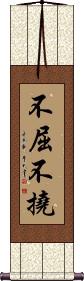
不屈不撓 means “Indomitable” or “Unyielding.”
不屈不撓 is a long word by Chinese standards. At least, it is often translated as a single word into English. It's actually a proverb in Chinese.
If you want to break it down, you can see that the first and third characters are the same. Both mean “not” (they work as a suffix to make a negative or opposite meaning to whatever character follows).
The second character means “bendable.”
The last means “scratched” or “bothered.”
So this really means “Won't be bent, can't be bothered.” I have also seen it written as “Will not crouch, will not submit.” This comes from the fact that the second character can mean “to crouch” and the last can mean “to submit” (as in “to give in” such as “submitting to the rule of someone else”). This may explain better why these four characters mean “indomitable.”
Notes:
Some will translate this as “indomitable spirit”; however, technically, there is no character to suggest the idea of “spirit” in this word.
Other translations include indefatigability, indomitableness, or unremitting tenacity.
The first two characters can be stand-alone words in Chinese.
In Japanese, this is considered two words (with very similar meanings). It's more common to see the word order flipped to 不撓不屈 in Japanese.
The same characters are used in old Korean Hanja. Just like in Japanese, the words are swapped to 不撓不屈 creating a word pronounced “불요불굴” in Korean.
See 不撓不屈
Confucius: Golden Rule / Ethic of Reciprocity
Do not do to others what you do not want done to yourself
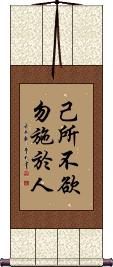
Some may think of this as a “Christian trait,” but actually, it transcends many religions.
This Chinese teaching dates back to about 2,500 years ago in China. Confucius had always taught the belief in being benevolent (ren), but this idea was hard to grasp for some of his students, as benevolence could be kind-heartedness or an essence of humanity itself.
When answering Zhong Gong's question as to what "ren" actually meant, Confucius said:
己所不欲勿施于人 or "When you go out, you should behave as if you were in the presence of a distinguished guest; when people do favors for you, act as if a great sacrifice was made for you. Whatever you wouldn't like done to you, do not do that thing to others. Don't complain at work or home.”
Hearing this, Zhong Gong said humbly, “Although I am not clever, I will do what you say.”
From this encounter, the Chinese version of the “Golden Rule” or “Ethic of Reciprocity” came to be.
The characters you see above express, “Do not do to others whatever you do not want to be done to yourself.”
See Also: Confucius Teachings | Benevolence
Dragon
Year of the Dragon / Zodiac Sign
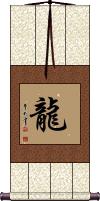
龍 is the character for dragon in Chinese, old Korean Hanja, and Japanese Kanji.
The dragon is a creature of myth and legend that dominates Chinese, Japanese, and even European folklore. In China, the dragon is the symbol of the Emperor, strength, and power, and the Chinese dragon is known as the god of water.
From the Chinese Zodiac, if you were born in the year of the Dragon, you . . .
Have a strong body and spirit.
Are full of energy.
Have vast goals.
Have a deep level of self-awareness.
Will do whatever you can to “save face.”
See also our Chinese Zodiac or Dragon Calligraphy pages.
Nothingness
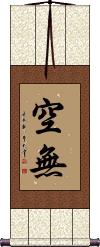
空無 is “nothingness” in a Buddhist context.
The first character means empty but can also mean air or sky (air and sky have no form).
The second character means have not, no, none, not, or to lack.
Together these characters reinforce each other into a word that means “absolute nothingness.”
I know this is a term used in Buddhism, but I have not yet figured out the context in which it is used. I suppose it can be the fact that Buddhists believe that the world is a non-real illusion, or perhaps it's about visualizing yourself as “nothing” and therefore leaving behind your desire and worldliness.
Buddhist concepts and titles often have this element of ambiguity or, rather, “mystery.” Therefore, such ideas can have different meanings to different people, and that's okay. If you don't get it right in this lifetime, there will be plenty more lifetimes to master it (whatever “it” is, and if “it” really exists at all).
Soothill defines this as “Unreality, or immateriality, of things, which is defined as nothing existing of independent or self-contained nature.”
Double Happiness Guest Book
Customize a special Asian guest book for your wedding
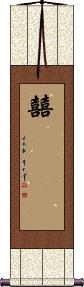
Start customizing a “Double Happiness Guest Book Wall Scroll” Here!
The paper panel length can be whatever you choose from 68cm to 135cm (27” to 53”).
If you don't mention what paper length you want in the special instructions tab (on the next page), we'll make it about 100cm (40”).
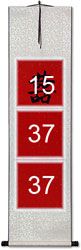
The medium-size scroll with a 33cm x 100cm (13” x 40”) paper panel can usually handle up to 89 signatures. That breaks down to 37 signatures per empty square and 15 signatures around the 囍 character. If you switch to a 135cm paper panel, add another 37 potential signatures.
We can splice two 135cm papers together, but that would be a crazy-long scroll. These are only estimates, your mileage may vary.
With silk panels, this will yield a wall scroll about 155cm (61”) long. That's enough for up to 89 signatures. Of course, that depends on if your guests just sign a brief salutation and name, or more verbose good wishes. Customer feedback is that 126 people can sign the 135cm long paper on a medium-sized scroll. If we go bigger than that, there will be a minor paper seam and an extra charge. Email me with your specifications if you need something special.
Most customers pick the festive red paper with gold flecks and white or ivory silk. Red is a good luck color in Chinese culture, thus the most popular choice. But, you can do any color combination that you want.
There is a long history of Chinese-character-use outside of mainland China. This Double Happiness character is also seen at weddings in Korea, Vietnam, Hong Kong, and Taiwan, as well as in Chinese communities in Thailand, Indonesia, and elsewhere. While Japan borrowed Chinese characters into their language, you won't see 囍 as often at Japanese weddings.
This in-stock artwork might be what you are looking for, and ships right away...

Gallery Price: $61.00
Your Price: $33.88

Gallery Price: $61.00
Your Price: $33.88

Gallery Price: $61.00
Your Price: $33.88

Gallery Price: $61.00
Your Price: $33.88


Gallery Price: $322.00
Your Price: $178.88

Gallery Price: $65.00
Your Price: $36.00
Not the results for whatever will be that you were looking for?
Below are some entries from our dictionary that may match your whatever will be search...
| Characters If shown, 2nd row is Simp. Chinese |
Pronunciation Romanization |
Simple Dictionary Definition |
行 see styles |
xíng xing2 hsing yukue ゆくえ |
(bound form) to walk; to go; to travel; (literary) trip; journey; visit; (bound form) temporary; makeshift; (bound form) current; in circulation; (bound form) to do; to perform; capable; competent; all right; OK!; will do; behavior; conduct (Taiwan pr. [xing4]); (literary) about to; soon (n,n-suf) (1) going; travelling; traveling; journey; trip; (2) act; action; (suffix noun) (3) bank; (counter) (4) counter for banks; (counter) (5) counter for groups or parties of people; (6) type of classical Chinese verse (usu. an epic from the Tang period onwards); (7) (hist) shopping district (of similar merchants; in the Sui and Tang periods); (8) (hist) merchants' guild (in the Tang period); (female given name) Yukue Go; act; do; perform; action; conduct; functioning; the deed; whatever is done by mind, mouth, or body, i.e. in thought, word, or deed. It is used for ayana, going, road, course; a march, a division of time equal to six months; also for saṁskāra, form, operation, perfecting, as one of the twelve nidānas, similar to karma, action, work, deed, especially moral action, cf. 業. |
勝手放題 see styles |
kattehoudai / kattehodai かってほうだい |
(n,adj-na,adj-no) at one's sweet will; doing whatever one pleases; however one pleases |
見風是雨 见风是雨 see styles |
jiàn fēng shì yǔ jian4 feng1 shi4 yu3 chien feng shih yü |
lit. see the wind and assume it will rain (idiom); fig. gullible; to believe whatever people suggest |
雷打不動 雷打不动 see styles |
léi dǎ bù dòng lei2 da3 bu4 dong4 lei ta pu tung |
not shaken by thunder (idiom); the arrangements are unalterable; to adhere rigidly to regulations; will go ahead whatever happens (of an arrangement or plan) |
ケセラセラ see styles |
keserasera ケセラセラ |
(wk) Que Sera, Sera (song title); Whatever Will Be, Will Be |
ケ・セラ・セラ |
ke sera sera ケ・セラ・セラ |
(wk) Que Sera, Sera (song title); Whatever Will Be, Will Be |
マーフィーの法則 see styles |
maafiinohousoku / mafinohosoku マーフィーのほうそく |
Murphy's Law ("Whatever can go wrong, will go wrong") |
Variations: |
keserasera; ke sera sera ケセラセラ; ケ・セラ・セラ |
(work) Que Sera, Sera (song title); Whatever Will Be, Will Be |
Variations: |
naruyouninaru / naruyoninaru なるようになる |
(exp,v5r) (kana only) (proverb) whatever will be, will be; things happen the way they happen; let nature take its course |
Variations: |
naruyouninaru / naruyoninaru なるようになる |
(exp,v5r) (kana only) (proverb) whatever will be, will be; things happen the way they happen; let nature take its course |
Variations: |
naruyouninaru / naruyoninaru なるようになる |
(exp,v5r) (kana only) (proverb) whatever will be, will be; things happen the way they happen; let nature take its course |
The following table may be helpful for those studying Chinese or Japanese...
| Title | Characters | Romaji (Romanized Japanese) | Various forms of Romanized Chinese | |
| Indomitable Unyielding | 不屈不撓 不屈不挠 | fu kutsu fu tou fukutsufutou fu kutsu fu to | bù qū bù náo bu4 qu1 bu4 nao2 bu qu bu nao buqubunao | pu ch`ü pu nao puchüpunao pu chü pu nao |
| Confucius: Golden Rule Ethic of Reciprocity | 己所不欲勿施於人 己所不欲勿施于人 | jǐ suǒ bú yù wù shī yú rén ji3 suo3 bu2 yu4, wu4 shi1 yu2 ren2 ji suo bu yu, wu shi yu ren jisuobuyu,wushiyuren | chi so pu yü, wu shih yü jen chisopuyü,wushihyüjen |
|
| Dragon | 龍 龙 | ryuu / tatsu ryu / tatsu | lóng / long2 / long | lung |
| Nothingness | 空無 空无 | kuu mu / kuumu / ku mu | kōng wú / kong1 wu2 / kong wu / kongwu | k`ung wu / kungwu / kung wu |
| Double Happiness Guest Book | 囍 喜喜 | xǐ / xi3 / xi | hsi | |
| In some entries above you will see that characters have different versions above and below a line. In these cases, the characters above the line are Traditional Chinese, while the ones below are Simplified Chinese. | ||||

Successful Chinese Character and Japanese Kanji calligraphy searches within the last few hours...



