Adventures in Asian Art


Chat

Didn't find what you want?

Try these methods:
1. Use other similar-meaning words.
2. Use fewer words or just one word.
3. Post your request on our forum so we can translate it for you.

All custom calligraphy items are made-to-order in our little Beijing artwork-mounting workshop.

Healer in Chinese / Japanese...

Buy a Healer calligraphy wall scroll here!

Start your custom "Healer" project by clicking the button next to your favorite "Healer" title below...

Quick links to words on this page...

  1. Doctor
  2. Benevolent and Skilled Doctor
  3. Healing Hands
  4. Heal / Healing
  5. Doctor
  6. Healing Hands
  7. Doctor
  8. Healing Hands
  9. Benevolent and Skilled Doctor
10. Acupuncture and Moxibustion
11. Acupuncture
12. Reiki
13. Birth / Life
14. Reiki - Master Symbol
15. You May Learn from Victory,...
16. Sensei / Master / Teacher / Mister
17. Tea

Prices for small custom wall scrolls start at:

Single-Character: $26.88

2 Characters: $33.88

3 Characters: $38.88

4 Characters: $43.88

8 Characters: $53.88

10 Characters: $55.88

Customizations that you select may raise or lower the price. Medium size available for $7 more.

Doctor

Chinese

China yī shēng
Korea 의생
醫生

This is the title used to refer to medical doctors or physicians in China.

Note: Sometimes this same term is used in Korean but not common.

Doctor

Japanese Kanji

Japan i shi
医師

This is the most common title used to refer to medical doctors or physicians in Japanese Kanji.

Benevolent and Skilled Doctor

China miào shǒu rén xīn xuán hú jì shì
妙手仁心懸壺濟世

This phrase celebrates the benevolence, skill, and service to his/her patients.

Here's a breakdown of the characters:
妙手 miào shǒu admirable skill in curing disease (when used in reference to doctors).
仁心 rén xīn kindheartedness, charity, benevolent heart.
悬壶济世 xuán hú jì shì practice medicine or pharmacy to help the people or public.

Healing Hands

Japanese only

Japan iyashi no te
癒しの手

This means "healing hands" in Japanese.

The first two characters mean healing, soothing, therapy, comfort, and/or solace.
The third character is a possessive connecting article.
The last Kanji means hand or hands.

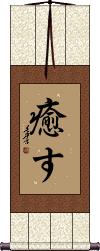
Heal / Healing

Japanese

Japan iya su
癒す

This is the common word for heal or healing in Japanese. This can mean to heal or to cure.

Doctor

Korean Hanja

China yī shī
Japan i shi
Korea 의사
醫師

This is the title used to refer to medical doctors or physicians in old Korean Hanja.

Notes:
Also means "doctor" in Chinese, but not the most commonly-used title.
This is the ancient/traditional form of doctor in Japanese (they simplified the first character in Japan after WWII).

Healing Hands

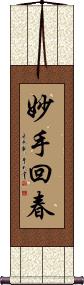
China miào shǒu huí chūn
Korea 묘수회춘
妙手回春

This can be translated as "healing hands".

The first two characters are used to describe a doctor or medical professional who has admirable skill in curing disease. Literally: Wonderful or skilled hands.

The last two characters mean "Springing back to life".

Altogether, it suggests that these skilled hands can cure whatever ails you and bring you back to life. This is a great honor to bestow on your doctor or other healthcare professional that has helped you.

Back to the top of this page

Doctor

Japanese Kanji

Japan i sha
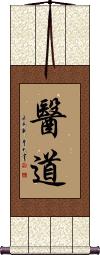
醫者

This a secondary title used to refer to medical doctors or physicians in Japanese Kanji.

Healing Hands

Japanese only

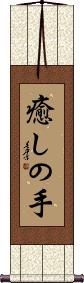
Japan iyashi no te
癒しの手

This can be translated as "healing hands" in Japanese.

The first two characters mean "to heal", "to cure", or healing.
The third character is a possessive particle that connects the ideas.
The last character is hand or hands.

Benevolent and Skilled Doctor

Short version

China miào shǒu rén xīn
妙手仁心

This phrase celebrates the benevolence, skill, and service to his/her patients.

Here's a breakdown of the characters:
妙手 miào shǒu admirable skill in curing disease (when used in reference to doctors).
仁心 rén xīn kindheartedness, charity, benevolent heart.

Back to the top of this page

Acupuncture and Moxibustion

China zhēn jiǔ
Japan shin kyuu
Korea 침구
鍼灸

This is the Chinese, Japanese Kanji, and old Korean Hanja word for acupuncture moxibustion.

Acupuncture

China zhēn shù
Japan shinjutsu
針術

This is how they write acupuncture in Chinese. The first character means "needle" or "pin". The second character means "technique" or "method".

This is theoretically a Japanese word as well, but not commonly used (select our other word for acupuncture if your audience is Japanese).

Acupuncture

China zhēn liáo fǎ
Japan hari ryou hou
針療法

This is one of two ways to write acupuncture in Chinese and Japanese. The first character means "needle" or "pin". The second character means "to treat" or "to cure". The last character means "method" or "way".

This is the only reasonable selection if your audience is Japanese. This is the formal way to express acupuncture in Chinese, so this version is universal in most of Asia (the best all around choice in most cases).

Back to the top of this page

Reiki

China líng qì
Japan reiki
Korea 령기 or 영기
靈氣

This is the title of a healing practice that is now found throughout the world but with origins in Japan.

Special note: Outside of the context of the healing practice of Reiki, this means "aura" or "spiritual essence that surrounds all living things". A Japanese person not familiar with the practice will take the "aura" meaning.

Reiki is a technique for stress reduction and relaxation that also heals. It can be compared to massage, but is based on the idea that an unseen "life force energy" flows through us and is what causes us to be alive. If your life force energy is low, you'll be more likely to get sick or feel stress. If your life force energy is abundant and flowing well, you become more capable of being happy and healthy.

There is a lot of information available if you want to Google this term - my job is to offer the calligraphy, while you can decide if it is right for you.

霊
気

Note: We are showing the ancient (traditional) form of the Reiki Kanji. I have seen Reiki written with both the slightly simplified version and this more classic form. If you want the form of Reiki with the two strokes in the shape of an X on the second character and reformed first character, simply click on the Kanji characters to the right.

Note: This is also a Chinese word, but in Chinese, these characters create a word that refers to a smart person, or someone with high aspirations. It is not read as a healing method in Chinese.
In Korean Hanja, this can be read as "mysterious atmosphere" by a Korean who is not familiar with the practice of Reiki (still has a cool meaning in Korean).

Birth / Life

China shēng
Japan shou / iku
Korea
生

This Chinese word means "to be born" and "to give birth". Also it's often used to refer to life itself, and sometimes "to grow".

This character is used in a lot of compound words such as "yi sheng", which means "doctor" (literally "healer of life"), "sheng ri" which means "birthday" (literally "birth day") and "xue sheng" which means student (literally "studying life" or "learner [about] life"). Few Chinese people will think of the literal meaning when this use words like doctor and student - but it is interesting to note.

This character has the same root meaning in Korean Hanja and Japanese. However, in Japanese, there are many possible pronunciations, and this can be used to mean "raw" or "unprocessed" (as in draft beer). Therefore, not be the best if your audience is Japanese.


See Also...  Life Force | Vitality

Reiki - Master Symbol

China dà guāng míng
Japan dai ko myo
Korea 대광명
大光明

This is a symbol associated with Reiki. A healing practice with origins in Japan - though practitioners can now be found throughout the world.

This is usually translated as "Great Bright Light". This symbol, as used in Reiki, alludes to "Enlightened Nature" or the radiance of a purified soul or deity.

Pronunciations in Chinese and Korean are included above, but this title has no meaning except when used by a Reiki practitioner. In fact, this title is not that well known by those outside the Reiki community in Japan. In fact, in Chinese, this would be interpreted as "Great Bright Future" (the second two characters alone create a word that means "bright future" in Chinese).

Back to the top of this page

You May Learn from Victory,
You Will Learn from Failure

China bǎi shèng nán lǜ dí
sān zhé nǎi liáng yī

百勝難慮敵三折乃良醫

This Chinese proverbs literally translates as: [Even a general who has won a] hundred victories [may be] hard put to see through the enemy's [strategy], [but one who has] broken [his] arm three [times] [will] be a good doctor.

Figuratively, this means: One cannot always depend on past successes to guarantee future success, but one can always learn from lessons drawn from failure.


See Also...  Failure - Mother Of Success | Experience - Mother Of Success | Fall Down 7 Times Get Up 8 | Hard Knocks

Sensei / Master / Teacher / Mister

China xiān shēng
Japan sen sei
Korea 선생
先生

If you've taken even a single karate class in your life, you know this term. This is sensei, which is associated in the west with a master or instructor of karate, aikido, judo, and other Japanese martial arts.

In reality, this is a term of respect for almost any professional or skilled person (doctor, lawyer, teacher, etc). In some cases, it is used for musicians and artists who have achieved a certain level of fame, skill, or accomplishment.

It should be noted that this is also a courtesy title in Chinese, but more like calling someone "mister" or "gentleman". It doesn't really have the "master" or "teacher" meaning in Chinese - see our Chinese "Master / Sifu / Shi Fu" entry if your audience is Chinese.

In Korean Hanja, this means teacher, instructor, schoolmaster, or schoolmistress.

This entry is more for educational purposes. This is kind of a strange thing to put on a wall scroll. It's a title that is used more orally to show respect, rather than something written in calligraphy. If you feel that it is appropriate in your circumstances, we are very willing to create a piece of sensei Japanese calligraphy artwork for you.

Tea

China chá
Japan cha
Korea
茶

This character means tea. It can refer to prepared tea (ready-to-drink) or to dry tea leaves.

The origin of tea is China, but the same character is used in Japanese Kanji, and old Korean Hanja with the exact same meaning. Japanese and Korean even borrowed the pronunciation from Chinese (pronounced "cha" in all three languages).

It's said that an early doctor (or herbologist) in ancient China kept poisoning himself as he tried different new herb concoctions. He invented tea as a means to detoxify himself as he recovered from 1 of the 76 times he nearly poisoned himself to death. Tea is seen not just as a drink, but as a form of medicine used to remove impurities from the body.

Back to the top of this page


A+ Rated

Details


Click on a
Select & Customize
button to select your calligraphy and start customizing your artwork project.


A nice Chinese calligraphy wall scroll

The scroll that I am holding in this picture is a "medium size"
4-character wall scroll.
As you can see, it is a great size to hang on your wall.
(We also offer custom wall scrolls in larger sizes)

A professional Chinese Calligrapher

Professional calligraphers are getting to be hard to find these days.
Instead of drawing characters by hand, the new generation in China merely type roman letters into their computer keyboards and pick the character that they want from a list that pops up.

There is some fear that true Chinese calligraphy may become a lost art in the coming years. Many art institutes in China are now promoting calligraphy programs in hopes of keeping this unique form of art alive.

Trying to learn Chinese calligrapher - a futile effort

Even with the teachings of a top-ranked calligrapher in China, my calligraphy will never be good enough to sell. I will leave that to the experts.


A high-ranked Chinese master calligrapher that I met in Zhongwei

The same calligrapher who gave me those lessons also attracted a crowd of thousands and a TV crew as he created characters over 6-feet high. He happens to be ranked as one of the top 100 calligraphers in all of China. He is also one of very few that would actually attempt such a feat.


If your search is not successful, just post your request on our forum, and we'll be happy to do research or translation for any reasonable request.

Successful Chinese Character and Japanese Kanji calligraphy searches within the last few hours...


Aaron
Aikido
Alive
Always
Animals
Archer
Aries
Balance
Beautiful
Beginner
Believe
Black
Blue
Bonsai
Brandon
Brother
Brotherhood
Capricorn
Cloud
Courage
Daisy
Death Before Dishonor
Diamond
Discipline
Dragon
Dragon Tiger Spirit
Emily
Eric
Erin
Eternal
Ethan
Faith
Family
Father
Feet
Fish
Flowers
Forest
Forever
Forgiveness
Frank
Free
Freedom
Friends
Friendship
Girl
Good Luck
Guardian
Happiness
Help
Honor
Hope
I Am Light
I Love You
I Want Sex
Inner Peace
Inner Strength
Integrity
Jaguar
Jason
Jenna
Jordan
Josh
Joshua
Julian
Katherine
Kendo
Kiss
Kristina
Lexi
Lion
Lonely
Love
Love Eternal
Love for A Son
Love is Patient
Loyalty
Luis
Master
Michael
Money Symbol
Mother Nature
Nathan
Never Forget
Never Give Up
Ninja
Ninjutsu
Ninpo
No Regrets
One Love One Heart
Orlando
Overcome
Patience
Peace
Perserverance
Phoenix
Power
Power Strength
Prosperity
Protect
Rain
Real
Red Color
Remember Me
Robert
Ruby
Ruth
Samurai
Sarah
Scorpio
Scorpion
Sexy
Sheila
Stone
Strength
Survive
Tai Chi
Tao Te Ching
Tiger
Timothy
Tree
True Love
Truth
Vanessa
Warrior
Water
Wisdom
Wolf

With so many searches, we had to upgrade to our own Linux server.
Of course, only one in 500 searches results in a purchase - Hey buy a wall scroll!!!


See: Our list of specifically Japanese Kanji Calligraphy Wall Scrolls. And, check out Our list of specifically old Korean Hanja Calligraphy Wall Scrolls.

The following table is only helpful for those studying Chinese (or Japanese), and perhaps helps search engines to find this page when someone enters Romanized Chinese or Japanese

Title
Characters 
Simplified
Traditional
Japanese Romaji
(Romanized Japanese)
Various forms of Romanized Chinese
Doctor医生
醫生
n/ayī shēng
yi sheng
i sheng
yi1 sheng1
yisheng
Doctor医师
医師 / 醫師
i shi
ishi
n/a
Benevolent and Skilled Doctor妙手仁心悬壶济世
妙手仁心懸壺濟世
n/amiào shǒu rén xīn xuán hú jì shì
miao shou ren xin xuan hu ji shi
miao shou jen hsin hsüan hu chi shih
miao4 shou3 ren2 xin1 xuan2 hu2 ji4 shi4
Healing Hands癒しの手
癒しの手
iyashi no te
iyashinote
n/a
Heal / Healing癒す
癒す
iya su
iyasu
n/a
Doctor医师
醫師
i shi
ishi
yī shī
yi shi
i shih
yi1 shi1
yishi
Healing Hands妙手回春
妙手回春
n/amiào shǒu huí chūn
miao shou hui chun
miao shou hui ch`un
miao4 shou3 hui2 chun1
miaoshouhuichun
miaoshouhuichun
miao shou hui chun
Doctor医者
醫者
i sha
isha
n/a
Healing Hands癒しの手
癒しの手
iyashi no te
iyashinote
n/a
Benevolent and Skilled Doctor妙手仁心
妙手仁心
n/amiào shǒu rén xīn
miao shou ren xin
miao shou jen hsin
miao4 shou3 ren2 xin1
miaoshourenxin
Acupuncture and Moxibustion针灸
鍼灸 / 針灸
shin kyuu
shinkyuu
shin kyu
zhēn jiǔ
zhen jiu
chen chiu
zhen1 jiu3
zhenjiu
Acupuncture针术
針術
shinjutsuzhēn shù
zhen shu
chen shu
zhen1 shu4
zhenshu
Acupuncture针疗法
針療法
hari ryou hou
hariryouhou
hari ryo ho
zhēn liáo fǎ
zhen liao fa
chen liao fa
zhen1 liao2 fa3
zhenliaofa
Reiki灵气 霊気
靈氣
reikilíng qì
ling qi
ling ch`i
ling2 qi4
lingqi
lingchi
ling chi
Birth / Life
shou / iku
sho / iku
shēng
sheng
sheng1
Reiki - Master Symbol大光明
大光明
dai ko myo
daikomyo
dà guāng míng
da guang ming
ta kuang ming
da4 guang1 ming2
daguangming
You May Learn from Victory, You Will Learn from Failure百胜难虑敌三折乃良医
百勝難慮敵三折乃良醫
n/abǎi shèng nán lǜ dí sān zhé nǎi liáng yī
bai sheng nan lv di san zhe nai liang yi
pai sheng nan lü ti san che nai liang i
bai3 sheng4 nan2 lv4 di2 san1 zhe2 nai3 liang2 yi1
Sensei / Master / Teacher / Mister先生
先生
sen sei
sensei
xiān shēng
xian sheng
hsien sheng
xian1 sheng1
xiansheng
Tea
茶 / 茶
chachá
cha
ch`a
cha2
cha
cha

If you have not set up your computer to display Chinese, the characters in this table probably look like empty boxes or random text garbage.
This is why I spent hundreds of hours making images so that you could view the characters in the "healer" listings above.
If you want your Windows computer to be able to display Chinese characters you can either head to your Regional and Language options in your Win XP control panel, select the [Languages] tab and click on [Install files for East Asian Languages]. This task will ask for your Win XP CD to complete in most cases. If you don't have your Windows XP CD, or are running Windows 98, you can also download/run the simplified Chinese font package installer from Microsoft which works independently with Win 98, ME, 2000, and XP. It's a 2.5MB download, so if you are on dial up, start the download and go make a sandwich.

Some people may refer to this entry as Healer Kanji, Healer Characters, Healer in Mandarin Chinese, Healer Characters, Healer in Chinese Writing, Healer in Japanese Writing, Healer in Asian Writing, Healer Ideograms, Chinese Healer symbols, Healer Hieroglyphics, Healer Glyphs, Healer in Chinese Letters, Healer Hanzi, Healer in Japanese Kanji, Healer Pictograms, Healer in the Chinese Written-Language, or Healer in the Japanese Written-Language.

Did you like this? Share it:


Copyright Oriental Outpost 2002-2013   -   All Rights Reserved
Image Use Policy Privacy Policy


This page of healer Chinese calligraphy dictionary search results was generated in 0.0182 seconds.