Buy a Custom Reiki Chinese or Japanese Calligraphy Wall Scroll
We have many options to create artwork with the Chinese characters / Asian symbols / Japanese Kanji for Reiki on a wall scroll or portrait.
If you want to create a cool Reiki wall scroll, this is the place. Below you will find a few Asian symbols that express the idea of Reiki.
1. Reiki
2. The Five Principles of Reiki
4. Reiki Precepts by Usui Mikao
Reiki
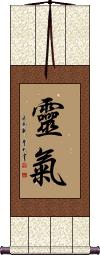
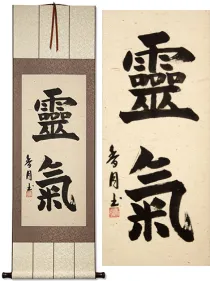
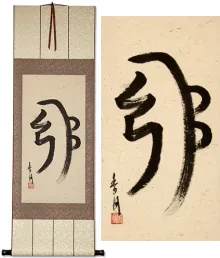
靈氣 is the title of a healing practice now found globally but with origins in Japan.
Special note: Outside of the context of the healing practice of Reiki, this means “aura” or “spiritual essence that surrounds all living things.” A Japanese person unfamiliar with the practice will take the “aura” meaning.
Reiki is a technique for stress reduction and relaxation that also heals. It can be compared to massage but is based on the idea that an unseen “life force energy” flows through us and is what causes us to be alive. If your life force energy is low, you'll be more likely to get sick or feel stressed. If your life force energy is abundant and flowing well, you become more capable of being happy and healthy.
There is a lot of information available if you want to Google this term - my job is to offer the calligraphy while you can decide if it is right for you.


Note: We are showing the ancient (traditional) form of the Reiki Kanji. I have seen Reiki written with the slightly simplified version and this more classic form. If you want the form of Reiki with the two strokes in the shape of an X on the second character and the modern first character, simply click on the Kanji characters to the right.
Note: 靈氣 is also a Chinese word, but in Chinese, these characters create a word that refers to a smart person or someone with high aspirations. It is not read as a healing method in Chinese.
In Korean Hanja, this can be read as a “mysterious atmosphere” by a Korean who is not familiar with the practice of Reiki (still has a cool meaning in Korean).
The Five Principles of Reiki
Reiki Gokai
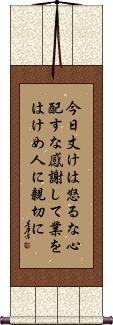
These are the five principles of Reiki.
They translate into English as...
At least for today:
Do not be angry,
Do not worry,
Be grateful,
Work with diligence,
Be kind to people.
Note: Because this selection contains some special Japanese Hiragana characters, it should be written by a Japanese calligrapher.
Reiki - Master Symbol
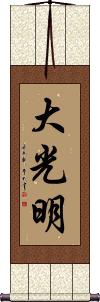
大光明 is the master symbol “Daikomyo” or “Dai Ko Myo,” which is usually associated with the healing practice of Reiki.
This title can be translated as “Great Bright Light.” This symbol, as used in Reiki, alludes to “Enlightened Nature” or the radiance of a purified soul or deity.
Pronunciations in Chinese and Korean are included above but this title has no meaning except when used by a Reiki practitioner. In fact, this title is not that well known by those outside the Reiki community in Japan.
In Chinese, this would be interpreted as “Great Bright Future” (the second two characters alone create a word that means “bright future” in Chinese).
Reiki Precepts by Usui Mikao
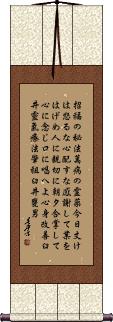
These are the precepts of Reiki that are attributed to Usui Mikao.
Here is a breakdown of the characters and a rough translation:
招福の秘法, 萬病の霊薬。
Invite blessings of [the] secret method, 10,000 illnesses of spiritual medicine.
今日丈けは: 怒るな, 心配すな, 感謝して, 業をはげめ, 人に親切に。
At least for today: Do not be angry, do not worry, be grateful, work with diligence, and be kind to people.
朝夕合掌して, 心に念じ, 口に唱へよ, 心身改善。
Morning [and] evening perform gassho (join hands), [with your] heart/mind in silent prayer, [with your] mouth chant, [thusly] mind [and] body [will] reform/improve.
臼井靈氣療法! -肇祖, 臼井甕男。
Usui Reiki Ryōhō! -Founder, Usui Mikao.
The middle portion of this is often titled, “The Five Principles of Reiki” and makes a nice calligraphy selection by itself. The Japanese text presented here can be considered the more verbose version.
Note: Because this selection contains some special Japanese Hiragana characters, it should be written by a Japanese calligrapher.
Reiki Precepts by Usui Mikao (Alternate)
Alternate Version
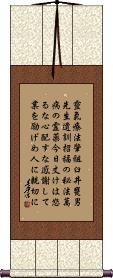
靈氣療法肇祖臼井甕男先生遺訓招福の秘法萬病の霊薬今日丈けは心配すな感謝して業を励げめ人に親切に is an alternate version of the precepts or tenets of Reiki by Usui Mikao.
It is impossible to be sure which version or versions were actually written by Usui Mikao. This is the less common of the three versions that you might see in the wild.
Here is a breakdown of the characters and a rough translation:
靈氣 療法 肇祖 臼井甕男。
Reiki therapy founder Mikao Usui
先生 遺訓。
Teacher's testament
招福の秘法, 萬病の霊薬。
Invite blessings of [the] secret method, 10,000 illnesses of spiritual medicine.
今日丈けは: 怒るな, 心配すな, 感謝して, 業をはげめ, 人に親切に。
At least for today: Do not be angry, do not worry, be grateful, work with diligence, [and] be kind to people.
Note: Because this selection contains some special Japanese Hiragana characters, it should be written by a Japanese calligrapher.
Life Energy / Spiritual Energy
Chi Energy: Essence of Life / Energy Flow
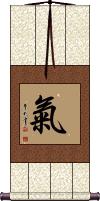
This 氣 energy flow is a fundamental concept of traditional Asian culture.
氣 is romanized as “Qi” or “Chi” in Chinese, “Gi” in Korean, and “Ki” in Japanese.
Chi is believed to be part of everything that exists, as in “life force” or “spiritual energy.” It is most often translated as “energy flow” or literally as “air” or “breath.” Some people will simply translate this as “spirit,” but you must consider the kind of spirit we're talking about. I think this is weighted more toward energy than spirit.
The character itself is a representation of steam (or breath) rising from rice. To clarify, the character for rice looks like this: 
Steam was apparently seen as visual evidence of the release of “life energy” when this concept was first developed. The Qi / Chi / Ki character is still used in compound words to mean steam or vapor.
The etymology of this character is a bit complicated. It's suggested that the first form of this character from bronze script (about 2500 years ago) looked like these samples: 

However, it was easy to confuse this with the character for the number three. So the rice radical was added by 221 B.C. (the exact time of this change is debated). This first version with the rice radical looks like this: 
The idea of Qi / Chi / Ki is really a philosophical concept. It's often used to refer to the “flow” of metaphysical energy that sustains living beings. Yet there is much debate that has continued for thousands of years as to whether Qi / Chi / Ki is pure energy or consists partially or fully of matter.
You can also see the character for Qi / Chi / Ki in common compound words such as Tai Chi / Tai Qi, Aikido, Reiki, and Qi Gong / Chi Kung.
In the modern Japanese Kanji, the rice radical has been changed into two strokes that form an X.
The original and traditional Chinese form is still understood in Japanese, but we can also offer that modern Kanji form in our custom calligraphy. If you want this Japanese Kanji, please click on the character to the right instead of the “Select and Customize” button above.
More language notes: This is pronounced like “chee” in Mandarin Chinese, and like “key” in Japanese.
This is also the same way to write this in Korean Hanja where it is Romanized as “gi” and pronounced like “gee” but with a real G-sound, not a J-sound.
Though Vietnamese no longer use Chinese characters in their daily language, this character is still widely known in Vietnam.
See Also: Energy | Life Force | Vitality | Life | Birth | Soul
Psychic Power
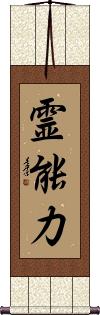
霊能力 is a word that means psychic power or spiritual ability in Japanese.
You may recognize the first character, 霊 (rei), is the same as the first Kanji in the word reiki. It means spirit or spiritual, but in this context can also mean psychic.
能力 can mean ability, capacity, or power.
Hon Sha Ze Sho Nen
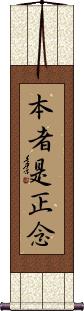
本者是正念 is a phrase or chant used by Reiki practitioners.
There are several ways to translate this, but mine would be “Original Nature is Mindfulness.”
Jin Shin Jyutsu
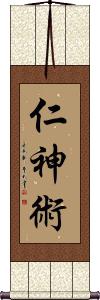
仁神術 is Jin Shin Jyutsu or Jin Shin Jutsu.
This is a practice of calming the mind and clearing the flow of Qi energy in the body. Jin Shin Jyutsu has some commonality with the practice of Reiki.
A good translation of 仁神術 would be “Benevolent Spirit Method.”
We can break that down into all of the possible meanings:
仁 = benevolence (esp. as a virtue of Confucianism), consideration, compassion, humanity, charity, kindness, or virtue.
神 = deity, soul, spirit, mysterious, psyche, god, divinity, spiritual powers, deva, divine, spiritual, or supernatural.
術 = way, method, means, art, trick, or plan. The correct romaji for this 術 Kanji should be “jutsu.” However, in martial arts, this is often written “jitsu” but in this case, “jyutsu” became common.
Need caring Reiki therapy in Houston or Austin Texas?
Please check out Ayurveda Wellness
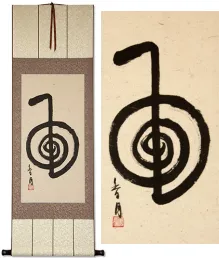
This in-stock artwork might be what you are looking for, and ships right away...
Gallery Price: $300.00
Your Price: $109.88
Gallery Price: $300.00
Your Price: $109.88
The following table may be helpful for those studying Chinese or Japanese...
| Title | Characters | Romaji (Romanized Japanese) | Various forms of Romanized Chinese | |
| Reiki | 靈氣 灵气 霊気 | reiki | líng qì / ling2 qi4 / ling qi / lingqi | ling ch`i / lingchi / ling chi |
| The Five Principles of Reiki | 今日丈けは怒るな心配すな感謝して業をはけめ人に親切に | kyou da ke wa oko ru na shin pai su na kan sha shi te gyou wo ha ke me hito ni shin setsu ni kyo da ke wa oko ru na shin pai su na kan sha shi te gyo wo ha ke me hito ni shin setsu ni | ||
| Reiki - Master Symbol | 大光明 | dai kou myou daikoumyou dai ko myo | dà guāng míng da4 guang1 ming2 da guang ming daguangming | ta kuang ming takuangming |
| Reiki Precepts by Usui Mikao | 招福の秘法萬病の霊薬今日丈けは怒るな心配すな感謝して業をはげめ人に親切に朝夕合掌して心に念じ口に唱へよ心身改善臼井靈氣療法肇祖臼井甕男 | shou fuku no hihou man byou no rei yaku kyou da ke wa oko ru na shin pai su na kan sha shi te gyou wo ha ke me hito ni shin setsu ni asayuu gasshou shite kokoro ni nenji kuchi ni tonae yo shin shin kaizen usui rei ki ryou hou cho so usu i mika o sho fuku no hiho man byo no rei yaku kyo da ke wa oko ru na shin pai su na kan sha shi te gyo wo ha ke me hito ni shin setsu ni asayu gasho shite kokoro ni nenji kuchi ni tonae yo shin shin kaizen usui rei ki ryo ho cho so usu i mika o | ||
| Reiki Precepts by Usui Mikao (Alternate) | 靈氣療法肇祖臼井甕男先生遺訓招福の秘法萬病の霊薬今日丈けは怒るな心配すな感謝して業を励げめ人に親切に | reiki ryouhou chouso usui mikao sensei ikun shoufuku no hihou yorozu byou no reiyaku kyou take ke wa oko ru na shinpai suna kansha shite gou o hagemu ge me hito ni shinsetsu ni reiki ryoho choso usui mikao sensei ikun shofuku no hiho yorozu byo no reiyaku kyo take ke wa oko ru na shinpai suna kansha shite go o hagemu ge me hito ni shinsetsu ni | ||
| Life Energy Spiritual Energy | 氣 气 / 気 | ki | qì / qi4 / qi | ch`i / chi |
| Psychic Power | 霊能力 | reinouryoku reinoryoku | ||
| Hon Sha Ze Sho Nen | 本者是正念 | hon sha ze shou nen honshazeshounen hon sha ze sho nen | ||
| Jin Shin Jyutsu | 仁神術 | jin shin jutsu jinshinjutsu | rén shén shù ren2 shen2 shu4 ren shen shu renshenshu | jen shen shu jenshenshu |
| In some entries above you will see that characters have different versions above and below a line. In these cases, the characters above the line are Traditional Chinese, while the ones below are Simplified Chinese. | ||||




