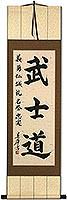
Seven Virtues of Bushido
We'll build you a quality custom Bushido wall scroll for you at a discount price!
Start your special Bushido project by clicking on the buttons next to your favorite Bushido-related titles below...
Don't want to wait? Check: In-Stock Ready-to-Ship Bushido Artwork.
1. Bushido / The Way of the Samurai
2. Justice / Rectitude / Right Decision
4. Benevolence
5. Respect
6. Honesty
7. Honor
8. Loyalty / Faithful / Devoted
9. Filial Piety
11. Wisdom
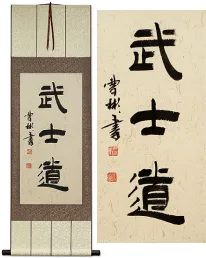
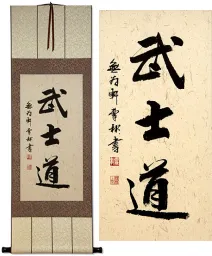
Bushido / The Way of the Samurai
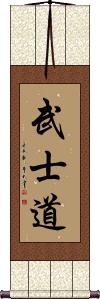
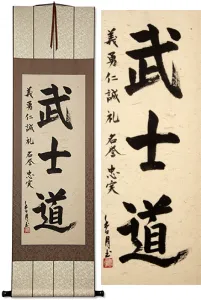
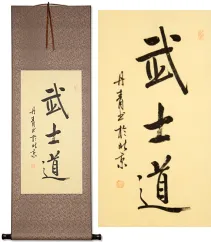
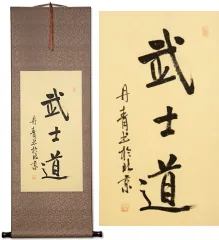
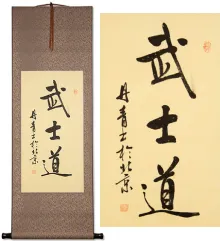
武士道 is the title for “The Code of the Samurai.”
Sometimes called “The Seven Virtues of the Samurai,” “The Bushido Code,” or “The Samurai Code of Chivalry.”
This would be read in Chinese characters, Japanese Kanji, and old Korean Hanja as “The Way of the Warrior,” “The Warrior's Way,” or “The Warrior's Code.”
It's a set of virtues that the Samurai of Japan and ancient warriors of China and Korea had to live and die by. However, while known throughout Asia, this title is mostly used in Japan and thought of as being of Japanese origin.
The seven commonly-accepted tenets or virtues of Bushido are Rectitude 義, Courage 勇, Benevolence 仁, Respect 礼(禮), Honour 名誉, Honesty 誠, and Loyalty 忠実. These tenets were part of oral history for generations, thus, you will see variations in the list of Bushido tenets depending on who you talk to.
See Also: Warrior
Justice / Rectitude / Right Decision
Also means: honor loyalty morality righteousness
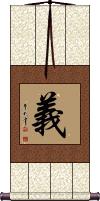
義 is about doing the right thing or making the right decision, not because it's easy but because it's ethically and morally correct.
No matter the outcome or result, one does not lose face if tempering proper justice.
義 can also be defined as righteousness, justice, morality, honor, or “right conduct.” In a more expanded definition, it can mean loyalty to friends, loyalty to the public good, or patriotism. This idea of loyalty and friendship comes from the fact that you will treat those you are loyal to with morality and justice.
義 is also one of the five tenets of Confucius's doctrine.
 There's also an alternate version of this character sometimes seen in Bushido or Korean Taekwondo tenets. It's just the addition of a radical on the left side of the character. If you want this version, click on the image to the right instead of the button above.
See Also: Judgment | Impartial | Confucius Tenets
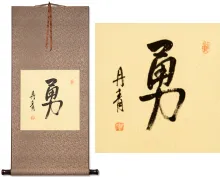
Bravery / Courage
Single Character for Courage
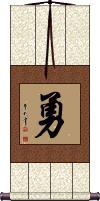
勇 can be translated as bravery, courage, valor, or fearless in Chinese, Japanese and Korean.
勇 is the simplest form to express courage or bravery, as there is also a two-character form that starts with this same character.
勇 can also be translated as brave, daring, fearless, plucky, or heroic.
Benevolence
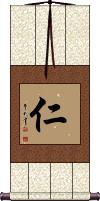
Beyond benevolence, 仁 can also be defined as “charity” or “mercy” depending on context.
The deeper meaning suggests that one should pay alms to the poor, care for those in trouble, and take care of his fellow man (or woman).
仁 is one of the five tenets of Confucius. In fact, it is a subject that Confucius spent a great deal of time explaining to his disciples.
I have also seen this benevolent-related word translated as perfect virtue, selflessness, love for humanity, humaneness, goodness, goodwill, or simply “love” in the non-romantic form.
Respect
Politeness, Gratitude and Propriety
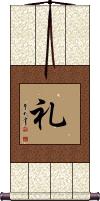
礼 is one of the five tenets of Confucius.
Beyond respect, 礼 can also be translated as propriety, good manners, politeness, rite, worship, or an expression of gratitude.
We show respect by speaking and acting with courtesy. We treat others with dignity and honor the rules of our family, school, and nation. Respect yourself, and others will respect you.
 Please note that Japanese use this simplified 礼 version of the original 禮 character for respect. 礼 also happens to be the same simplification used in mainland China. While 禮 is the traditional and original version, 礼 has been used as a shorthand version for many centuries. Click on the big 禮 character to the right if you want the Traditional Chinese and older Japanese versions.
See Also: Confucius
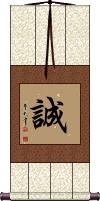
Honesty
Honor
(Modern Japanese version)
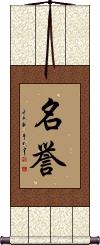
名譽 is a version of honor that is about having or earning the respect of others and about your reputation.
It is the status of being worthy of honor (not to be confused with doing honorable things or specific actions - see our other “honor” listing for that).
 Both modern Japanese and modern mainland Chinese use the same simplified version of the second character of honor. You can make a special request for the traditional second character as shown to the right (just click on that character to the right of you want to order that version). Before WWII, both Japan and China used the traditional form but modern Japanese and Chinese use this simplified form. Koreans still use the traditional form when they are not writing in their modern Hangul glyphs.
Loyalty / Faithful / Devoted
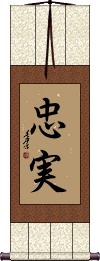
忠実 is a Japanese way to write “Loyalty” - it also contains the ideas of being faithful, devoted, true, and obedient.
The second character is a modified form only used in the Japanese lexicon; however, Chinese speakers can easily guess the meaning.
Filial Piety
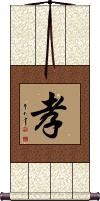
孝 represents filial piety.
Some will define this in more common English as “respect for your parents and ancestors.”
孝 is a subject deeply emphasized by the ancient philosophy and teachings of Confucius.
Some have included this in the list for the Bushido, although generally not considered part of the 7 core virtues of the warrior.
Note: 孝 is not the best of meanings when seen as a single character. Some will read the single-character form to mean “missing my dead ancestors.” However, when written as part of Confucian tenets, or in the two-character word that means filial piety, the meaning is better or read differently (context is important for this character).
We suggest one of our other two-character filial piety entries instead of this one.
Honesty / Fidelity
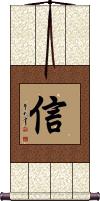
信 is another character that expresses the idea of honesty.
It can also mean truth, faith, belief in, fidelity, sincerity, trust, and/or confidence.
Some have included this in the list for the Bushido, although “makoto” is probably more common/popular.
Note: In some contexts, this character can mean a letter (mail), news, or envoy. However, alone, it will generally be read with the honesty-meaning.
See Also: Loyalty Trustworthiness Trustworthy
Wisdom
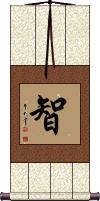
智 is the simplest way to write wisdom in Chinese, Korean Hanja, and Japanese Kanji.
Being a single character, the wisdom meaning is open to interpretation, and can also mean intellect, knowledge or reason, resourcefulness, or wit.
智 is also one of the five tenets of Confucius.
智 is sometimes included in the Bushido code but is usually not considered part of the seven key concepts of the code.
See Also: Learn From Wisdom | Confucius
During the 9th and 12th centuries in Japan the warrior class were known as Samurai, also called Bushi ("Bushi" means "warrior", "Do" is "Way", hence Bushido = Way of the Warrior).
They emerged from the provinces of Japan to become the ruling class until their decline and later total abolition in 1876 during the Meiji Era.
These warriors were men who lived by Bushido; it was their way of life. The Samurai's loyalty to the emperor and his overlord or daimyo were unsurpassed. They were trustworthy and honest. They lived frugal lives with no interest in riches and material things, but rather in honor and pride. They were men of true valor. Samurai had no fear of death. They would enter any battle no matter the odds. To die in battle would only bring honor to one's family and one's lord.
The actual code was passed on verbally to each generation of Samurai, but over time, seven chief virtues emerged, and became the written form of Bushido. Please note that variations exist, as some people use different Kanji or have 8 or 9 tenets.
Of course, credit is generally given that a Chinese man (known in the west as "Confucius") is the father of these values in China. Therefore, you'll find these concepts belong not only to the Japanese samurai, but have spread throughout Asia. Variations of these soldierly and moral values can be seen in China, Korea, Vietnam, and elsewhere.
This in-stock artwork might be what you are looking for, and ships right away...
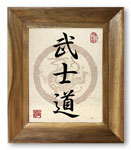
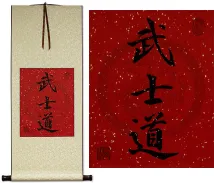
Gallery Price: $72.00
Your Price: $39.88
Gallery Price: $200.00
Your Price: $118.88

Gallery Price: $103.00
Your Price: $56.88
Gallery Price: $87.00
Your Price: $47.88
Gallery Price: $87.00
Your Price: $47.88
Gallery Price: $87.00
Your Price: $47.88
Gallery Price: $200.00
Your Price: $98.88

Gallery Price: $200.00
Your Price: $98.88
Gallery Price: $200.00
Your Price: $98.88

Gallery Price: $200.00
Your Price: $98.88
Gallery Price: $65.00
Your Price: $39.88

Gallery Price: $36.00
Starting at: $20.00
The following table may be helpful for those studying Chinese or Japanese...
| Title | Characters | Romaji (Romanized Japanese) | Various forms of Romanized Chinese | |
| Bushido The Way of the Samurai | 武士道 | bu shi do / bushido | wǔ shì dào wu3 shi4 dao4 wu shi dao wushidao | wu shih tao wushihtao |
| Justice Rectitude Right Decision | 義 义 | gi | yì / yi4 / yi | i |
| Bravery Courage | 勇 | isamu / yu- | yǒng / yong3 / yong | yung |
| Benevolence | 仁 | jin | rén / ren2 / ren | jen |
| Respect | 禮 礼 | rei | lǐ / li3 / li | |
| Honesty | 誠 诚 | makoto | chéng / cheng2 / cheng | ch`eng / cheng |
| Honor | 名譽 名誉 | meiyo | míng yù / ming2 yu4 / ming yu / mingyu | ming yü / mingyü |
| Loyalty Faithful Devoted | 忠實 忠実 | chuujitsu / chuugi chujitsu / chugi | ||
| Filial Piety | 孝 | kou / ko | xiào / xiao4 / xiao | hsiao |
| Honesty Fidelity | 信 | shin | xìn / xin4 / xin | hsin |
| Wisdom | 智 | chi / tomo | zhì / zhi4 / zhi | chih |
| In some entries above you will see that characters have different versions above and below a line. In these cases, the characters above the line are Traditional Chinese, while the ones below are Simplified Chinese. | ||||




